For the first two weeks of July 2026, foreign portfolio investors did something they had not done since March: they bought. More than ₹15,157 crore flowed into Indian equities in the first half of the month, reversing four straight months of selling. The easy read is the obvious one: global investors looked at India again and liked what they saw.
It is worth slowing down on that. A Geojit Financial Services strategist, asked to explain the reversal, pointed not to India but to Korea: weakness in the semiconductor trade and foreign investors turning sellers in markets such as South Korea redirected flows toward India. India was not chosen. It was the place money landed when a much bigger trade came apart somewhere else.
Nor did India's own market do anything to earn the inflow. The BSE Sensex climbed only about 1.4 percent over the month to July 31, 2026, a shrug of a move for a market supposedly being "discovered," and nowhere near the scale of what was happening in Seoul at the same time.
South Korea's AI-chip rally erased $2.18 trillion in about a month.
The number that explains the whole rotation sits in Seoul, not Mumbai. South Korean stocks lost as much as $2.18 trillion in market value as the AI-driven rally that had powered Asia's markets for over a year collapsed, erasing almost 40 percent of the KOSPI's value from a peak reached little more than a month earlier. That peak had carried the index to an all-time high of 9,385.59 points in June 2026. That is not a correction. It is a rally in reverse, and it is the actual event that July's Indian inflow is a side effect of.
Korea built its whole export economy on one bet
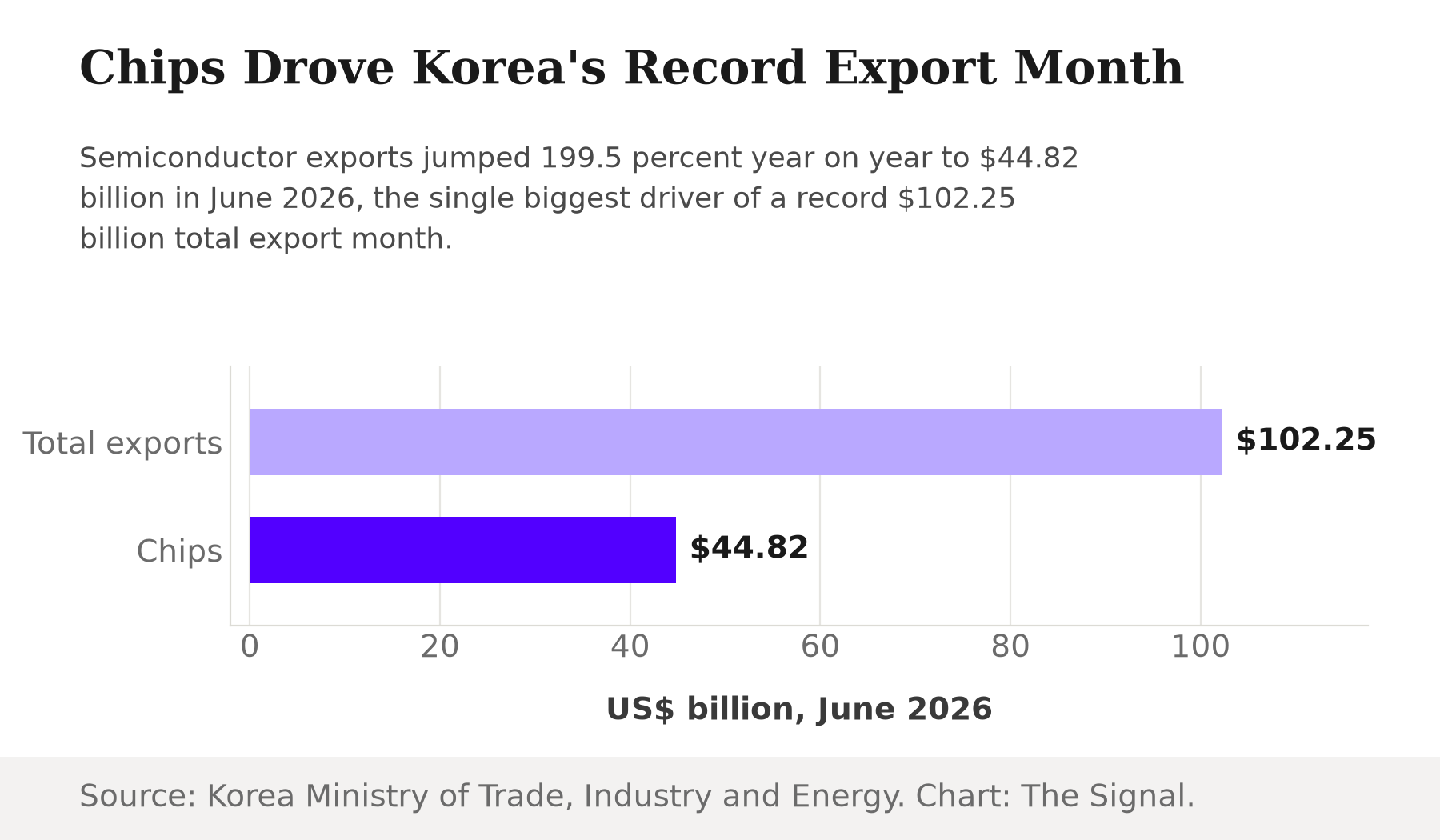
The scale of what just broke only makes sense against the scale of what had been built. South Korea's semiconductor exports jumped 199.5 percent year on year to a record $44.82 billion in June 2026, the main driver of the country's first ever $100 billion plus export month: $102.25 billion total, up 70.9 percent year on year. Chips alone accounted for close to 44 percent of Korea's entire export bill in June 2026.
Zoom out from one month and the concentration looks structural, not incidental. Korea's ICT exports, dominated by semiconductors, reached a record $253.9 billion in the first half of 2026, up 120.5 percent year on year from $115.1 billion, with semiconductors and SSDs alone accounting for 83.7 percent of that ICT total.
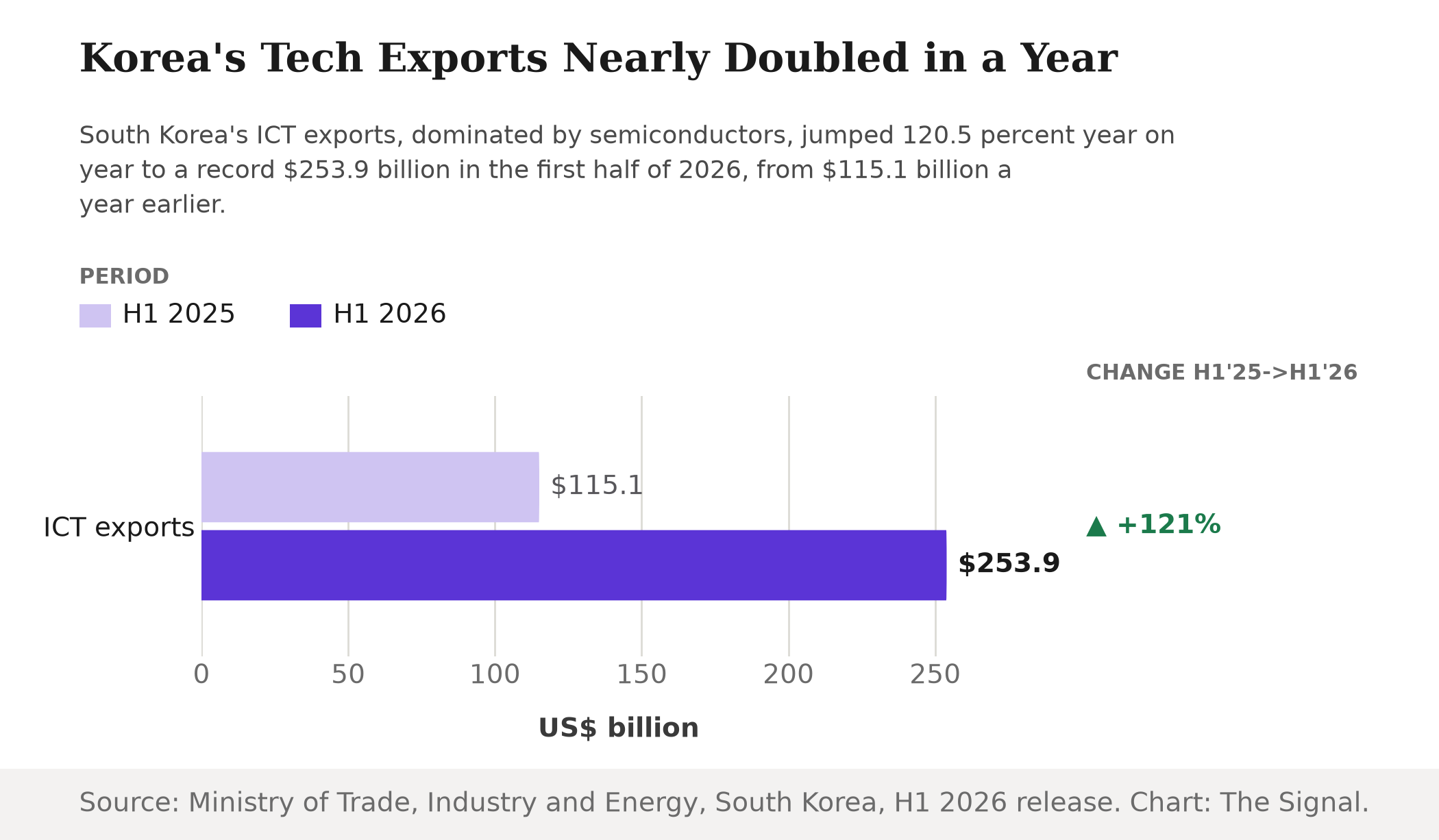
A concentrated export base is a virtue on the way up. But that same 83.7 percent semiconductor share of ICT exports is also what makes the whole export economy a single point of failure once the chip-demand story is doubted, and by late July 2026 it was being doubted hard.
The doubt has a name: circular financing
The specific worry that tipped sentiment was not abstract. Nvidia was in talks in late July 2026 to guarantee roughly $250 billion of financing for a 10-gigawatt OpenAI data center project that SB Energy, a SoftBank subsidiary, is building in Piketon, Ohio. A chipmaker underwriting the financing for its own biggest customer's data centers is the kind of arrangement that looks fine as long as nobody asks who is actually carrying the risk. Once investors started asking that question of the whole AI capital stack, chip-heavy markets were the ones with nowhere to hide, and Korea, the most chip-concentrated major market in Asia, took the direct hit.
India was never part of that stack. It ran a $68 billion electronics trade deficit in FY2025-26, importing a record $116.17 billion of electronics against just $48.0 billion of electronics exports: a country that still buys far more chips and electronics than it sells has no comparable AI-chip export base to doubt, so it had nothing to lose when the doubt arrived. That absence, not any Indian strength, is the mechanism behind July's inflow.
India's floor was already domestic, and bigger
The rotation into India also lands on a market that had already solved its own foreign-selling problem, well before Korea's chips cracked. Foreign institutional investors pulled roughly $58 billion out of Indian equities over the 22 months since the market's September 2024 peak, but domestic institutional investors absorbed it with a record $166 billion of buying, nearly three times as much, pushing DII ownership of Indian stocks to a record 21 percent.
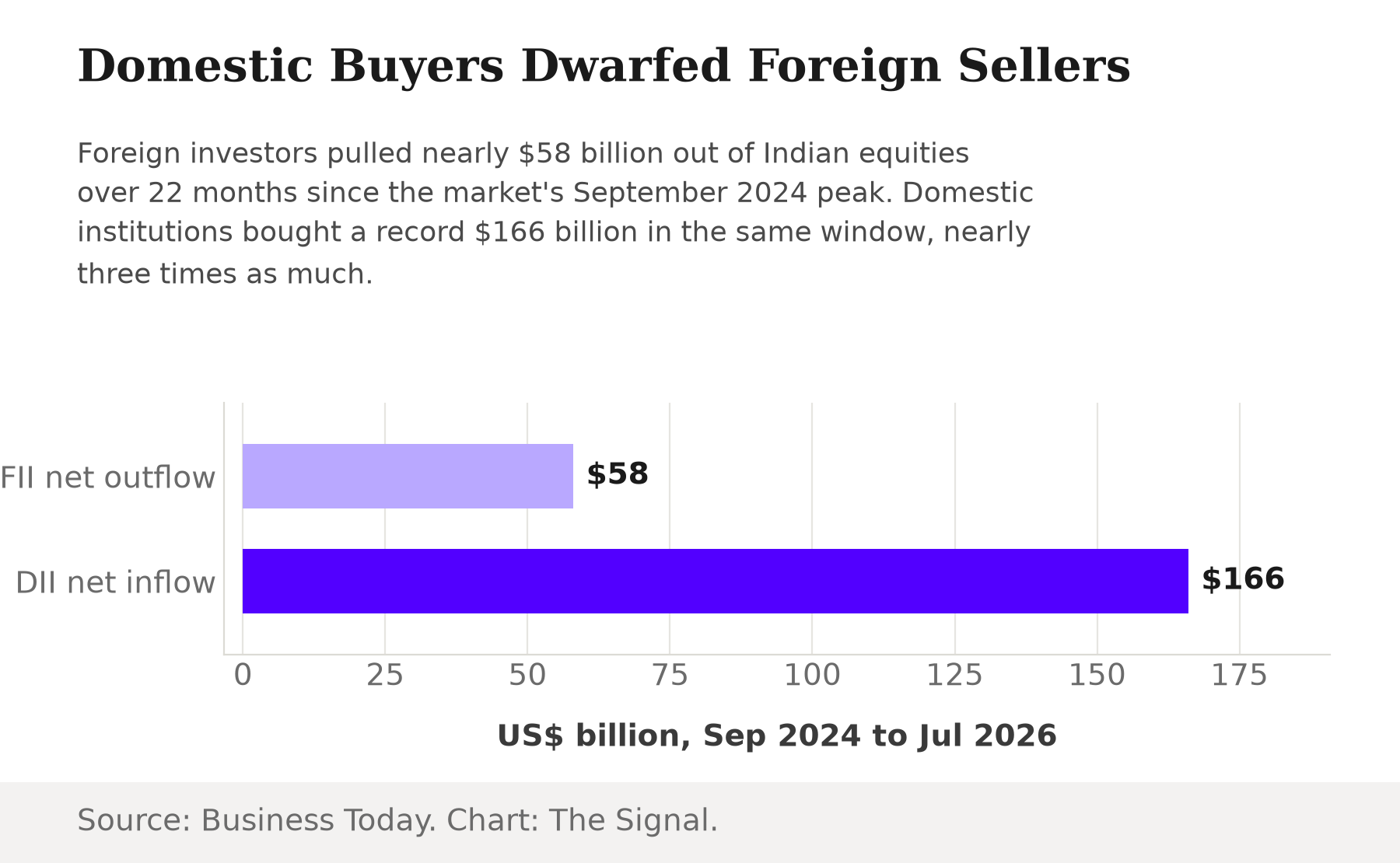
Domestic mutual funds and insurers were already the marginal buyer of Indian equities before a single dollar rotated out of Seoul. July's foreign inflow is real money, but set against a record $166 billion of domestic buying built up over the 22 months since September 2024, it is a rounding adjustment to who owns Indian stocks, not the reason the market held up.
The honest objection
The strongest case against calling this a pure accident is that markets do not much care about motive. If foreign money keeps landing in India regardless of why it left Korea, the practical effect on Indian valuations and float is identical to a genuine vote of confidence: prices rise, IPOs get easier, credit gets cheaper, whatever the money's stated reason for showing up.
That case holds only as long as the exit door stays shut behind it. The Geojit strategist's own framing, in the same note, was that flows moved toward India because chip markets turned into sellers, not because India's fundamentals re-rated. Money that arrives because a trade elsewhere blew up tends to leave the moment that trade stabilizes or a better one appears, since nothing about the destination itself changed in between. A vote of confidence and a parking spot can look identical for a quarter. They behave very differently the moment the storm passes.
The Signal
India did not out-argue Korea for foreign capital in July 2026. It happened to be standing in a part of the market with no AI-chip exposure to unwind when the exposure everyone else had bet on turned violent. That absence is now being sold, implicitly, as a virtue: the "anti-AI trade." But a virtue built on what you don't own only holds for as long as the thing you don't own keeps failing. Watch what happens to India's foreign flows the next time a chip stock anywhere rallies. If they reverse out again, July's inflow was never a vote on India. It was a parking spot.
Reporting basis: the KOSPI collapse and its $2.18 trillion valuation loss are per Reuters wire copy carried by Al Jazeera; the KOSPI's June 2026 peak level and the Sensex's muted July 2026 move are per Trading Economics. South Korea's June 2026 export and semiconductor-export figures, and its first-half 2026 ICT export figures, are from the country's Ministry of Trade, Industry and Energy. The Nvidia-OpenAI Ohio financing talks are per The Wall Street Journal's original reporting, as relayed by Al Jazeera. India's FII and DII flow figures since the September 2024 peak are per Business Today. The July 2026 FPI inflow figure is per The Hans India, and the analyst attribution of that inflow to the Korean chip selloff is per Upstox's markets desk, quoting a Geojit Financial Services strategist. India's FY2025-26 electronics trade deficit is per Ministry of Commerce and Industry data reported by The Week. The semiconductor share of Korea's June export total and the year-on-year change in Korea's ICT exports are The Signal's calculations from those figures.