Nithin Kamath spent July 29, 2026 telling investors to worry about the product his own brokerage sells. Zerodha's margin trading facility (MTF) book stands at about Rs 9,000 crore, which Kamath called the biggest risk the brokerage has taken since it started in 2010. He drew a direct parallel to South Korea, where the KOSPI index surged 60% between April and June 2026 before falling 35% the following month, warning that in India too, "when the markets fall, things get really ugly...margin calls increase, leading to forced selling." Read at face value, this is a founder doing the responsible thing: flagging risk before it lands.
It is worth slowing down on that. Zerodha earns interest on every rupee of MTF it lends, so a warning from Kamath about his own book carries real credibility. But his book is not actually the story. Zerodha's roughly Rs 9,000 crore sits inside an industry-wide MTF book of Rs 1.3 lakh crore as of June 2026, a little under 7% of the total. The number that carries this story is the industry figure, not his.
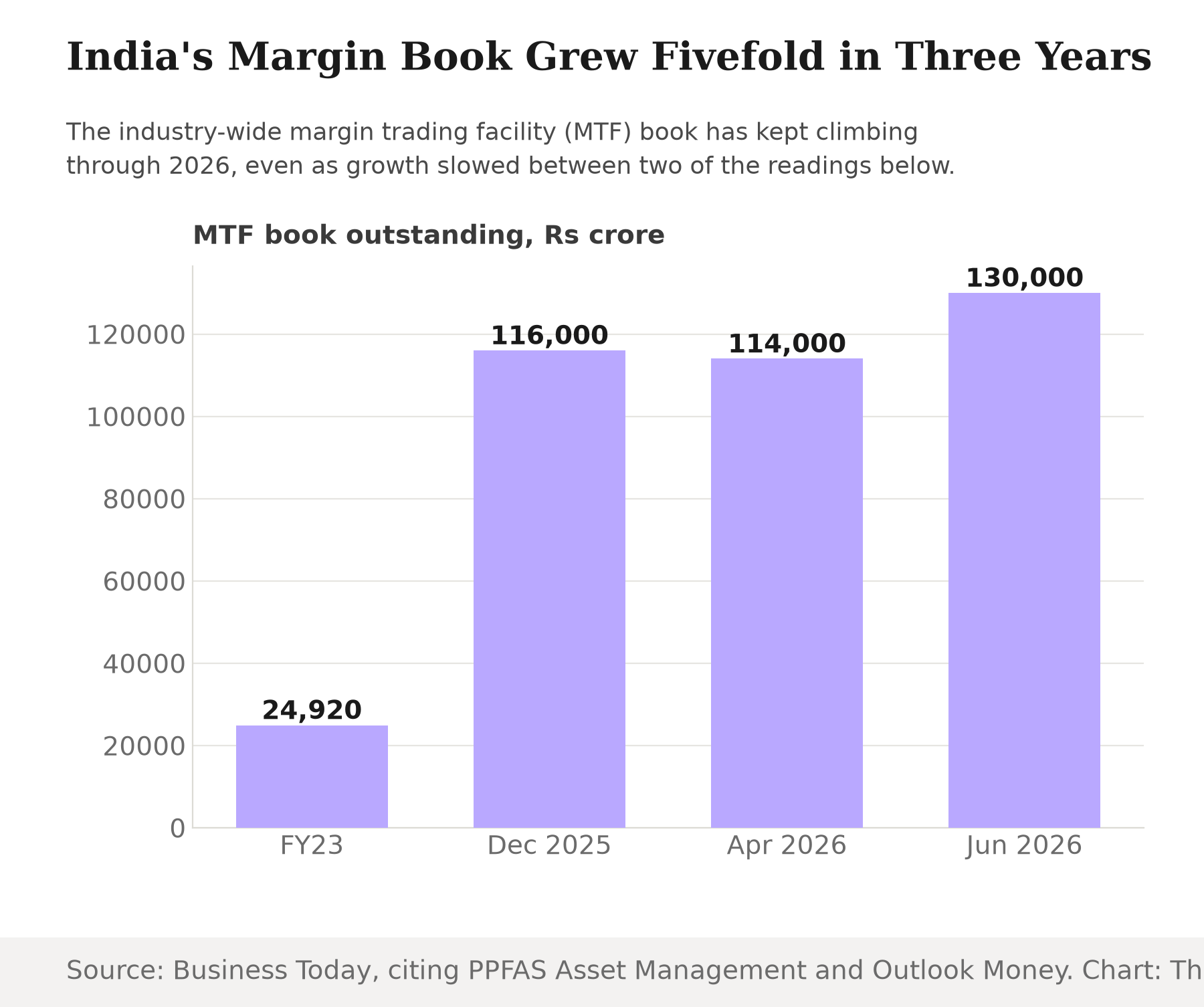
India's margin book has grown roughly fivefold in three years.
The industry-wide MTF book grew from Rs 24,920 crore in FY23 to Rs 1.16 lakh crore by December 2025, a more than 4.5-fold rise in under three years that PPFAS Asset Management had already flagged as a risk. By June 2026 it had climbed further, to Rs 1.3 lakh crore, up 6% in that month alone.
The mechanism inside the number
Kamath's warning is not just about size. It is about how a single rupee of collateral turns into several rupees of exposure. He described a "layered leverage" mechanism: a customer pledges Stock A, gets 80% margin on it, and uses that margin to take a further position worth 400% in the same stock, a loop he called a "highly concentrated house of cards", and one he says is especially dangerous in mid- and small-cap stocks, where lower circuits can leave no exit once a stock starts falling. Nearly 50% of the industry-wide MTF book is concentrated in non-F&O stocks, spread across roughly 1,500 MTF-eligible names: stocks with no futures and options market, which means no derivatives-based hedge and, in a bad session, no buyer at any price inside the circuit band.
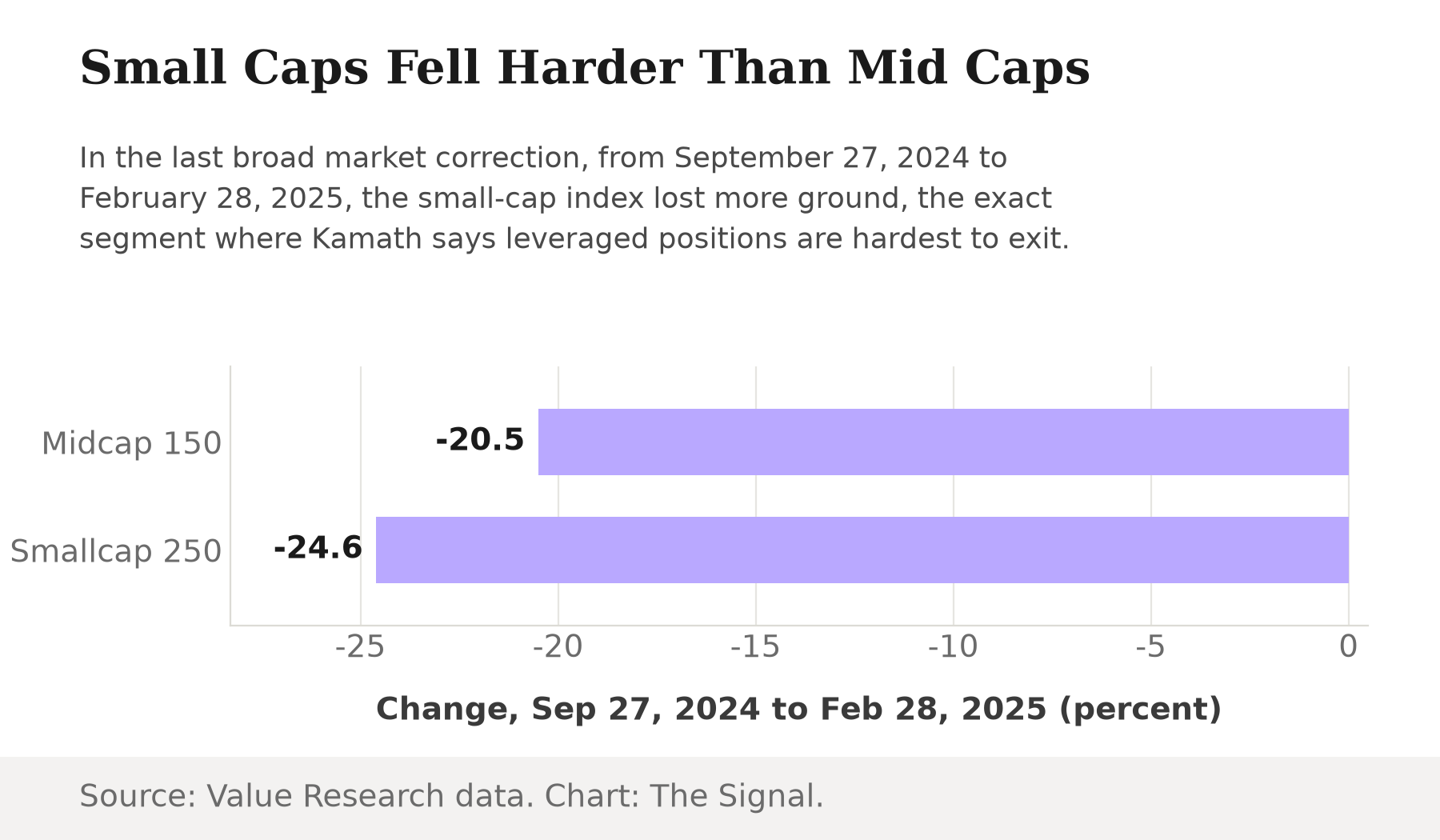
That detail matters because small caps do not fall the same way large caps do. In the last broad market correction, from September 27, 2024 to February 28, 2025, the Nifty Smallcap 250 TRI fell 24.6% against a 20.5% decline for the Nifty Midcap 150 TRI, and small caps did not outperform mid caps even once over rolling seven-year windows measured since October 2020. Small caps amplify drawdowns, not just rallies, which is exactly the segment where Kamath says the layered leverage concentrates.
Regulators moved first. The book kept growing anyway
This is not a story about an unregulated market catching everyone by surprise. The Reserve Bank of India had already tightened the rules governing bank credit to capital-market intermediaries, including MTF brokers: 100% collateralisation and a 40% minimum haircut on pledged equity, up from the earlier 12-25% haircut band. The RBI also capped loans against securities at Rs 1 crore per individual at the banking-system level, and separately, SEBI's June 2026 consultation paper proposed raising the minimum net worth threshold for brokers offering MTF from Rs 3 crore to Rs 5 crore, with part of that net worth ring-fenced against MTF exposure.
Regulators tightened MTF collateral rules before Kamath's warning, not after.
| Rule | Change |
|---|---|
| RBI capital market exposure directions | 100% collateralisation, minimum haircut raised to 40% |
| Bank financing of MTF brokers | At least 50% must be cash-collateralised |
| Loans against securities | Capped at Rs 1 crore per individual, banking-system-wide |
| SEBI minimum net worth for MTF brokers | Proposed rise from Rs 3 crore to Rs 5 crore, with ring-fencing |
Source: Reserve Bank of India; News on AIR; Moneylife, citing RBI's Amendment Directions; ETV Bharat, citing SEBI's June 2026 consultation paper.
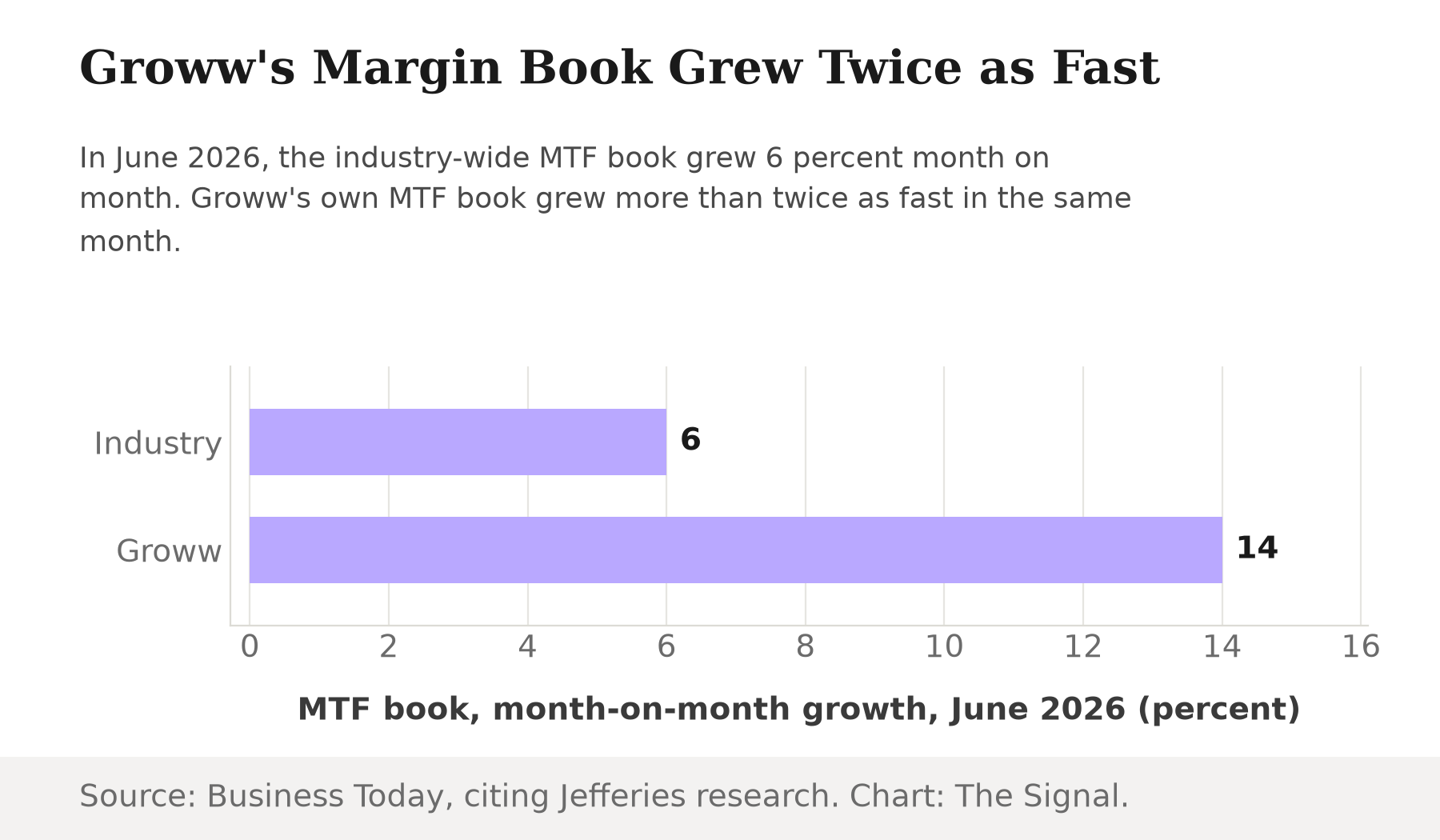
The timing is the tell. The RBI had originally planned to start these tighter rules on April 1, 2026, then deferred that start to July 1, 2026 after banks and intermediaries asked for more time. The stricter regime, in other words, was barely a month old when Kamath spoke. In the month immediately before it took effect, the industry MTF book was still accelerating, up 6% in June 2026 alone, and Groww's own MTF book grew more than twice as fast, up 14% month on month, ahead of the market, according to Jefferies. New rules raise the cost of leverage going forward. They do not unwind the leverage already sitting on the book.
The honest objection
The strongest case against reading this as a warning sign is that Indian markets have not actually broken yet. There has been no 2026 event resembling the Korean selloff Kamath cited, and MTF is, structurally, a bet that some of India's smaller companies deserve the capital they are getting: retail investors funding conviction positions with borrowed money is not new, and margin books grow in bull markets by design, not by accident. A regulator that has already raised haircuts to 40% and is now proposing higher net-worth thresholds for brokers is also not a regulator asleep at the wheel; SEBI's and the RBI's moves suggest the system is adapting in real time, and Kamath surfacing the risk publicly, rather than sitting on it, is itself a stabilising act.
That case holds up until the correction actually arrives. The 2024-25 drawdown data already shows what happens to leveraged small-cap positions in a real correction, not a hypothetical one: a steeper fall than mid caps, in the exact stocks Kamath says carry the least liquidity to exit. Tighter collateral rules change what new leverage costs. They do not change what happens to the leverage already layered onto roughly 1,500 non-F&O stocks the day the market turns.
The Signal
Kamath is not warning about a product failure. He is warning about a mechanism that his own numbers describe precisely: a fivefold increase in India's margin book in three years, nearly half of it sitting in stocks with no options market and no reliable exit once a decline starts. Regulators have already raised the price of that leverage. They have not removed what is already outstanding. The number to watch from here is not Zerodha's Rs 9,000 crore, which is the smallest, most transparent slice of this. It is whether the industry's Rs 1.3 lakh crore book keeps growing through the second half of 2026, or whether the new haircut regime finally slows it, because the last time small caps fell hard, they fell harder than everything else on the board.
Reporting basis: Nithin Kamath's warning, Zerodha's own MTF book size, and the "layered leverage" mechanism are per Business Today's and Outlook Money's reporting of his July 29, 2026 comments; the South Korea comparison is per The Tribune's separate report of the same remarks. The industry-wide MTF book figures for FY23, December 2025, April 2026 and June 2026 come from three separate Business Today and Outlook Money reports, each citing different data points (PPFAS Asset Management's analysis and Jefferies research, via Business Today) rather than one continuous series, so the figures are not perfectly like-for-like across dates. The small-cap and mid-cap correction data and the rolling seven-year comparison are from Value Research. The RBI's collateral and haircut rules are per the RBI's own press release, with the haircut band and cash-collateral detail via Moneylife's reporting of the RBI's Amendment Directions, and the loans-against-securities cap via News on AIR. SEBI's proposed net worth changes are per ETV Bharat's report of SEBI's June 2026 consultation paper. Zerodha's share of the industry book, and the roughly fivefold growth figure spanning the FY23 and June 2026 data points, are The Signal's calculations from those figures.