A SEBI board memorandum cleared in July 2024 reads like the regulator finally closing the loop on unlicensed stock tipsters. The rule, which took effect that August, states that any person regulated by SEBI, and the agents of such persons, may not associate directly or indirectly with anyone who provides investment advice or makes a return or performance claim on securities, unless SEBI itself permits it. Read as a headline, it sounds like the end of the road for finfluencers handing out stock tips without a license.
It is worth slowing down on what the rule actually does. It restricts who SEBI-regulated brokers, advisers and asset managers can associate with. It does not require the finfluencers themselves to register with SEBI at all. A year after the rule took hold, Business Standard reports, citing a CFA Institute study of finfluencer content posted between January and October 2025, that only around 6 percent of financial influencers are registered with SEBI as investment advisers, while 33 percent continue to provide explicit stock recommendations.
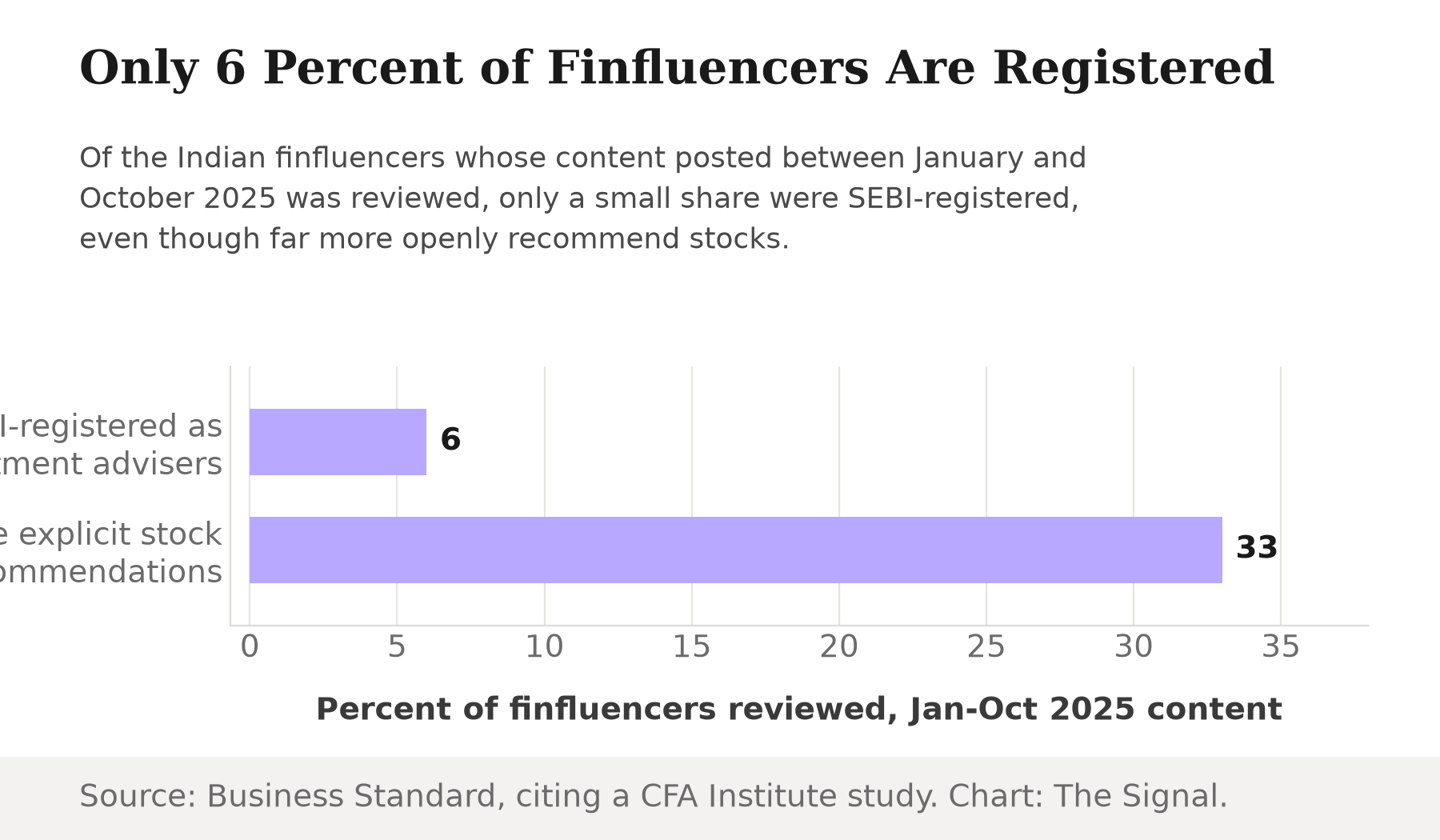
Six percent registered, a third recommending stocks anyway. That gap is the story, not the rule's headline.
Two surveys, one direction
This was not the first reading of the same population. A CFA Institute survey published in March 2025 found just 2 percent of Indian finfluencers were SEBI-registered, with 33 percent already giving explicit stock recommendations. Between that March 2025 wave and the October 2025 one, registration nearly tripled, from 2 percent to 6 percent, while the share giving stock tips did not move at all: 33 percent both times.
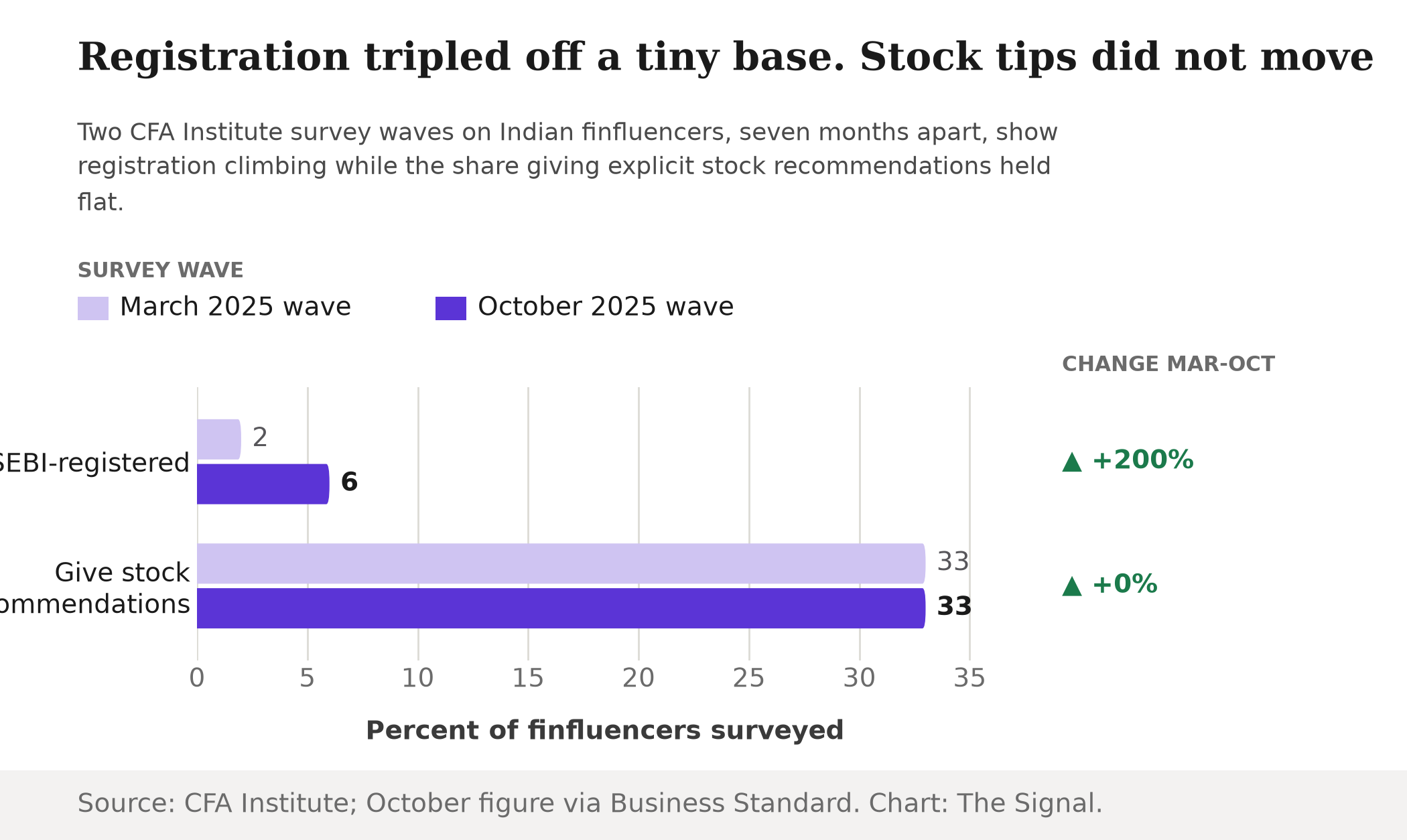
A tripling sounds like progress until the base is this small. Going from 2 in 100 to 6 in 100 still leaves 94 in 100 finfluencers the October 2025 study counted outside SEBI's own list of registered advisers, and it did nothing to the one-in-three who openly tip stocks.
The rule bars the wrong door
The reason the registration numbers barely moved is written into the rule's own text. It only bars a SEBI-regulated intermediary and its agents from associating with an unregistered advice-giver; it does not compel the advice-giver to register. A finfluencer who takes no sponsorship, distribution tie-up or paid slot from a regulated broker or fund house sits entirely outside the rule's reach, whether or not they are posting stock picks to a million followers on Instagram or Telegram. SEBI pulled the lever that controls who licensed firms can shake hands with, leaving untouched the much larger question of who is allowed to publish an opinion in the first place.
The adviser pool that is supposed to fill the gap
SEBI's own chairman has said as much. In March 2026, Tuhin Kanta Pandey said, per India's national broadcaster, that the gap between India's expanding investor base and its declining pool of registered investment advisers is being filled by unregulated voices, like influencers, who present opinion as expertise.
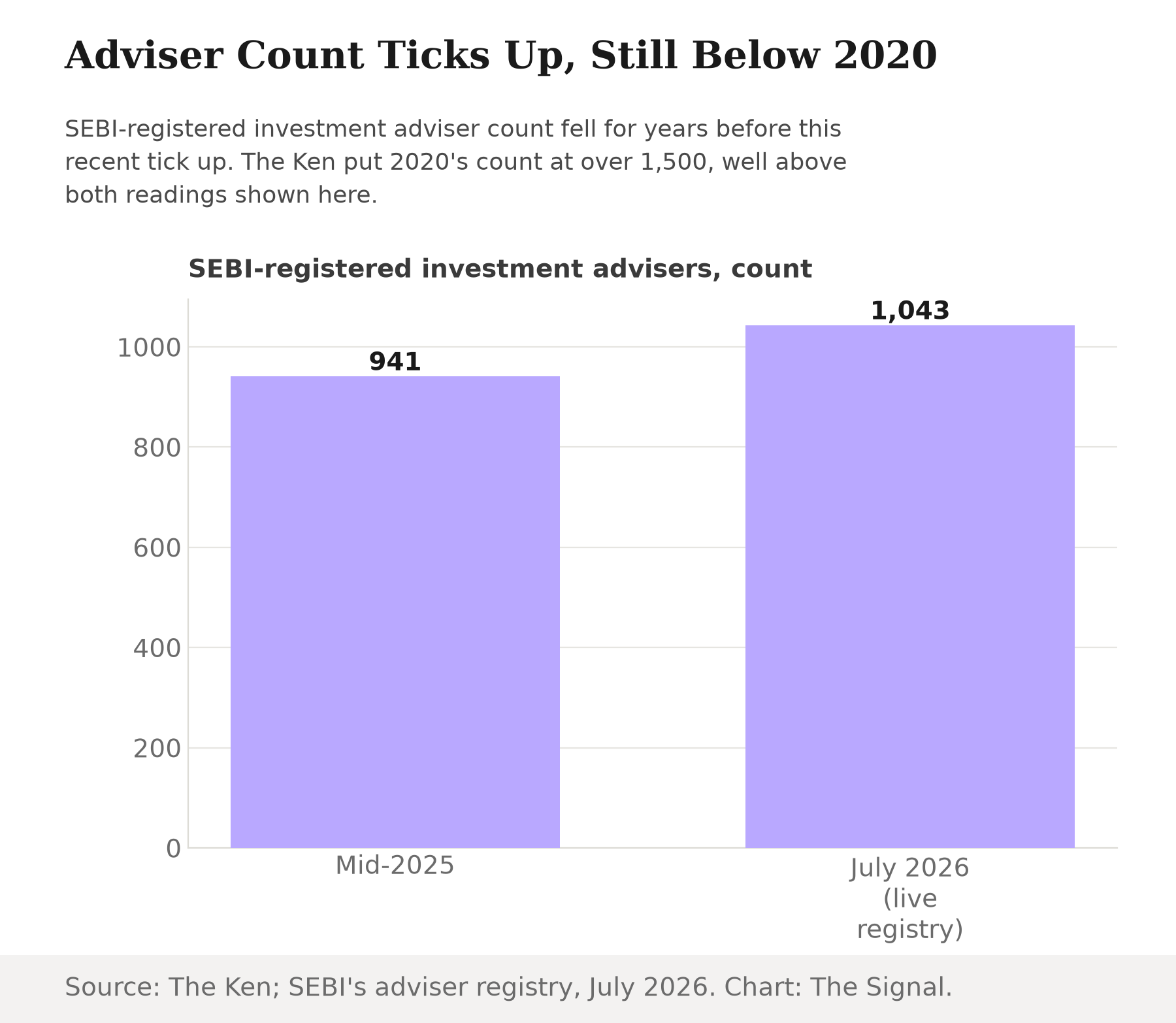
The numbers behind that remark are stark. The Ken reports that the number of SEBI-registered investment advisers fell from over 1,500 in 2020 to about 941 by mid-2025, leaving roughly one registered adviser for every 200,000 investors. That count has ticked up since: SEBI's live investment-adviser registry lists 1,043 registered advisers, checked this month, still nearly a third fewer than The Ken's 2020 count of over 1,500.
Meanwhile the pool of people the advisers are meant to serve kept expanding regardless. India's total demat account count stood at 21.6 crore at the end of December 2025, split 4.3 crore at NSDL and 17.3 crore at CDSL, Business Standard reports. A licensed-adviser count still measured in four digits is not the pool that scale calls for.
What is actually happening to the money
The stakes of taking investment advice from an unlicensed voice are not abstract. A SEBI press release states that 93 percent of individual traders incurred losses in equity derivatives (F&O) between FY22 and FY24, with aggregate losses exceeding ₹1.8 lakh crore over those three years. A SEBI study finds the picture barely changed in FY25: nearly 91 percent of individual traders in the equity derivatives segment posted a net loss, a share little different from FY24. Whoever is filling the advice gap, the trades that follow are losing money on a scale that has held steady for three years running.
The honest objection
The strongest case for SEBI's design is that licensing every individual voice posting stock opinions online is close to an impossible enforcement task, given how many creators exist and how quickly a banned account can reappear under a new handle. Choking the association instead means a licensed broker or fund house can no longer lend its credibility to an unregistered tipster. That, at least, stops an investor from mistaking a finfluencer's opinion for an endorsed one. And the registration share genuinely moved, tripling from 2 percent to 6 percent within about seven months: real progress off a small base. SEBI is not entirely toothless against individuals either: in December 2025 it barred finfluencer Avadhut Sathe and his trading academy from the securities market and ordered Rs 546.16 crore in disgorgement, after finding they had been running an unregistered investment advisory business.
That case holds up only to a point. The Sathe order came from SEBI's separate, longstanding power to act against unregistered investment advisers, not from the association rule this piece is about, and it took a search-and-seizure operation against an operation that had collected over Rs 600 crore to trigger it. That is enforcement against one large operator, not a mechanism reaching the mass of small accounts. It does not explain why 94 percent of finfluencers, most of them recommending stocks at the same one-in-three rate as before, remain completely outside SEBI's own count of registered advisers, or why the licensed-adviser pool meant to be the credible alternative still sits below its 2020 level even after a year of modest recovery. It also is not the only available design: the UAE's Securities and Commodities Authority, under a rule that took effect in May 2025, requires any individual with at least 1,000 followers who gives financial recommendations to register directly, rather than only restricting who licensed firms may associate with. A rule that only restricts who regulated firms can shake hands with does not touch the far larger population of finfluencers who never needed that handshake to begin with.
The Signal
The 2024 rule was built to defend the perimeter around SEBI-regulated firms, and on that narrow front it may be working exactly as designed. But the perimeter was never the whole battlefield. Most of the stock tips reaching India's 21.6 crore demat accounts come from voices the rule cannot reach, watched over by a licensed-adviser pool still smaller than it was in 2020, while nine in ten retail traders taking their own positions in derivatives keep losing money. Watch the next wave of the CFA Institute's survey: should the registered share keep climbing on its own momentum, the market may be correcting itself. If it stalls in single digits while the recommendation rate holds at a third, the rule will have done everything it was built to do, and none of what investors actually needed.
Reporting basis: the finfluencer registration and stock-recommendation figures are from two CFA Institute surveys, a March 2025 wave and an October 2025 update, the latter as reported by Business Standard. SEBI's association rule is per SEBI's own July 2024 board memorandum. The current count of registered investment advisers is from SEBI's live registry, checked this month; the 2020 and mid-2025 counts are per The Ken's reporting. SEBI chairman Tuhin Kanta Pandey's remark on the adviser gap is per Newsonair, part of Prasar Bharati, India's public broadcaster. Demat account totals are per Business Standard. The FY22-FY24 and FY25 trader-loss figures are from two separate SEBI studies. The Avadhut Sathe enforcement order is per Business Standard's reporting; the UAE registration requirement is per Chambers and Partners' reporting on SCA Resolution No. 10 of 2025. The registration-rate tripling and the comparison across the 2020, mid-2025 and current adviser counts are The Signal's calculations from those figures.