Read the quarterly ownership numbers out of the National Stock Exchange and the story writes itself. Domestic institutional investors closed the March 2026 quarter (Q4 FY26) owning 19.6% of NSE-listed companies, an all-time high that kept them above foreign investors for a sixth straight quarter, the widest gap between the two groups in 100 quarters. Domestic mutual funds on their own reached a fresh record of 11.4% ownership, their 11th consecutive quarter of gains. Average monthly SIP contributions hit a record Rs 30,978 crore for the quarter, the 22nd straight quarter of sequential growth. Add it up and one conclusion looks obvious: Indian households are winning the argument over who owns the country's stock market.
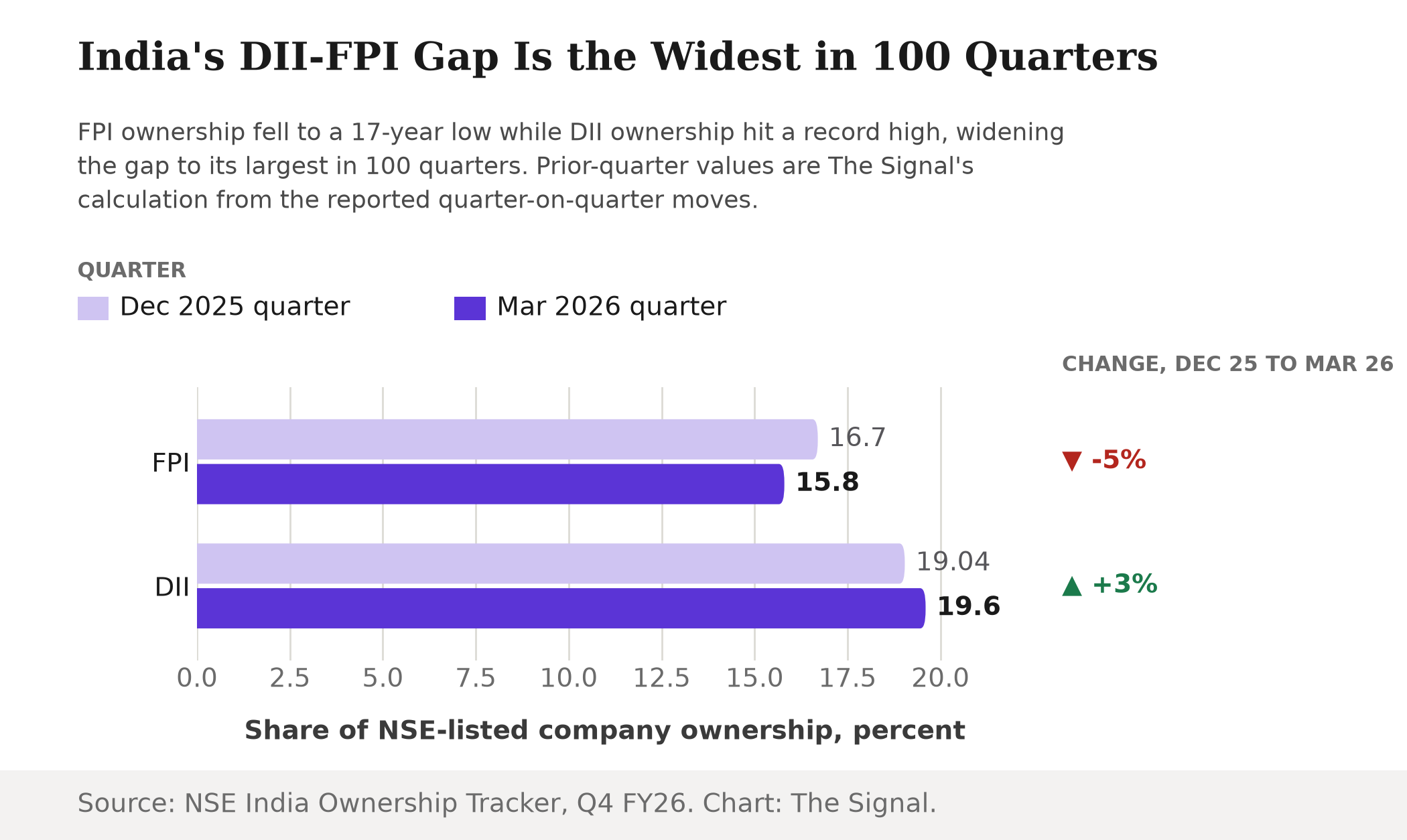
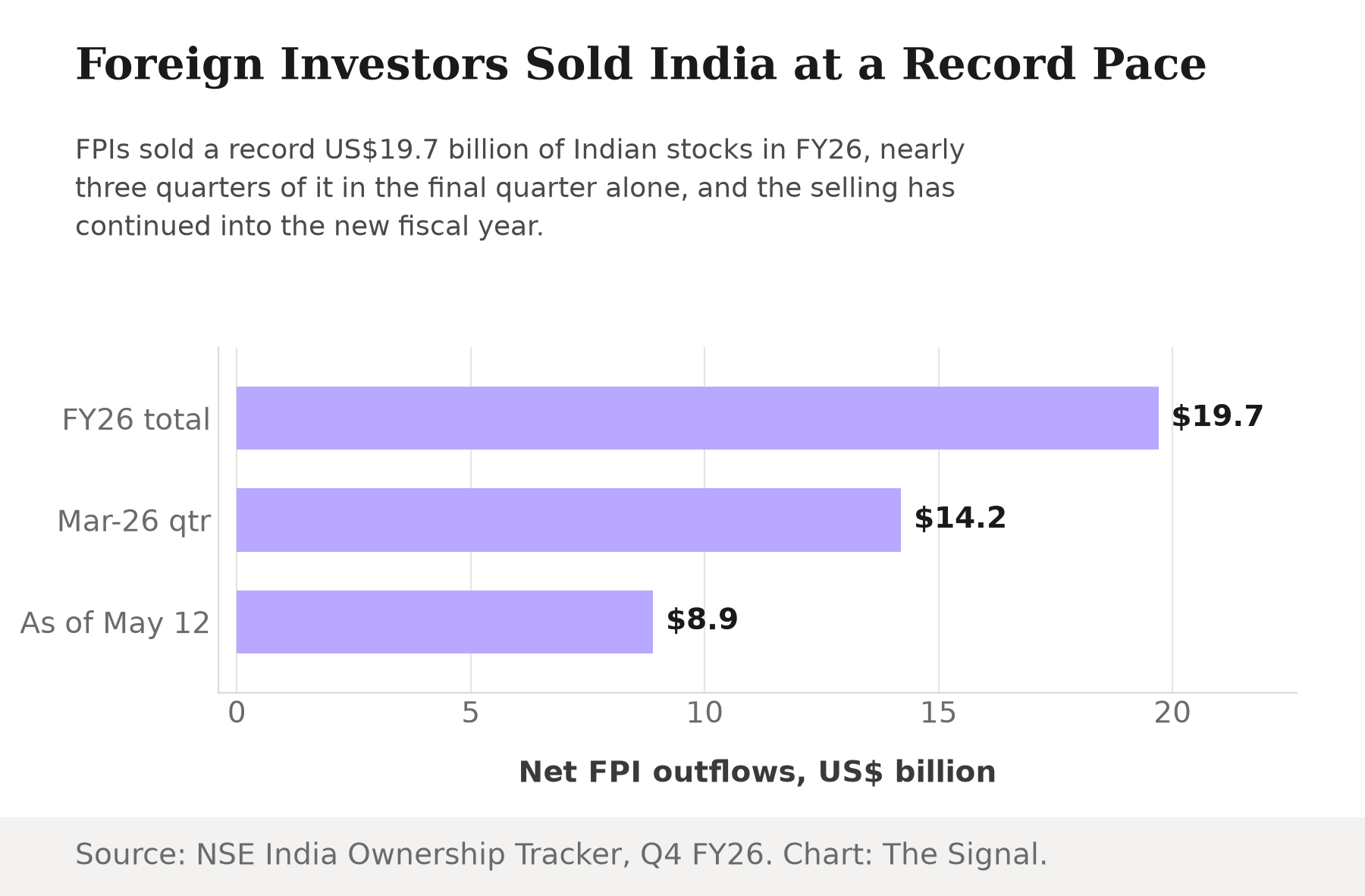
It is worth slowing down on that. The domestic surge did not happen in a vacuum. Foreign investors were leaving at the fastest pace on record. FPIs sold a net US$19.7 billion of Indian shares in FY26, the largest annual outflow on record, with US$14.2 billion of it, nearly 72%, in the March quarter alone. The selling did not pause with the new fiscal year either: FPIs had already sold another US$8.9 billion of Indian stocks by May 12, 2026. FPI ownership itself fell to 15.8%, its lowest level in 17 years. So the real question is not whether domestic money is winning. It clearly is. The question is where that money, and the space foreign investors left behind, is actually going. The obvious guess is that it is piling into the same handful of large, familiar names that index funds and SIP-driven flows tend to favour, making the market's ownership base narrower rather than wider.
That guess is wrong. The evidence is a single number: 161. The Herfindahl-Hirschman concentration index for institutional shareholding in NSE-listed companies fell to 161 in the March 2026 quarter, down from 188 the quarter before, and now sits at roughly half the pandemic-era peak of 320 hit in September 2020. A falling HHI means institutional money is spread across more companies, not fewer. The record domestic buying and record foreign selling that dominate the quarter's headlines are coinciding with an ownership base that keeps getting less concentrated.
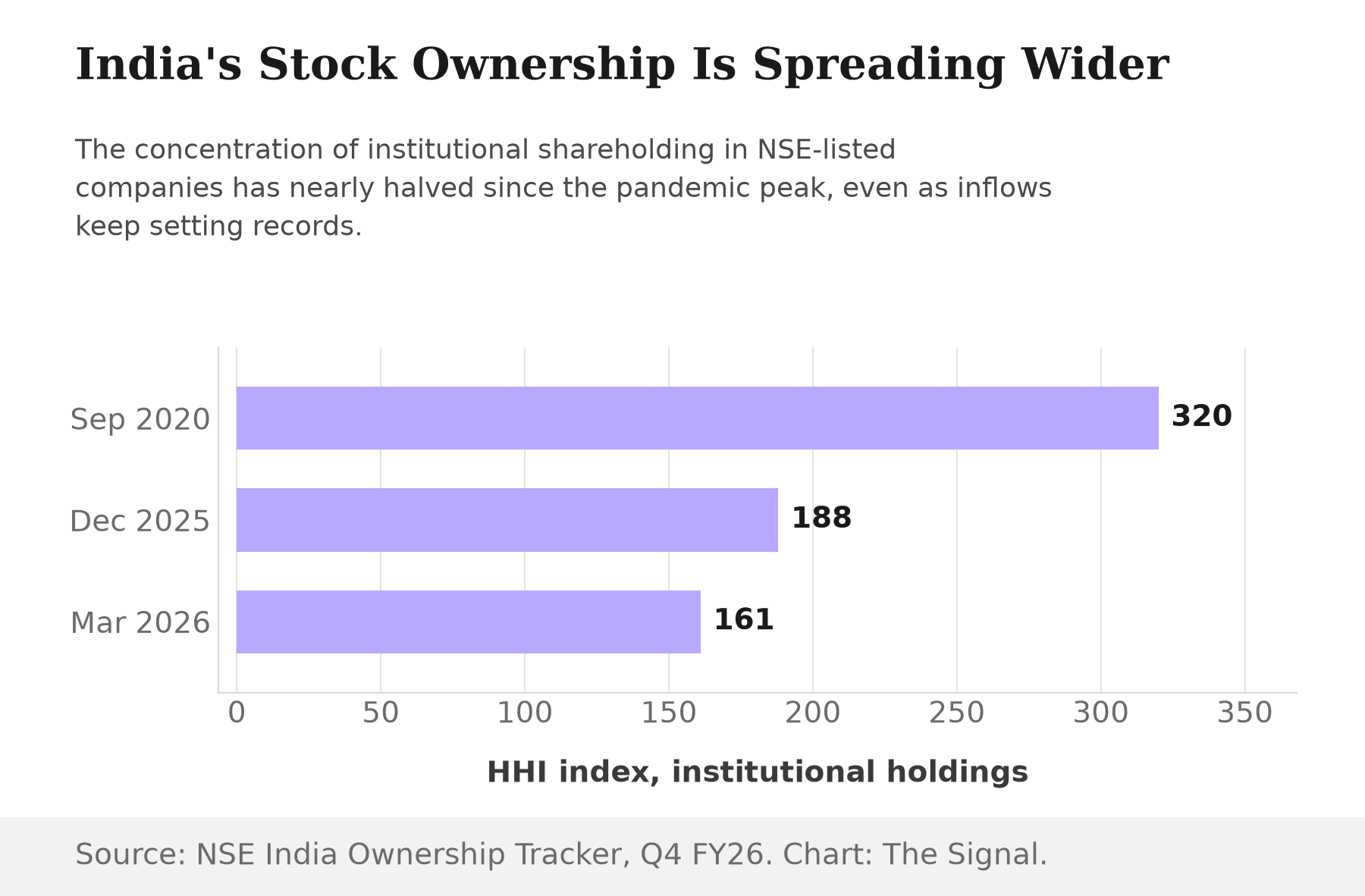
Why the crossover isn't a squeeze into fewer names
If domestic flows were simply chasing the largest, most familiar stocks, the biggest names should be soaking up a growing share of institutional money. The opposite happened. Nifty 50 constituents' share of total institutional ownership in NSE-listed companies fell to 59.2% in the March 2026 quarter, down 1.7 percentage points quarter on quarter, as large-cap outflows outpaced those from mid and small caps. Passive funds, the vehicles most likely to concentrate money into a handful of index heavyweights, remain a small slice of the market: index fund and ETF ownership of NSE-listed companies edged up to an all-time high of just 2.1% in the same quarter. Record SIP inflows and record DII ownership are not showing up as a bigger bet on the Nifty 50. They are showing up as a broader one.
The sector-level detail backs this up. Domestic mutual funds' ownership gains in the quarter were spread across the market rather than piled into one trade: DMF ownership hit record highs in Financials (14.5%), Consumer Discretionary (13.1%) and Healthcare (12.9%), with 6 of the 11 sectors NSE tracks reaching record DMF ownership levels and the sharpest quarter-on-quarter gains landing in Real Estate, Financials and Communication Services. A rotation into one or two favourite trades would show up concentrated in a couple of those sectors. This gain is spread across almost all of them.
The quarter's ownership shifts, side by side
| Metric | Q4 FY26 (March 2026) | What changed |
|---|---|---|
| FPI ownership | 15.8% | 17-year low |
| DII ownership | 19.6% | Record high; widest lead over FPI in 100 quarters |
| DMF ownership | 11.4% | Record high; 11th straight quarter of gains |
| Passive fund ownership | 2.1% | Record high |
| Average monthly SIP inflow | Rs 30,978 crore | Record; 22nd straight quarter of sequential growth |
| Nifty 50 share of institutional ownership | 59.2% | Down 1.7 percentage points quarter on quarter |
| Institutional concentration (HHI) | 161 | Down from 188; about half the September 2020 peak of 320 |
| FPI net outflows, FY26 | US$19.7 billion | Record for any fiscal year |
Source: NSE, Economic Policy and Research, India Ownership Tracker, Q4 FY26.
The honest objection
The strongest case against reading this as active diversification is mechanical, not behavioural. Part of the Nifty 50's falling share reflects index underperformance rather than a deliberate shift, since large caps saw steeper outflows than mid and small caps did in the quarter. If the biggest stocks simply fell out of favour and dragged concentration down with them, that is a story about large caps struggling, not about domestic funds consciously spreading their bets wider. It would be a thin comfort if concentration eased only because the index heavyweights had a bad quarter.
That case is real, but it does not explain the multi-year pattern sitting underneath one quarter's mechanics. Domestic mutual fund ownership has climbed for 11 straight quarters, not one, an increase of roughly 3.35 percentage points since December 2022. SIP inflows have grown sequentially for 22 straight quarters through cycles that included both rallies and the volatility this same NSE report describes for the March quarter, up 18.7% year on year even as market sentiment stayed subdued. One quarter's index underperformance can explain one quarter's HHI move. It cannot explain three years of the concentration index heading toward half its pandemic peak while a record share of the market's incremental money keeps arriving through systematic, diversified vehicles rather than one-off bets.
There is a sharper version of the objection worth confronting directly: what if the broadening is only happening on the domestic side, while the shrinking pool of foreign money left in India is retreating into a narrower set of blue chips? The data say the opposite. FPI-only portfolio concentration fell to an HHI of 208 in Q4 FY26, down from 260 the prior quarter, the lowest level since NSE's analysis began in 2001 and nearly half the pandemic-era peak of 411, as foreign investors expanded their investee base to 2,217 companies from roughly 1,200 five years earlier. Even as FPIs sell at a record pace in aggregate, the money that stays is not retreating to a narrower shortlist of familiar names. It is spread wider than at any point on record.
The Signal
Domestic funds have not just caught up with foreign investors, they have pulled ahead by the widest margin in a hundred quarters, while the money that used to belong to foreigners keeps leaving at a record pace. The reflex read is that this is a story about who owns India's stock market. The more useful read is about how: broader, not narrower, with the Nifty 50's grip loosening even as the total pool of domestic money sets a new high almost every quarter. Watch two things from here. FPI selling was already at US$8.9 billion for the new fiscal year as of May 12, 2026; if that keeps accelerating and the concentration index keeps falling in step, the broadening is real. If domestic inflows ever stall and ownership snaps back toward the same index heavyweights, then all the record SIP money will have bought is a narrower rally with extra steps.
Reporting basis: every figure in this piece, the FPI, DII and DMF ownership shares, SIP inflows, FPI net outflows, passive fund ownership, the institutional and FPI-only HHI concentration indices, sector-wise DMF ownership gains, and the Nifty 50 share of institutional holdings, comes from a single origin: the National Stock Exchange's Economic Policy and Research team's India Ownership Tracker for the quarter ended March 2026, published in May 2026, which itself compiles underlying data from AMFI, SEBI, and Bloomberg/CMIE Prowess. The prior-quarter (December 2025) ownership levels for FPI and DII, and the resulting widening of the gap between them, are The Signal's calculations from the report's own stated quarter-on-quarter point changes.