
On 23 July 2026, the Parliamentary Standing Committee on Finance tabled its 36th report on the Securities Markets Code, 2025, recommending an interim framework of self-regulatory organisations, supervised by the RBI or SEBI, to audit crypto exchange reserves and legally segregate customer funds from company balance sheets. Read as a headline, it sounds like India finally building guardrails for a market that has needed them for years. The committee itself framed it that way, noting that India has an estimated 39 million KYC-verified crypto traders who currently have no dedicated legal protections, despite being taxed at a flat 30 percent rate on their gains.
It is worth slowing down on that. The report landed three weeks after the RBI itself, in a submission to the same committee reported on 3 July 2026, said virtual digital assets should not be legalised in India at this stage, citing risks to the country's financial system. One arm of the state is drafting a rulebook for a market the country's central bank has just told the same room it does not want legalised.
Nearly nine in ten Indian crypto trades happen beyond any Indian regulator's reach.
That is the harder problem sitting underneath the RBI-versus-Parliament disagreement. An Esya Centre study found that since 1 April 2022, trading volume on Indian crypto exchanges fell by almost two-thirds, and that 88 percent of transaction volume remained lost to offshore exchanges as of March 2024. A self-regulator can only supervise the exchanges that register with it. If nearly nine in ten trades already clear on platforms outside that net, the new body is being built to police the smaller side of the market.
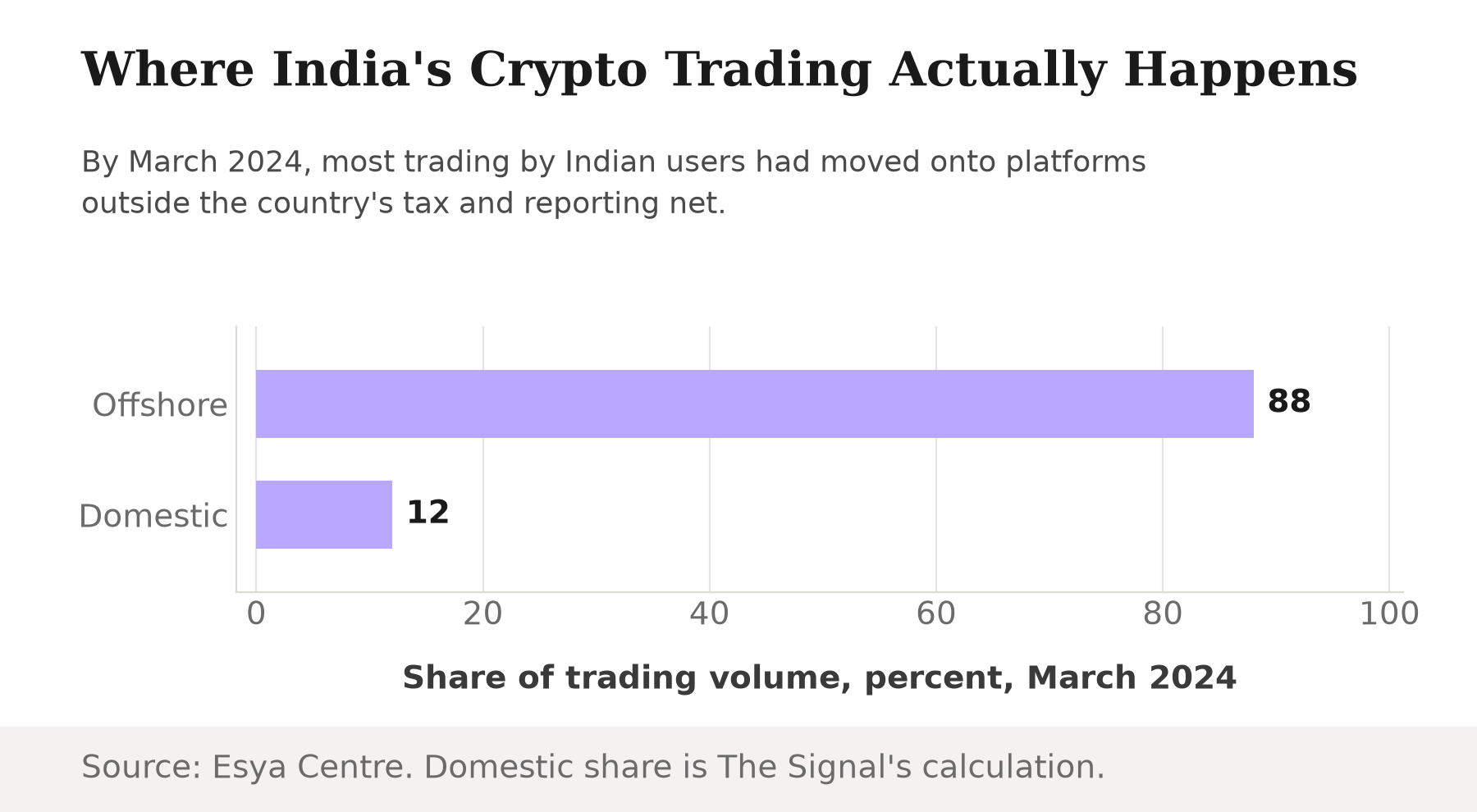
Source: Esya Centre, "Taxes and Takedowns" (2024). Domestic share is The Signal's calculation. Chart: The Signal.
A tax regime built to be avoided
The flight offshore was not an accident of the market. It was priced in. Section 194S of the Income-tax Act imposes a 1 percent tax deducted at source on every payment for a virtual digital asset transfer to a resident, effective 1 July 2022, which bites on every trade regardless of whether it made money. Section 115BBH taxes any gains at a flat 30 percent, with no deduction for expenses beyond the cost of acquisition and no set-off or carry-forward of losses against other income. An active trader on a compliant Indian exchange loses a sliver of capital on every single transaction and cannot net a bad month against a good one. An offshore exchange charges neither. The Esya Centre's finding that domestic volume fell by almost two-thirds after the regime took hold is not a mystery: the tax did exactly what a 1 percent-per-trade levy on a thin-margin activity will do: send the activity somewhere the levy cannot reach.
A regulator that keeps discovering new names
India's anti-money-laundering law does require any exchange serving Indian users, wherever it is based, to register with the Financial Intelligence Unit. Enforcement of that rule has been running for years, and it keeps finding fresh ground to cover rather than closing out the old list. As of December 2023, only 31 virtual digital asset service providers had registered with FIU-IND, while nine major global offshore exchanges, including Binance, Kraken, KuCoin and Huobi, were still operating in India unregistered and were referred for URL-blocking. In January 2025, FIU-IND fined the offshore exchange Bybit ₹9.27 crore for expanding its services in India for years without securing the mandatory registration. In October 2025, the agency issued non-compliance notices to 25 more offshore exchanges, including Huione, Paxful, Changelly, CEX.IO and CoinEx. Nine names flagged in one round, twenty-five more in the next: the roll call of unregistered platforms serving Indian traders is not shrinking as fast as new ones are found. The registered list has grown since, but so has the takedown list: as of 9 March 2026, 54 virtual digital asset service providers had registered with FIU-IND, of which three had already stopped operating, leaving 51 active, while over the same three years since registration became mandatory the agency had directed the takedown of 53 unregistered VDA exchanges, almost one takedown order for every platform that ever registered.
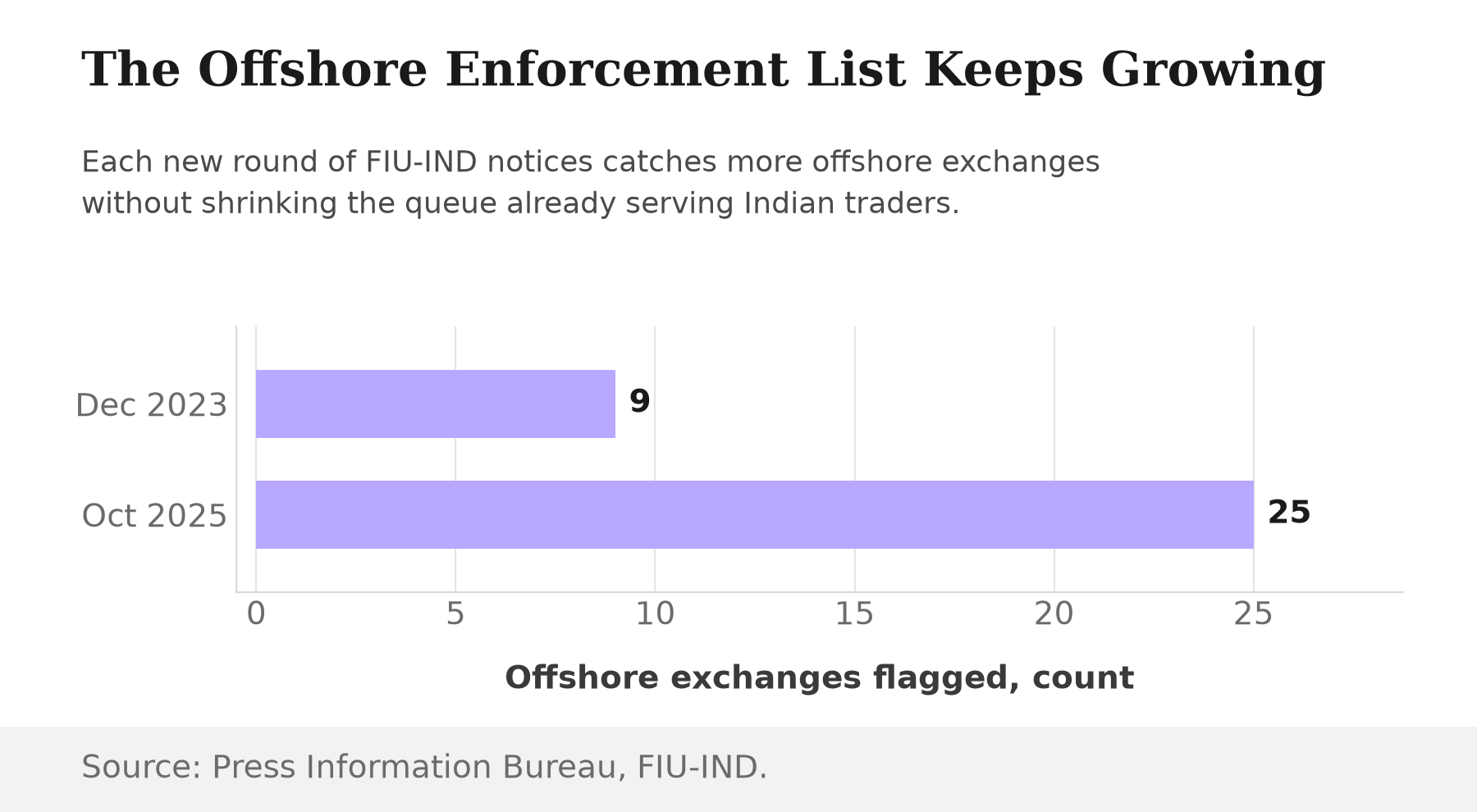
Source: Financial Intelligence Unit India, via the Press Information Bureau, December 2023 and October 2025. Chart: The Signal.
What the self-regulator would actually cover
The Standing Committee's proposal is more sophisticated than a simple registry. It would put self-regulatory organisations under RBI or SEBI supervision, with a mandate to audit exchange reserves and keep customer money legally separate from a company's own balance sheet, the kind of structural safeguard that has failed at unregulated offshore exchanges elsewhere. That is a genuine improvement over the status quo for whichever exchanges actually join it. The question the report does not answer is how many of India's traders that membership would actually cover.
What the self-regulator can see and what it cannot
| Group | Count | As of |
|---|---|---|
| Registered domestic virtual digital asset service providers | 31 | December 2023 |
| Major offshore exchanges still unregistered, flagged for URL-blocking | 9 | December 2023 |
| Additional offshore exchanges issued non-compliance notices | 25 | October 2025 |
| Total VDA service providers registered with FIU-IND (51 still active) | 54 | March 2026 |
| Cumulative unregistered VDA exchanges directed for takedown since 2023 | 53 | March 2026 |
| KYC-verified Indian crypto traders, taxed at 30 percent with no dedicated protections | 39 million | 2026 |
Source: Financial Intelligence Unit India, via the Press Information Bureau, December 2023 and October 2025; Lok Sabha Unstarred Question No. 5805, 30 March 2026, via Cyril Amarchand Mangaldas; Parliamentary Standing Committee on Finance's 36th report, via Cryptopolitan.
The most recent registered base, as of 9 March 2026, was 51 active platforms. The traders the committee says the framework is meant to protect number in the tens of millions. A self-regulatory organisation's authority runs only as far as its membership, and its membership is drawn from the exchanges that show up and register, which is precisely the group the tax regime gave the strongest reason to leave.
The honest objection
The strongest case for the proposal is that it was never meant to solve the offshore problem directly. Its job is to formalise the domestic industry: give registered Indian exchanges credible, audited self-governance, so that a trader who stays onshore gets real protections instead of none. On that reading, RBI's skepticism about legalising virtual digital assets outright and the Committee's push for an interim SRO framework are not actually in conflict. The RBI is arguing about whether crypto should exist as a legal asset class at all; the Committee is arguing about how to govern the part of it that already operates within India's tax and reporting system, whatever its size. A rule that improves outcomes for the 51 platforms active on FIU-IND's register as of March 2026 and their users is still worth having even if it cannot touch the rest.
That case holds for the domestic industry on its own terms. It strains against the specific way this market formed. India did not end up with 88 percent of its trading volume offshore by chance; its own tax design pushed it there, and its own enforcement agency has spent since at least December 2023 discovering new offshore names faster than it has grown the registered list. A self-regulator layered on top of a shrinking domestic base does not close that gap. It formalises one side of it while the other side keeps growing untouched.
The Signal
India now has two answers to the same question, delivered to the same committee weeks apart: the RBI's answer is that virtual digital assets should not be legalised, and the Committee's answer is a self-regulatory framework to govern the exchanges that already are operating legally. Both can be true at once, and neither reaches the 88 percent of trading volume that a 1 percent transaction tax and a 30 percent gains tax already pushed beyond India's borders. Watch what the FIU-IND publishes next: if the registered count grows faster than the offshore list does, the SRO is pulling the market back onshore. Keep the offshore notices arriving in batches of 25 while the registry stays near 54, though, and the self-regulator will be auditing the reserves of a market that mostly moved out from under it.
Reporting basis: the tax mechanics come from the Finance Bill 2022 explanatory memorandum, published by the Ministry of Finance. The FIU-IND registration counts, the Bybit penalty and the offshore non-compliance notices are from Financial Intelligence Unit India press releases via the Press Information Bureau, spanning December 2023 to October 2025. The March 2026 registration and takedown totals are from the Ministry of Finance's 30 March 2026 Lok Sabha reply to Unstarred Question No. 5805, as reported by law firm Cyril Amarchand Mangaldas. The RBI's submission to the Parliamentary Standing Committee is as reported by Business Today, citing people aware of the deliberations, and is the only source for that account. The Standing Committee's 36th report and its self-regulatory organisation proposal are as reported by Cryptopolitan, the only outlet consulted for that report's contents. The trading-volume shift to offshore exchanges is from a single Esya Centre research study, Taxes and Takedowns, published in 2024. The domestic trading-volume share and the multiple between the two enforcement rounds are The Signal's calculations from those figures.