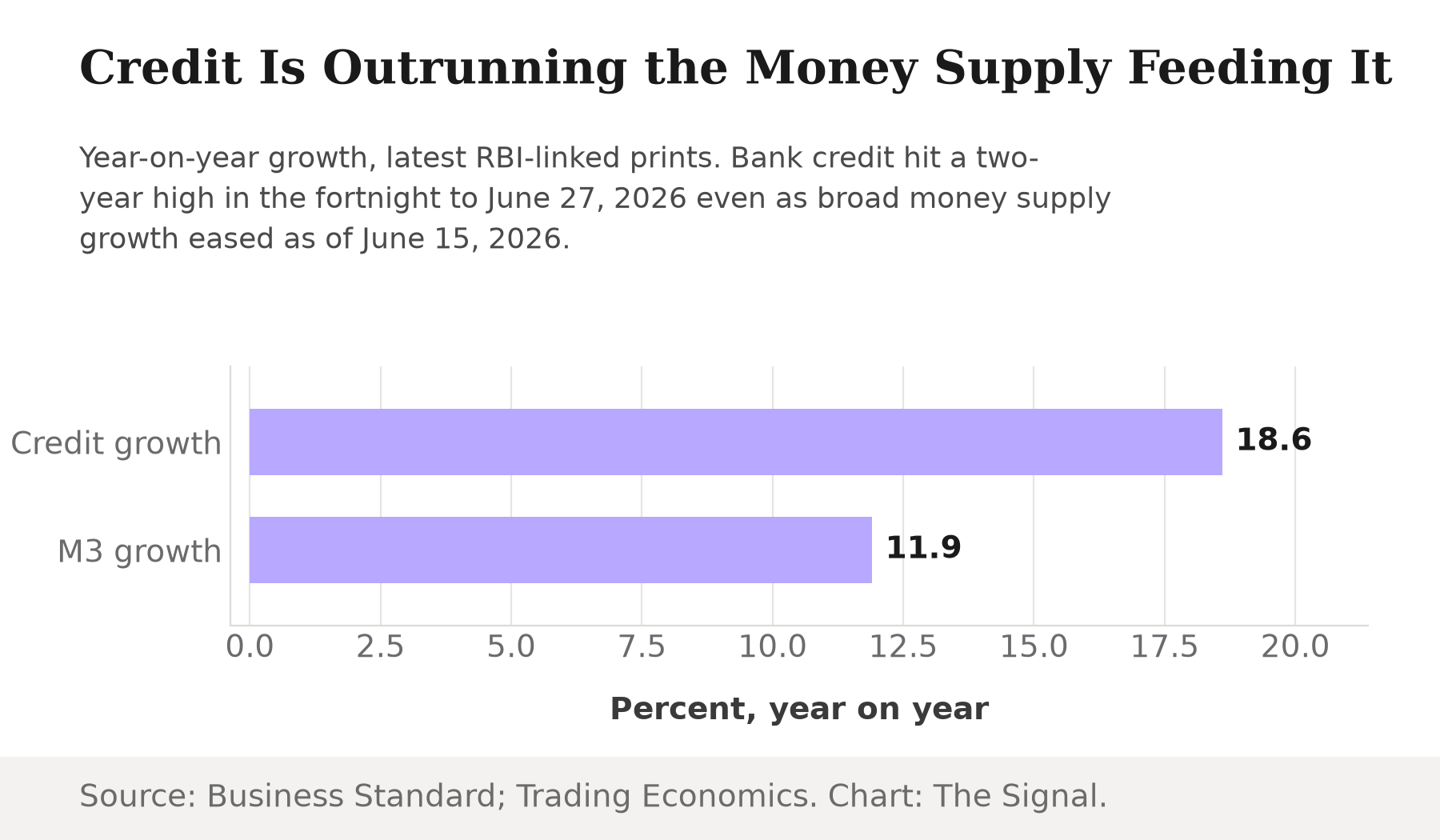
Bank credit is on a tear. Scheduled commercial banks' credit growth accelerated to 18.6 percent year-on-year in the fortnight ended June 27, 2026, a two-year high, and deposits kept pace: overall deposits jumped by around Rs 6.97 trillion in the same fortnight, the third-highest fortnightly deposit mobilisation in 29 years. Read only that print and Indian banking looks flush: households and firms are borrowing, deposits are pouring in, and the credit cycle is turning up.
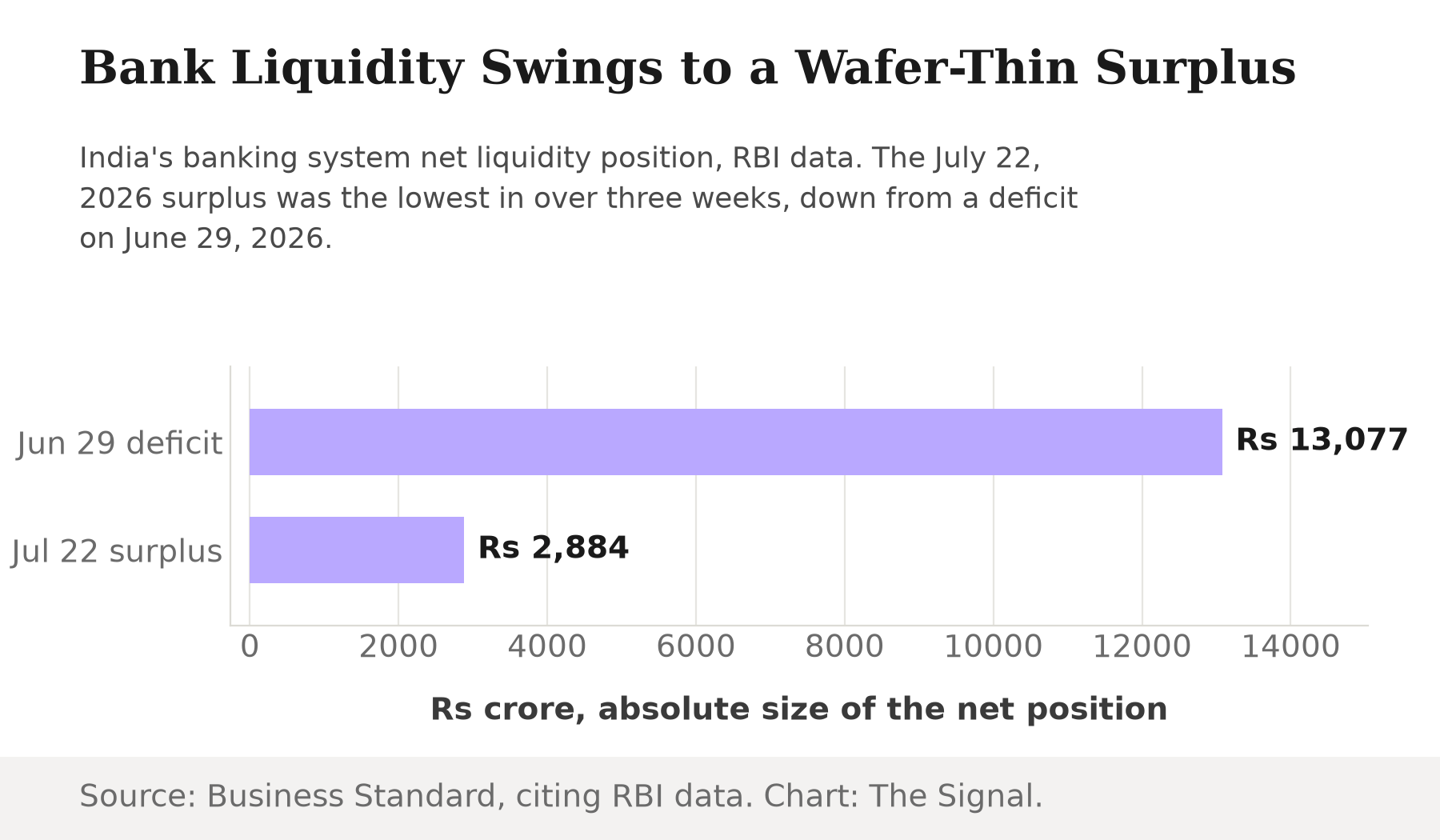
It is worth slowing down on that. India's banking system net liquidity surplus fell to Rs 2,884 crore on July 22, 2026, the lowest level in over three weeks, down from a deficit of Rs 13,077 crore as recently as June 29, 2026. The system swung from a shortage of nearly Rs 13,077 crore to a surplus of under Rs 3,000 crore in three weeks, and that surplus is now the cushion the entire banking system is running on. For a system funding a two-year-high credit cycle, that is a very thin buffer.
The RBI has been selling dollars, and that drains rupees from the same system.
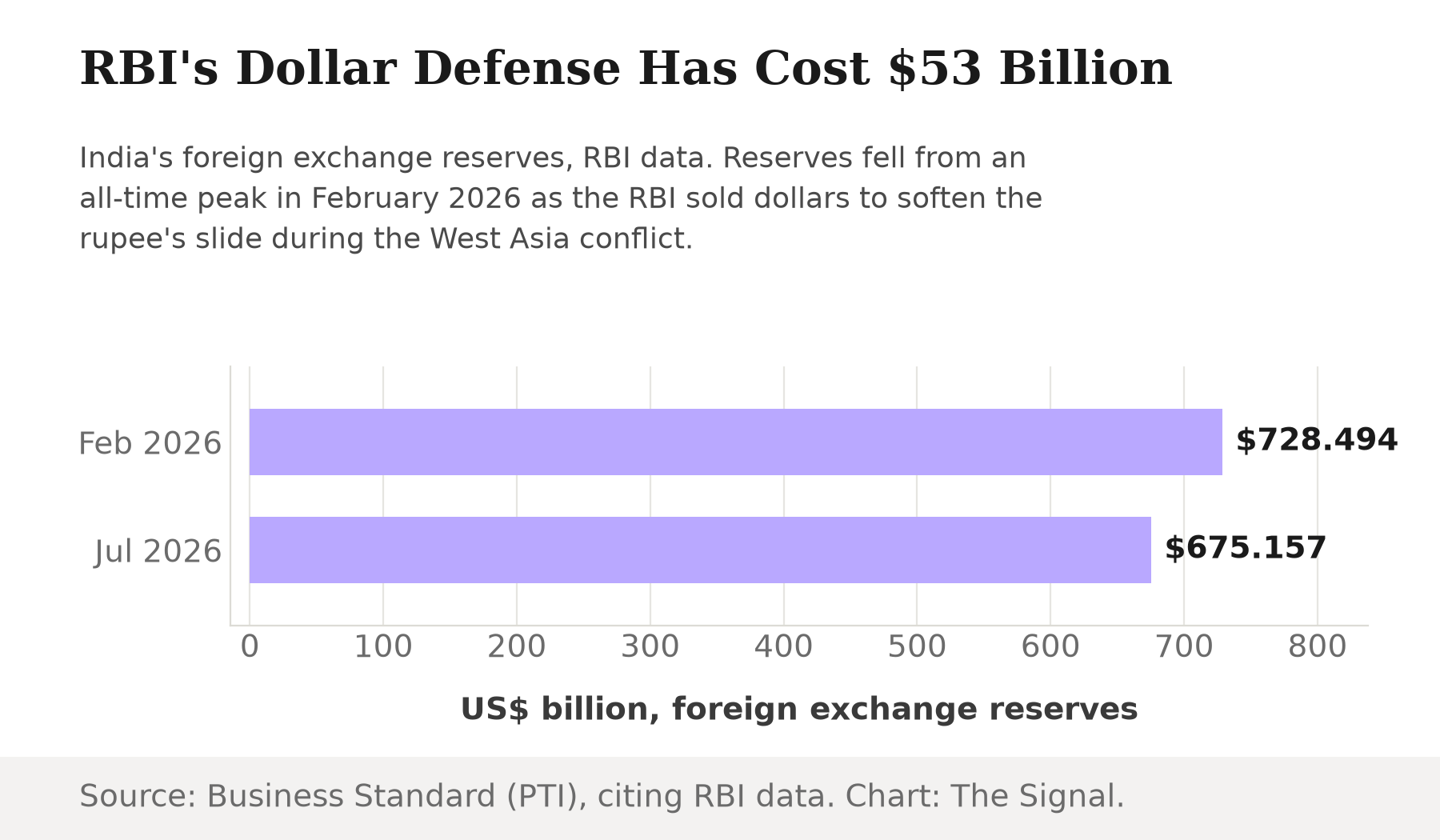
The reason the cushion is this thin is not really a domestic story. The rupee settled at 96.57 per dollar on July 22, 2026, nearing a two-month low, having already set a record closing low of 96.83 per dollar on May 20, 2026, as Brent crude climbed to $93.5 to $95.5 a barrel, its highest level in about six weeks, on escalating West Asia tensions. To soften that slide, the RBI has been selling dollars in the spot market. India's foreign exchange reserves fell from an all-time high of $728.494 billion in the week ended February 27, 2026 to $675.157 billion in the week ended July 10, 2026, a decline of roughly $53 billion, as the RBI intervened in the forex market through dollar sales during the West Asia conflict.
That roughly $53 billion did not simply vanish from the economy. Selling dollars is a two-sided trade: the RBI hands a bank dollars and takes rupees in return, draining that same sum from circulation in the banking system unless it separately injects rupees back through another operation to offset it. Reserve managers everywhere face this trade-off; India's is now running at the same moment its own credit cycle needs more rupees, not fewer.
The corridor the RBI says it isn't touching
On paper, the RBI has not tightened anything. Its Monetary Policy Committee voted unanimously on June 5, 2026 to keep the policy repo rate unchanged at 5.25 percent, with the Standing Deposit Facility rate at 5.00 percent and the Marginal Standing Facility rate at 5.50 percent, retaining a neutral stance. Seven weeks on, the corridor is still where the MPC left it, and the RBI's own daily operations show it is still working exactly as designed for some banks even as the system-wide cushion has thinned.
Some banks still have rupees to park; the system as a whole does not.
| Instrument | Rate | Amount, July 24, 2026 |
|---|---|---|
| Standing Deposit Facility (banks parking cash with the RBI) | 5.00% | Rs 1,85,102 crore |
| Marginal Standing Facility (banks borrowing from the RBI) | 5.50% | Rs 483 crore |
| Policy repo rate (unchanged since June 5, 2026) | 5.25% | not a daily operation |
Source: RBI's Monetary Policy Statement, June 5, 2026 and RBI Money Market Operations, July 24, 2026.
On July 24, 2026, banks parked Rs 1,85,102 crore overnight with the RBI under the Standing Deposit Facility at 5.00 percent, while only Rs 483 crore was drawn via the Marginal Standing Facility at 5.50 percent. That is not a system in acute distress: a large pool of banks still has enough spare cash to park it with the RBI rather than borrow at the ceiling rate. The spread is the problem. A system that can post a system-wide surplus of just Rs 2,884 crore while a subset of banks parks over a lakh crore under the SDF has its liquidity bunched in a few hands rather than spread across the banks that need it to fund fresh lending.
Credit is speeding up as the cushion vanishes
The timing is what makes this worth watching. Credit growth hit that two-year high of 18.6 percent just as the money supply feeding it was decelerating. India's M3, or broad money supply, growth eased to 11.9 percent year-on-year as of June 15, 2026, down from 12 percent as of May 31, 2026. Eighteen-point-six against 11.9 is a gap of nearly seven percentage points, and it is opening at the same time the RBI is pulling rupees out of the system to hold the exchange rate.
None of these three facts, the thin liquidity surplus, the dollar sales, and the credit-versus-money-supply gap, is proof that the RBI has quietly tightened policy. But stacked together, in the same three-week window, they describe a banking system funding faster loan growth on a shrinking base of spare rupees, at the exact moment its central bank is removing rupees from that base to fight a currency problem that has nothing to do with domestic credit demand.
The honest objection
The strongest case against reading any of this as tightening is that the RBI has told the market, in writing, that it isn't tightening: the MPC held the repo rate at 5.25 percent and explicitly kept a neutral stance on June 5, 2026, and banks still parked Rs 1,85,102 crore in the Standing Deposit Facility on July 24, 2026, hardly the sign of a system starved of cash. On this reading, a three-week liquidity low is just noise inside a corridor the RBI fully controls, dollar sales are a separate operation with no bearing on the rate stance, and the central bank has every tool it needs to top up liquidity the moment it judges the buffer too thin.
That case is real, and the RBI has offsetting tools it has used before: it ran a 7-day Variable Rate Repo auction on July 20, 2026, notified for Rs 1,25,000 crore, and allotted Rs 72,051 crore of it at a cut-off rate of 5.26 percent, injecting rupees back into the system two days before the July 22 print. That is the RBI actively topping up liquidity, exactly as the objection says it can. But the system-wide surplus still fell to just Rs 2,884 crore, the lowest in over three weeks, even with that injection already landed. That objection describes the RBI's declared stance. The system's day-to-day cash position is a separate matter, and the two can diverge even when the policy rate does not move: a rate held steady still tightens in practice if the overnight cushion beneath it keeps thinning while credit demand keeps rising, and here the cushion stayed thin despite an active refill. The swing from a Rs 13,077 crore deficit on June 29, 2026 to a Rs 2,884 crore surplus on July 22, 2026 is a system-wide number, not a subset of banks, and it fell to that three-week low in the same stretch that credit growth hit a two-year high and dollar sales widened. A neutral stance on paper does not guarantee neutral conditions in the money market underneath it.
The Signal
The RBI is fighting two fronts with one balance sheet. Dollar sales hold the rupee's line against oil-driven pressure from the West Asia conflict; that same balance sheet is what banks draw on to fund a credit cycle now growing at 18.6 percent a year. Every dollar spent on the first front is a rupee unavailable for the second, and the system's cushion for absorbing that trade-off is the thinnest it has been in over three weeks. Watch two numbers together, not separately: if Brent crude stays elevated and the RBI keeps selling dollars, and the system liquidity print tips back into deficit rather than holding a surplus, that is the RBI needing to actively refill the till through repo operations or bond purchases just to keep the credit cycle it did not touch from stalling on a currency fight it did not start. A rescue on one balance sheet is a squeeze on the other.
Reporting basis: the banking system liquidity figures and the credit growth and deposit mobilisation figures are per Business Standard's reporting of Reserve Bank of India data. The foreign exchange reserves figures are per Business Standard's reporting, as carried from Press Trust of India, drawing on Reserve Bank of India data. The M3 money supply growth figures are from Trading Economics, compiled from Reserve Bank of India releases. The rupee exchange rate and Brent crude figures are per Business Standard's markets desk. The Monetary Policy Committee's June 5, 2026 decision is from the Reserve Bank of India's own Monetary Policy Statement, and the Standing Deposit Facility and Marginal Standing Facility figures are from the Reserve Bank of India's Money Market Operations data, and the July 20, 2026 Variable Rate Repo auction result is from the Reserve Bank of India's own press release on that auction, all primary Reserve Bank of India sources. The percentage-point gap between credit growth and M3 growth and the size of the liquidity swing are The Signal's calculations from those figures.