
India's rupee hit a record low of around 92 to the dollar on March 4, 2026, as Brent crude climbed above $85 amid US-Israeli strikes on Iran that stoked fears of a supply disruption through the Strait of Hormuz. The pressure had been building for months: India's balance of payments deficit had already widened to $30.80 billion in the fiscal year ended March 2026, more than six times the $4.90 billion deficit of the year before. Two years earlier, India had run a $63.70 billion surplus. Into that gap, RBI reopened a concessional FCNR(B) swap facility via a circular dated June 8, 2026, a tool last used during the 2013 taper-tantrum crisis, to pull foreign-currency deposits from non-resident Indians back into the banking system. Read the headline numbers and the rescue looks like it is working: $20.72 billion flowed in during the first six weeks alone, and analysts have already raised their forecast for the full window to $60-70 billion.
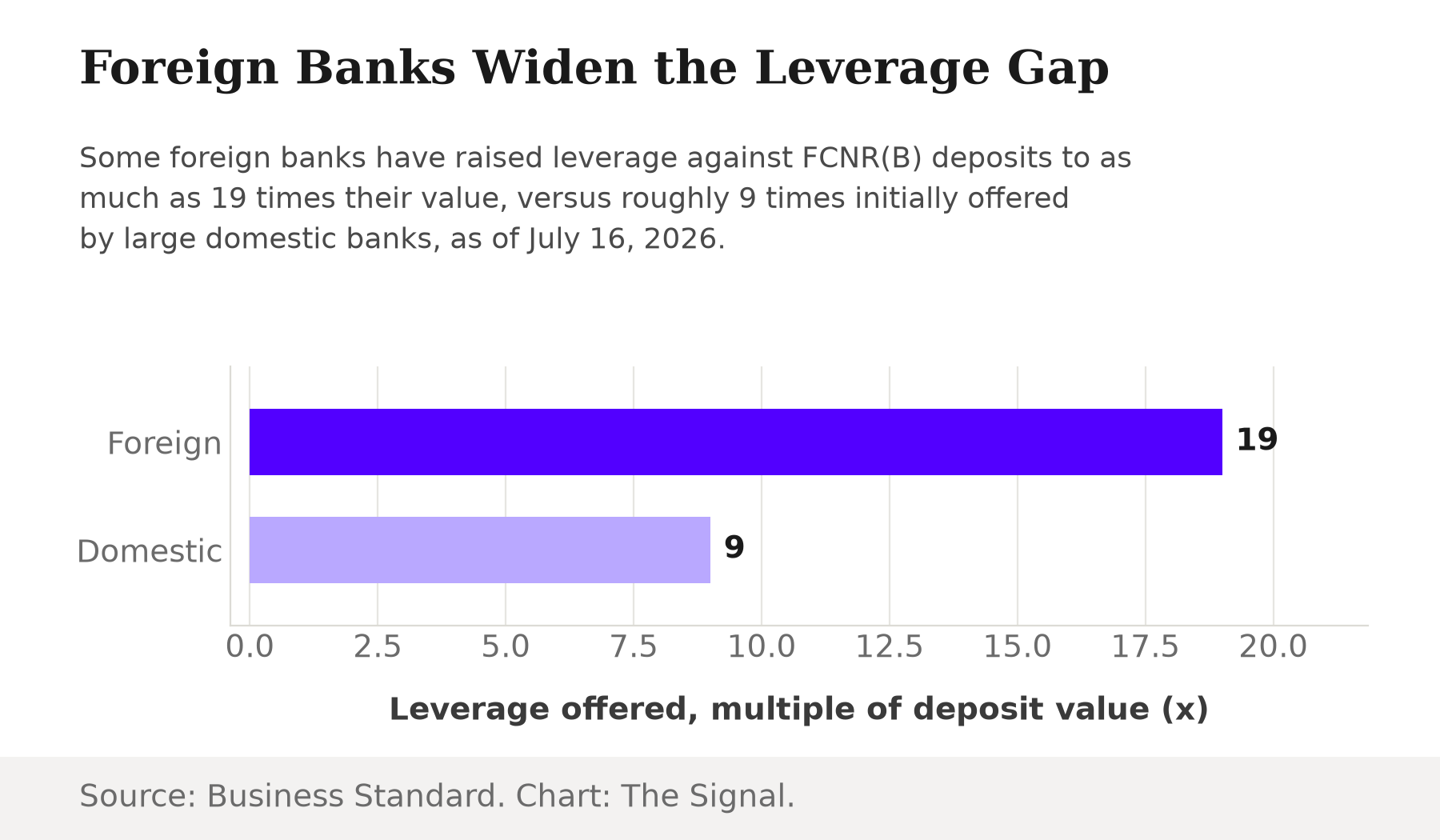
It is worth slowing down on who is actually bringing that money in. Some foreign banks have pushed the leverage they offer against NRI deposits to as much as 19 times the deposit's value, while most large domestic banks initially settled around 9 times. That is not a footnote. It is the clearest evidence yet that a scheme built to reconnect the diaspora with Indian banks is instead being won by the branches of foreign lenders competing hardest on terms.
Why RBI reached for this tool again
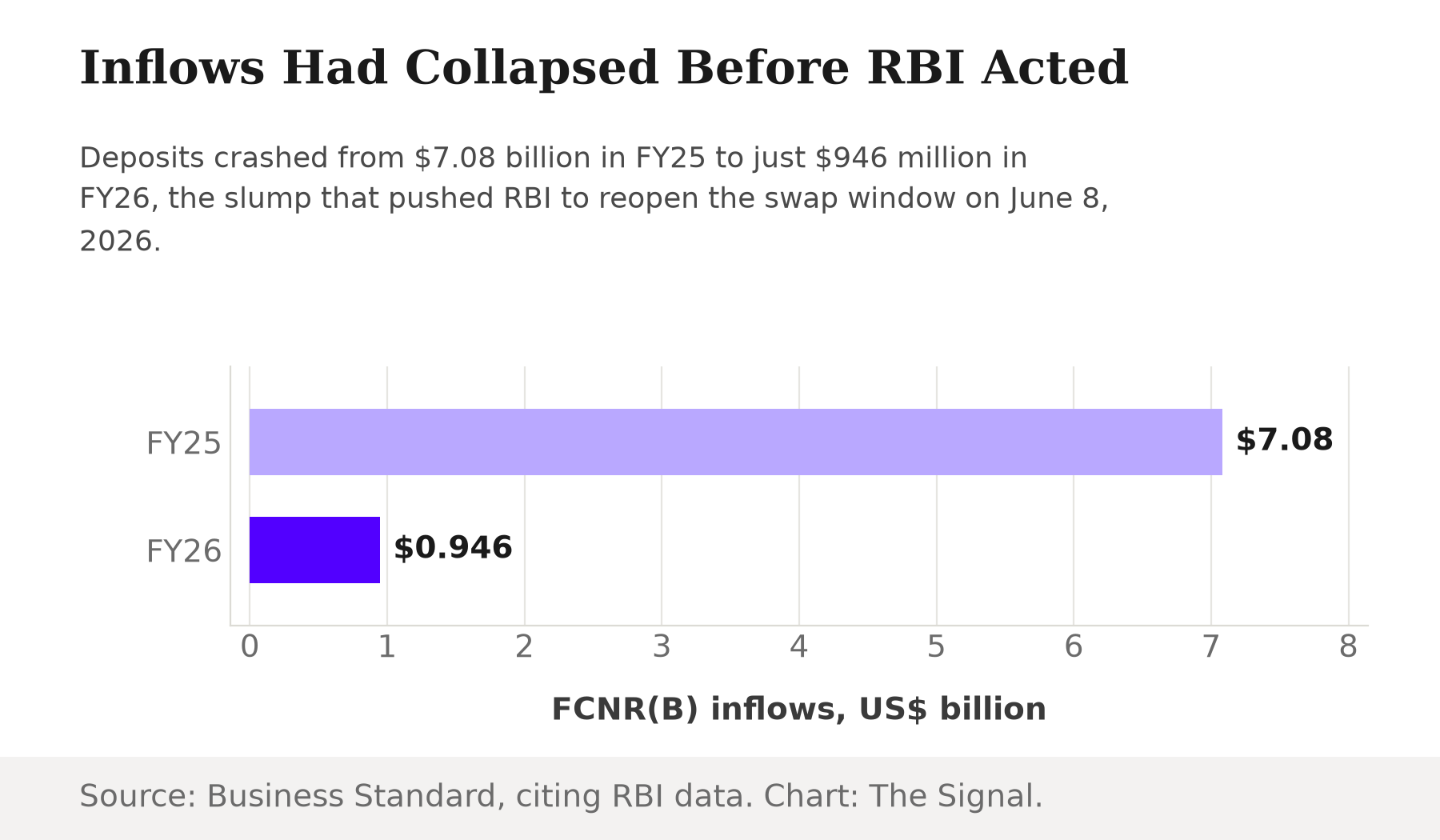
The scheme exists because the ordinary channel had dried up. FCNR(B) inflows collapsed from $7.08 billion in FY25 to just $946 million in FY26, a slump that left the RBI short of a dependable source of dollars just as the oil shock was pushing the rupee to new lows. Reopening the swap was a direct response: it re-prices FCNR(B) deposits so banks can compete for the same diaspora money they had stopped bothering to chase.
The mechanics are generous by design. Fresh three-to-five-year FCNR(B) deposits mobilised through September 30, 2026 are exempt from CRR and SLR, and RBI itself absorbs the hedging cost, which lets banks offer NRI deposit rates 150-200 basis points higher than they could before the scheme. RBI's own FAQ describes the facility as a plain buy or sell foreign exchange swap, covering only the deposit principal and not the interest, with the swap capped at a maximum of five years. RBI, in other words, is paying the hedging bill so banks can pay depositors more. What it does not control is what banks then do to win those depositors.
The leverage race is the real story
That is where foreign banks pulled ahead. Offering a bigger loan against the same deposit is a lending decision layered on top of RBI's rate subsidy, not something the scheme mandates, and it is a lever foreign banks have pulled harder than domestic ones. A depositor able to borrow 19 dollars against every dollar parked, instead of 9, has a much stronger reason to bank with whichever lender offers that ratio. Any bank could have used that subsidy to compete on rates alone. Foreign lenders chose the more aggressive contest instead, and domestic banks have so far been slower to follow them into it.
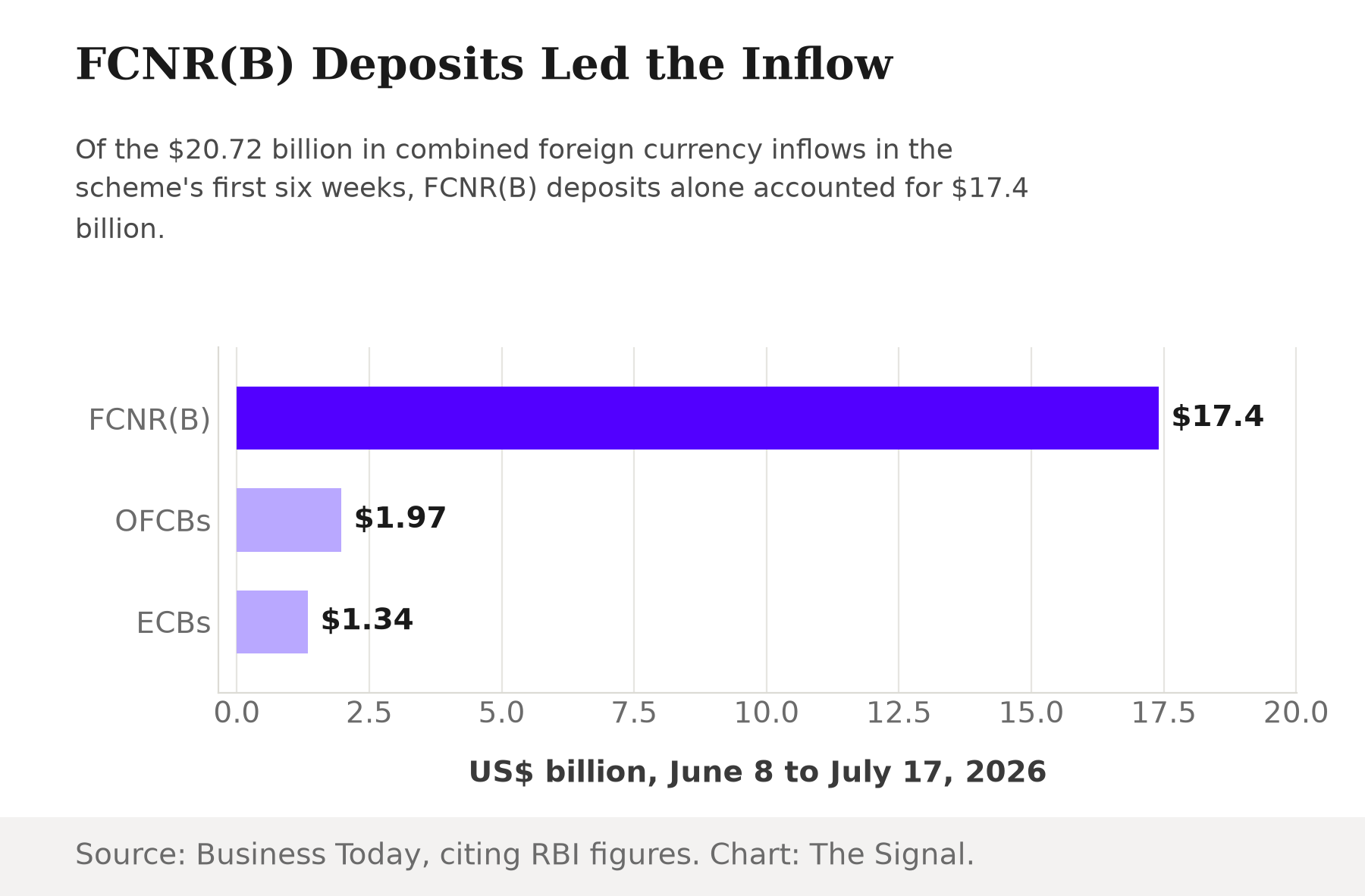
Composition data on the money already in the door reinforces how concentrated the response has been. Of the $20.72 billion raised between June 8 and July 17, 2026, FCNR(B) deposits contributed $17.4 billion, overseas foreign currency borrowings $1.97 billion and external commercial borrowings $1.34 billion. The deposit channel, the one where the leverage race is playing out, is doing almost all of the work.
A bigger, faster repeat of 2013
The 2013 precedent, also launched under a rupee crisis, looked different in its mechanics. Raghuram Rajan's RBI fixed the swap cost at 3.5 percent, compounded semi-annually, and required a one-year lock-in on top of the three-year minimum deposit tenor. That window ultimately worked: it raised close to $34 billion in total, $26 billion of it through FCNR(B) deposits and $8 billion through external commercial borrowings, equal to about 12 percent of India's forex reserves in 2013. The 2026 window is on pace to beat that scale well before its own deadline, and it is doing so by giving banks more room to compete on price rather than fixing the cost centrally, which is exactly the design choice that opened space for the leverage race.
The 2026 window is already closing in on 2013's total, in a fraction of the time.
| 2013 window | 2026 window | |
|---|---|---|
| Launched | September 6, 2013 | June 8, 2026 |
| Minimum deposit tenor | 3 years | 3 to 5 years |
| Swap cost / lock-in | Fixed at 3.5%, compounded semi-annually; 1-year lock-in | RBI absorbs the hedging cost; swap capped at 5 years, tied to deposit maturity |
| Total raised | About $34 billion (final) | $20.72 billion in 6 weeks; analysts now forecast $60-70 billion |
Sources: RBI's 2013 FAQ; RBI's 2026 FAQ; Business Standard; Outlook Business; Business Today; Business Standard.
The urgency behind that pace has eased somewhat since the rupee's low. Brent crude, which had peaked at more than $126 a barrel on April 30, 2026 during the Israel-Iran war, had fallen more than 38 percent to $70.82 a barrel by July 2, 2026 as ceasefire talks progressed. The oil shock that triggered the scheme has cooled. The swap window has not slowed down to match: analysts raised their inflow forecast to $60-70 billion as recently as July 21, 2026, weeks after the immediate crude-price emergency had passed.
The honest objection
The strongest case against calling this hot money is that the deposits are real and genuinely locked in. FCNR(B) money carries a three-to-five-year minimum tenor and a swap RBI has capped at five years, tied to the deposit's own maturity, not a scheme an investor can unwind overnight. A leverage ratio is a lending decision by a bank, not evidence that the underlying dollars are fickle; an NRI depositing real savings for three years has made a genuine multi-year commitment whichever bank holds the account. On this reading, foreign banks are not attracting hot money so much as simply competing harder for the same durable deposits domestic banks are also chasing, and the leverage gap could narrow once domestic banks respond in kind.
That case holds for the deposit itself, but it does not fully answer the leverage question. The three-to-five-year lock-in binds the depositor's original dollars. It says nothing about the borrowed money layered on top through a leverage facility running as high as 19 times the deposit's value, which is a separate credit line a bank can reprice or withdraw on its own schedule, independent of the underlying deposit's maturity. A scheme can be full of contractually sticky deposits and still see a meaningful share of its headline number come from a lending contest that is far more sensitive to rates than the deposits themselves. The two are not the same claim, and 2026's numbers do not yet let us separate them.
The reversibility question is not hypothetical, either. The 2013 window supplies the direct precedent: outstanding FCNR-B deposits fell from $44.11 billion at the end of September 2016 to $20.85 billion by December 2016, a roughly 53 percent drop in a single quarter, as the three-year deposits mobilised under the original swap came due. The lock-in held for exactly as long as it was contracted to hold, and no longer; once it expired, most of that money left the banking system rather than rolling over. If the 2026 tranche behaves the same way once its own three-to-five-year clock runs out, the $60-70 billion now being forecast is really a fixed-term loan, one the diaspora is being paid handsomely to extend and, in foreign banks' case, leveraged as well, rather than a permanent addition to India's reserves.
The Signal
RBI built a subsidy any bank could use to raise NRI deposit rates. Foreign banks chose instead to compete on how much they will lend against those deposits, and they are winning the bulk of the money because of it. That is a different outcome than the one a scheme aimed at India's own banking system implicitly promised. Watch two things as the window runs to its September 30, 2026 close: whether domestic banks close the leverage gap, and whether the pace of inflows holds up now that the oil shock that started this has already cooled. A rescue that keeps accelerating after the emergency has passed, fed by a leverage contest rather than by deposit growth, is not proof the diaspora came home. It is proof someone spotted a good trade.
Reporting basis: the FCNR(B) scheme's terms are per the Reserve Bank of India's own FAQ pages for the 2026 facility and the 2013 precedent. The scheme's rate flexibility and CRR/SLR exemption, and the FY25-to-FY26 inflow collapse that preceded it, are per Business Standard, citing RBI circulars and data. The $20.72 billion inflow total and its FCNR(B), OFCB and ECB composition are per Business Today, citing RBI figures. The leverage gap between foreign and domestic banks is per a separate Business Standard report on bank practices, and the $60-70 billion revised forecast is per a further Business Standard report citing analyst estimates. The 2013 window's final total is per Outlook Business, citing RBI historical data, and is the only source for that figure. The rupee's record low and the Brent crude peak and subsequent decline are per Trading Economics and Al Jazeera respectively. India's balance of payments deficit is per the RBI's Annual Report, as reported by Outlook Money. The 2013 window's post-maturity redemption figures are per Business Standard, citing RBI data. No figure in this piece is The Signal's own calculation.