Japanese private companies committed $12.5 billion in India through roughly 120 cooperation agreements at the 16th India-Japan Annual Summit, timed to Prime Minister Sanae Takaichi's first official visit to New Delhi, Asian News International reports. More than 150 Japanese firms now sit in the Japan-India Economic Forum, per the same report. Behind the deal-making sits a less visible structural push: to settle a slice of India-Japan trade directly in rupees and yen, skipping the dollar leg every transaction currently runs through.
The financial backstop for that push is already funded. India and Japan renewed their bilateral currency swap arrangement at up to $75 billion, effective February 28, 2026, the Bank of Japan reports. A swap line lets each central bank lend the other's currency against US dollars during a liquidity crunch. That is a different job from settling everyday trade invoices, but the size shows how much the two central banks are willing to commit to the relationship.
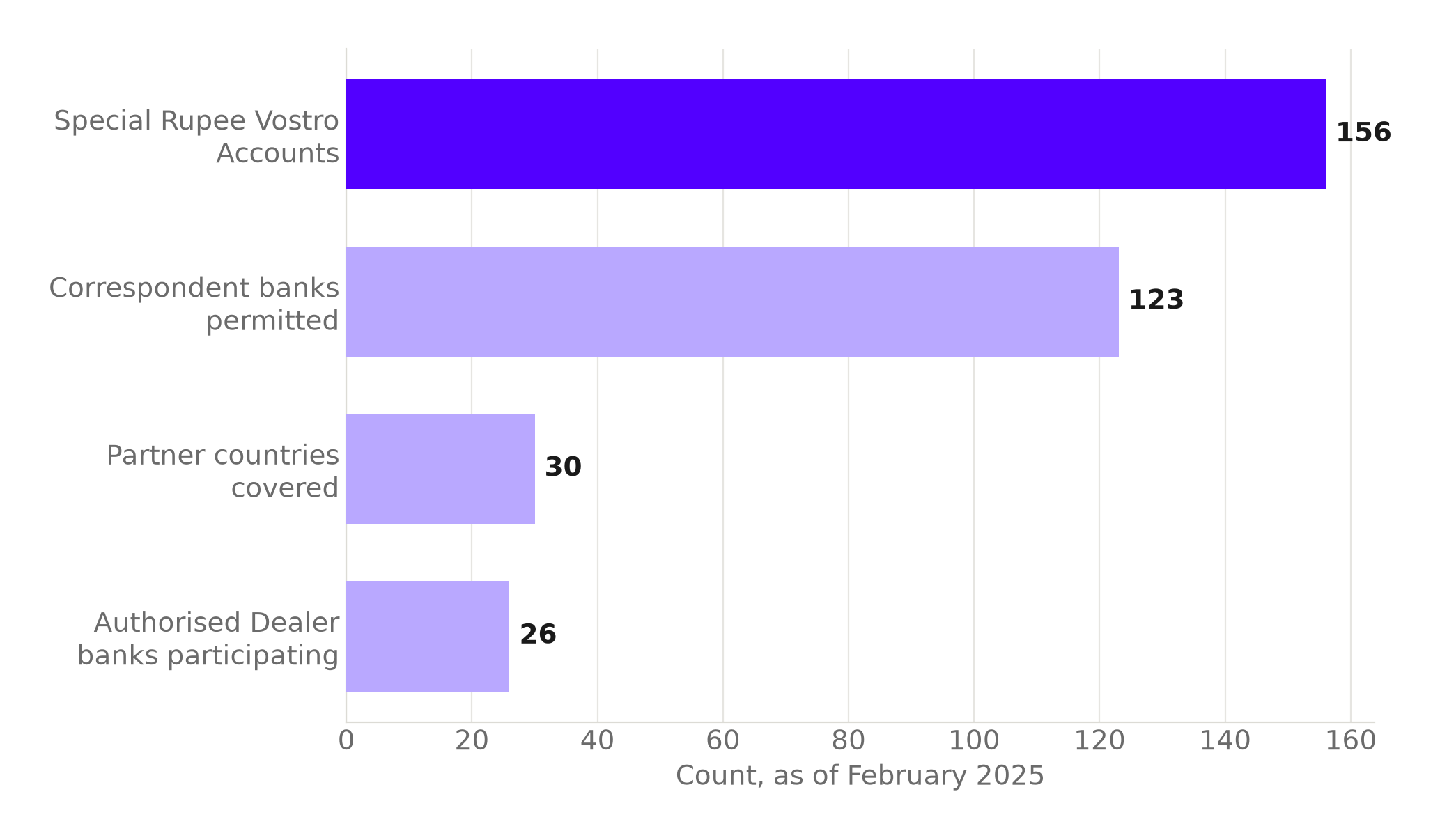
Strip out the backstop and the pledges, and look only at what already exists to settle trade in rupees rather than dollars. As of February 2025, the RBI had permitted 123 correspondent banks from 30 countries to open a combined 156 Special Rupee Vostro Accounts with 26 Authorised Dealer banks in India, Upstox's markets desk reports, citing RBI data. That is the entire rupee settlement network India has built with every trading partner on earth, not just Japan. It is smaller than the roster of Japanese firms that just showed up at one summit.
The money on the table
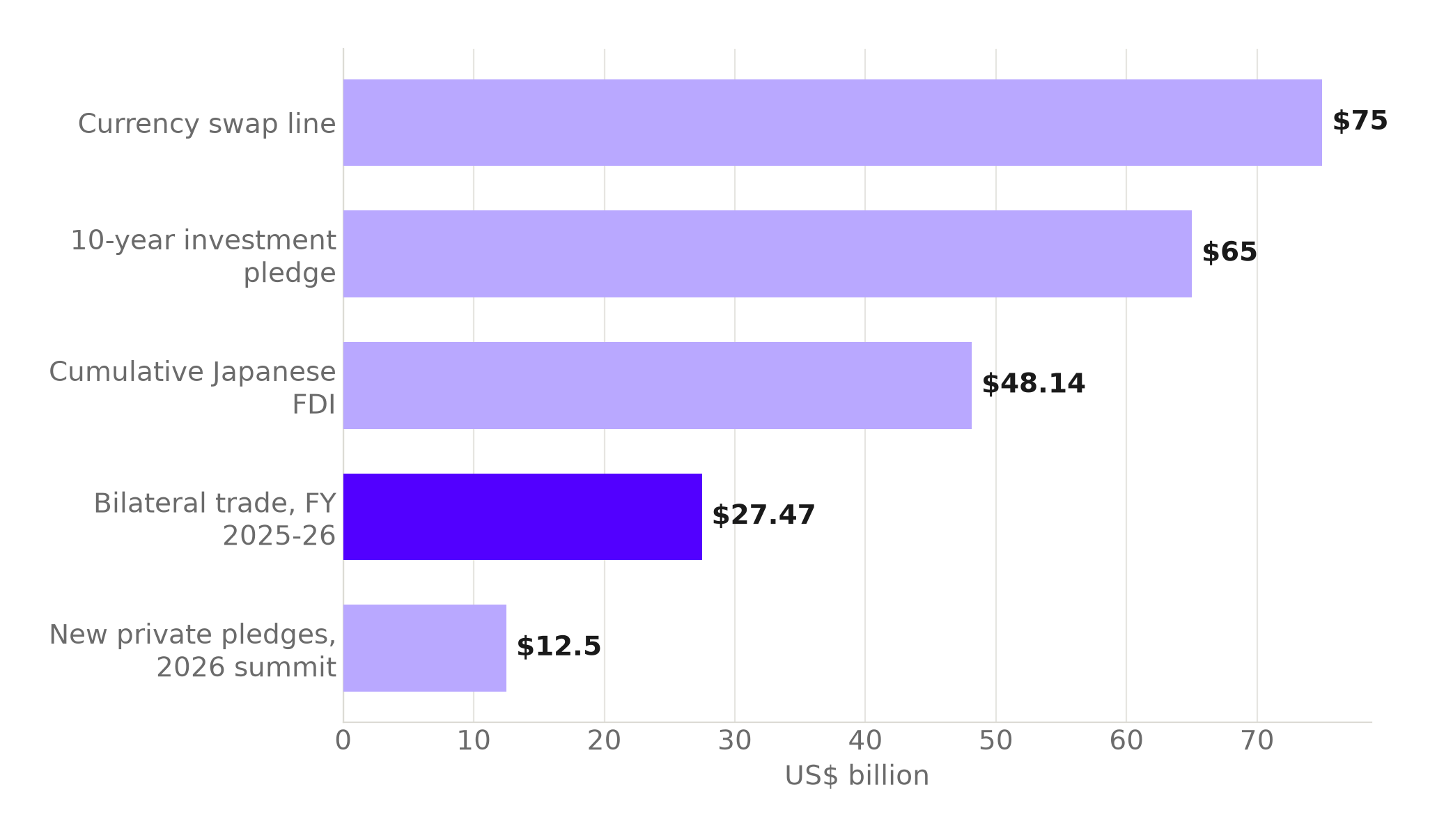
Rank every number attached to this relationship and a pattern appears: the biggest figures are backstops and promises, not trade that has already happened.
The currency swap line is the single largest number tied to this relationship, bigger than the investment pledge, the FDI stock, or a year of trade.
By our calculation, the $75 billion line is worth close to three times India and Japan's fiscal 2025-26 trade of $27.47 billion.
 Source: Bank of Japan, DD News, Embassy of India in Tokyo, ANI. Chart: The Signal.
A swap line is contingent money, drawn only in a crisis. A ten-year investment pledge is a target, not a completed transfer. Japan's own $65 billion estimate of that pledge converts a 10 trillion yen commitment into dollars, so it will move with the yen-dollar rate over the decade rather than sit fixed like a finished deal.
What actually crosses the border
Bilateral trade between India and Japan totaled $27.47 billion in fiscal year 2025-26, India's April-to-March accounting year, distinct from the calendar-year framing used for the swap line and the summit pledges, the Embassy of India in Tokyo reports. Japan sold India $21.43 billion of goods. India sold Japan just $6.04 billion, a gap of roughly $15.4 billion that flows one way, in dollars, every year. Cumulative Japanese foreign direct investment into India totals $48.14 billion since April 2000, making Japan the fifth-largest source of FDI into the country, the Embassy of India in Tokyo reports.
The money moving between India and Japan is several times larger than the network built to settle any of it in rupees.
| Dollar flows, India-Japan | Amount | Rupee settlement network, February 2025 | Count |
|---|---|---|---|
| Bilateral trade, FY 2025-26 | $27.47 billion | Special Rupee Vostro Accounts | 156 |
| Japan's exports to India | $21.43 billion | Correspondent banks permitted | 123 |
| Cumulative Japanese FDI, 2000 to 2026 | $48.14 billion | Partner countries covered | 30 |
| New private pledges, 2026 summit | $12.5 billion | Authorised Dealer banks participating | 26 |
Source: Embassy of India, Tokyo; Bank of Japan; ANI; Upstox, citing RBI data.
The plumbing built to carry it
The mechanism that would carry rupee-yen trade already has a name and an origin date. An RBI circular from July 2022 created the Special Rupee Vostro Account: a foreign correspondent bank opens an account at an Indian bank and settles trade payments directly in rupees, no dollar conversion required, an RBI circular states. Three years later, the entire buildout looks like this.
India's entire rupee settlement network, across all 30 partner countries, comes to just 156 accounts.
That is barely more than the 150-plus Japanese firms already sitting in the Japan-India Economic Forum.
 Source: Upstox, citing RBI data. Chart: The Signal.
Every bar in that chart covers all 30 of India's rupee-settlement partners combined, not Japan specifically. Nothing in the summit announcements points to a vostro or local-currency track built for Japan alone. The swap line and the investment pledges are the whole of what is public so far.
One precedent, three years old
The closest working model for what India and Japan are discussing already exists, and it shows how slow this kind of plumbing is to build. India and the UAE signed a memorandum of understanding on July 15, 2023, to promote bilateral use of the rupee and the dirham through a Local Currency Settlement System, the Reserve Bank of India reports. Three years on, that remains the only comparable bilateral rupee settlement framework India has built with a major trading partner. If Japan follows the same path, a working system is a multi-year project, not a summit outcome.
The honest objection
The case for skepticism has a real counter. India and Japan have just produced the highest-visibility signal of intent available this year: a renewed nine-figure swap line, a ten-year investment pledge, and a fresh $12.5 billion in private commitments. That kind of stacked political capital is exactly what preceded the UAE deal, and Japan is a far larger, more strategically aligned partner than the UAE was at the time. Settlement infrastructure also does not have to scale all at once. Banks can begin invoicing bilateral shipments in rupees and yen through existing correspondent relationships before any formal vostro network for Japan is announced, the same way the broader 156-account system grew one bank at a time rather than in a single rollout.
That case is real, but it does not close the gap. The UAE took years to move from a signed memorandum to a working system, and it is still the only one after three years despite comparable fanfare when it was signed. Nothing India and Japan announced this year is a vostro or local-currency-settlement memorandum. It is a swap line and money pledges, the same categories that already exist in other relationships without producing a second UAE-style system yet.
What to watch
The stakes are modest in the near term and larger over a decade. A working rupee-yen channel would cut dollar-conversion costs and dollar exposure on a $27.47 billion trade relationship, and it would give India a second working template for the local-currency settlement it wants to build more broadly. Watch for a bilateral memorandum with Japan that mirrors the UAE's Local Currency Settlement System, growth in the 156-account network beyond its current size, and any published data on how much India-Japan trade actually gets invoiced outside the dollar once a mechanism exists.
The swap line is signed. The invoices are still priced in dollars.
Reporting basis: figures on the currency swap line and its effective date are from the Bank of Japan. Trade, investment pledge, and FDI figures are from the Embassy of India in Tokyo and DD News. The rupee settlement network's account, bank, and country counts are from Upstox, citing RBI data. The Special Rupee Vostro Account mechanism and the India-UAE Local Currency Settlement System memorandum are from the Reserve Bank of India. The comparison of the swap line to India-Japan's annual trade is a calculation by The Signal, dividing the two reported figures.