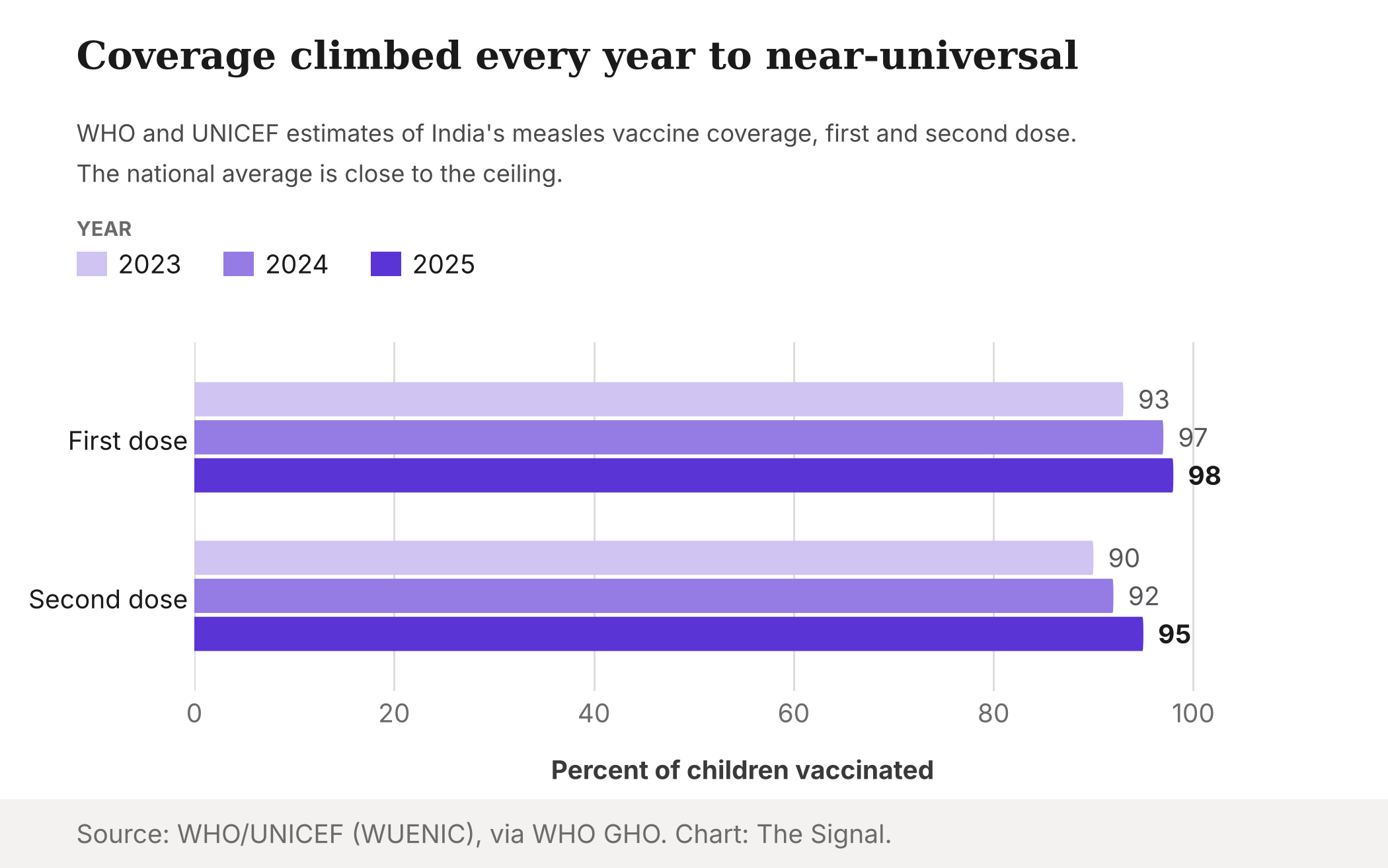
The global good news on measles arrived this week, and India's part of it has been on the books since July. WHO and UNICEF estimate that 98 percent of Indian children received a first dose of measles vaccine in 2025, up from 93 percent in 2023. Second-dose coverage reached 95 percent in 2025, up from 90 percent in 2023. UNICEF India reports that zero-dose children fell from 909,000 in 2024 to 679,000 in 2025, and that India has dropped out of the ten countries with the most children unvaccinated against measles. Globally, WHO estimates 72,000 measles deaths in 2025, a 91 percent fall since 2000.
The same week, a WHO official said India will miss its own finish line. Dr Santosh Gurung, WHO's technical officer for measles and rubella control, said India will not meet the 2026 regional elimination target and is instead making progress towards interrupting indigenous transmission by 2029, with verification in 2032.
The easy read is that India is in the last mile: coverage is nearly universal, so elimination is a matter of time. Strip one number out and that story dissolves.
The number that does not fit
In WHO provisional surveillance data, India recorded 26,607 measles cases between December 2025 and May 2026, second only to Bangladesh's 42,174 and ahead of Yemen's 14,521. For the whole of 2025, WHO's annual series shows India reported 17,995 cases. Six months of reports, overlapping 2025 only by December, already exceed the full year by roughly half.
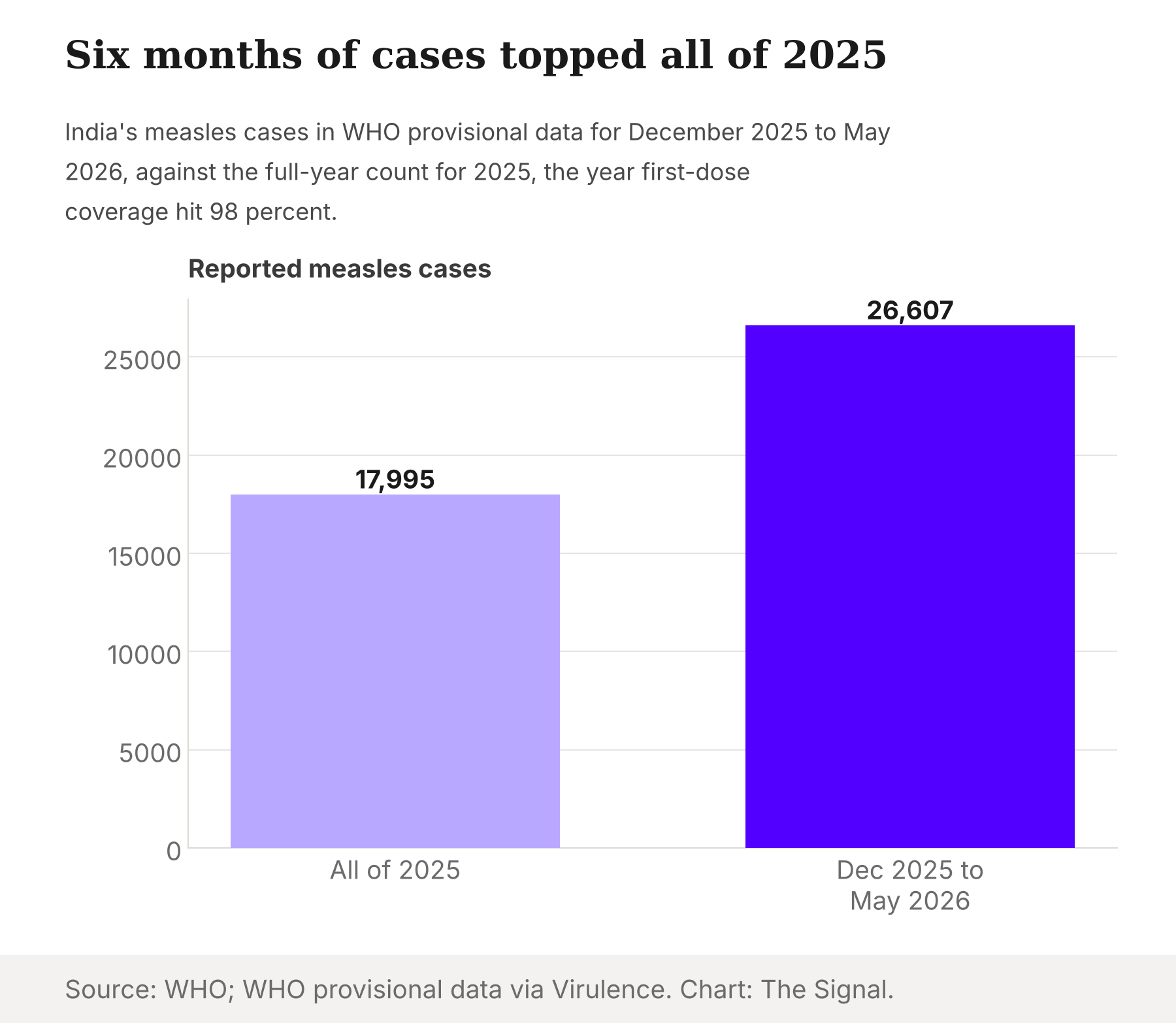
That is the paradox the headline figures hide. Coverage rose for three straight years. Cases did not keep falling with it.
The region with the best average has the most cases
India is not an outlier in its own neighbourhood. WHO says nearly half of the world's measles cases in 2025 occurred in the South-East Asia Region. UN News, reporting the WHO findings, adds the detail that matters: the region has the highest first-dose coverage of any WHO region, at 96 percent, which the report reads as a sign that high regional averages can mask disparities between and within countries.
A national average is the wrong unit for a disease like measles. WHO's fact sheet notes that one infected person can generate up to 18 secondary infections. A virus that efficient does not need a low national average. It needs one district, one migrant settlement, or one cohort of children who missed their second dose, clustered tightly enough to keep chains going.
Measured that way, the residual is not small. Even at 2025's levels, 2 percent of each birth cohort is missing a first dose and 5 percent a second, by the WHO/UNICEF estimates. UNICEF's own count of 679,000 zero-dose children in 2025 is a real improvement, and still a population larger than many cities, added fresh every year.
The swing is the signal
India's measles count does not glide down. It lurches. WHO's annual series shows 5,700 cases in 2021, 40,967 in 2022 and 65,150 in 2023 before a fall to 18,530 in 2024. An editorial in The Lancet Regional Health, Southeast Asia notes that India's measles incidence rose from 4 to 45.3 cases per million population between 2021 and 2023.
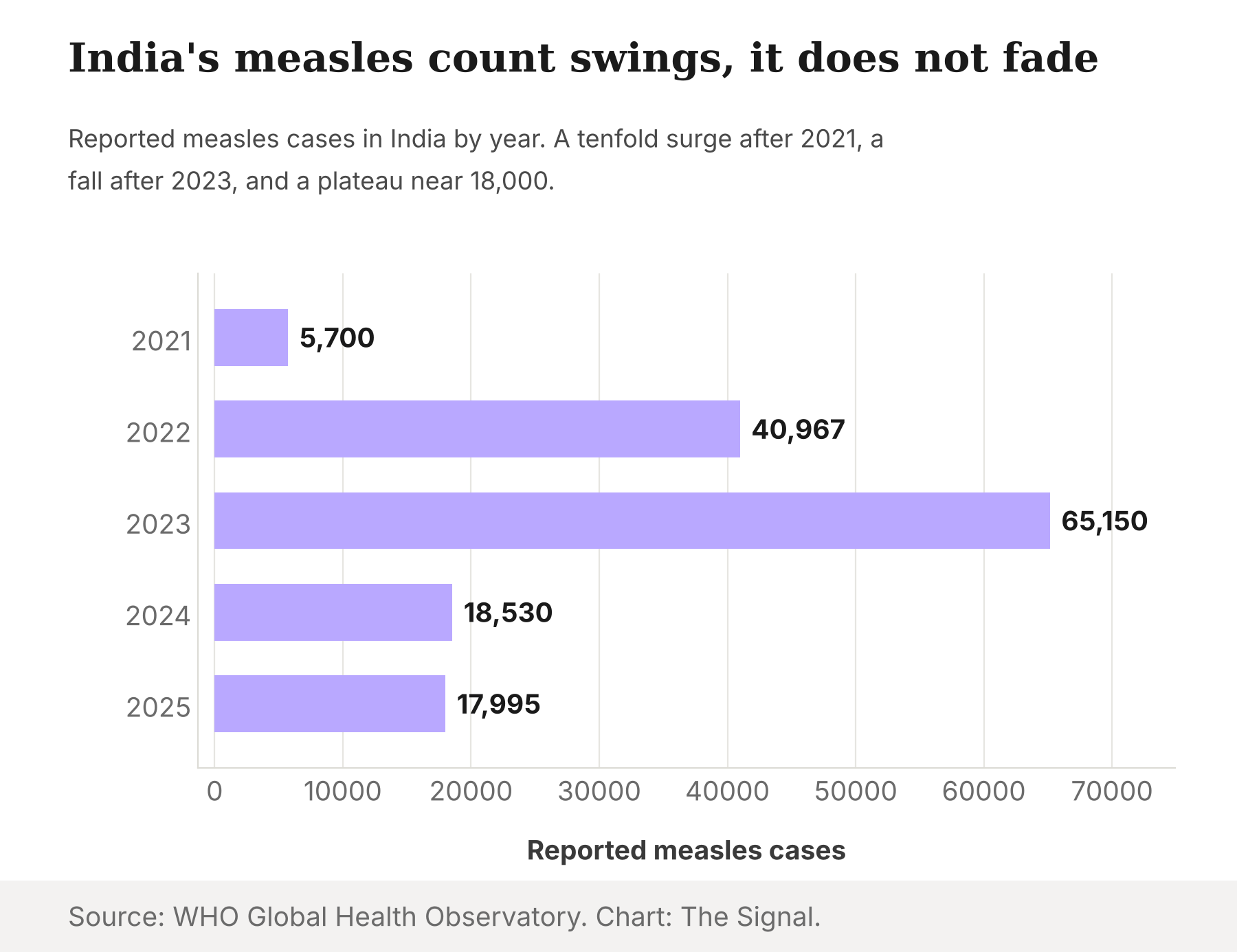
That shape is what an immunity gap looks like when it builds and then burns off. Pockets of unprotected children accumulate across a few birth cohorts. An outbreak sweeps through them. Cases fall because the susceptible pool has been used up, as much as because vaccination closed it. Then the pool refills. The 2026 provisional numbers suggest the refill is already under way.
This is why the WHO South-East Asia Regional Verification Commission, reviewing the region in July 2025, classified India as endemic for both measles and rubella and said it was concerned about meeting the 2026 timeline in the absence of any urgent accelerated action.
The deadline has moved before
2026 was itself a reset. ThePrint reported in April 2025 that India had targeted elimination for 2015, then 2020, then 2023, before moving to 2026. The same report cited government figures putting measles-rubella coverage at 93.7 percent for the first dose in 2024–25 and 92.2 percent for the second. Those are close to, but not the same as, the WHO/UNICEF estimates for calendar 2025, which use a different period and method.
Neither number can show where the missing children are. The CDC's MMWR review of India's programme through 2021 warned that India's coverage estimates are based on administrative data and might be inaccurate. It also found that surveillance sensitivity lagged: the national discard rate for suspected cases that tested negative was 1.81 per 100,000 in 2021, below the target of 2, and only 42 percent of districts met that target. Those figures are five years old. They are the latest district-level surveillance measures in the public record we could verify, and that gap is itself telling.
The honest objection
The strongest case against this reading is that the progress is real and fast. First-dose coverage rose five points in two years. Zero-dose children fell by roughly a quarter in a single year. Reported cases in 2025 were about 72 percent below the 2023 peak. On that view, the 2026 provisional count is an echo of earlier gaps, and the 2029 transmission target is the credible one.
The wider picture supports patience too. Elimination is fragile everywhere. 92 countries are now verified as measles-free, down from 95 at the end of 2025, after the United States, Mexico and Bolivia lost their status this month. India missing a regional deadline is not unusual.
All of that is fair. None of it rescues the national average as a guide. A rising caseload alongside rising coverage means the coverage figure is measuring the wrong thing for elimination. The objection argues that 2029 is achievable. It does not argue that 98 percent tells you whether India is on track for it.
The Signal
India's measles programme has won the argument it used to have, about reach. It has not yet won the one that decides elimination, about where the last few percent live and whether surveillance can find them before the virus does. The national coverage number is close to its ceiling and can no longer move much. The case count can, and in the six months to May 2026 it moved the wrong way. The next WHO/UNICEF coverage estimates come in July 2027. The figure worth watching before then is whether India's full-year 2026 case count lands above 2025's. If it does, 2029 becomes the fourth deadline in a row that the average said India would meet.
Reporting basis: India's coverage estimates for 2023 to 2025 are the WHO/UNICEF Estimates of National Immunization Coverage, read from WHO's Global Health Observatory, and India's annual reported measles cases for 2021 to 2025 are from the same WHO database. The zero-dose figures are per UNICEF India's July 2026 release of those estimates. The December 2025 to May 2026 case count is WHO provisional surveillance data, as reported in an August 2026 editorial in the journal Virulence. Global deaths, the South-East Asia share of cases and the region's 96 percent first-dose coverage come from WHO's 27 November 2026 measles report, the last two as relayed by UN News, and are therefore one origin. The 2029 and 2032 timeline rests on a single on-record statement by a WHO technical officer, as reported by Daijiworld. India's endemic classification is from the WHO South-East Asia Regional Verification Commission's 2025 meeting report. The earlier missed deadlines and government coverage figures are per ThePrint. The 2021 surveillance indicators are from a CDC MMWR report, and the 2021 to 2023 incidence change from an editorial in The Lancet Regional Health, Southeast Asia. The comparison of six months of 2026 cases with the 2025 total, the share of children missing each dose, and the percentage changes in coverage, zero-dose children and cases are The Signal's calculations from those figures.