The obvious way to read Thursday's Supreme Court ruling is as a defeat for the packaged-food industry. On November 26, 2026, a bench of Justices JB Pardiwala and K Vinod Chandran ordered a separate red hexagon for each nutrient of concern, with the words HIGH FAT, HIGH SUGAR or HIGH SALT, instead of the single combined hexagon the regulator had proposed. The firms that opposed warnings lost. That reading is true, and it misses the more useful point.
The companies on the losing side already know how to do this. Outlook Business has reported that many of the Maggi packets sold in Britain are made in India and carry red front-of-pack labels warning of high salt. The factory, the recipe family and the printing line exist. What has been missing is an Indian rule that asks for the same label at home.
So the court has not invented a new burden. It has asked firms to bring home a practice they already run elsewhere. That moves the fight from whether to label to where the thresholds sit.
What the court actually changed
The ruling rewrites three parts of what FSSAI put forward in August.
First, the trigger. FSSAI's plan, as LiveLaw reported from its affidavit, was to show a red hexagon only on products high in two or more of added saturated fat, added sugar and salt in its first phase, reaching single-nutrient warnings only in a second phase. A crisp high only in salt, or a drink high only in sugar, could have passed phase one with a clean front.
Second, the measure. The court told FSSAI to treat total sugars and saturated fat rather than added sugar and added fat as the nutrients of concern alongside salt, The South First reported. Total sugar is printed on most nutrition panels today, so it is easier to police.
Third, the size. Each hexagon must take up 4 to 5 percent of the principal display panel, according to The Federal, and the case returns in ten weeks for a progress report.
| Design choice | FSSAI proposal, August 2026 | Supreme Court, November 26, 2026 |
|---|---|---|
| When a warning appears | Two or more nutrients high (phase one) | Each nutrient that is high gets its own |
| Sugar and fat measure | Added sugar, added saturated fat | Total sugars, saturated fat |
| Label form | One combined hexagon | Separate hexagon per nutrient |
| Label size | Not fixed in the reported proposal | 4 to 5 percent of the front panel |
Source: LiveLaw on the FSSAI affidavit; LiveLaw on the judgment.
The double standard is the argument
The court went further than design. Reuters reported that the bench urged multinationals to apply the same standards across markets, and said of firms that resist warnings in India while using them elsewhere: "If true, such double standards are deeply troubling." The same report said the ruling moves India closer to Chile and Mexico, which run some of the strictest regimes.
The labels are not the only difference. The Outlook Business report found that a can of Fanta in London has 63 calories while the Indian version has around three times as much sugar, and that Nestle has used interpretive labels in Britain since 2013. A firm that prints a red salt warning on noodles shipped from India to Britain cannot easily argue that the same warning is unworkable on noodles sold in India.
The market at stake is large and growing. Reuters, citing IMARC Group estimates, reported that India's packaged food market grew to $137.25 billion in 2026 from $129.18 billion in 2025, a rise of about 6 percent in a year.
What warnings did where they already exist
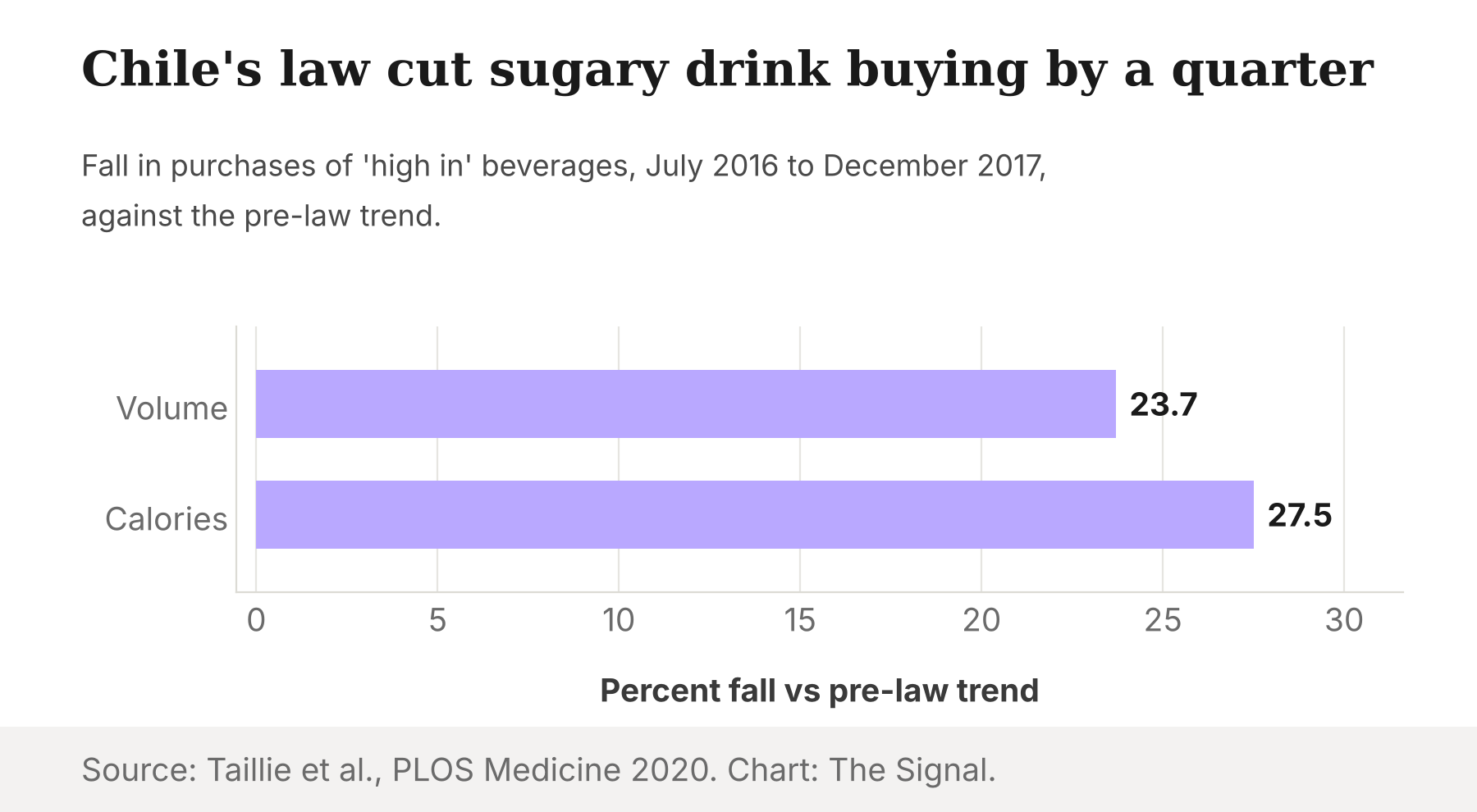
Chile is the usual reference, for good reason. A 2020 PLOS Medicine study found that after Chile's law took effect, the volume of "high in" beverage purchases fell 22.8 mL per person per day, or 23.7 percent, against the pre-law trend, with calories from those drinks down 27.5 percent over July 2016 to December 2017.
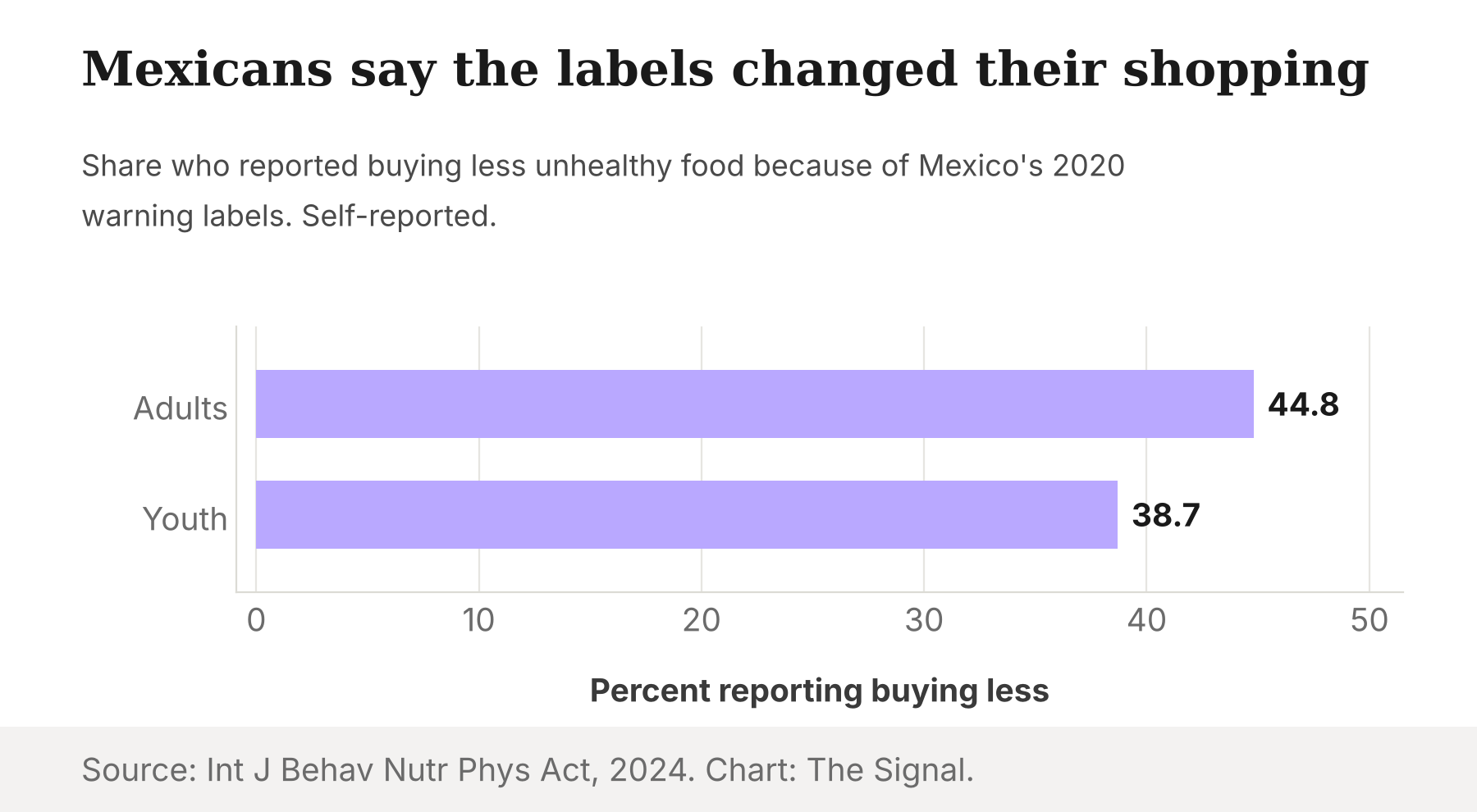
Mexico adopted warning labels in 2020. A 2024 study in the International Journal of Behavioral Nutrition and Physical Activity found that 44.8 percent of adults and 38.7 percent of youth reported buying less of unhealthy food categories because of the labels. That is what people say they did, not measured sales, but it points the same way as Chile.
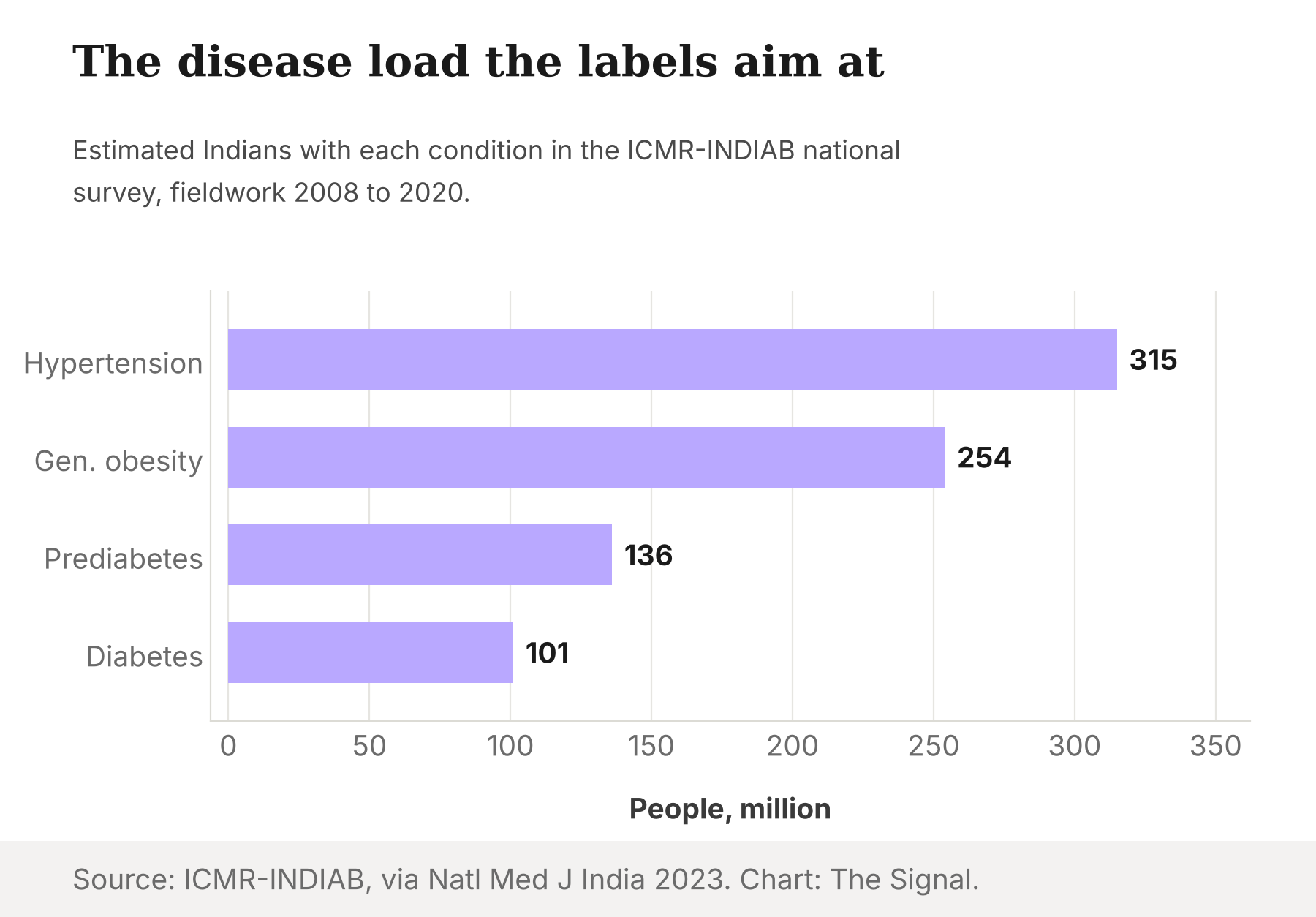
India's reason to care is the scale of diet-linked disease. The ICMR-INDIAB national survey, summarised in the National Medical Journal of India, estimates that 315 million Indians have hypertension, alongside 101 million with diabetes, 136 million with prediabetes and 254 million with generalised obesity. That fieldwork ran from 2008 to 2020, so these are the latest national estimates rather than a 2026 count.
The honest objection
The strongest case against reading too much into Chile is in the Chile study itself. It measures the whole policy package, which also restricted marketing to children and sales in schools, so the label cannot be credited alone. The authors say plainly that an observational design cannot prove causality. Mexico's evidence is self-reported. A reasonable skeptic can say India is borrowing a result that was never isolated.
There is a design objection too. If thresholds are set too low, almost every biscuit, namkeen and sweet carries three hexagons, and warnings that sit on everything stop meaning anything. The court seems alive to this. It asked FSSAI for evidence-based thresholds that are neither too low nor too high, according to LiveLaw's report.
Neither objection rescues the industry's main argument, though. The case against labels has been that they are unworkable or unproven. Firms that already print them on Indian-made goods for British shelves have answered the first half themselves. The second half, effect size, is a reason to set thresholds carefully, not a reason to skip the label.
The Signal
The ruling settles the format: one hexagon per problem nutrient, measured on total sugar and saturated fat, large enough to see. It does not settle the numbers. The next ten weeks are about thresholds, and that is where lobbying will move, because a cutoff a few grams higher can take a best-selling product off the warning list without anyone arguing against labels at all. Companies get one year to adjust once the law is final, Reuters reported. Watch whether FSSAI's cutoffs look like the ones these brands already meet in Britain, Chile and Mexico. If they do, India gets the label its own factories already print for export.
Reporting basis: The court's directions rest on one origin, the Supreme Court's November 26, 2026 judgment in 3S and Our Health Society vs Union of India, as reported by LiveLaw, The South First and The Federal; the judgment text itself was not reviewed, so details follow those reports. FSSAI's August proposal is per LiveLaw, reporting the regulator's affidavit. The double-standards remark, the one-year adjustment period and the Chile and Mexico comparison are per Reuters, via Khaleej Times; the Maggi, Fanta and Nestle comparisons are per Outlook Business; the packaged food market size is IMARC Group's estimate, per Reuters via The Star. The Chile figures come from Taillie et al. in PLOS Medicine (2020), the Mexico figures from a 2024 study in the International Journal of Behavioral Nutrition and Physical Activity, and the disease estimates from the ICMR-INDIAB study as summarised in the National Medical Journal of India. That is eight independent origins, with Reuters counted once although two outlets carried it. The roughly 6 percent market growth figure is The Signal's calculation from those figures.