The HPV campaign has produced the kind of number health ministries hope for. The Union Health Ministry said on 21 November that more than 1 crore doses of the HPV vaccine were given in less than nine months, reaching nearly 87% of an annual target cohort of about 1.2 crore 14-year-old girls. The count is precise down to the state: six states report full coverage, and Uttar Pradesh alone has vaccinated more than 29.33 lakh girls. The read writes itself: India has finally moved on cervical cancer.
It is worth slowing down on that. The vaccine protects girls who turned 14 in 2026. They reach 30, the age at which India's screening programme starts looking for them, in 2042. Every woman who will develop cervical cancer before then is outside the vaccine's reach. Her protection is the screening programme, and that programme cannot agree with itself about how many women it has screened.
One programme, three numbers
In July 2025, the Health Ministry told the Lok Sabha that 10.18 crore women had been screened for cervical cancer out of an eligible 25.42 crore women aged 30 and above, as of 20 July 2025. In March 2026, the same ministry gave the same house a new figure from the same portal: 8,73,17,364 women screened as of February 2026. A running total that only counts women who have been screened cannot shrink. This one fell by 1.45 crore in seven months.
A third reply sits between them. In December 2025, the minister gave year-wise counts: 21,11,011 women screened in 2020-21, rising to 1,75,48,256 in 2024-25 and 1,27,23,558 in 2025-26 up to 30 November. Add up all six periods and the total is 6.86 crore, below both cumulative figures.
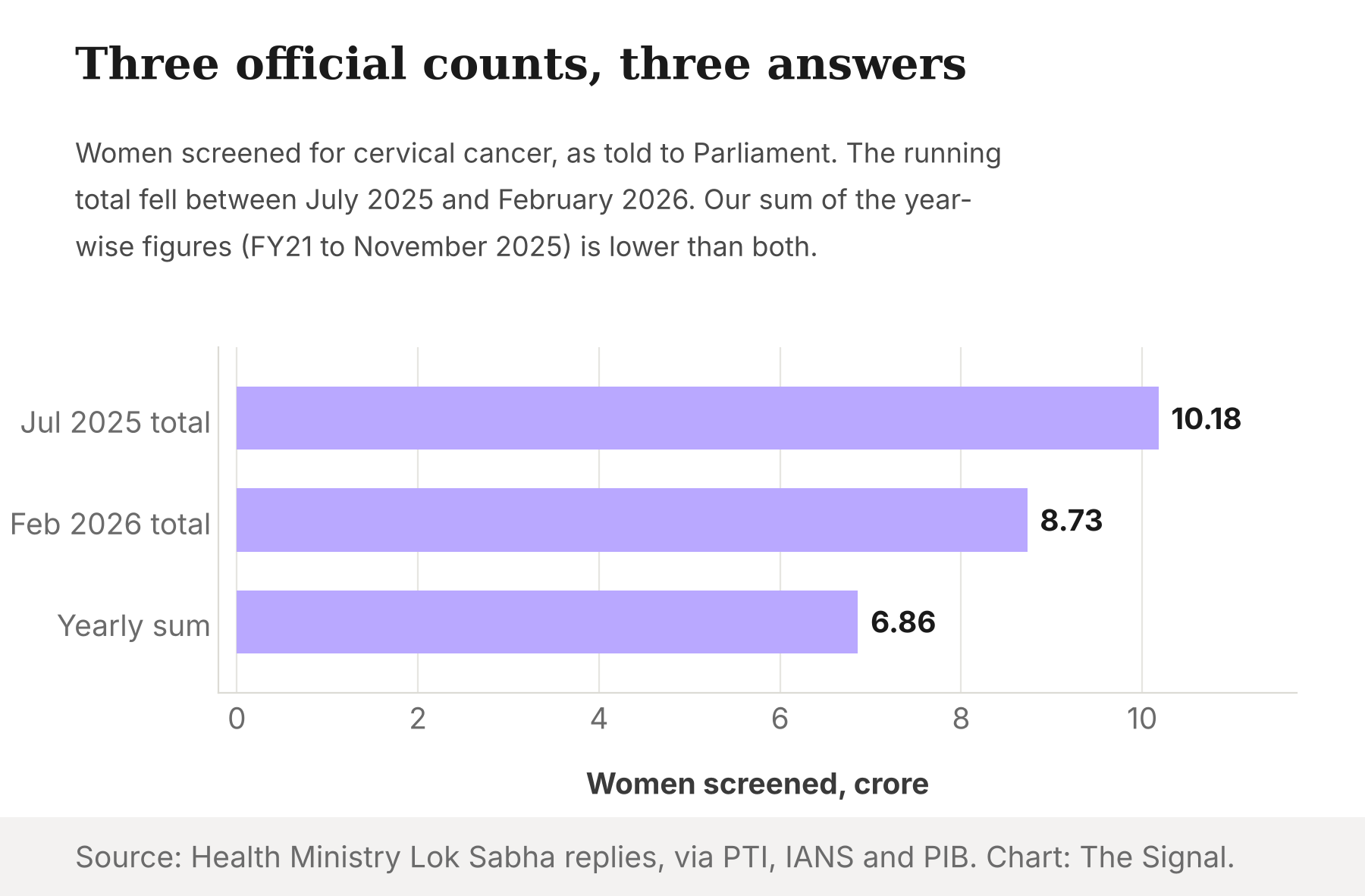
There may be benign explanations, such as duplicate records removed from the portal, or entries from before 2020-21 that the year-wise series leaves out. Neither the March nor the December reply offers one. What the record shows is that the government's best count of women screened moved by 1.45 crore with no stated reason, while its count of girls vaccinated is reported to two decimal places by state.
The survey that never matched the portal
Household surveys disagree with all of them. The fifth National Family Health Survey, run in 2019-21, found that 1.97% of women aged 30 to 49 had ever been screened for cervical cancer, according to a 2023 analysis in BMC Women's Health. The state range ran from 0.2% in West Bengal and Assam to 10.1% in Tamil Nadu.
That survey predates most of the portal's growth, so the two are not a like-for-like test. But the portal's February 2026 figure of 8.73 crore, set against 25.42 crore eligible women, implies about 34% screened. A rise from 2% to 34% in about five years would be a remarkable expansion. It could be real. Without a newer survey, nothing independent confirms it.
The same women are screened for breast cancer nearly twice as often as for cervical cancer.
| Screening on the NP-NCD portal, as of February 2026 | Screened | Diagnosed |
|---|---|---|
| Oral cancer | 34,71,30,399 | 2,14,208 |
| Breast cancer | 16,24,45,340 | 77,107 |
| Cervical cancer | 8,73,17,364 | 93,062 |
Source: Ministry of Health and Family Welfare, Lok Sabha reply via PIB.
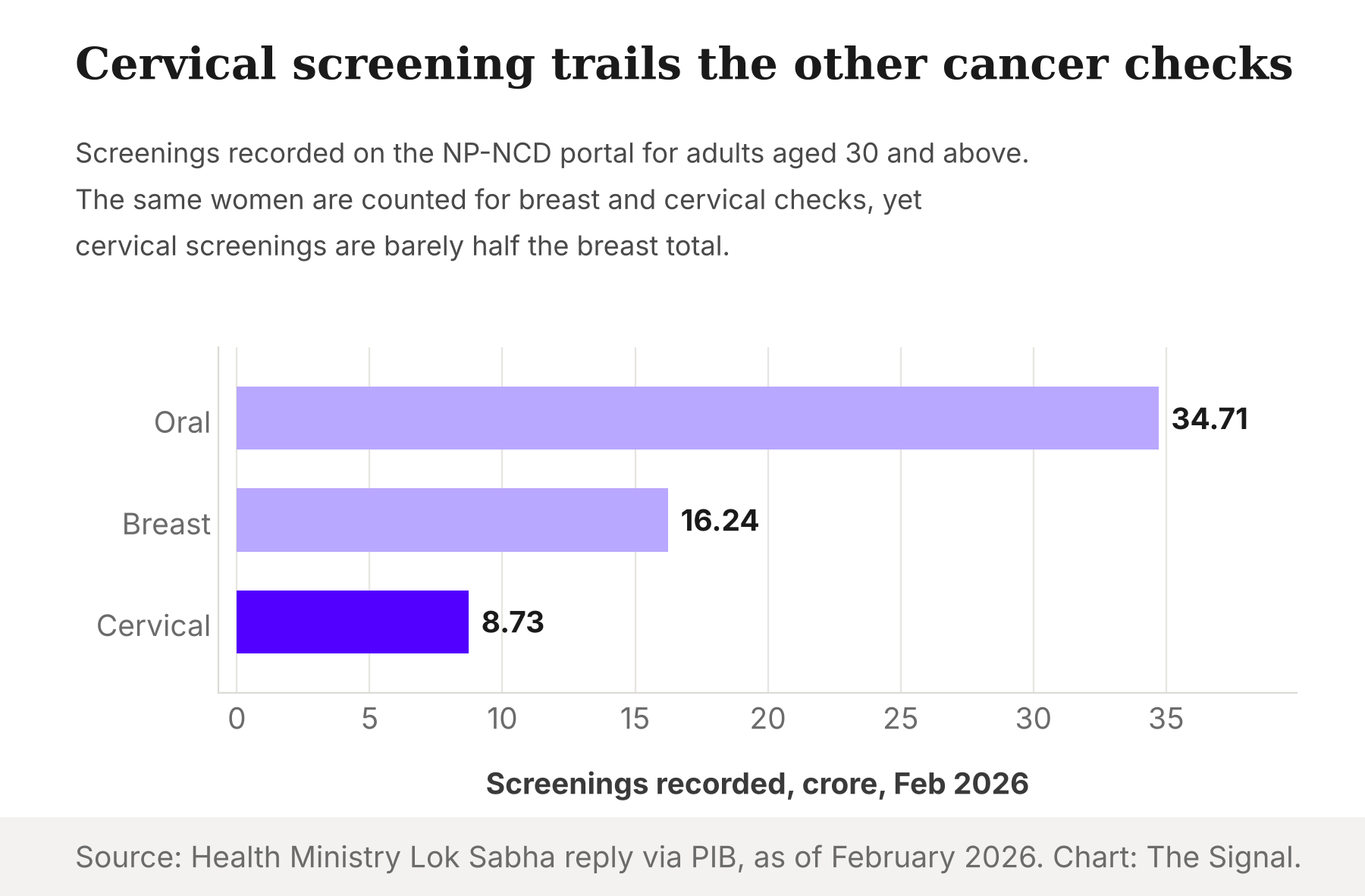
The cervical figure is the weakest of the three cancer checks on the ministry's own table, even though breast and cervical screening target the same women aged 30 and above. The gap points to the check itself, not to who turns up.
Screening at this pace never catches up
The yearly series shows the scale of the shortfall. Screenings peaked at 1,86,84,268 in 2022-23 and were 1,75,48,256 in 2024-25. Against 25.42 crore eligible women, the 2024-25 pace would take more than 14 years to reach each woman once.
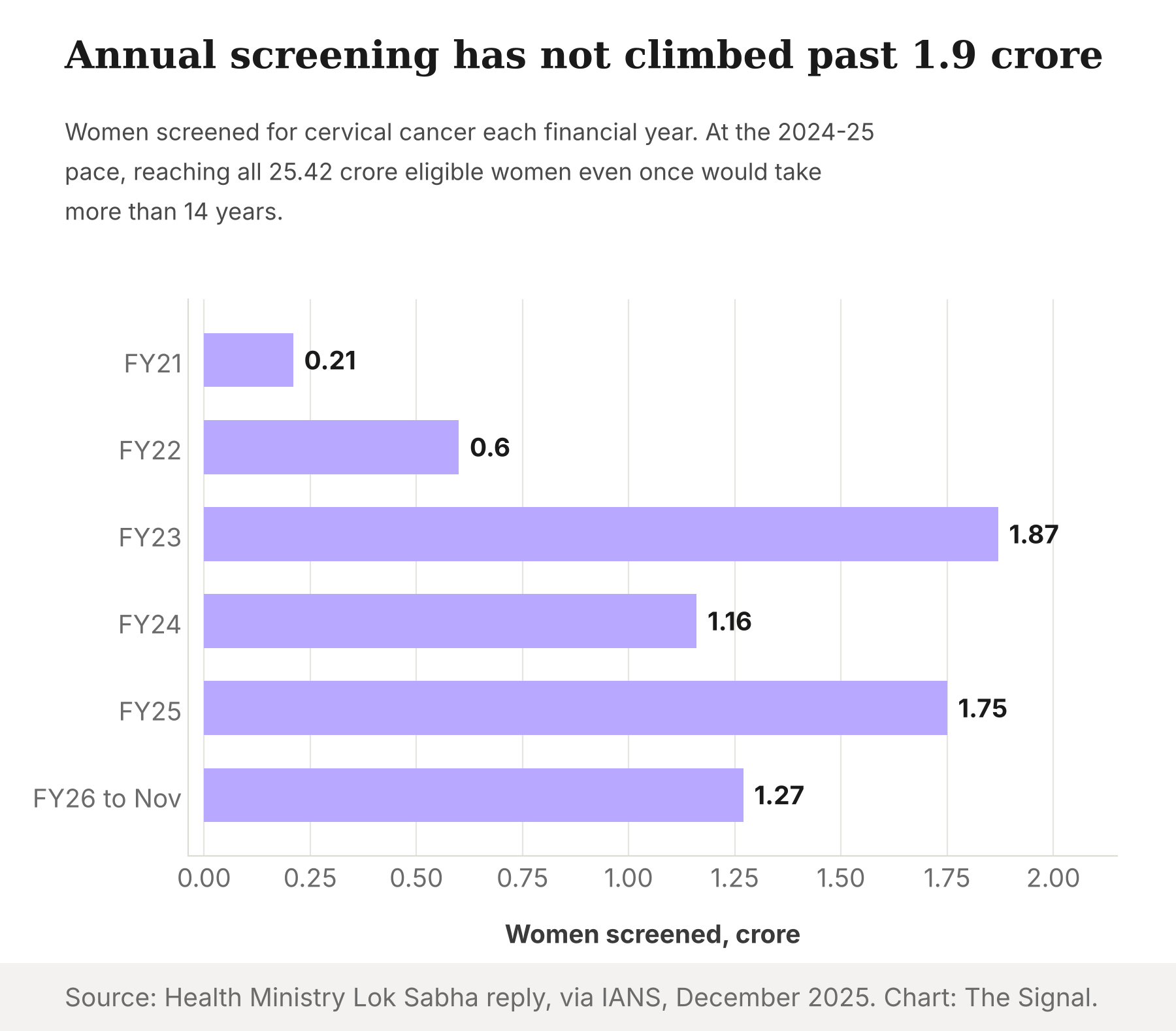
The WHO's elimination strategy asks for 70% of women screened by ages 35 and 45, alongside 90% of girls vaccinated by 15. For a single year's cohort of girls, India is near the first target. It has no reliable measure of the second.
What the screening finds is thin as well. The portal records 93,062 cervical cancers diagnosed across all its screening to February 2026. The WHO's cancer agency estimates 79,360 new cervical cancer cases in India in 2024 alone. Years of screening have found little more than one year's new cases.
Even the death toll is uncertain
The burden estimates are moving too. At the campaign's launch in February 2026, the government cited GLOBOCAN 2022: over 1,20,000 new cases and nearly 80,000 deaths a year. The agency's 2024 edition puts deaths at 36,319, and ICMR's cancer registry programme estimated 35,691 deaths in 2023. One official document puts the annual toll at more than double the newer estimates. A programme cannot set screening targets well when it does not know whether it is preventing 36,000 deaths a year or 80,000.
The honest objection
The strongest case against this reading is that the vaccine is the better investment, and the government is right to lead with it. A single dose of Gardasil-4 gives 93 to 100% effectiveness against the HPV types that cause cervical cancer, according to the launch backgrounder. It is a single visit at 14. Screening needs trained staff, repeat visits and follow-up treatment for every positive result. Counting errors in a portal built for 25 crore women are a back-office problem, not proof that women are going unscreened.
That case is right about the vaccine and wrong about the timing. The vaccine cannot reach a woman who is 35 today. For the next two decades, India's cervical cancer deaths will be decided by screening. And a programme that cannot say within 1.45 crore how many women it has screened cannot tell which districts are missing them. The vaccine data shows the opposite approach working: Tamil Nadu led NFHS-5 on screening at 10.1%, yet sits at 76.12% HPV coverage, below Bihar and Uttar Pradesh. Because the campaign is counted precisely, that lag is visible and can be fixed.
The Signal
The HPV campaign proves India can run a precise, state-by-state count of a cancer intervention when it wants to. The screening programme has had the portal for years and still reports a running total that went down. The vaccine protects women who will turn 30 from 2042. The women at risk before then depend on the programme India measures worst. Watch the next parliamentary reply on cervical screening. If it reconciles the 10.18 crore and the 8.73 crore, the programme is being managed. If it prints a third unexplained number, it is only being reported. The girls are counted. The women still have to be found.
Reporting basis: the HPV dose count, the 87% cohort coverage and the state-wise figures are from the Ministry of Health and Family Welfare's 21 November 2026 release, via PIB; the launch details, the single-dose effectiveness and the GLOBOCAN 2022 burden figures are from the ministry's February 2026 backgrounder, via PIB. The February 2026 screening and diagnosis counts for cervical, breast and oral cancer are from a ministry Lok Sabha reply published by PIB. The July 2025 cumulative screening figure and the 25.42 crore eligible population are per PTI's report of a Lok Sabha reply, and the year-wise screening counts and ICMR-NCRP death estimates are per IANS's report of a December 2025 Lok Sabha reply; the original parliamentary documents were not checked. The 2024 case and death estimates are from the International Agency for Research on Cancer's GLOBOCAN 2024 India fact sheet, the same body behind the 2022 figures the government cited, so the two editions are one origin. The NFHS-5 screening rates are from a single 2023 BMC Women's Health analysis of the survey. The WHO targets are from the WHO cervical cancer fact sheet. The 1.45 crore fall, the 6.86 crore year-wise total, the 34% implied coverage, the 14-year pace, the breast-to-cervical ratio and the 2042 date are The Signal's calculations from those figures.