Early this month, a Hyderabad paediatrician and a Dutch drug-access charity announced that seven Indian children with Allan-Herndon-Dudley syndrome (AHDS), a genetic disorder that stops thyroid hormone reaching the brain, would get their medicine at a fraction of its price. One mother told The South First she had spent ₹12 lakh to ₹13 lakh for a single month of her son's treatment. The coverage read it as a story of generosity, a rare win for a few families.
It is worth slowing down on that. The same molecule, in the same year, has two prices that differ by more than a hundred times. India's rare disease policy, and almost every court fight over it, has been an argument about how much money to put on the table per patient. The tiratricol case shows the bigger variable is what that money is spent against.
One cap, two prices
Under the National Policy for Rare Diseases, financial support of up to ₹50 lakh per patient is provided for treatment at notified Centres of Excellence, the Health Ministry said in August 2024. That is a fixed rupee number. What it buys depends entirely on the price of the drug.
For tiratricol, the price is not one number. At the German price of €178.33 a tablet, a year of treatment costs about ₹4 crore, according to the Pharmaceutical Accountability Foundation (PAF), while a version compounded by a Dutch pharmacy brings it down to roughly ₹2.5 lakh a year per child, as ThePrint reported on November 5. The South First puts the commercial cost higher still, at an estimated €441,000, or about ₹4.68 crore, per patient a year.
Put the cap against those two prices. At ₹4 crore a year, ₹50 lakh pays for one-eighth of a year: about six weeks of a lifelong treatment. At ₹2.5 lakh a year, the same ₹50 lakh pays for 20 years.
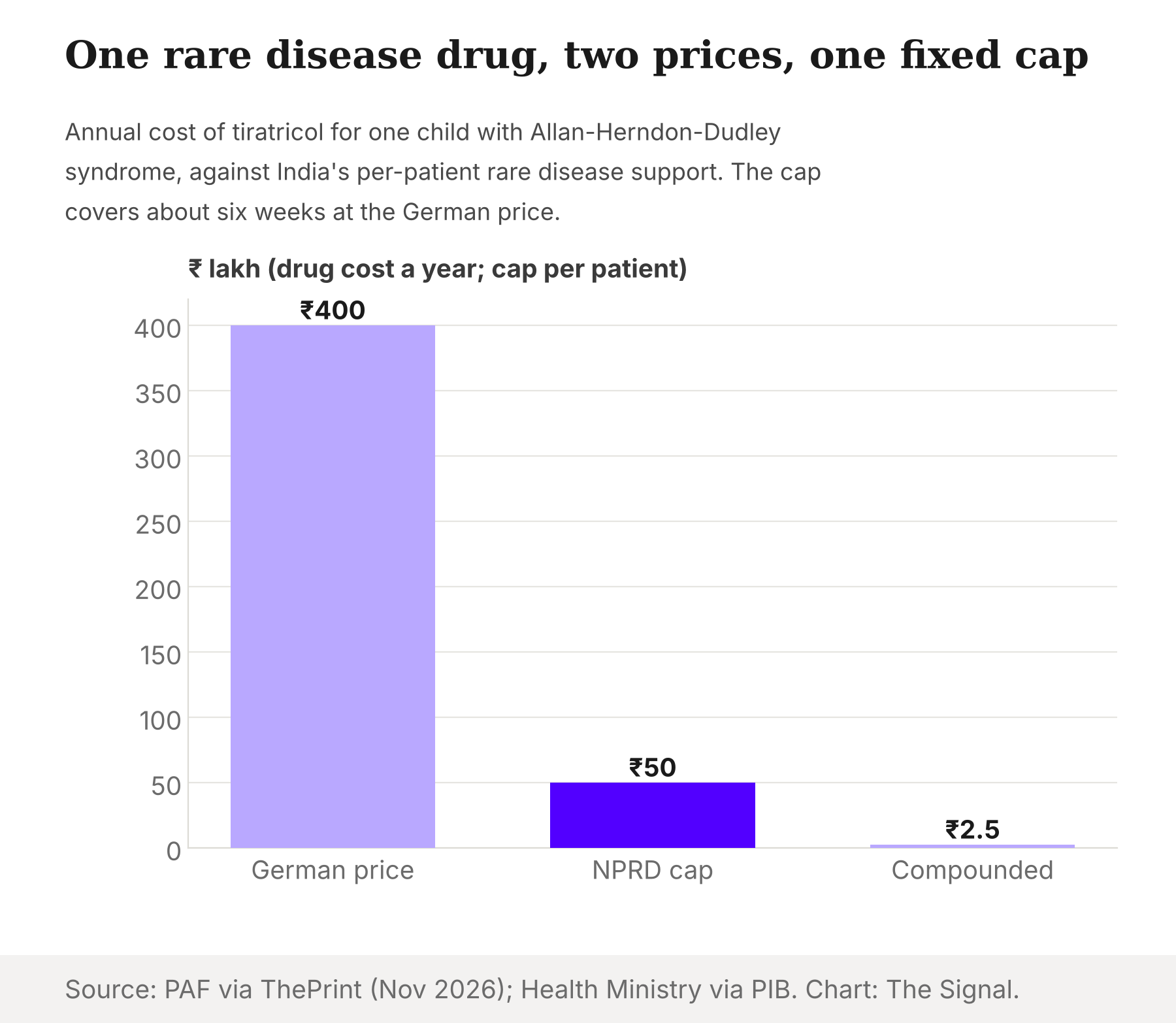
The policy did not change between those two scenarios. Only the supplier did.
The price is a choice, not a law of chemistry
Tiratricol is not a new invention. The European Medicines Agency describes Emcitate, the branded version, as a hybrid of Téatrois, which has been authorised in France since 1974. Emcitate was designated an orphan medicine in November 2017 and received EU-wide marketing authorisation on 12 February 2025.
What changed was the price. PAF told ThePrint that tiratricol rose from €0.35 a tablet in France in 2017 to €178.33 in Germany in 2026. That is a roughly 510-fold increase for a molecule that has been on a French market for five decades. The orphan designation, which rewards companies for developing drugs for small patient groups, turned an old, cheap compound into a premium product.
India has seen this before, and it has seen the price fall back just as hard. In November 2023, Health Ministry officials said domestically made nitisinone, used for Tyrosinemia Type 1, cost ₹2.5 lakh a year against ₹2.2 crore when imported, and trientine for Wilson's disease fell from ₹2.2 crore to ₹2.2 lakh, as PTI reported.
Three drugs, the same pattern: a branded price near ₹2 crore to ₹4 crore a year, an alternative near ₹2.5 lakh.
| Drug | Condition | Imported or branded, a year | Domestic or compounded, a year |
|---|---|---|---|
| Nitisinone | Tyrosinemia Type 1 | ₹2.2 crore | ₹2.5 lakh |
| Trientine | Wilson's disease | ₹2.2 crore | ₹2.2 lakh |
| Tiratricol | Allan-Herndon-Dudley syndrome | about ₹4 crore | about ₹2.5 lakh |
Source: Union Health Ministry, via PTI (November 2023); PAF, via ThePrint (November 2026).
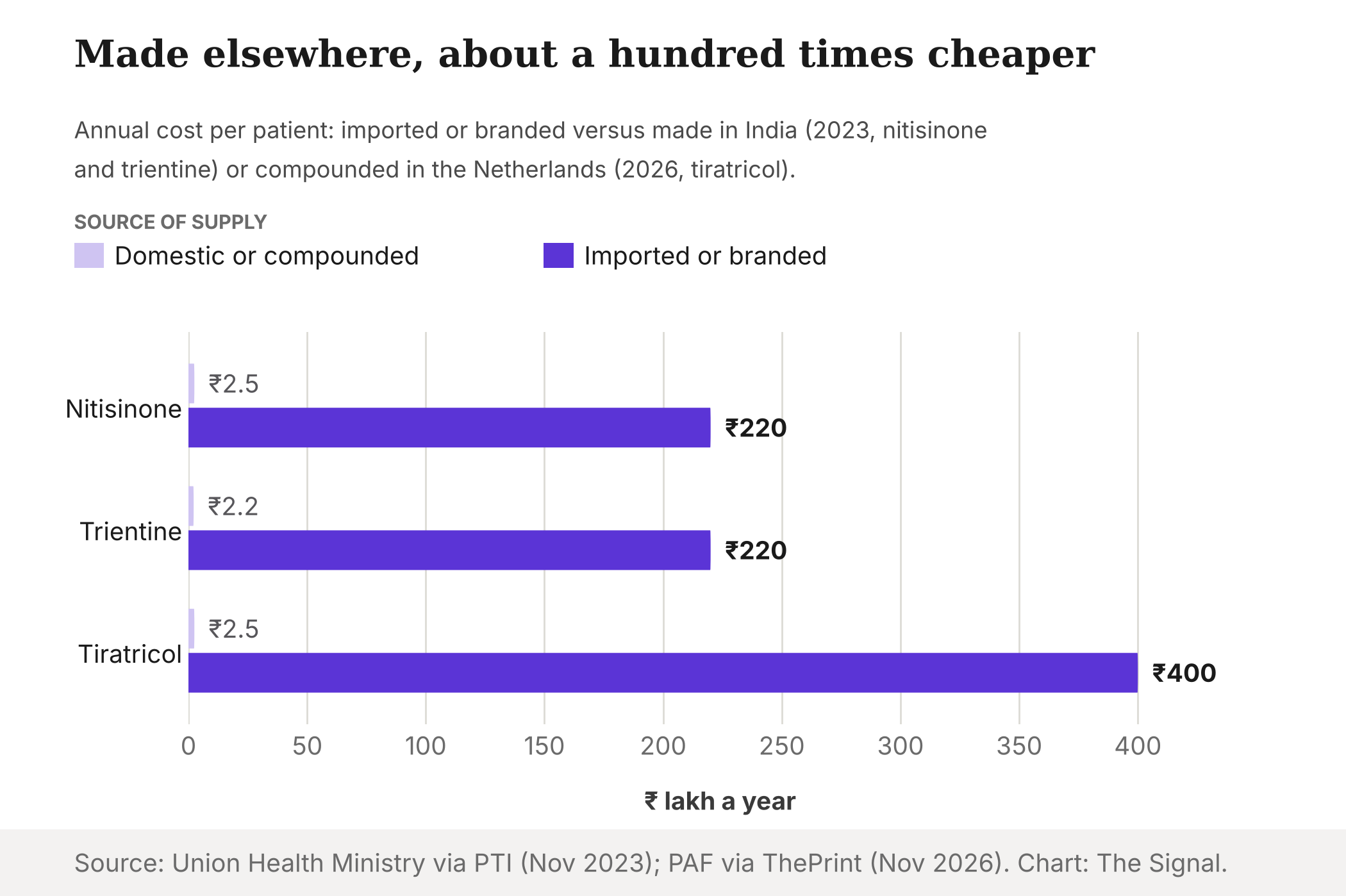
Each of those cuts came from someone else making the molecule. None of them came from raising the cap.
The budget, priced two ways
The same arithmetic applies to the whole programme. About ₹26,400 lakh, or ₹264 crore, was allocated to Centres of Excellence from 2021-22 to March 2025, the government told Parliament in February 2026, as PTI reported. The number of those centres has grown from 8 to 15, the Union Health Secretary said in May 2026.
Spent on tiratricol at the German price, ₹264 crore would cover 66 child-years of treatment. At the compounded price, it would cover more than 10,000. What sets the programme's reach is the budget divided by the price, and of those two terms it is the price that moves a hundredfold.
That reframes the long legal fight over money. In October 2024 the Delhi High Court directed the Union to establish a national fund for rare diseases, with ₹974 crore recommended for 2024-25 and 2025-26, LiveLaw reported. The Supreme Court stayed the part of that ruling that removed the ₹50 lakh cap on 9 December 2024, and in February 2025 the bench told the government it "can also negotiate" with drug makers. The court was pointing at the right lever: a bigger fund still buys only weeks of treatment if it is spent at branded prices, while the same money at near-production prices buys years.
There is also a coverage gap the price story exposes. AHDS is not registered under India's National Portal for Rare Diseases, ThePrint reported, while 63 rare diseases are included under the policy. So the seven families are being helped by a Dutch charity and a crowdfunding appeal, outside the state system entirely.
The honest objection
The strongest case against this reading is that a pharmacy-compounded capsule is not a scalable policy. Compounding is made one patient at a time, outside the regulatory testing a licensed product gets. Egetis Therapeutics, which markets Emcitate, also has a real argument. A company director told ThePrint that "if we had not bought the drug, it would have disappeared from the market". High orphan prices exist so that someone runs those trials. And many rare disease therapies, gene therapies above all, have no cheap copy waiting to be made.
That case is real, and it limits where the argument applies. It does not apply to gene therapies, and it should not be read as saying every orphan price is padding. But it does not explain a 510-fold rise on a molecule sold in France since 1974. It also does not explain why India's own manufacturers could cut nitisinone and trientine by roughly a hundred times in 2023. For old, small-molecule drugs, which is what all three in the table are, the 2023 precedent shows the lower price can come from a licensed Indian manufacturer, not just a charity.
The Signal
India's rare disease debate has been about the size of the cheque: whether ₹50 lakh is enough and whether courts can lift it. For old, small-molecule orphan drugs, that is the less important number. PAF puts the cost of a full year of compounded treatment for all seven children at €14,200, or about ₹15 lakh: roughly what one Hyderabad family paid for a single month of the branded drug. Watch two things: whether AHDS is added to the national list, and whether an Indian manufacturer takes up tiratricol the way Indian firms took up nitisinone in 2023. If both happen, the cap stops being the constraint. The cheque was never the main problem. The price was.
Reporting basis: the ₹50 lakh per-patient cap and the 63 covered diseases are from the Ministry of Health and Family Welfare, via Press Information Bureau releases of August 2024 and May 2026, which also give the Centres of Excellence count. The ₹264 crore allocation to those centres is from the ministry's February 2026 reply in Parliament, as reported by PTI and carried by ThePrint. Tiratricol prices (German list price, the 2017 French price and the compounded price) are the Pharmaceutical Accountability Foundation's figures as reported by ThePrint, a single advocacy origin; The South First's €441,000 annual estimate, the mother's monthly spend and the €14,200 total for seven children are per The South First's reporting. Emcitate's authorisation dates and its link to Téatrois are from the European Medicines Agency. The nitisinone and trientine price falls are Union Health Ministry figures from November 2023, as reported by PTI. The Delhi High Court and Supreme Court rulings are as reported by LiveLaw. The weeks and years of treatment the cap buys, the 510-fold price rise and the child-years the ₹264 crore allocation would cover are The Signal's calculations from those figures.