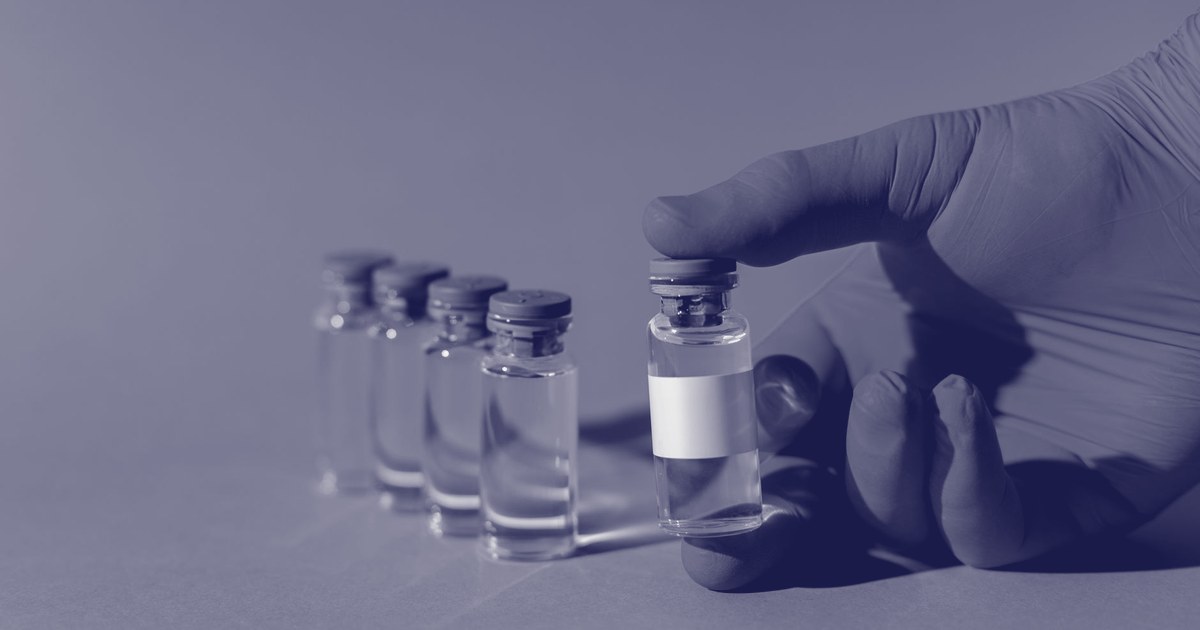
On 20 November, the Union agriculture minister will unveil something India has never had: a home-grown inactivated vaccine for chickens against the H5N1 bird flu strain known as Clade 2.3.2.1a, developed by the ICAR-National Institute of High Security Animal Diseases in Bhopal. The ministry's own release makes the case for it. Clade 2.3.2.1a has caused most bird flu outbreaks in Indian chickens, and no specific commercial vaccine against it exists. Read the top line and India has closed a gap.
It is worth slowing down on that. A vaccine changes nothing on a farm until someone is allowed to inject it. India's bird flu policy has not allowed that. In its own 2023 filing to the World Organisation for Animal Health (WOAH), the body that sets global animal-health trade standards, the government wrote that vaccination against HPAI has not been allowed in India. HPAI is highly pathogenic avian influenza, the lethal form of bird flu. The 18 November announcement does not say whether that rule is changing. It says who made the vaccine. It does not say who may use it.
The policy is to cull, and the outbreaks are speeding up
India's answer to bird flu has been a radius. Under the Revised 2021 Action Plan, everything within one kilometre of a confirmed case is the infected zone, and the area out to 10 km is the surveillance zone. Birds in the inner circle are killed. Farmers may restart production only 90 days after the area is certified clean. The Department of Animal Husbandry and Dairying (DAHD) described it plainly in April 2025: a strict "detect and culling" policy within a 1 km radius, with compensation shared 50:50 between the Centre and the states.
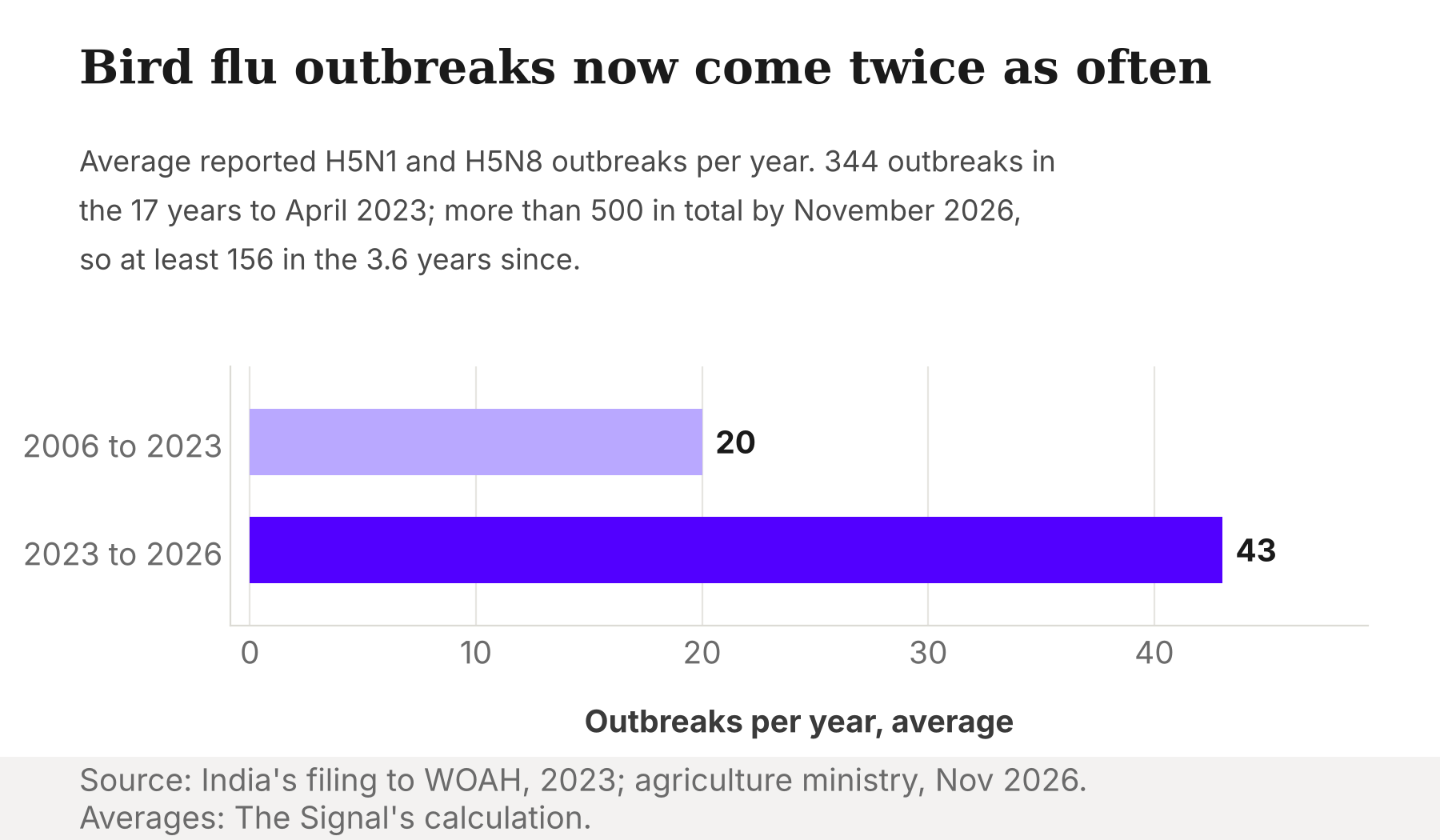
That approach was built for an occasional emergency, and the emergencies are no longer occasional. India told WOAH that it recorded 344 HPAI outbreaks between February 2006 and April 2023, and over 9 million birds died or were culled. By November 2026, the agriculture ministry put the total at more than 500 combined H5N1 and H5N8 outbreaks since 2006.
Set those two counts side by side and the pace becomes visible. The first 344 took the 17 years to April 2023, roughly 20 a year. With the total past 500 by November 2026, at least 156 more came in the three and a half years since, roughly 43 a year.
One district shows what a cull-only policy costs
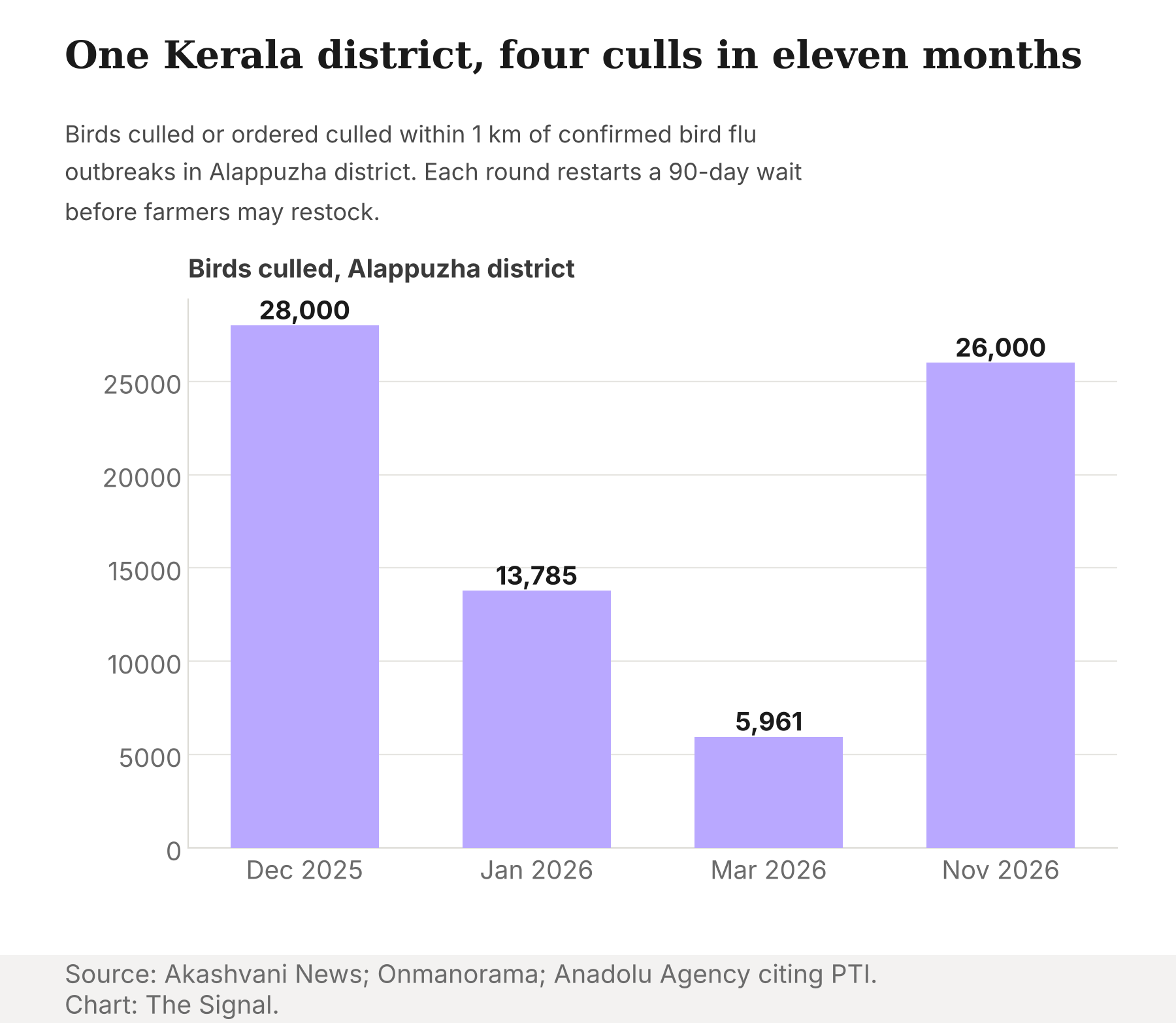
Alappuzha, the duck-farming district in Kerala's backwaters, is what that pace looks like on the ground. In late December 2025, around 28,000 birds were culled there within two days. In January 2026, bird flu was confirmed in four more panchayats, and around 13,785 birds were marked for culling. In March 2026, about 5,961 birds in Alappuzha and 14,228 in neighbouring Kozhikode were to be culled. On 18 November 2026, around 26,000 birds were due to be culled after the Bhopal institute confirmed infection at two Alappuzha farms.
That is four culls in one district in under a year, roughly 74,000 birds. Each one restarts the 90-day restocking clock for the farms inside the circle.
The national stakes are larger than one district. The ministry's release estimates that a major outbreak could cut India's GDP growth by up to 1.5 percent and put more than 20 percent of the country's poultry at risk, and it puts the 2006 outbreak's losses at Rs 2,200 to 3,000 crore. The flock exposed is large: 851 million poultry birds, as per the 2019 Livestock Census.
Why the rule has held: the export farms
India had a reason not to rush into vaccination, and it sits in the trade file. In October 2023, WOAH approved India's self-declaration that 26 poultry compartments in Maharashtra, Tamil Nadu, Uttar Pradesh and Chhattisgarh are free of HPAI. Compartments are sealed, audited farm networks that can export even when the wider country has outbreaks. The government presented the approval as an export opening, noting that India shipped poultry and poultry products to 64 countries worth $134 million in 2022-23.
The same filing ties that status to the ban. India told WOAH that because vaccination is not allowed, the birds in the compartments are not vaccinated against HPAI. An unvaccinated flock is the simplest kind of disease-free claim to prove: if a bird has antibodies, it was infected.
WOAH does not require that simplicity. Its December 2023 policy brief says that vaccination does not affect a country's or zone's HPAI-free status if surveillance supports the absence of infection. The catch is the surveillance. A vaccinating country has to prove, with testing it pays for, that its vaccinated birds are not quietly carrying the virus.
Vaccinating is allowed under WOAH rules, but it moves the burden of proof onto surveillance.
| What a vaccination decision has to settle | Cull-only (India today) | Vaccination under WOAH standards |
|---|---|---|
| Control in an outbreak | Kill every bird within 1 km | Vaccinate as one tool inside a wider strategy with an exit plan |
| Proof of freedom for export | Unvaccinated flocks, no antibodies | Surveillance that shows no infection despite vaccination |
| Trade status | 26 compartments recognised as HPAI-free | Status unaffected if surveillance supports absence of infection |
Sources: DAHD Action Plan 2021; India's 2023 filing to WOAH; WOAH policy brief, December 2023.
The honest objection
The strongest case for keeping the ban is scientific, and DAHD's own experts made it. At an April 2025 meeting called after poultry companies urged the government to explore vaccination, scientists pointed out that currently available HPAI vaccines do not provide sterile immunity but only reduce virus shedding. A vaccinated bird can still carry and pass on the virus at lower levels. That makes outbreaks harder to see. Bird flu is also a human health concern: the agriculture ministry, citing WHO, counts 1,003 human H5N1 cases and 479 deaths across 25 countries since 2003. Hiding the virus inside healthy-looking flocks is a real risk. Most countries have not vaccinated either. WOAH reports that 81 percent of responding members, 107 of 133, used no avian influenza vaccination at all in the past five years.
That case is real, and it is why the meeting ended with an agreement that further scientific evaluation is needed before a policy decision. But it is an argument about how to vaccinate, not whether a vaccine should exist. India has already made the second choice. In the same April 2025 release, DAHD noted that it had permitted a commercial H9N2 vaccine, also from the Bhopal institute, against a milder low-pathogenic strain. The government is now launching an H5N1 vaccine with a ministerial ceremony. Having built the tool, the state still has to publish the decision that would let farmers use it. That decision would cover which flocks, with what surveillance, and how the 26 export compartments are kept apart.
The Signal
India has spent two decades treating bird flu as a fire to be put out with a firebreak. The outbreaks now come about twice as often, and one Kerala district has been through four culls in a year. A vaccine is the first sign that the state is thinking about prevention rather than demolition. But a vaccine is not a policy. Watch for three things after 20 November: a DAHD order that says who may vaccinate, a revision of the 2021 Action Plan that adds vaccination to the radius, and a surveillance plan that keeps the export compartments certifiable. Without those, India will own a bird flu vaccine and keep fighting bird flu the old way. A vial in a Bhopal laboratory does not stop a cull in Alappuzha.
Reporting basis: the vaccine's launch date, developer and target strain, the count of more than 500 outbreaks since 2006, the 2006 loss estimate, the GDP and flock-at-risk projections, and the WHO human-case figures are from the Ministry of Agriculture and Farmers Welfare's 18 November 2026 release via PIB. The statement that HPAI vaccination has not been allowed, the 344 outbreaks and 9 million birds to April 2023, and the 851 million poultry population are from DAHD's 2023 self-declaration to WOAH, published by WOAH. The compartment approval and 2022-23 export figures are from a separate DAHD release via PIB, and the April 2025 vaccination discussion, the H9N2 permission and the detect-and-cull description from another; these three are one origin, DAHD, speaking at different times. The 1 km and 10 km zones and the 90-day restocking rule are from DAHD's Revised 2021 Action Plan. The trade-status principle and the 81 percent figure are from WOAH's December 2023 policy brief. Alappuzha cull counts come from three outlets: Akashvani News (December 2025 and January 2026), Onmanorama citing official figures (March 2026), and Anadolu Agency relaying the Press Trust of India (November 2026); the December and November figures are approximate as reported. The per-year outbreak averages and the roughly 74,000-bird Alappuzha total are The Signal's calculations from those figures.