On 14 November 2026, World Diabetes Day, the World Health Organization issued its first guidelines on diagnosing and managing type 1 diabetes in adults, written to apply in every setting, including low-resource, emergency and humanitarian ones.
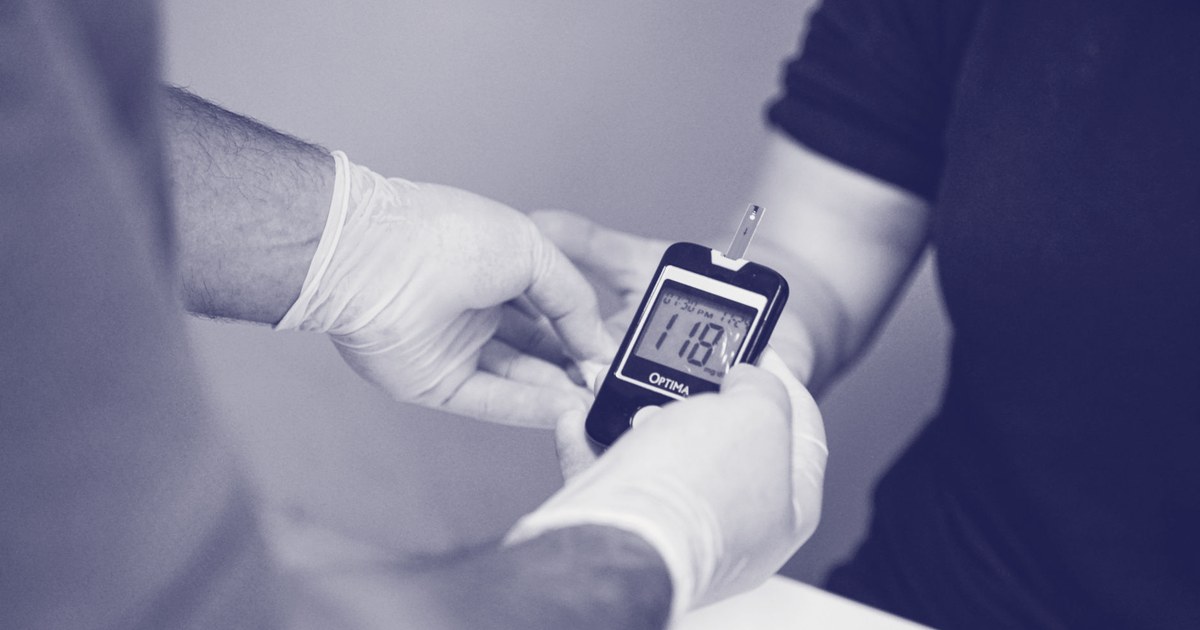
What the guideline asks for is modest. WHO's guideline page says it strongly recommends intensified insulin therapy with multiple daily injections, doses adjusted to blood glucose readings, and it prefers human insulin over newer analogues because human insulin generally costs less. No pumps, no sensors. The floor is a syringe, a vial of insulin and a way to check blood sugar at home. WHO's 2022 coverage targets already commit countries to giving 100% of people with type 1 access to affordable insulin and glucose self-monitoring by 2030.
India already hands out a version of that floor. It is written for children.
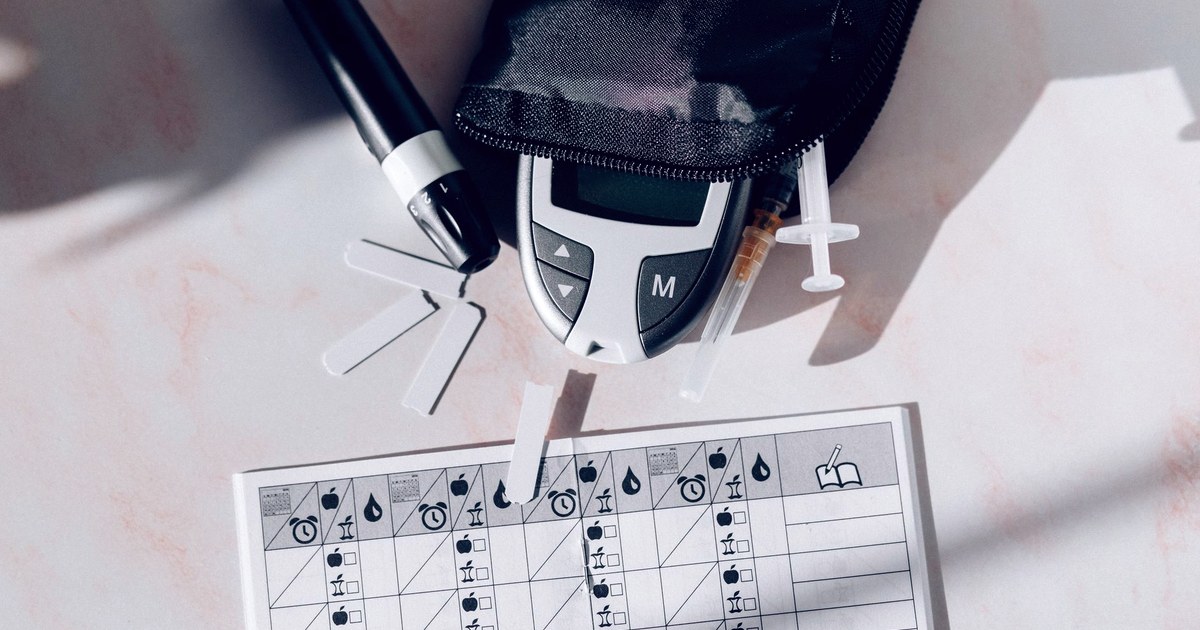
The Health Ministry's 2026 RBSK guidance on diabetes in children screens children and adolescents up to 18 and refers those who test positive to NCD clinics at district hospitals, run under the national NCD programme (NP-NCD), for free insulin and self-monitoring supplies. Table 4 of the same document spells out the take-home kit: regular insulin and glargine, 100 glucose test strips and 25 lancets a month, and a glucometer and lancing device each year. That is, nearly item for item, the regimen the new guideline describes for adults.
Most of the patients are past the cutoff
AJMC, reporting the 2025 IDF Atlas estimates by Ogle and colleagues, puts India's type 1 population at 987,000 in 2025, second only to the US at 1.5 million. The same report says India has the largest under-20 type 1 population anywhere, at 307,000. Subtract one from the other and roughly 680,000 Indians with type 1, about 69%, are 20 or older. Both inputs come from one secondary write-up of the study, so treat that split as an estimate.
RBSK stops at 18, but the AJMC under-20 figure runs to 20. People aged 18 and 19 are too old for the kit but are counted among the under-20s. So 680,000 is a floor on Indians with type 1 past the RBSK age limit.
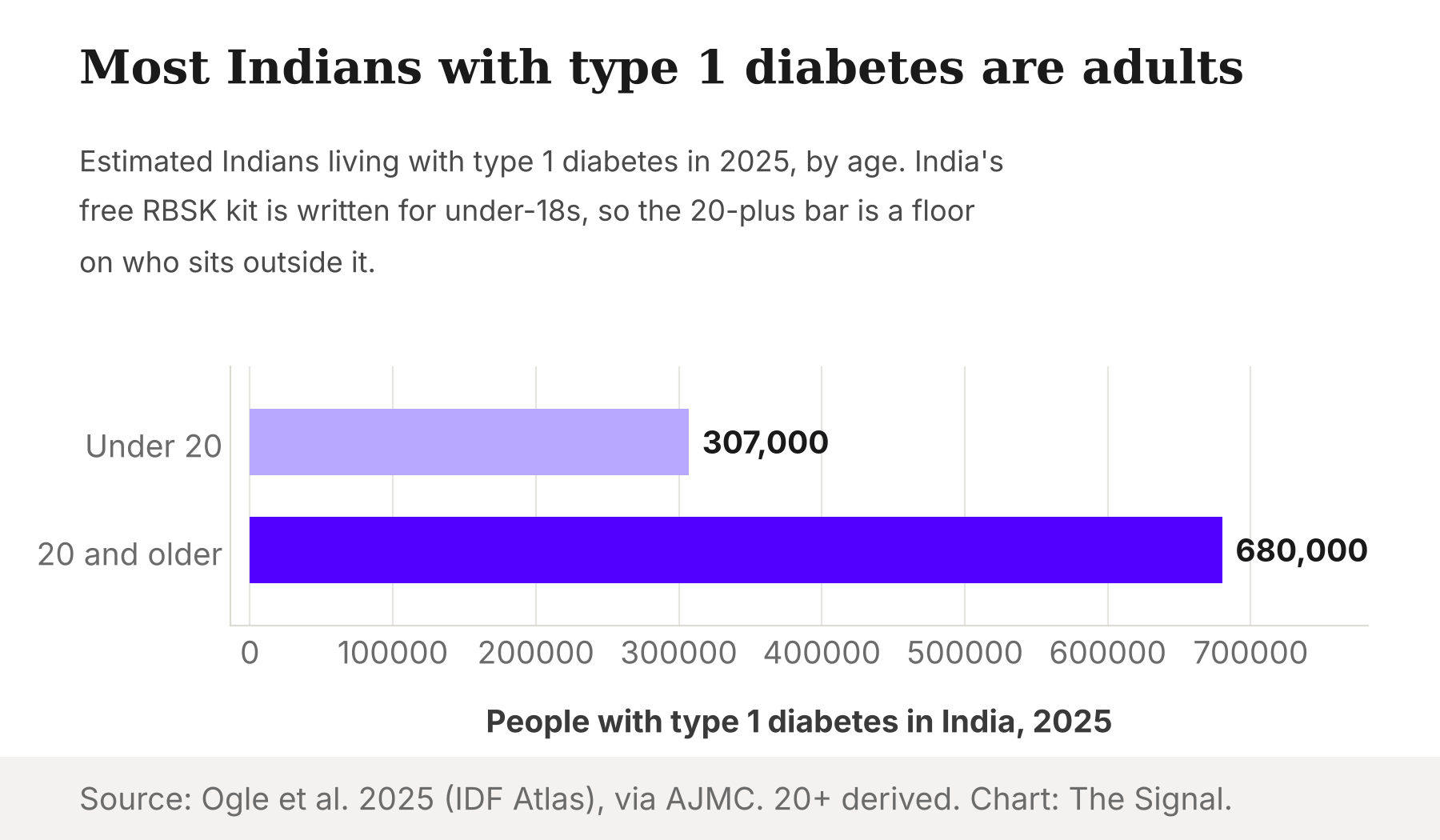
Source: AJMC, reporting Ogle and colleagues' 2025 estimates. The 20-and-older figure is The Signal's calculation. Chart: The Signal.
The state schemes draw the same line
Kerala's Mittayi scheme, the best-known state type 1 programme, requires the beneficiary to be below 18 and the family to earn under ₹2 lakh a year. A 2022 paper in The Lancet Regional Health, Southeast Asia described India's national NCD programme as adult-centric, with no initiatives for children, and noted that people with type 1 in India lacked a free supply of insulin, syringes, meters and strips. The 2026 RBSK guidance answers the children's half of that complaint.
The adult half is thinner. The Health Ministry's NP-NCD training module for programme managers lists human insulin, soluble and premix, among diabetes medicines down to primary health centres, but mentions type 1 only to define it. None of these documents excludes adults, but none sets out a type 1 package for anyone past 18 either. That is an absence of provision, not a written exclusion, and it is the gap the new adult guideline now names.
The kit India funds for children is the regimen WHO now recommends for adults.
| What the regimen needs | WHO adult guideline (November 2026) | RBSK package for under-18s (2026) |
|---|---|---|
| Insulin | Multiple daily injections; human insulin preferred on cost | Regular insulin and glargine |
| Glucose checks | Doses adjusted to blood glucose values | 100 test strips and 25 lancets a month |
| Devices | Self-monitoring, per WHO's 2030 coverage target | A glucometer and a lancing device a year |
| Who it is for | Adults, in all settings | Children and adolescents up to 18 |
Sources: WHO guideline page, WHO coverage targets, RBSK guidance, Table 4.
What the floor costs a household
The best Indian cost data predate the guideline and cover children, so read them as a scale. A 2022 peer-reviewed survey of 380 families by PGIMER Chandigarh found mean annual out-of-pocket spending on type 1 care of ₹55,185 in 2021: ₹28,965 on insulin administration, ₹21,576 on glucose monitoring and ₹5,069 on lab tests. Only 11.6% of families received any financial support, and 30.3% spent more than half their family income on the disease.
MoSPI's Household Consumption Expenditure Survey put average monthly spending per person in 2023-24 at ₹4,122 in rural India and ₹6,996 in urban India, or ₹49,464 and ₹83,952 a year. Against that, the PGIMER mean of ₹55,185 is about 1.1 times what an average rural Indian spent on everything in 2023-24, and about two-thirds of the urban figure.
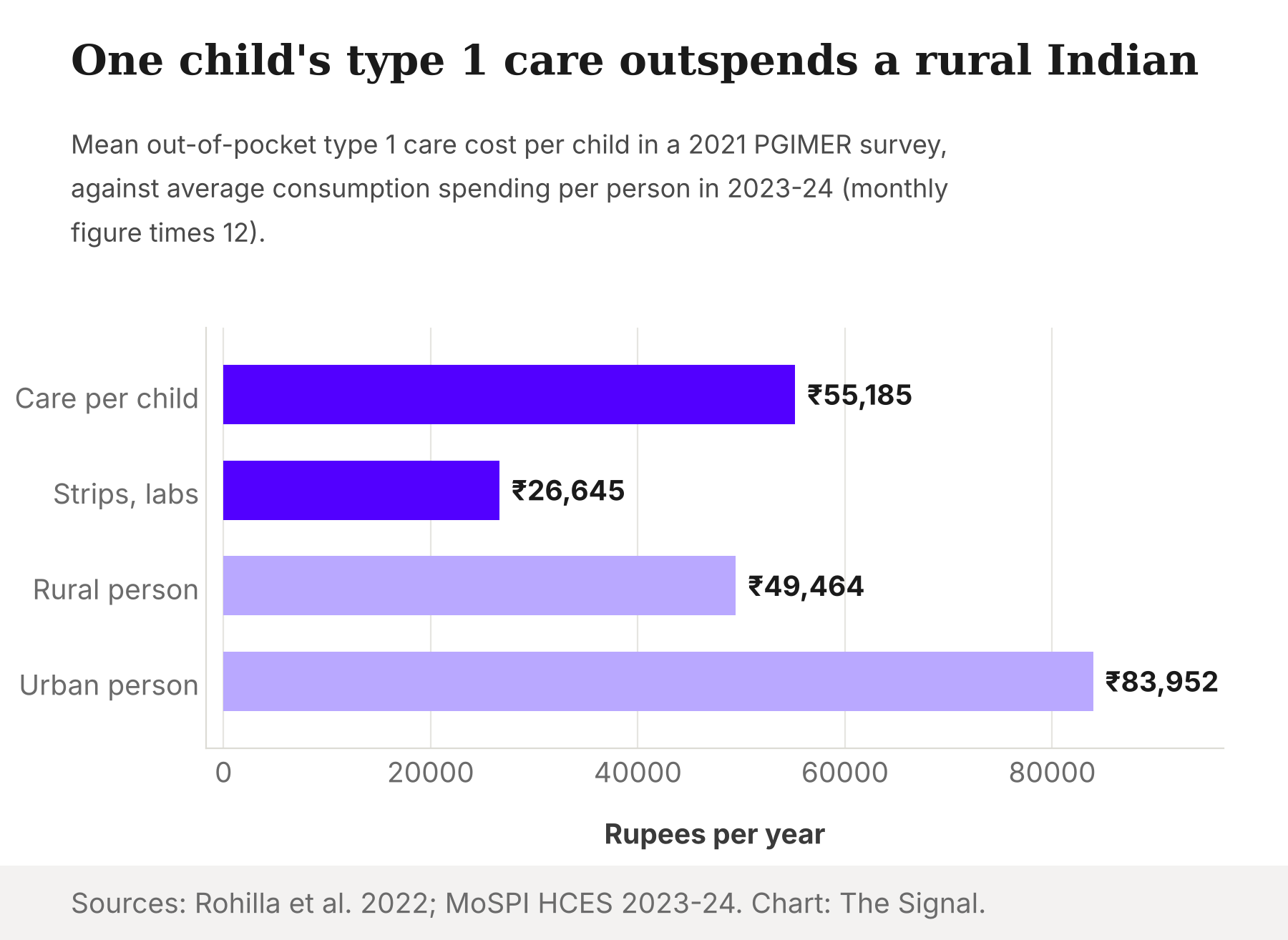
Source: PGIMER survey, Diabetology International (2022); MoSPI HCES 2023-24. Annual consumption figures are The Signal's calculation from monthly averages. Chart: The Signal.
That PGIMER figure sits above the WHO floor, not on it. It records what families of children actually paid, on whatever insulin formats they used, while the guideline is built around the cheapest insulin. A 2019 study of Bengaluru private pharmacies, using 2017 prices, found human insulin cartridges and pens cost 2.5 and 3.6 times as much as vials, and analogues roughly twice as much as human insulin. A month's supply cost the lowest-paid unskilled worker between 1.4 and 9.3 days' wages. Those prices are nine years old.
The part cheap insulin cannot shrink
Insulin is only about half the bill. In the PGIMER survey, glucose monitoring and lab tests came to ₹26,645 a year, about 48% of the total. The WHO regimen depends on that spending, because it adjusts doses to blood glucose values. Even with free insulin, monitoring and lab tests alone would equal about 54% of what an average rural Indian spent in 2023-24, by our calculation from the MoSPI consumption figure.
A 2016 study in The National Medical Journal of India, at a government referral clinic in Lucknow, points the same way. It found 81% of type 1 patients had no government subsidy or health insurance, out-of-pocket payment made up 87% of costs, and direct costs averaged 18.6% of family income. Home glucose monitoring, at 40% of costs, edged out insulin, at 39.5%, as the largest item.
That is why the RBSK kit is worth more than its insulin. Strips, meters and lancets cover the monitoring line, roughly half of spending in both studies, and Table 4 of the RBSK guidance marks them as not on India's National List of Essential Medicines.
The honest objection
The strongest case for the current design is that India's type 1 population is unusually young, so starting with children is triage rather than neglect. Ogle and colleagues estimate 9.5 million people with type 1 worldwide in 2025, 1.8 million of them under 20. India's 307,000 under-20s, per AJMC's report of the same study, are about 17% of that global under-20 group, while its 987,000 total is about 10% of all cases. That burden also breaks the global pattern: WHO's diabetes fact sheet says the majority of the roughly 9.5 million people with type 1 in 2025 live in high-income countries. A health system with a fixed budget and a school screening programme already running would reasonably reach children first. Nothing here shows adults being turned away from NCD clinics, either.
That case is real, but it explains the order, not the endpoint. Even in this young-skewing population, adults are about 69% of patients. Worldwide the share is roughly 81%: subtract the 1.8 million under-20s from the 9.5 million total in the Ogle estimate and about 7.7 million are 20 or over. And type 1 does not end at 18. Every child the RBSK kit keeps well becomes an adult who still needs 100 strips a month. The better the children's programme works, the larger the group it hands on with nothing attached.
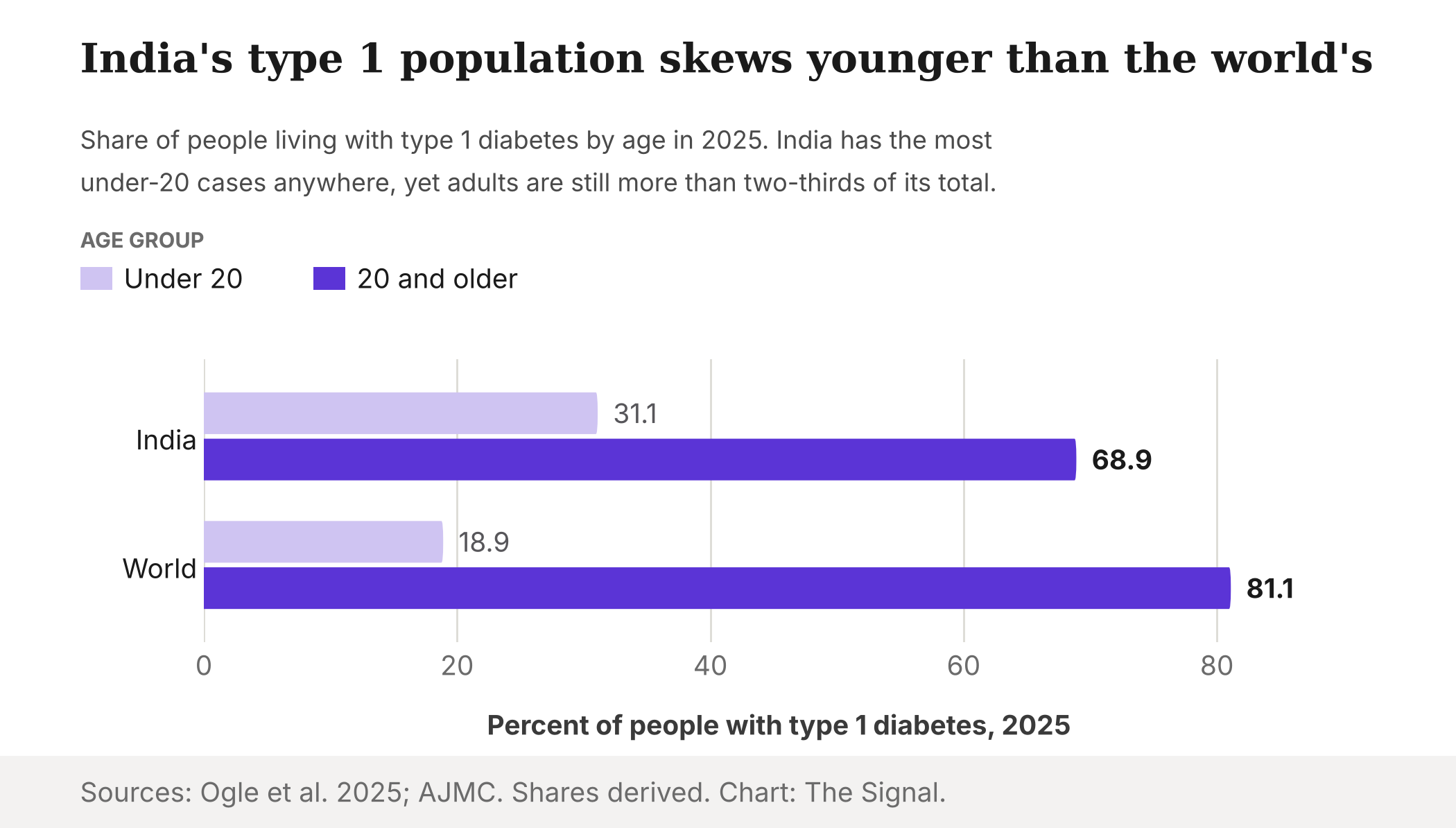
Source: AJMC for India; Ogle and colleagues (2025) for the world. Shares are The Signal's calculations. Chart: The Signal.
The Signal
The new guideline does not ask India for anything exotic. It asks for human insulin, several injections a day and a meter to dose against, which is the kit India already gives its children. The 2030 target of affordable insulin and self-monitoring for every person with type 1 is now about four years away. Watch for two moves: a Health Ministry or state decision to carry the RBSK package past 18, and test strips and meters entering the essential-medicines list. Until one of those happens, India's free type 1 care has an age limit the disease does not.
Reporting basis: the guideline, its insulin recommendation and the 2030 coverage target are from the World Health Organization, through its 14 November 2026 release, its guideline page, its diabetes fact sheet and its 2022 World Health Assembly feature, which together count as one origin; the fact sheet's case count itself draws on the same IDF Atlas estimates as Ogle and colleagues. Global type 1 estimates are from Ogle and colleagues in Diabetes Research and Clinical Practice (2025); the India totals by age come from the same study as reported by AJMC, a single secondary source. The RBSK screening rule and take-home kit are from the Health Ministry's 2026 guidance under the National Health Mission, and the Mittayi eligibility rules are from the Kerala Social Security Mission. The description of the national NCD programme is from a 2022 paper in The Lancet Regional Health, Southeast Asia, and its medicine list from the Health Ministry's 2025 NP-NCD training module. Cost figures are from Rohilla and colleagues' PGIMER survey (Diabetology International, 2022, covering children) and a 2016 Lucknow study in The National Medical Journal of India; insulin price ratios are from a 2019 Journal of Pharmaceutical Policy and Practice study using 2017 Bengaluru prices; consumption spending is from MoSPI's HCES 2023-24. No source states that adults are excluded. The adult count and shares for India and the world, India's shares of global cases, the annualised consumption figures, and the cost-to-consumption ratios are The Signal's calculations from those figures.