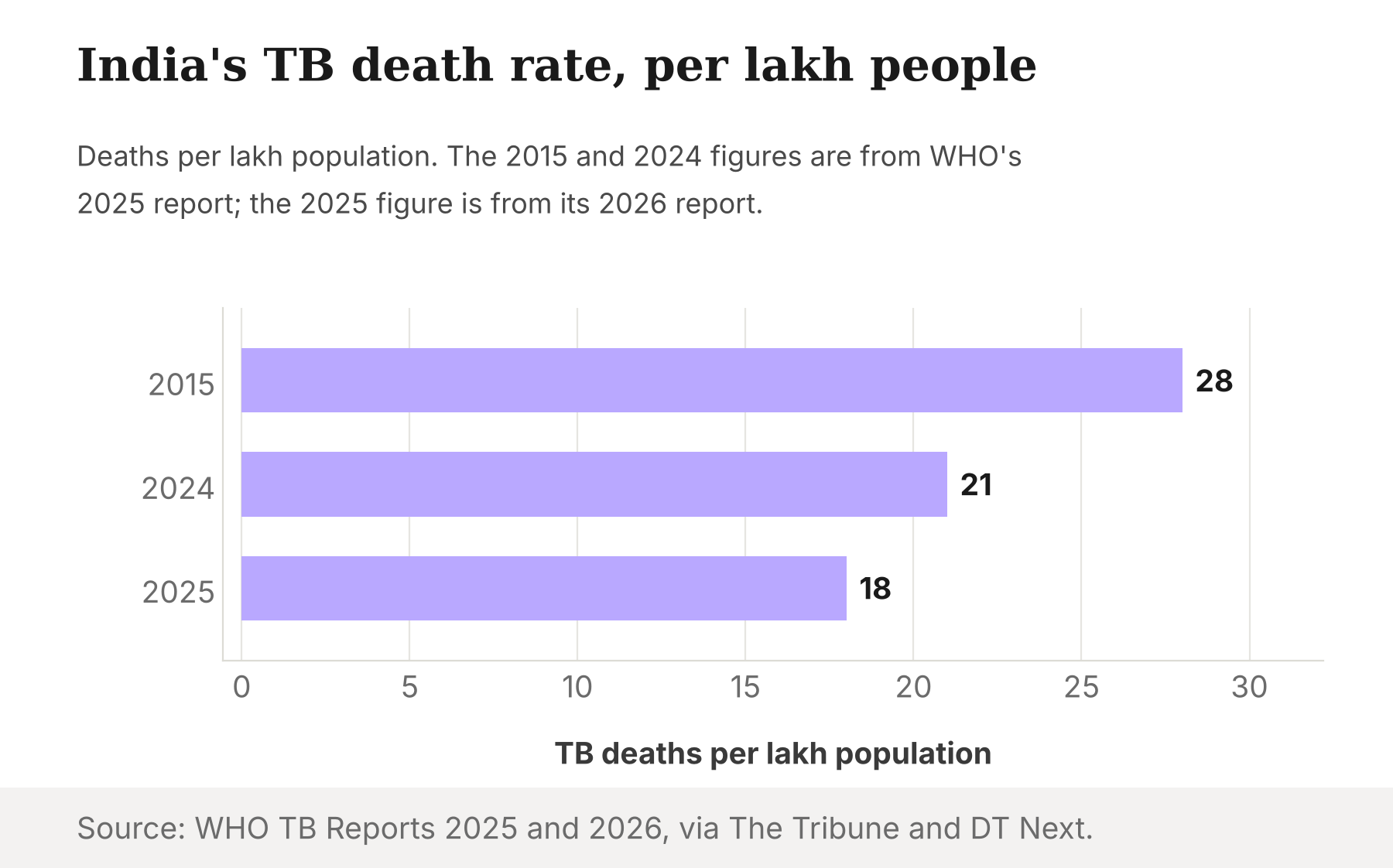
The World Health Organization released its Global Tuberculosis Report 2026 on November 12, and the India headline was a good one. India's TB mortality fell 38 percent between 2015 and 2025, against a global decline of 35 percent, with the death rate down from 28 per lakh people to 18 per lakh, and a 94 percent treatment success rate for drug-susceptible TB. The country that carries the world's largest TB burden is now beating the world average on keeping patients alive. Read the top line and the programme is working.
It is worth slowing down on that. The same report contains a sentence that got far less attention. On its incidence page, the one that counts how many people fall ill, WHO writes that "Estimates of TB incidence for India are under review." This is not a footnote about a small country. India accounts for about a quarter of all TB cases on Earth, by WHO's own estimate on that page.
So the 2026 report tells India, with confidence, how many fewer of its people are dying of TB. It does not yet tell India how many are catching it. And catching it is the number India staked its reputation on.
The pledge was about new cases
India did not promise to cut TB deaths. It promised to end the disease. A Press Information Bureau backgrounder states that India "pledged to achieve the End TB targets by 2025, five years ahead of the SDG deadline of 2030", under the National Strategic Plan for 2017 to 2025. That deadline has now passed, and the report that should have scored it cannot yet give India an incidence figure for it.
The latest number WHO has published is a year older. In WHO's 2025 report, India's TB incidence fell 21 percent, from 237 per lakh people in 2015 to 187 per lakh in 2024. For scale, WHO's global milestone for 2025 was a 50 percent cut in the incidence rate from 2015, and the world as a whole managed 14 percent. The matching milestone for deaths was a 75 percent cut.
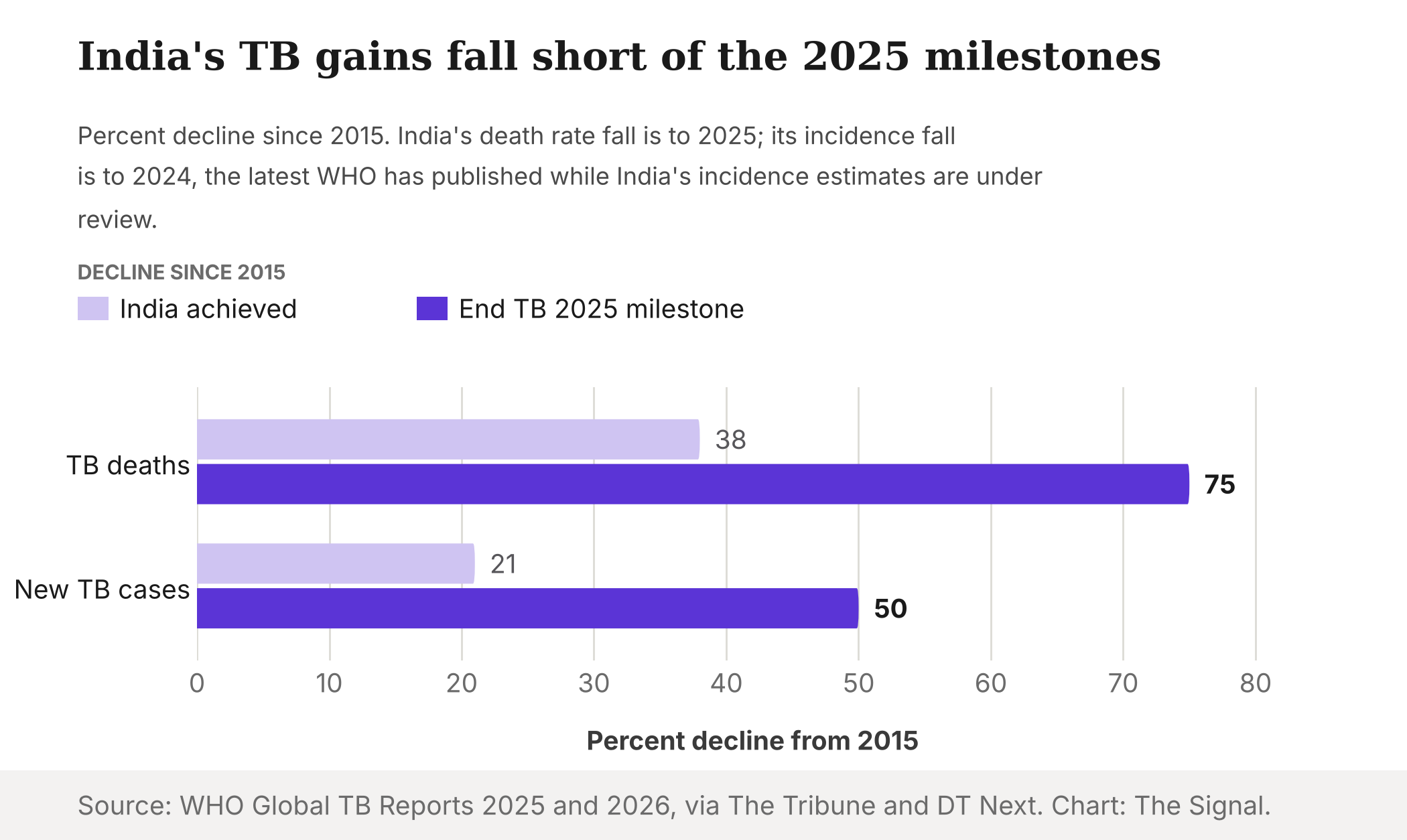
On the latest figure for each measure, India is ahead of the world and roughly halfway to where the 2025 milestones said it should be. The difference is that one of those two bars is now provisional.
Deaths are the number India has learned to move
The death figure did not fall by accident. It is the measure most responsive to what India's programme has got good at: finding patients and treating them. By WHO's 2025 estimate, India diagnosed 26.18 lakh of an estimated 27 lakh TB cases in 2024, and the "missing" cases that never reached the system fell from 15 lakh in 2015 to under one lakh. Find nearly everyone, cure 94 percent of the drug-susceptible patients, and deaths fall.
Tamil Nadu shows how directly that lever works. Its TNKET programme flags severely ill patients at diagnosis and puts them in hospital first. A practice paper in BMJ Global Health by ICMR-NIE and the state TB cell found that Tamil Nadu cut its TB death rate by at least 38 percent across quarterly diagnosis cohorts from July 2024 to December 2025. That is a real gain in lives. It also changes nothing about how many people in Tamil Nadu are infected next year. Triage saves the sick. It does not stop the next case.
That is the structure of India's progress. Deaths respond to care, which India controls closely and now funds itself. Incidence responds to transmission, prevention and the conditions people live in, which move more slowly and are harder to measure. India has pulled the first lever hard. Whether it has moved the second is exactly what WHO is re-examining.
Why the review matters more than it sounds
An estimate under review can move a long way. WHO's 2026 report introduced a new way to estimate incidence from death-registration data and tried it first on two countries. For Mongolia, WHO's previously published estimates put incidence at about 446 per 100,000 people in 2024; the new method puts it at 223 per 100,000 in 2025. A change of method halved a country's TB burden on paper.
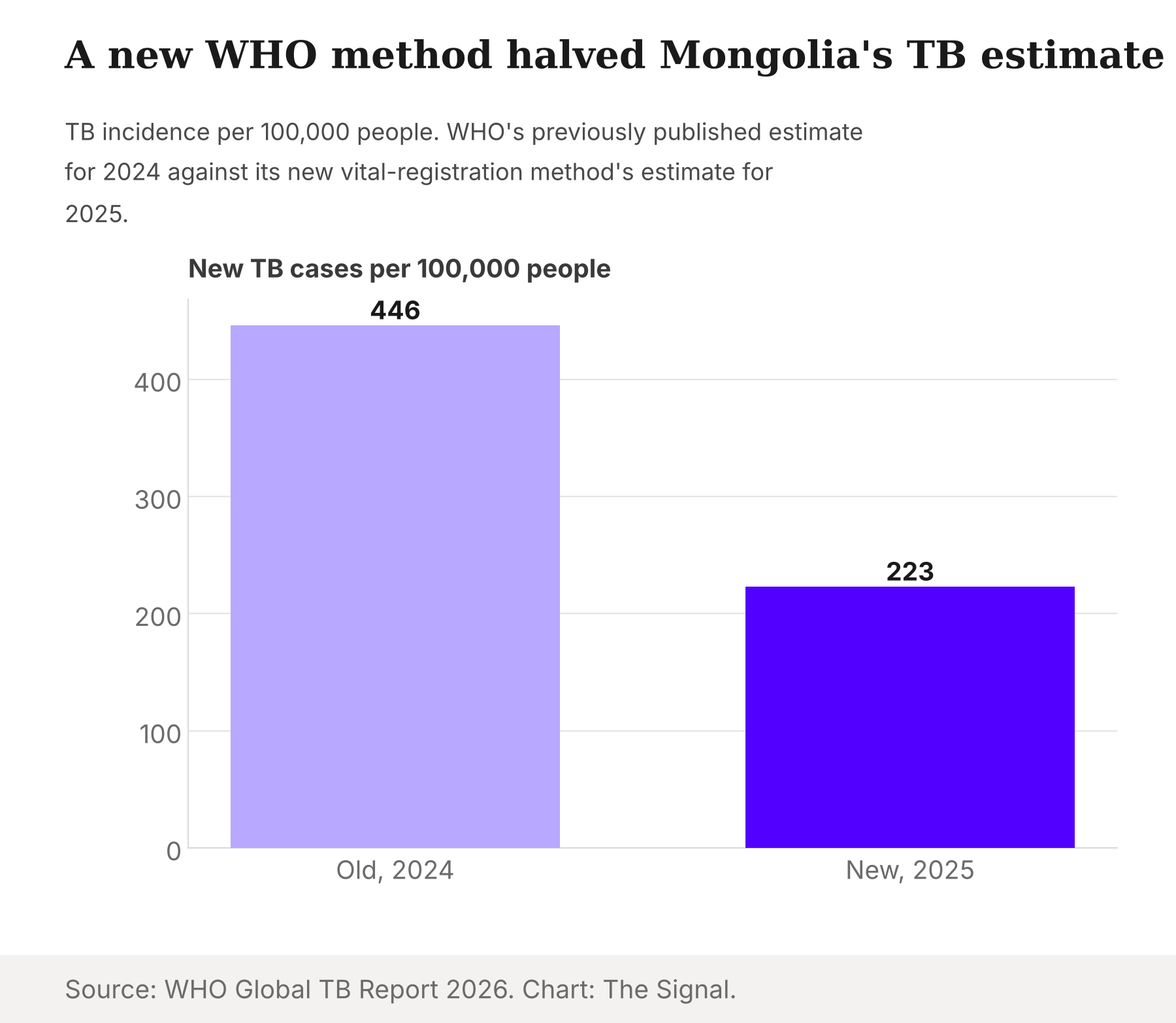
India's review is a separate exercise, and nothing says it will land the same way. But the Mongolia case shows the scale of what is at stake. India's denominator is a quarter of the world's cases. A revision could make India's 21 percent look like a near-miss on the 2025 milestone, or leave it where it is. Until WHO publishes, nobody can honestly say which.
The money makes this an Indian question, not a donor one. India meets 96 percent of its TB programme's funding needs from domestic resources. Globally, WHO says domestic TB funding rose 14 percent to US$5.6 billion between 2024 and 2025, while international financing fell by a similar scale. When the budget is your own, the number you steer it by is your own problem. Steer by deaths and the money keeps flowing to finding and treating patients; steer by incidence and some of it has to go to stopping transmission too.
The honest objection
The strongest case against this reading is that it makes too much of a procedural line. Deaths are the harder number to fudge and the one that matters most to families. WHO says India accounted for 23 percent of global TB deaths in 2025 and reached the first End TB mortality milestone that year. On this view, a pending incidence revision is routine statistical housekeeping, and the 2025 incidence trend was already heading the right way at 21 percent.
That case is real, and nothing here argues the death figure is wrong. But it answers a different question. The pledge India made for 2025 was to end TB, not to make it less fatal, and ending a disease is measured in new cases. A country can cut deaths sharply while transmission falls slowly, because modern treatment works on people who are already sick. The 2026 report confirms the half of the job India is visibly winning and defers the half the deadline was about.
The Signal
India's TB story has split into two numbers. The death rate is falling fast, is backed by WHO's newest report, and responds to the care India has scaled. The incidence rate is the one India promised to drive toward zero by 2025, and WHO now lists it as under review. Until that review is published, India's TB achievement is a mortality achievement. Watch for WHO's updated India estimate: if it shows new cases falling as steeply as deaths, the 2025 pledge was a near-miss, and if not, India has built an excellent system for treating a disease it has not yet learned to stop. The report counted the deaths; the cases are still open.
Reporting basis: India's 2015 and 2025 TB death rates, the 38 percent mortality decline, the 94 percent treatment success rate and the 96 percent domestic funding share are per DT Next, reporting the Union Health Ministry's reading of the WHO Global TB Report 2026; we verified the DT Next report, not the ministry statement itself. The statement that India's incidence estimates are under review, India's share of global cases and deaths, the global incidence and mortality declines, the 2025 End TB milestones, the Mongolia method comparison and global funding figures are from the WHO Global Tuberculosis Report 2026 and WHO's November 12, 2026 release, which together count as one origin. India's 2015 and 2024 incidence and death rates and its 2024 diagnosis and missing-case figures are from WHO's 2025 report as reported by The Tribune, a second relay of the same WHO estimates rather than an independent count. India's 2025 elimination pledge is from a Press Information Bureau backgrounder. The Tamil Nadu result is from a BMJ Global Health practice paper by ICMR-NIE and the Tamil Nadu State TB Cell, as reported by DT Next; we did not verify the paper directly. The comparisons of India's declines against the 2025 milestones are The Signal's calculations from those figures.