The Indian Council of Medical Research uploaded the ninth annual report of its antimicrobial resistance network on 17 November 2026, a day before World AMR Awareness Week opened, and one line in it is built for a headline. In blood samples from typhoid patients collected across 2025, only 21 of 1,075 Salmonella Typhi isolates, 2.0%, were susceptible to ciprofloxacin, ICMR's AMRSN Annual Report 2025 reports. For the related Paratyphi A strain it was 1 of 281. Read on its own, the story is the familiar one: India's antibiotics are failing, and the bugs are winning.
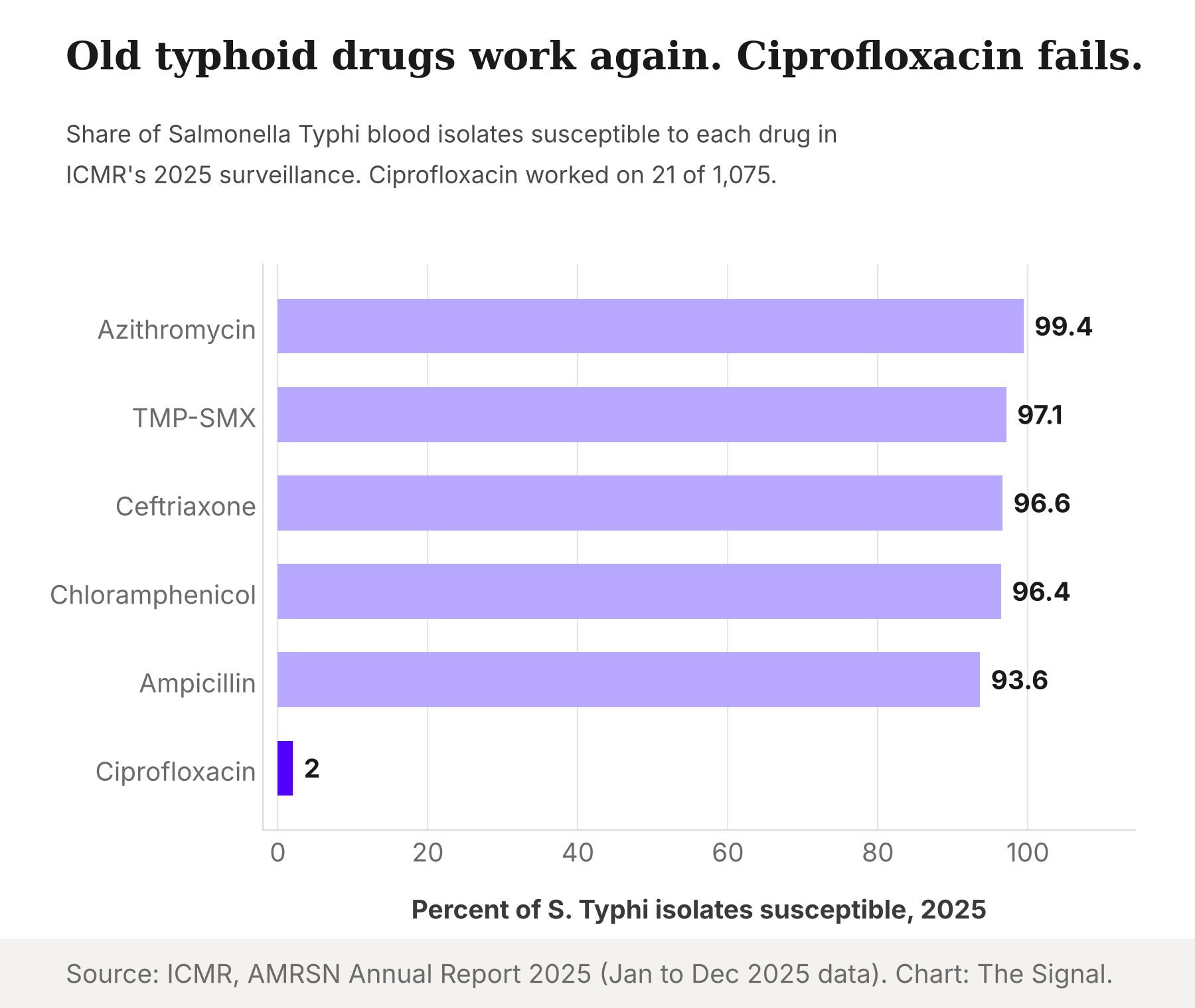
It is worth slowing down on that. The same report, on the same typhoid isolates, lists the drugs that still work, and the list is a surprise. S. Typhi was 99.4% susceptible to azithromycin, 97.1% to trimethoprim-sulfamethoxazole, 96.6% to ceftriaxone, 96.4% to chloramphenicol and 93.6% to ampicillin in 2025, ICMR reports. Ampicillin and chloramphenicol are among the oldest typhoid drugs there are. They are working again.
Put two figures from the same samples side by side: 93.6% for ampicillin against 2.0% for ciprofloxacin. That is not a country whose antibiotics are uniformly collapsing. It is a country whose resistance map looks like a record of what it has been prescribing.
The drugs that rested came back
ICMR does not leave the pattern to inference. The report attributes the re-emergence of susceptibility to older first-line drugs to reduced antimicrobial selection pressure following their decreased use, and says the continued low susceptibility to fluoroquinolones, the class ciprofloxacin belongs to, highlights their limited therapeutic role. In plain terms: bacteria stop carrying the machinery to beat a drug once that drug stops being thrown at them, and keep it for as long as the drug stays in circulation.
The comeback is older and slower than the 2025 snapshot suggests. ICMR's 2024 report shows ampicillin susceptibility in S. Typhi rising from 91.9% in 2017 to 97.5% in 2024, and chloramphenicol from 96% to 97.6%. Both drugs were already above 90% when the network's trend series began, so most of their recovery happened before 2017, and 2025's ampicillin figure of 93.6% is a step back from 2024 rather than a new high.
In 2025, five typhoid drugs worked on more than 93% of samples. Ciprofloxacin worked on 2%.
Source: ICMR AMRSN Annual Report 2025. Chart: The Signal.
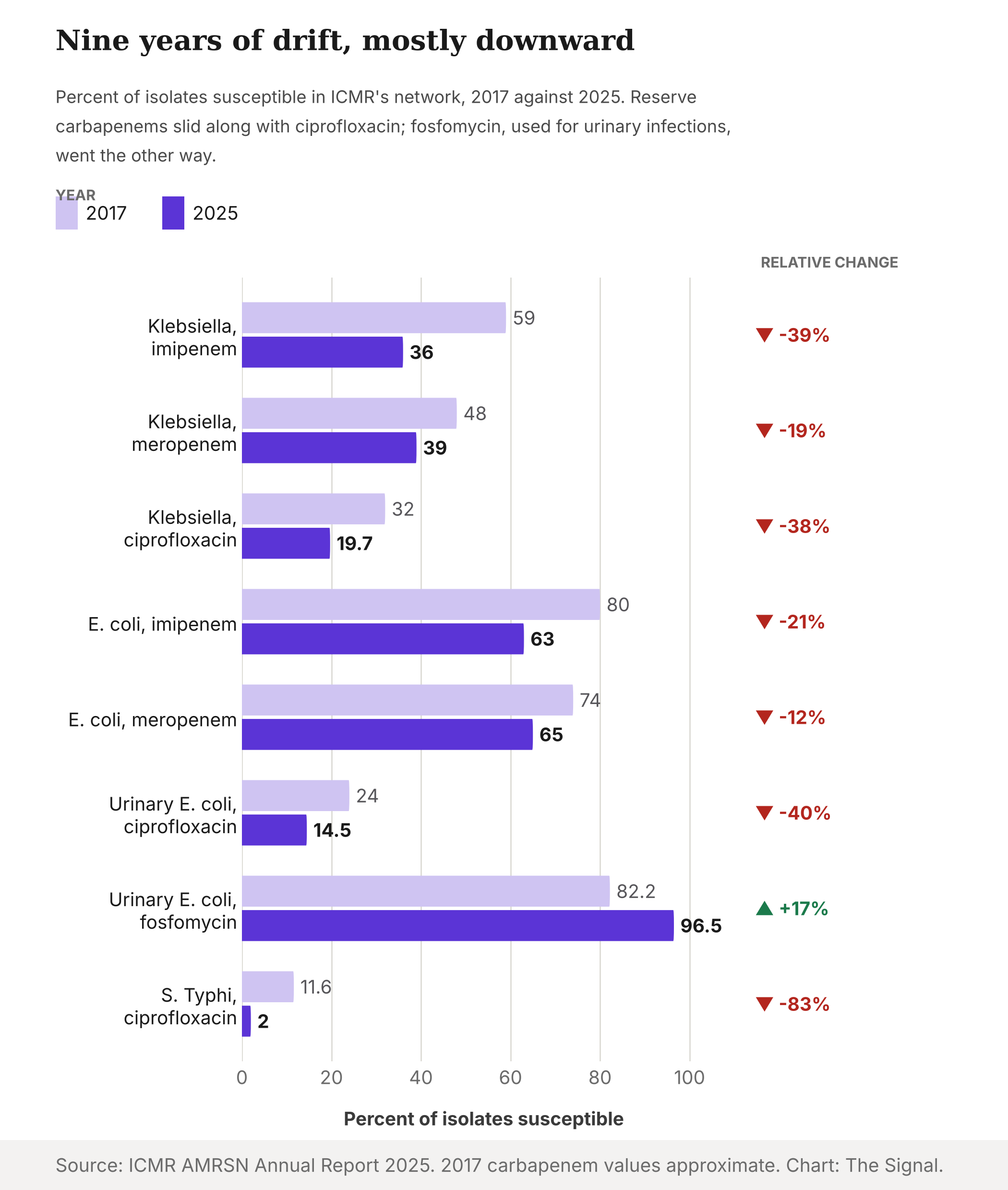
Ciprofloxacin is the counter-example, and it has been sliding for years. ICMR's nine-year trend data show ciprofloxacin susceptibility in S. Typhi fell from 11.6% in 2017 to 2.0% in 2025, staying below 3% since 2022, after a brief rise in 2021. None of this is new to ICMR: its 2024 report already found more than 95% fluoroquinolone resistance in S. Typhi. On the 2025 figure, 1,054 of every 1,075 typhoid isolates would shrug off the drug.
The same pattern, beyond typhoid
The broader gut bacteria that cause urinary, bloodstream and wound infections tell a messier version of the same story. ICMR's trend data show E. coli susceptibility to ciprofloxacin declined to around 9% in 2025. Only 18.4% of E. coli isolates were susceptible to cefotaxime and 24.7% to ceftazidime, two third-generation cephalosporins, and ICMR found low susceptibility even in outpatients, which it reads as resistance being widespread in the community.
For comparison, WHO's 2025 global surveillance report finds more than 40% of E. coli worldwide resistant to third-generation cephalosporins, and about 1 in 3 reported infections resistant in WHO's South-East Asia Region in 2023. The two are not measured identically (WHO counts resistant, ICMR counts susceptible), but India's network sits well past the global line.
Urine samples show the recovery side too. For urinary E. coli, ICMR reports fosfomycin susceptibility rose from 82.2% in 2017 to 96.5% in 2025, while ciprofloxacin fell from 24.0% to 14.5%. Nitrofurantoin slipped from 88.3% to 79.1% but, in ICMR's words, kept better efficacy.
From 2017 to 2025, susceptibility fell for every drug shown except fosfomycin.
Source: ICMR AMRSN Annual Report 2025, trend tables. Chart: The Signal.
The pressure moves to the reserve shelf
When the everyday drugs stop working, treatment climbs to the carbapenems, the injectable drugs hospitals hold back for infections nothing else touches. Those are eroding too. ICMR's trend data show E. coli imipenem susceptibility fell from about 80% in 2017 to 63% in 2025. For Klebsiella pneumoniae, imipenem susceptibility fell from about 59% to 36% over the same period, and meropenem from about 48% to 39%. A second, separate government network finds the same. The NCDC's NARS-Net bulletin for July to December 2025 reports 59% carbapenem resistance among Klebsiella blood isolates, and 79% to 80% of E. coli blood isolates producing ESBL enzymes that disable penicillins and cephalosporins.
Typhoid's fallback drugs are holding, though both networks show a foothold of resistance. The two measure different things, so they belong side by side rather than merged.
In both national networks, typhoid's fallback drugs are still holding.
| Network and period | What is counted | Ceftriaxone | Azithromycin |
|---|---|---|---|
| ICMR AMRSN, Jan to Dec 2025 | Percent of S. Typhi isolates susceptible | 96.6% | 99.4% |
| NCDC NARS-Net, Jul to Dec 2025 | Resistant S. Typhi isolates, of 1,083 | 20 (about 1.8%) | 19 (about 1.8%) |
Sources: ICMR AMRSN Annual Report 2025; NCDC NARS-Net bulletin, July to December 2025. Percentages for NARS-Net are calculated from its counts.
New molecules are arriving at the top of that ladder. The Ministry of Science and Technology said Wockhardt's nafithromycin, launched on 20 November 2024 with BIRAC support, was India's first indigenously developed antibiotic aimed at resistance, for community-acquired pneumonia on a three-day course. In May 2026, Business Today reported CDSCO approval of Wockhardt's Zaynich for complicated urinary infections, citing company data that 89% of trial patients were cured against 68.4% on meropenem. That trial result is Wockhardt's own figure, not an independent one. On access, Wockhardt chairman Habil Khorakiwala told Business Today in June 2026 that Zaynich should reach Indian patients around December 2026 or January 2027, at roughly an 80% discount to the US, where a seven-to-ten-day course would cost $10,000 to $15,000. On his numbers an Indian course would still cost roughly $2,000 to $3,000, a company estimate rather than a published price, and a sum that keeps the drug a hospital option.
Where the volume sits
If resistance tracks use, the question is where India's use goes. The best national picture is old. A 2022 study in The Lancet Regional Health, Southeast Asia estimated from sales data that India's private sector consumed 5,071 million daily doses of antibiotics in 2019. WHO's "Watch" group, the broader-spectrum drugs WHO wants used sparingly, made up 54.9% of those doses, against 27.0% for the first-choice "Access" group: roughly two Watch doses for every Access dose. Unapproved formulations accounted for 47.1%. On WHO's 2023 AWaRe list, ciprofloxacin, ceftriaxone, azithromycin and meropenem are all Watch-group antibiotics, while ampicillin and chloramphenicol are in the Access group. So the Watch majority includes the class ICMR finds failing. Two cautions apply. The 2019 study's headline share does not isolate fluoroquinolones. And the Watch label marks resistance potential, not current failure: ceftriaxone and azithromycin are Watch drugs that still work on nearly all typhoid isolates. Those are 2019 figures, nearly seven years old, and nothing in this evidence base updates them.
The honest objection
The strongest case against reading too much into these rates comes from the government's own surveillance. The NCDC bulletin itself cautions that data from government medical colleges, 91 sites in its July to December 2025 round, can skew toward higher resistance, because samples come mainly from admitted patients or those whose infections did not respond to first-line treatment. That bias is not abstract here. A typhoid patient who reaches a lab after ciprofloxacin failed is, by construction, more likely to carry a ciprofloxacin-resistant strain. On this view, the 2% figure describes the patients who made it to a teaching hospital, not the patient at a neighbourhood clinic.
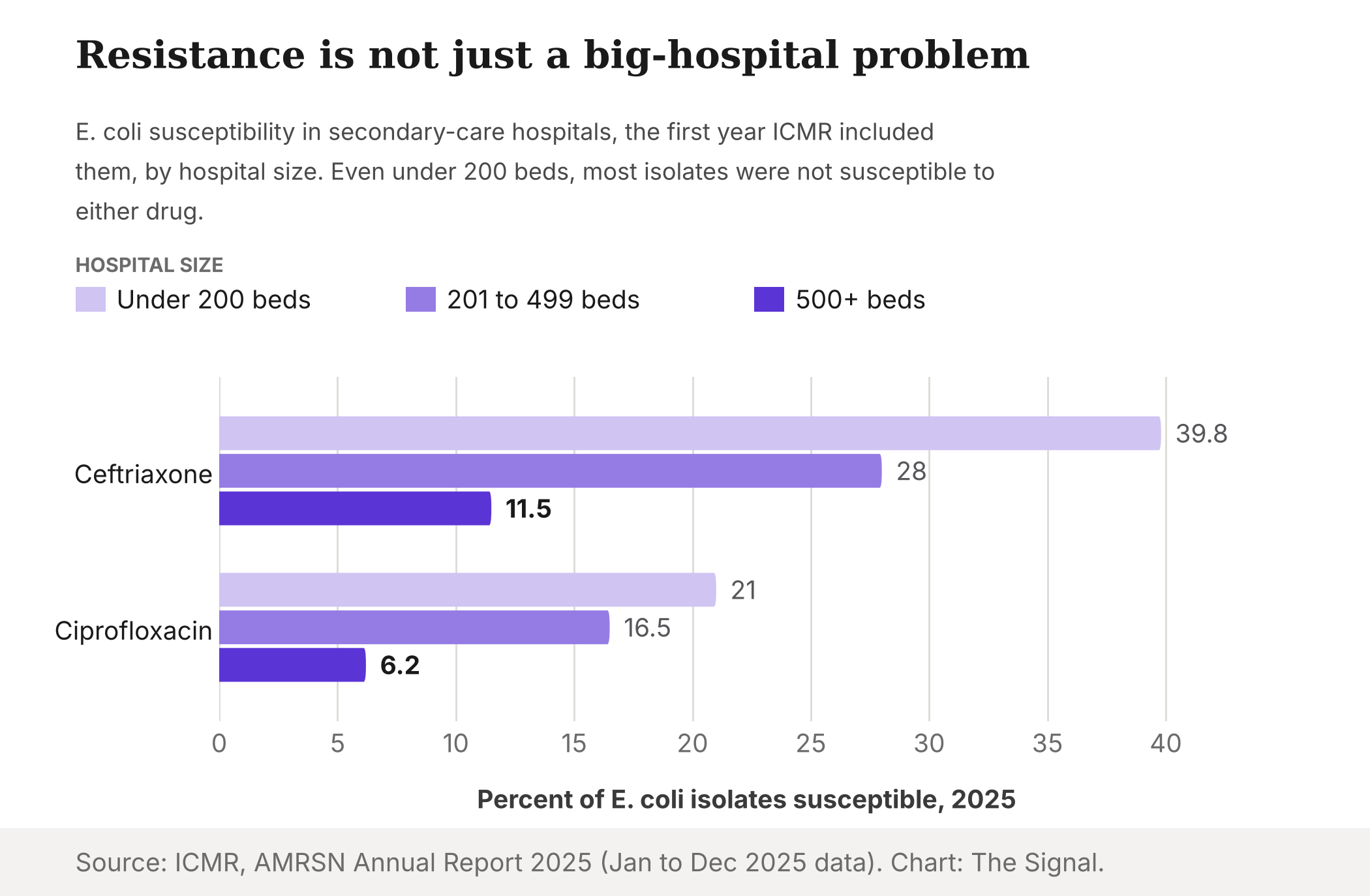
That case is real, and it should change how the numbers are read. The levels are best treated as upper bounds for community infection, and India does not publish a clean community figure to replace them. But the bias cannot produce the thesis. It cannot explain why ampicillin and chloramphenicol, tested on the same skewed samples, came back above 93%. Nor does it account for ICMR's finding of low cephalosporin susceptibility even among E. coli from outpatients. ICMR's location-wise data put outpatient E. coli at 24.5% susceptible to cefotaxime and 11.5% to ciprofloxacin, against 10.5% and 6.6% for ICU isolates. Outpatients fare better, as the bias argument predicts, but three in four still carry strains a common cephalosporin cannot treat. And it weakens badly in the report's first look at smaller hospitals: in secondary-care hospitals with under 200 beds, only 39.8% of E. coli were susceptible to ceftriaxone and 21.0% to ciprofloxacin in 2025, against 11.5% and 6.2% in hospitals with 500 or more beds. The big hospitals are worse, roughly 3.5 times worse on ceftriaxone, but the small ones are no refuge.
In 2025, bigger hospitals saw more resistant E. coli, but small ones were no refuge.
Source: ICMR AMRSN Annual Report 2025. Chart: The Signal.
The Signal
The usual AMR story is a countdown to the day nothing works. India's own surveillance tells a more useful one: resistance moves with use, and it can move backwards. ICMR credits the recovery of older typhoid drugs to their decreased use, while the drug class still in wide circulation has stayed below 3% susceptible since 2022. The cost of ignoring that runs upward, to carbapenems already failing on most Klebsiella and to new molecules that so far have only company trial data behind them. What to watch in ICMR's 2026 report is not whether ciprofloxacin recovers. It is whether fosfomycin and the old typhoid drugs keep their gains once doctors start reaching for them again. A drug that rests can return; a drug that is overused, it turns out, does not get the chance.
Reporting basis: the typhoid, E. coli, Klebsiella, urinary and secondary-hospital susceptibility figures, and ICMR's reading of why older drugs recovered, come from one origin, the ICMR AMRSN Annual Report 2025, covering January to December 2025, with the 2024 fluoroquinolone figure and the 2017 to 2024 ampicillin and chloramphenicol trend from the same network's 2024 report. The carbapenem, ESBL and typhoid resistance counts and the medical-college caveat are from a second, independent government network, the NCDC's NARS-Net bulletin for July to December 2025. The global and regional comparison is WHO's GLASS 2025 report, using 2023 data, and the Access and Watch groupings are from WHO's 2023 AWaRe classification. India's 2019 consumption mix rests on a single peer-reviewed study (Koya et al., Lancet Regional Health, Southeast Asia). The nafithromycin details are the science ministry's, via PIB, and the Zaynich trial result, launch timing and price guidance are Wockhardt's own data and statements as reported by Business Today, the only news outlet among the sources. The 1,054-of-1,075 count, the NARS-Net percentages, the Watch-to-Access ratio, the 3.5-times hospital gap, the three-in-four outpatient share and the $2,000 to $3,000 Zaynich course estimate are The Signal's calculations from those figures.