Sepsis is the body's runaway response to an infection, and it is one of the largest killers on earth. A 2020 Global Burden of Disease analysis in The Lancet estimated 11.0 million sepsis-related deaths in 2017, 19.7% of all global deaths in 2017. The standard answer to that toll has been speed. The Surviving Sepsis Campaign's 2021 international guidelines recommend giving antimicrobials "immediately, ideally within 1 h of recognition" for adults with possible septic shock or a high likelihood of sepsis. The logic looks airtight: if every hour counts, start the drug before the patient even reaches hospital.
On November 24, 2026, that logic met a randomized trial and lost.
A three-hour head start that bought nothing
The PITSTOP-Antibiotics trial, published in JAMA, randomized 2,091 adults, 2,048 of them analysed, who had suspected infection, a fever of at least 38.0 °C and systolic blood pressure under 100 mm Hg. Paramedics gave each one either 1 g of intramuscular ceftriaxone, a broad-spectrum antibiotic, or a saline placebo in the ambulance. The drug went in a mean of 37 minutes after paramedics arrived, and the median patient was 75, as ThePrint reported from the paper. That was a mean of 3 hours earlier than when antibiotics were provided as part of usual care in hospital, CIDRAP noted.
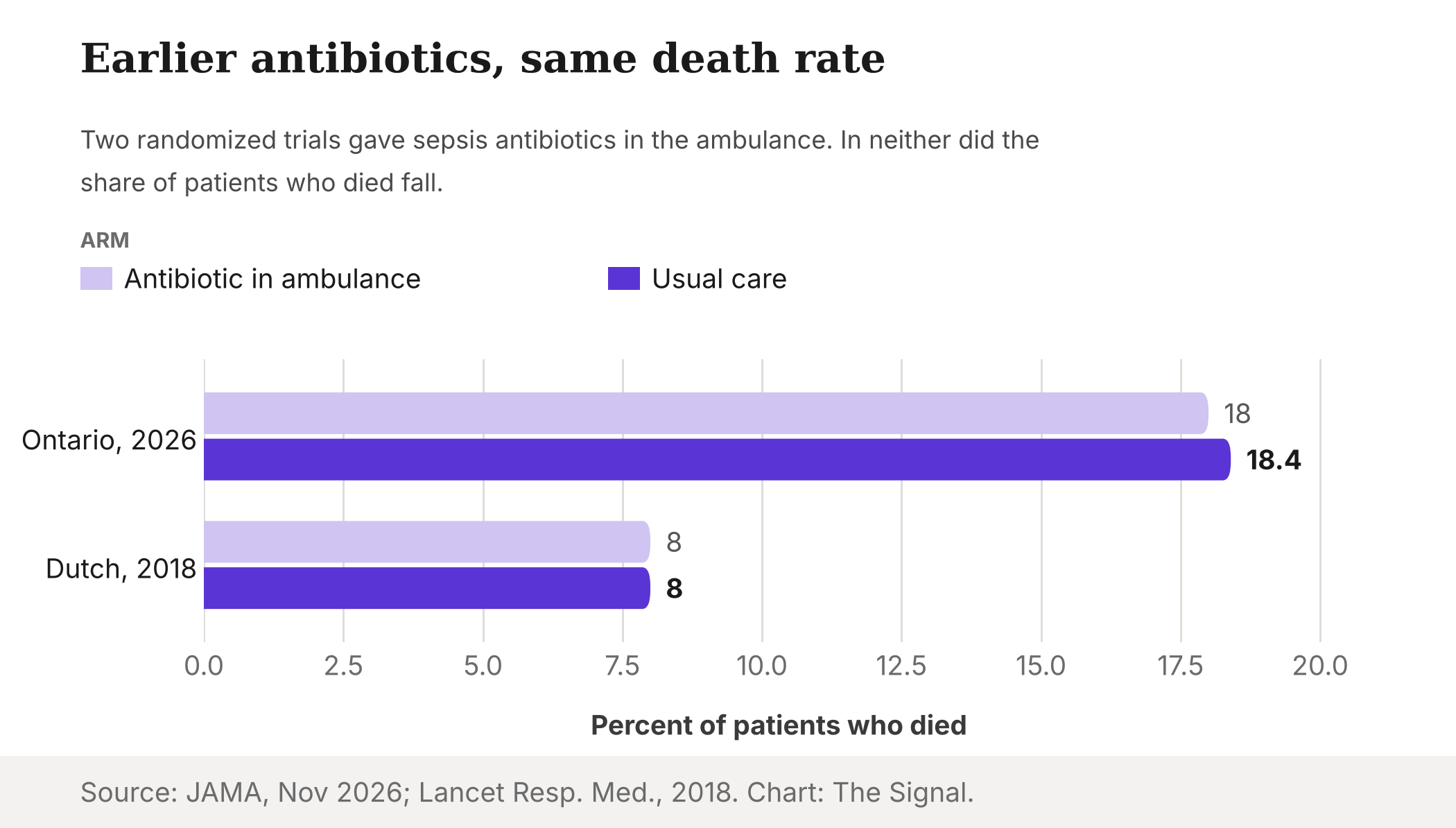
Three hours is an enormous lead in a disease supposedly measured in minutes. It changed nothing measurable. Across 4 paramedic services in Ontario, Canada, hospital mortality was 18.0% (182 of 1,009) in the ceftriaxone group and 18.4% (186 of 1,011) in the placebo group, a risk ratio of 0.97 with a 95% confidence interval of 0.81 to 1.17. That interval straddles 1, which means the trial found no difference it could separate from chance.
The cost side did show up. Adverse events were more frequent with ceftriaxone, 6.2% against 1.5% on placebo, according to JAMA's summary of the trial. That is roughly four times the rate, for no survival gain.
The second trial to say so
This is not a lone result. The 2018 PHANTASi randomized trial in The Lancet Respiratory Medicine found that Dutch ambulance crews gave antibiotics a median of 26 minutes before patients reached the emergency department. At day 28, 8% had died in each arm, and the authors concluded that "giving antibiotics in the ambulance did not lead to improved survival, regardless of illness severity."
Two randomized trials, two countries, eight years apart, the same answer. So why does the hour-by-hour rule feel so well established?
Where the clock rule came from
Much of the evidence for speed is observational. A 2017 New England Journal of Medicine study of 49,331 patients at 149 New York hospitals found that each hour of delay in antibiotics was associated with higher in-hospital mortality, an odds ratio of 1.04 per hour. Put plainly, every hour of waiting went with about 4% higher odds of dying.
Observational studies can show that late antibiotics travel with worse outcomes. They struggle to show that the lateness is the cause. A patient who waits five hours for a drug may also be waiting for a doctor, a bed and a diagnosis, in a busier or thinner hospital. The Ontario trial's authors suggest early antibiotics may have served as a surrogate for other aspects of care that improved patient outcomes, CIDRAP reported. In other words, fast antibiotics may have been a marker of a good hospital, not the thing that saved lives.
A randomized trial strips that confounding out. When it does, the three-hour edge vanishes.
Why this lands harder in India
The Ontario trial used ceftriaxone, a third-generation cephalosporin. In India, that choice looks much weaker.
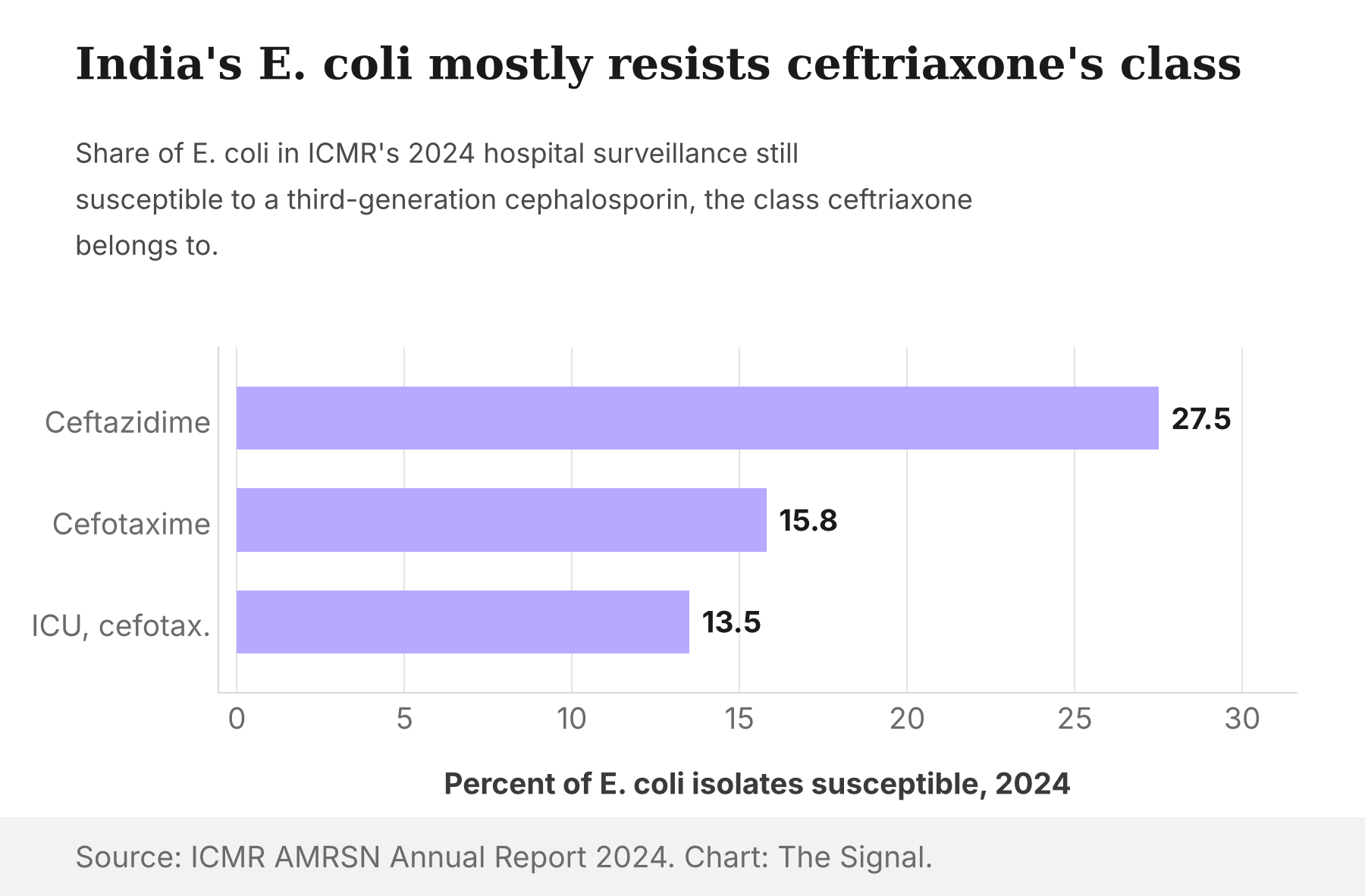
The Indian Council of Medical Research's surveillance report for 2024 found that only 15.8% of E. coli isolates were susceptible to cefotaxime, a drug in the same class, and 27.5% to ceftazidime. In intensive care units the cefotaxime figure fell to 13.5%. Put another way, in Indian hospital surveillance roughly five in six E. coli isolates shrug off the drug class the trial tested.
India is not an outlier in its region. The World Health Organization's 2025 global surveillance report found that in the South-East Asian region 1 in 3 reported infections were resistant to antibiotics, and that more than 40% of E. coli and over 55% of K. pneumoniae globally are now resistant to third-generation cephalosporins.
Put the two findings side by side. In Ontario, giving the drug three hours early did not lower deaths. Where the drug class fails against most E. coli, an early dose given before anyone knows the bug is likely to offer even less, and every dose given to a patient with a resistant infection or no bacterial infection at all adds selection pressure for more resistance. The guideline's own fallback points the same way: for possible sepsis without shock, the Surviving Sepsis Campaign suggests "a time-limited course of rapid investigation" and antimicrobials within 3 hours if concern persists. Investigation is what tells a clinician which drug to reach for.
Earlier antibiotics bought more side effects, not more survivors.
| Measure | Ambulance antibiotic | Usual care | Source |
|---|---|---|---|
| Hospital mortality, Ontario (2026) | 18.0% | 18.4% | JAMA |
| 28-day mortality, Netherlands (2018) | 8% | 8% | Lancet Resp. Med. |
| Adverse events, Ontario (2026) | 6.2% | 1.5% | JAMA |
Sources: PITSTOP-Antibiotics, JAMA; PHANTASi, Lancet Respiratory Medicine; JAMA research summary.
The honest objection
The strongest case against reading too much into this is that the trial answers a narrow question. Its patients were in Ontario, mostly elderly, and reached a well-equipped hospital that started antibiotics anyway. A 0.81 to 1.17 confidence interval also cannot rule out a modest benefit. And the 1-hour rule was written chiefly for septic shock, the sickest patients, where a small gain could still matter.
Each point is fair. None restores the original claim. The trial did not find that antibiotics are useless, only that moving them earlier, ahead of hospital care, did not reduce mortality in a population with low blood pressure and fever. Where hospital arrival takes far longer than it does in Ontario, the arithmetic could differ, and no trial yet tests that. What the evidence no longer supports is treating the clock as the main lever, and treating any antibiotic as better than waiting for the right one.
The Signal
For a decade, sepsis care has been sold as a race. Two randomized trials, in Ontario and in the Netherlands, now say that the race, at least the part run in the ambulance, does not change who lives. The observational link between speed and survival likely tracked the quality of the hospital rather than the timing of the drug. For India, that reframing matters more than it does for Canada, because the drug a speed-first protocol would reach for is one that ICMR's own surveillance shows E. coli mostly resists. What to watch is whether sepsis guidelines soften the clock for patients without shock, and whether Indian protocols invest in rapid cultures rather than faster empirical doses. In a country losing the resistance war, the fastest antibiotic is worth little if it is the wrong one.
Reporting basis: the Ontario trial's enrolment, dose, mortality and adverse-event figures are from the PITSTOP-Antibiotics paper and its research summary in JAMA; the 37-minute dosing time and median age are per ThePrint, reporting the JAMA paper, and the three-hour lead and the authors' surrogate explanation are per CIDRAP, reporting the same paper, so these three outlets rest on one origin. The Dutch trial results are from the PHANTASi paper in The Lancet Respiratory Medicine, via Maastricht University's repository. The hour-by-hour association is from Seymour and colleagues in the New England Journal of Medicine (2017), the timing recommendations from the Surviving Sepsis Campaign's 2021 guidelines, India's susceptibility figures from ICMR's Antimicrobial Resistance Research and Surveillance Network report for 2024, the regional and global resistance figures from the World Health Organization's 2025 surveillance report, and the global death toll from a Global Burden of Disease analysis in The Lancet. That is seven independent origins. The "roughly four times" adverse-event comparison, the "about 4% higher odds" reading of the odds ratio and the "five in six" resistance share are The Signal's calculations from those figures.