On 26 November, a Hyderabad drugmaker started shipping a generic copy of a twice-yearly HIV prevention injection. Hetero announced phased shipments of generic injectable lenacapavir to Africa, with an initial 300,000 vials bound for Zambia, Uganda and Zimbabwe. On 25 November, the Global Fund said the world's first generic deliveries had arrived in Zambia, just one year after Gilead's own product reached sub-Saharan Africa. The obvious read is a win for Indian pharmacy-of-the-world manufacturing, and it is one.
It is worth slowing down on where the shot is going. The same factory base that is now supplying Lusaka has no public buyer at home. India has had national guidelines for pre-exposure prophylaxis (PrEP) since 2022, yet government centres still do not distribute it, and the daily pill sells privately for Rs 2,200 to Rs 3,000 a month, IndiaSpend reported in March 2026. India is not short of the drug. It is short of an order.
The price was bought with volume, not discovered
Lenacapavir is injected twice a year, and the Global Fund describes it as nearly 100% effective at preventing HIV infections. In the United States, Gilead's branded version, Yeztugo, carries a list price of $28,218 a year. The generic price is roughly $40, about one seven-hundredth of that.
That $40 came from a deal, not from competition. The Gates Foundation's September 2025 deal with Hetero was supported by upfront funding and volume guarantees, which the foundation said would let Hetero manufacture at roughly $40 per patient per year after a short oral starter regimen. UNAIDS called the deals a price reduction from USD 28,000 to USD 40 per person per year. A generic maker can quote a price that low only when someone has promised to buy enough of it.
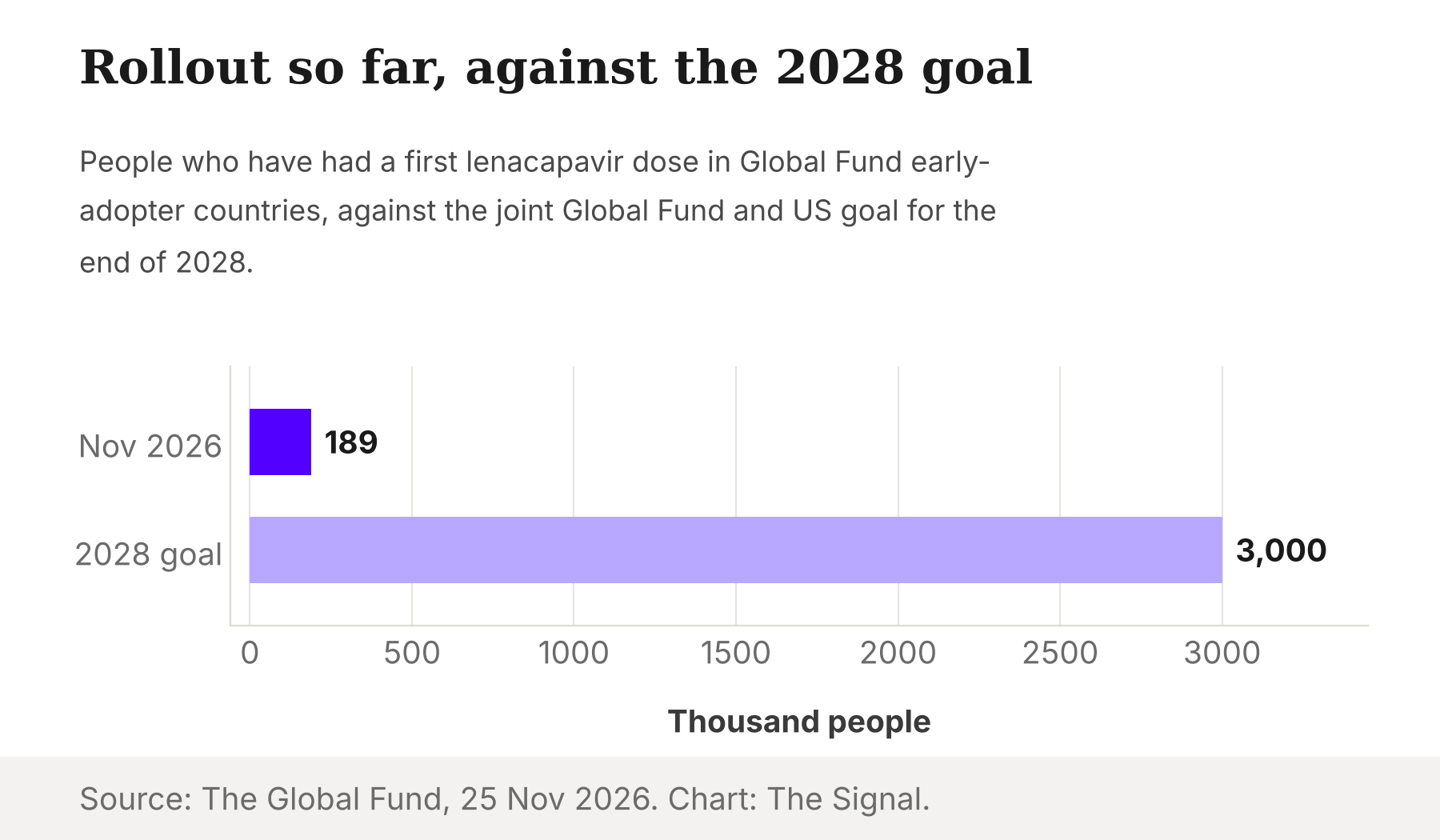
The buyers are donors. The Global Fund and the US government plan to deliver four times the 2026 volume of lenacapavir in 2027, and they have raised their joint ambition to 3 million people through 2028. Before generics existed, PEPFAR and the Global Fund had agreed to provide Gilead's product to as many as two million people over three years, Reuters reported. Pooled, guaranteed donor demand set the price. Indian factories fill the orders.
What a year of the shot is worth in rupees
Set the two prices side by side. At the rupee's 26 November close of 92.44 to the dollar, a $40 year of the shot works out to about Rs 3,698. A year of the private-market daily pill, at Rs 2,200 to Rs 3,000 a month, costs Rs 26,400 to Rs 36,000.
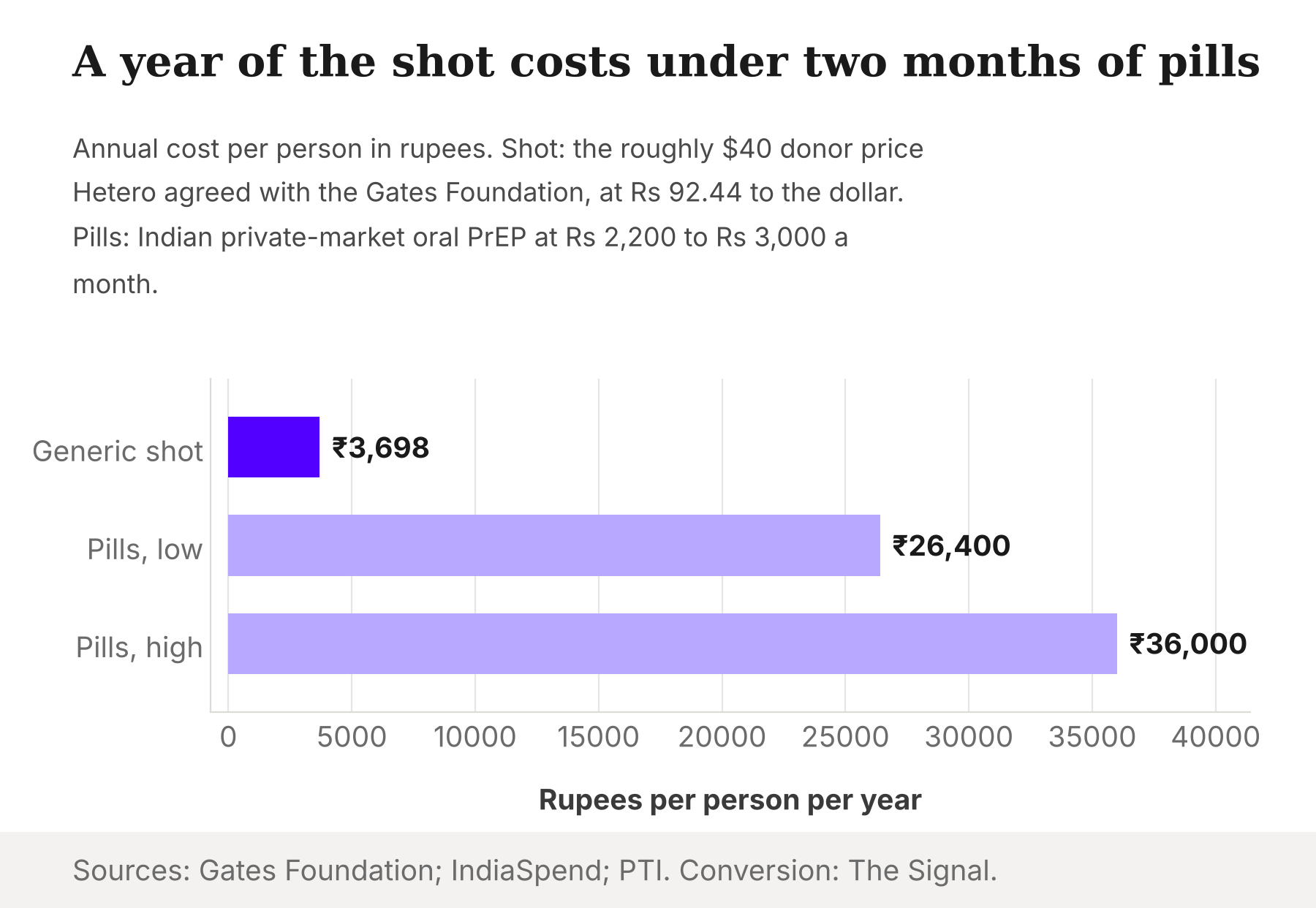
Put differently, a full year of the twice-yearly shot at the donor price costs what an Indian private buyer spends on five to seven weeks of pills. The comparison has a limit that should be stated plainly. The $40 is a donor procurement price for Global Fund markets, not a price any Indian pharmacy has quoted. Hetero says it plans to launch generic lenacapavir in India over the coming months, subject to regulatory approvals, and it has not announced an Indian price.
Why Africa is first
The sequence follows the money. Gilead's voluntary licence limits sales of the generics to 120 high-incidence, resource-limited countries, and the first doses went where a buyer with a budget was waiting. More than 189,000 people across 10 early-adopter countries had received a first dose by November 2026, according to the Global Fund. Against the 3 million goal, that is about 6% of the way there.
India's own buyer would be the National AIDS Control Organisation (NACO). It has not placed the equivalent bet. The 2022 PrEP guidelines exist on paper, and the oral pill remains available only privately or through a handful of non-profits in select cities. A drug that needs a programme to reach people cannot reach them through a programme that has not started.
The honest objection
The strongest case for India's caution is that its epidemic does not look like Zambia's. India's adult HIV prevalence fell from 0.33% in 2010 to 0.20% in 2024, against a global average of 0.7%, and new infections fell from 1.25 lakh in 2010 to 64,500 in 2024, government data released through PIB show. A low-prevalence, concentrated epidemic is a poor fit for broad PrEP, and money spent on prevention for people at low risk is money not spent on testing and treatment, which is what drove those declines.
That case is real, and it argues for targeting, not for absence. A concentrated epidemic is exactly where a discreet, twice-yearly product could earn its cost, because it can be aimed at the groups that carry most new infections without asking them to take a daily pill. The objection explains why India should not copy a mass African rollout. It does not explain why, four years after the 2022 guidelines, government centres still do not distribute PrEP.
The Signal
India's drug industry and India's health programme are now answering two different questions. Hetero has shown that an Indian factory can make a near-perfect HIV prevention shot at a price donors can fund at scale. NACO has not yet shown that India wants to buy it, even for the people at highest risk. Watch two things in the next few months: whether Hetero's Indian launch comes with a price anywhere near the roughly $40 donor price, and whether NACO announces any public PrEP rollout, oral or injectable. Until then, the cheapest HIV prevention India makes is an export.
Reporting basis: the shipment volumes, destination countries and India launch plan are per Hetero's announcement as reported by BioSpectrum India. The arrival of the first generic deliveries, the 189,000 first doses, the 2027 volume plan and the 3 million goal are from the Global Fund's release of 25 November 2026 and its update of 14 April 2026, and the efficacy description is the Global Fund's. The roughly $40 price and the volume guarantees are per the Gates Foundation's own September 2025 release, with the USD 28,000 comparison from UNAIDS; Yeztugo's $28,218 US list price is as reported by BioPharma Dive, and the earlier two-million-person PEPFAR agreement is per Reuters, as carried by The Tribune. The 120-country licence limit is per Health Policy Watch. India's prevalence and new-infection figures are from NACO's HIV estimates, via PIB. The absence of public PrEP distribution and the private pill price rest on a single source, IndiaSpend's March 2026 reporting. The exchange rate is PTI's, via Deccan Herald. The rupee cost of the shot, the annual pill cost, the weeks-of-pills comparison, the roughly 700-fold price gap and the 6% progress figure are The Signal's calculations from those figures.