
The headline number is easy to state. Climate Impact Lab's new El Niño heat tracker says about 55,000 heat-related deaths are projected in India, most of them in March, over the six months from October. Only Nigeria, at about 56,000, ranks higher. It is a forecast, not a count.
The obvious read is a climate-risk story: a very strong El Niño, a hot spring, a large country. That read is fair. NOAA's 8 October update has an El Niño Advisory in effect with the event strengthening, and a strong-to-very-strong El Niño likely through January to March 2027. India's own monsoon forecasters saw it coming. The India Meteorological Department cut its 2026 monsoon forecast to 90 percent of the long-period average on 29 May and raised the chance of a deficient monsoon from 35 percent to 60 percent.
It is worth slowing down on that number, because the more revealing figure sits next to it.
The count that would have to catch it
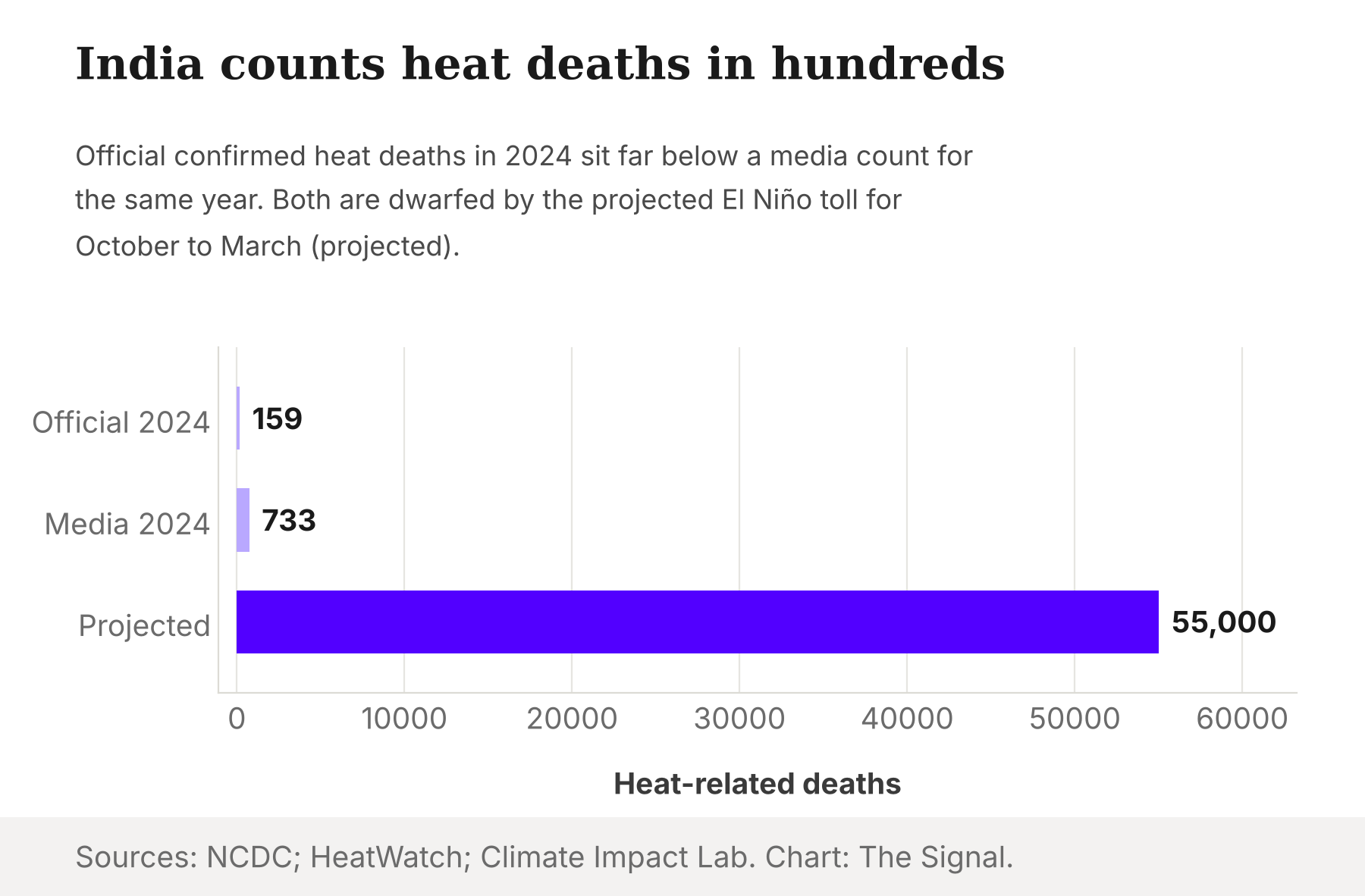
In 2024, India reported nearly 48,000 heatstroke cases and 159 deaths due to extreme heat, according to National Centre for Disease Control data obtained under the Right to Information Act and reported by PTI. The same data showed that in 2025, from 1 March to 24 June, India reported 7,192 suspected heatstroke cases and only 14 confirmed deaths.
Set 159 deaths beside 55,000 projected. The projected toll is about 346 times the confirmed heat deaths India recorded in all of 2024. The two numbers cover different years and different periods, so this is not a like-for-like comparison. It is a comparison of scale, and the scale is the point.
India does not agree with itself on what it counted
Even the 2024 baseline is contested. HeatWatch, a non-profit, built a count from news reports and identified a toll of 733 deaths in 2024, against an official figure of 360 that Down To Earth attributed to the Union Health Ministry. The 360 is more than double the 159 in the NCDC data above. That is two official-sounding numbers for one year, and a media tally twice the larger one.
The two kinds of number also measure different things. The official tallies count confirmed heatstroke deaths. The lab's projection counts additional heat-related deaths compared with a normal year, which is a wider net than a certificate that reads "heatstroke".
The number moved, and the reason is the calendar
The 55,000 is not the first India figure from this team. In September, its report projected over 15,800 additional heat-related deaths in India between September 2026 and February 2027, compared with a normal year, nearly half of them in December to February.
The October figure is about 3.5 times that. The lab says the global total rose mainly because it added March to the forecast window and because August and September turned out to be much warmer than forecast. For India, the tracker puts most of the deaths in March itself.
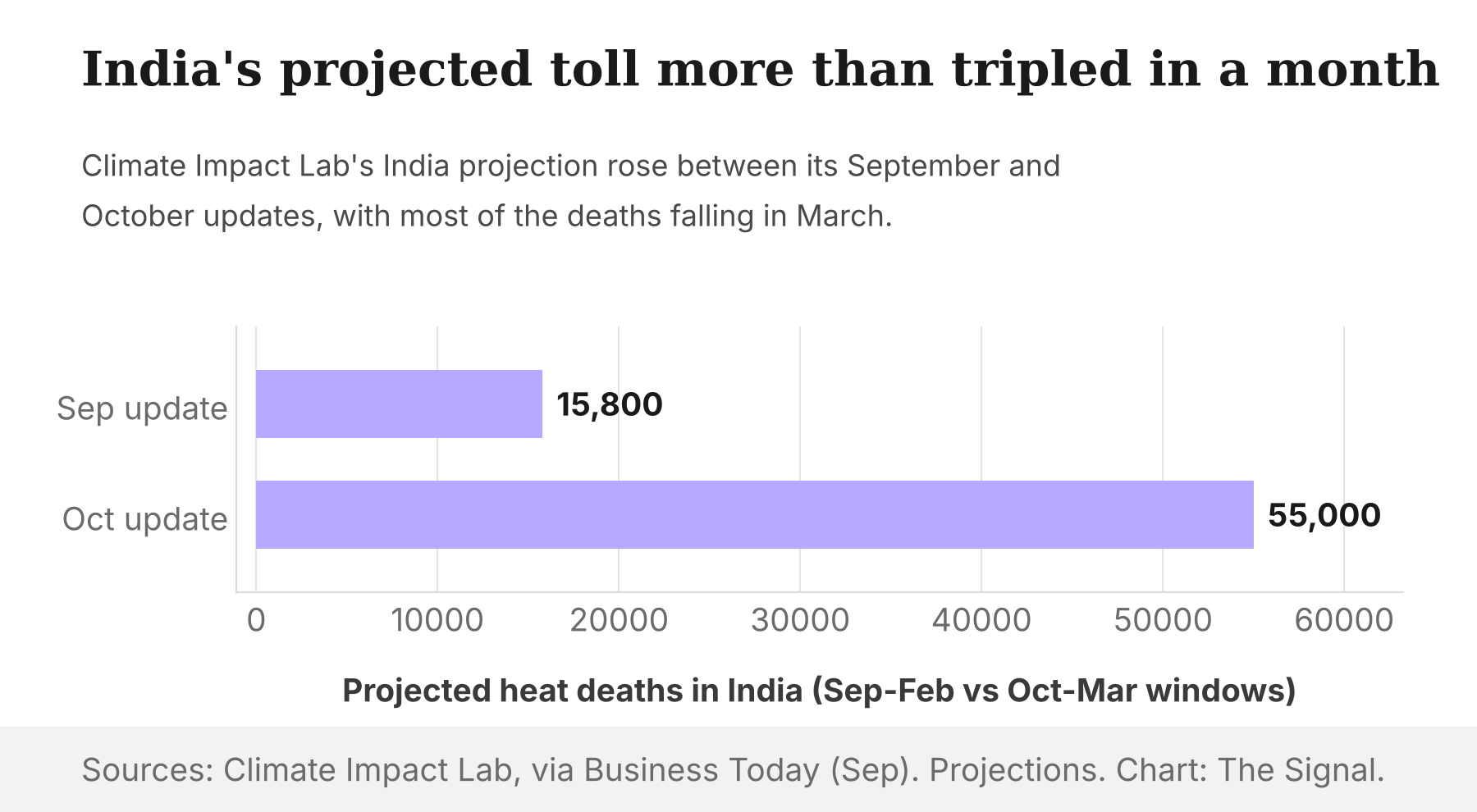
That timing matters, because most of the projected deaths fall in March, the last month of the forecast window.
The honest objection
The strongest case against the 55,000 comes from inside the field. The lab's estimates rest on temperature-mortality relationships across 24,378 regions, measured against a 1996 to 2025 average, and the methodology had not yet been peer reviewed when the September report appeared. Akshay Deoras of the University of Reading called the figures subjective and found the India projection "not so convincing" because India's deadly dry heatwaves typically occur outside the projection window. He added that no one has seen an El Niño quite like this one.
That objection is real and it should discipline how the number is used. It argues against quoting 55,000 as a prediction. It does not remove the gap in the baseline: India's NCDC data showed 159 confirmed heat deaths in 2024, and a media count for 2024 found 733.
The Signal
The risk in this forecast is not only the heat. It is that India's surveillance would record a mild-looking winter and spring while the real toll sat in deaths that are never certified as heatstroke, and in a March that arrives last. A system that confirmed 14 deaths from 7,192 suspected cases between March and June 2025 has already shown how narrow its net is.
Watch the next Climate Impact Lab update for any further move in the India figure, and watch whether state health departments publish heat-illness admissions for March, not only confirmed heatstroke deaths. If the 2027 NCDC count stays in the hundreds while the model says tens of thousands, one of them is wrong, and only one of them is being measured.
Reporting basis: the 55,000 India projection and the revision from the September figure are from the Climate Impact Lab's tracker, with the September figure as reported by Business Today of the lab's earlier report. The lab's methodology and the expert criticism of it are as reported by Al Jazeera, and the lab's methodology was not independently reviewed here. The 159 and 14 confirmed deaths are from NCDC data obtained under the RTI Act, as reported by PTI via ThePrint. The 733 media count is HeatWatch's analysis and the 360 official figure is the Union Health Ministry's, both as reported by Down To Earth, and the two official figures were not reconciled. The ENSO status is from NOAA's Climate Prediction Center and the monsoon forecast is the India Meteorological Department's, as reported by Business Today. The 346-times and 3.5-times comparisons are The Signal's calculations from those figures.