On 27 October 2026, a Supreme Court bench of Justices Vikram Nath and Sandeep Mehta heard a challenge to how India prices medicines, reserved its order and allowed written submissions within two weeks. Justice Nath put the central question to the Centre plainly: "What stops you from taking control of the entire range of medicines and drugs?"
The surface read is a familiar one. India has a drug price regulator, the National Pharmaceutical Pricing Authority (NPPA), and a statute, the Drugs (Prices Control) Order, 2013 (DPCO). Both sound like they cover medicines in general. The Centre's own framing supports that: the Press Information Bureau notes that "both schedule and non-schedule drugs are covered under DPCO, 2013."
It is worth slowing down on the word "covered."
Two kinds of control
The order divides medicines into two groups. Formulations listed in Schedule-I are "scheduled", and the NPPA fixes a ceiling price for them. Everything else is "non-scheduled." For those drugs, a manufacturer "is at liberty to fix the maximum retail price (MRP) of drugs launched by it", according to a February 2025 PIB release on the NPPA.
What the law does limit is movement after launch. Under para 20, no manufacturer can raise the MRP of a non-scheduled formulation by more than 10 percent in the preceding 12 months. So the regime has two instruments. For the scheduled group it sets the level. For the rest it caps the rate of change.
That distinction would be a technicality if the second group were small. It is not.
The figure that carries the argument
At the hearing, petitioner Kishan Chand Jain put non-scheduled medicines at about 83 percent of the market by value. The Centre's lawyer, Additional Solicitor General Aishwarya Bhati, did not dispute the shape of that. She said scheduled medicines are 35 percent by volume and 18 percent by price.
A parliamentary committee reached the same place in August 2026. Its 33rd report on the NPPA, as reported by South First, found that medicines whose prices the NPPA directly regulates account for "only 18 percent of the overall pharmaceutical market", with roughly 82 percent non-scheduled.
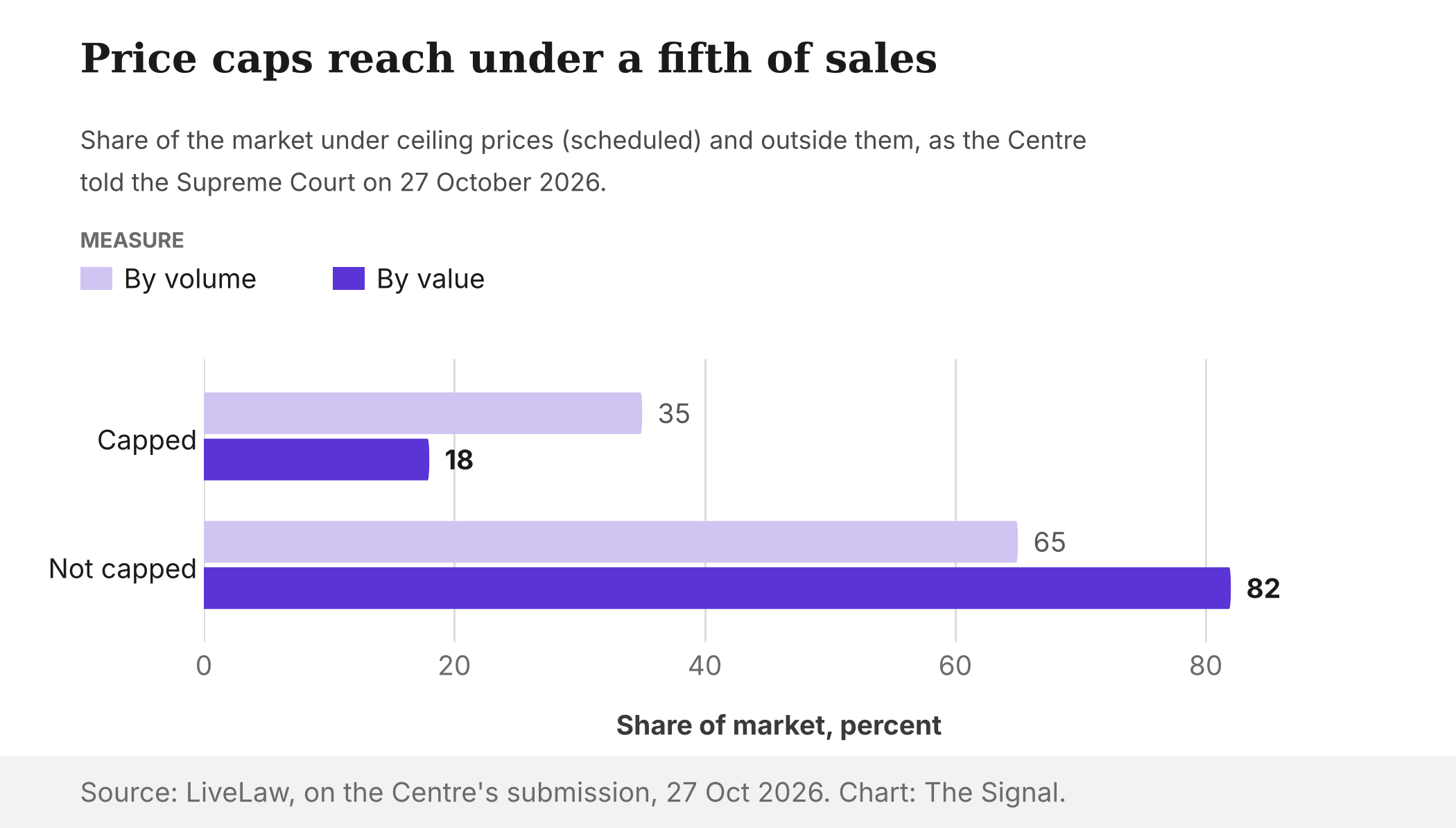
The volume and value figures also say something about price levels. Using the Centre's two numbers, non-scheduled medicines hold 65 percent of volume and 82 percent of value, while scheduled medicines hold 35 percent and 18 percent. Our calculation: value per unit sold is about two and a half times higher for non-scheduled medicines than for scheduled ones. The uncapped group is the more expensive group.
What a rate cap does not do
The Department of Pharmaceuticals has a defence ready. It told the committee that the average annual price increase for non-scheduled medicines between April 2020 and March 2025 was 5.6 percent, below the 10 percent ceiling. On that reading, the cap is working and the market is disciplining itself.
A cap on increases cannot discipline a starting price, though. A drug launched at a high MRP can rise by 5.6 percent a year from that base indefinitely without breaching anything. The bench's examples were all about the level, not the pace. Justice Mehta cited a saline drip with an MRP of ₹15 sold for ₹270, and said government pharmacies sell a medicine for ₹6 that carries an MRP of ₹270. Those gaps sit between the printed price and the price paid, and a 10 percent annual limit on the printed price does not touch them.
The fix that already exists has a quirk
The Centre does intervene outside the schedule, case by case. It has capped MRPs for 106 non-scheduled formulations in 2014, set ceilings for stents and knee implants in 2017, and capped trade margins on 42 anti-cancer drugs in 2019, as it described them to the Court. The Centre also told the Court there is no legal bar to wider control. The limit, it said, is a policy choice.
The anti-cancer cap shows both the promise and the problem. The NPPA says the 30 percent trade margin cap on 42 non-scheduled anti-cancer medicines cut the MRP of 526 brands by around 50 percent on average and saves patients about ₹984 crore a year. That is a large effect from a narrow list.
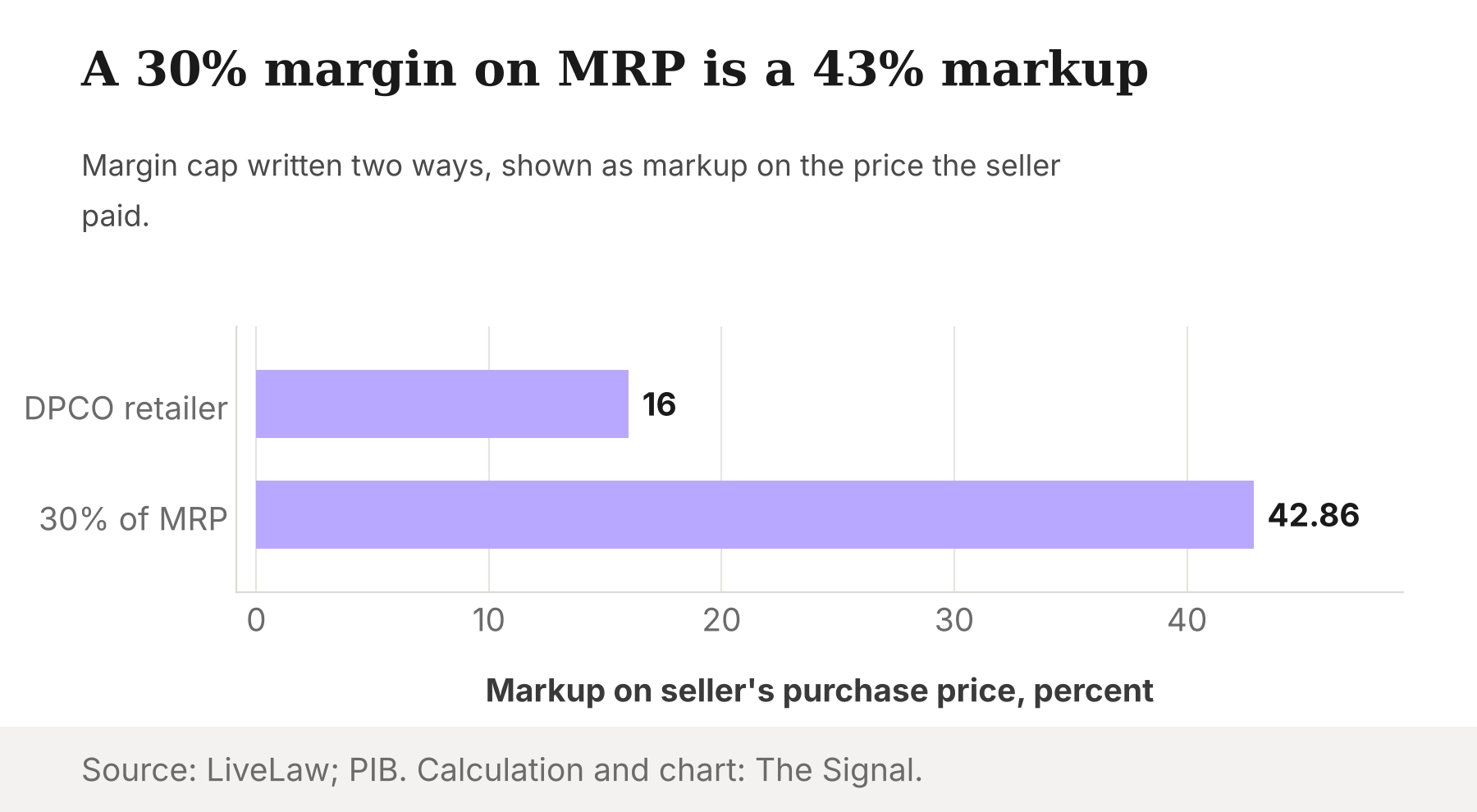
But the petitioner argued the wording matters. A 30 percent margin on MRP equals a markup of about 42.86 percent on the purchase price, while the DPCO formula for scheduled drugs allows a 16 percent retailer margin on the price to the retailer. The arithmetic is simple: a 30 percent cut of the selling price is 30 divided by 70 of what the seller paid.
The honest objection
The Centre's case deserves full weight. It told the Court that complete price control is not the answer, that it constantly calibrates drug prices, and that Indian medicine prices are among the lowest in the world. Its filings point to real reasons for higher margins on some products: low-value items, rural distribution, cold chains and expiry returns. A blanket ceiling set badly could push a supplier out of remote markets or a cheap product off the shelf.
The bench was not persuaded. It told the Centre: "Your calibration is too wayward." That exchange leaves the real disagreement narrow. Nobody is arguing that distribution costs are zero. The dispute is whether a regime that fixes levels for about a fifth of sales and limits increases on the rest is the right place to put the line.
The Signal
The order is reserved, so nothing has changed yet. What the hearing has done is put one number on the record: by the Centre's own count, price ceilings reach 18 percent of sales by value. If the Court tells the Centre to widen coverage, the practical form could be margin caps by category, the tool the Centre already uses, rather than a single ceiling on everything. If it declines, the 10 percent rule stays the only brake on most of the market, and the next thing to watch is whether launch prices, which no one currently regulates, start to carry the weight. A price cannot be said to rise too fast when it never had a ceiling to start from.
Reporting basis: the DPCO's scheduled and non-scheduled definitions, the para 20 limit and the anti-cancer margin cap are from Press Information Bureau releases of 30 July 2024 and 7 February 2025 on the Department of Pharmaceuticals and the NPPA. Everything said at the 27 October 2026 hearing, including the market-share figures given by the petitioner and the Centre's lawyer, the Court's remarks, the price examples and the Centre's list of past interventions, is per LiveLaw's report of the hearing, and the Court's "wayward" remark and the Centre's arguments are as also reported by LawBeat. The committee's 18 percent figure and the 5.6 percent average annual increase are per South First's report of the 33rd Report of the Standing Committee on Chemicals and Fertilizers; the original report was not checked, and the committee's and the Centre's 18 percent figures may share one underlying source. The petitioner's 42.86 percent markup is his argument as reported by LiveLaw. The value-per-unit multiple is The Signal's calculation from the Centre's volume and value shares.