On 22 October 2026, Gavi and UNICEF announced a deal to bring the price of the RTS,S malaria vaccine, sold as Mosquirix, to EUR 5.50 per dose, a cut of about 40 percent. Reuters put that at $6.16 a dose and reported that the lower price should take effect by early 2027. The savings are real: the two organisations expect around US$50 million between 2027 and 2029, and say that money could protect up to one million more children with the full four-dose course.
The surface read is a pharmaceutical company giving ground on a children's vaccine, and a clean win for global health. Part of that is right. Cheaper doses mean more children covered.
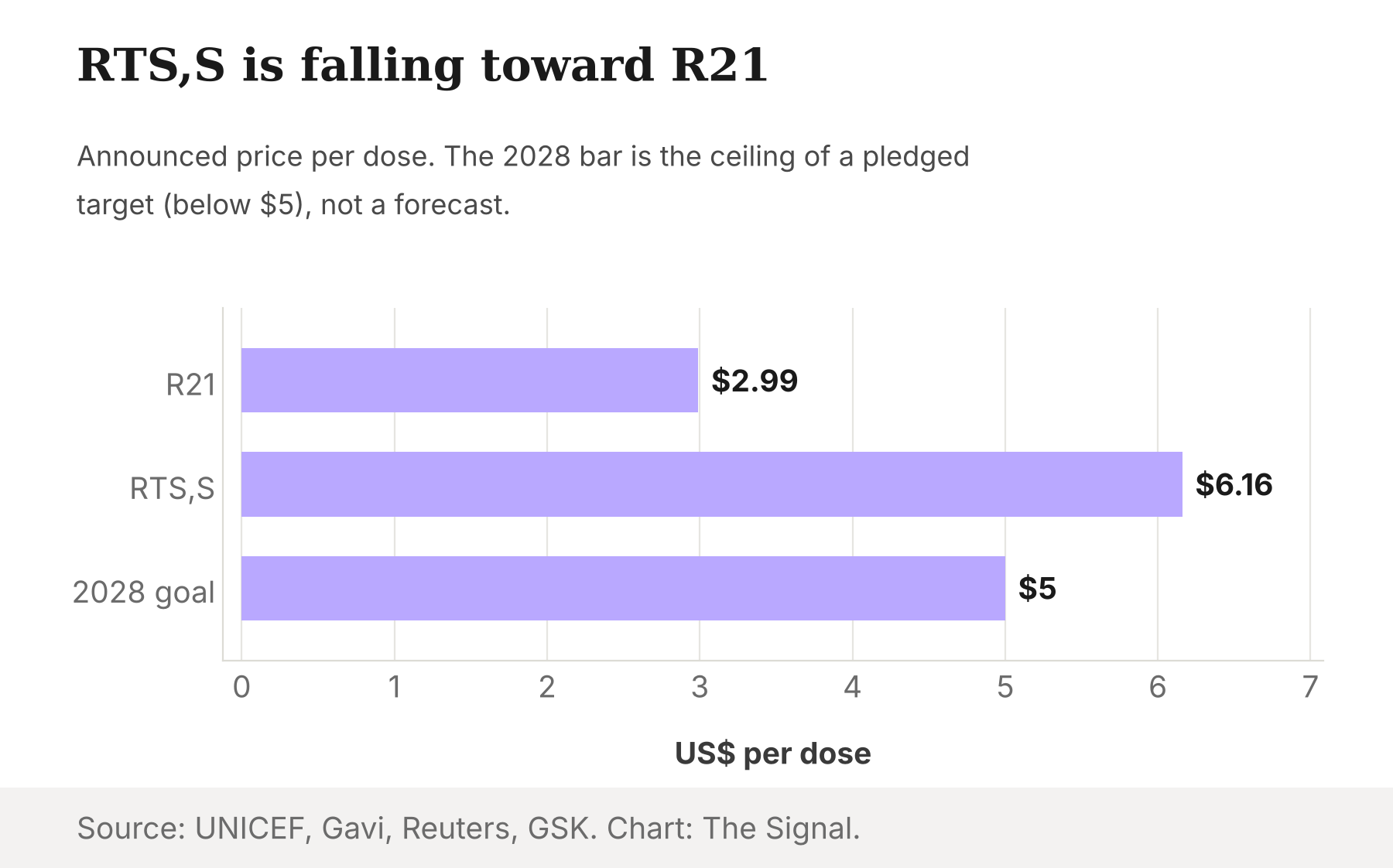
It is worth slowing down on the number itself, though. The other approved malaria vaccine, R21/Matrix-M, was priced by Gavi and UNICEF in November 2025 at US$2.99 per dose, with that lower price anticipated to take effect in approximately one year. Set $6.16 beside $2.99 and RTS,S, after its 40 percent cut, still costs about twice as much per dose.
The gap is not buying a better vaccine
If RTS,S were the stronger product, a premium would make sense. The World Health Organization says it is not obviously so. In its question-and-answer page on the two shots, WHO states that both vaccines are safe, efficacious and prequalified. It adds that they have not been tested in a head-to-head trial, and that there is no evidence to date showing that one vaccine performs better than the other. The same page says R21 is currently less expensive than RTS,S.
The schedule is identical: four doses per child. That makes the per-child arithmetic simple. At the announced prices, four doses of R21 come to $11.96 and four doses of RTS,S to $24.64.
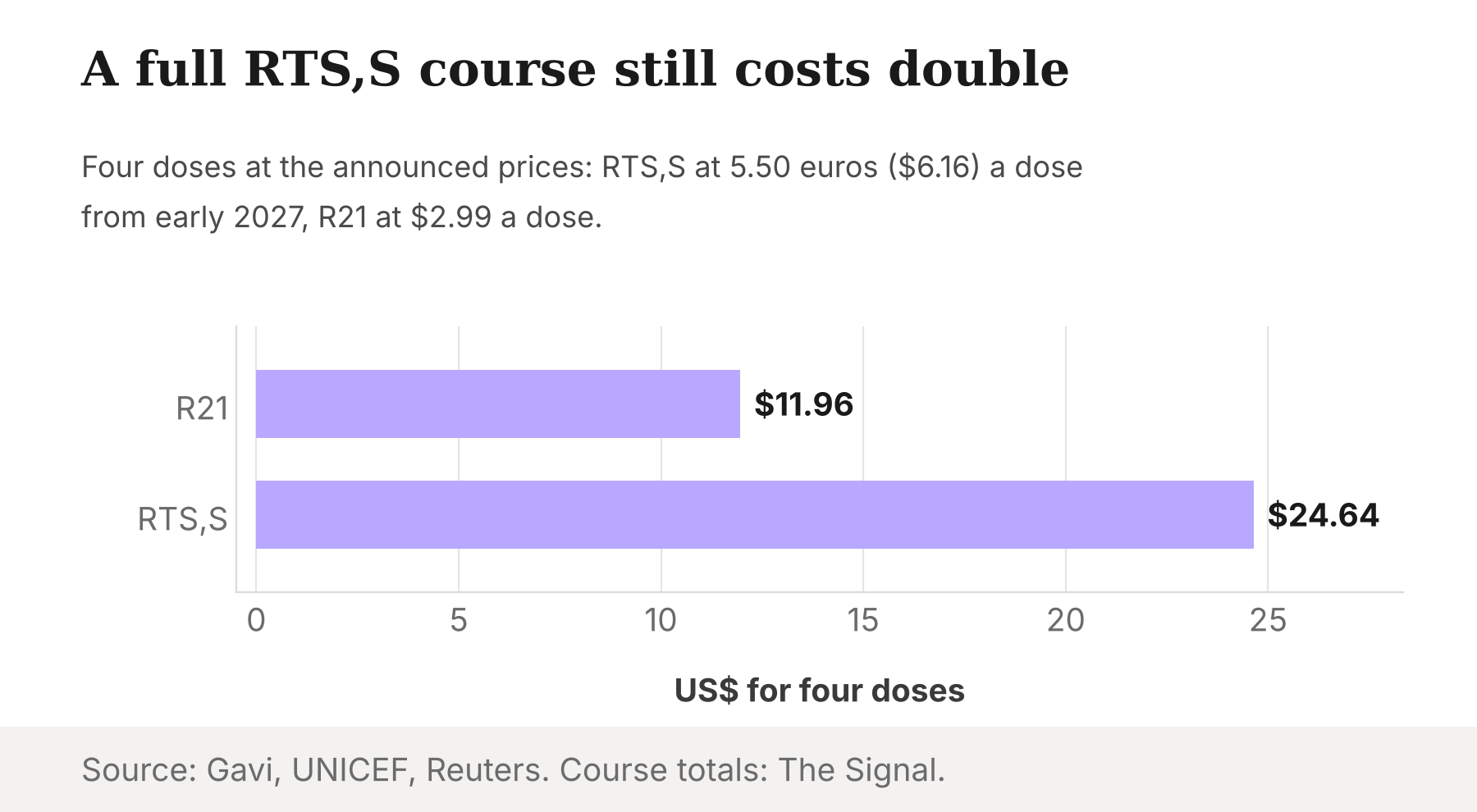
A caveat on comparability. Because the vaccines have not been tested in a head-to-head trial, per WHO, "no evidence of a difference" is not proof of equivalence. Programmes may have reasons to buy both, including supply security. But on the evidence WHO has published, the buyer is paying roughly double for a product with no demonstrated advantage.
The price cut is a manufacturing story
The cut did not come from GSK, the company that developed RTS,S with partners. The vaccine is now being transferred from GSK to Bharat Biotech for future supply. Reuters reported that GSK will keep supplying the adjuvant until Bharat fully takes over production, expected by 2028, the ingredient that boosts the vaccine's immune response.
That timeline matters because the lower price is not simply switched on. The agreement is subject to regulatory and manufacturing milestones, and Reuters said UNICEF cannot begin buying doses until those are met, including WHO prequalification of a new manufacturing facility. The price is a promise tied to a factory that has to pass inspection first.
It also sits above a target the companies set themselves. In June 2025, GSK said Bharat Biotech would be reducing the price of RTS,S to less than $5 progressively by 2028, and that Bharat had invested over $200 million in new, higher-output manufacturing facilities. The new price of $6.16 is the first step on that path, not the end of it. Even the 2028 ceiling of $5 would leave RTS,S above R21's $2.99.
For an India-anchored reader, the point is that the cost curve of a vaccine for African children now runs through Indian factories. R21 carries the Serum Institute of India among its developers: UNICEF's release describes it as co-developed by the University of Oxford and Serum Institute of India. RTS,S is moving to Bharat Biotech. India's manufacturers are not just suppliers here. Their capacity and pricing now shape what buyers can pay.
Why price is the lever that matters
Cheaper doses only count if money, not supply, is what limits coverage. WHO's May 2026 statement says it is. It reports that 25 endemic African countries are offering malaria vaccines, and that funding constraints are preventing many countries from scaling up malaria vaccination to their national targets. Gavi's own page counts over 39 million doses delivered as of 28 January 2026.
The stakes are measurable. An evaluation in Ghana, Kenya and Malawi found that an estimated 1 in 8 child deaths were averted among those eligible over four years. WHO also notes that an estimated 438 000 African children died of malaria in 2024. When a programme is budget-bound, every dollar shaved off a dose is a dose someone else gets.
That is also why the earlier deal on R21 mattered. The November 2025 agreement was expected to save up to US$90 million, against around US$50 million for the new RTS,S deal. The savings are different sizes and cover different periods, so they are not a like-for-like comparison. But the pattern is the same: the lower the unit price, the further a fixed budget stretches.
The honest objection
The strongest case against reading too much into the price gap is that vaccine procurement is not a simple lowest-price auction. WHO says the two vaccines have not been tested in a head-to-head trial, so a programme cannot be sure they are interchangeable. Buying from two suppliers protects against a factory problem at either one, and that has value the per-dose price does not capture. The RTS,S price is also still falling: the 2028 target is not yet reached, and the milestones that unlock the new price could slip.
That case is real, and it supports keeping both products on the shelf. It does not explain why one costs twice as much as the other for the same four-dose schedule with no demonstrated difference in performance. Supply insurance is worth paying for. Whether it is worth a $12.68 premium per child, is a question the buyers will have to answer with their own budgets.
The Signal
The headline cut is the smaller story. The larger one is that the vaccine is moving from GSK to Bharat Biotech, with GSK to keep supplying only the adjuvant, so malaria vaccine pricing increasingly runs through Indian manufacturers. That shift is what made a 40 percent cut possible, and it is what could bring RTS,S below $5 by 2028 if Bharat Biotech's new facility clears WHO prequalification.
Watch two things. First, whether prequalification arrives on schedule, because UNICEF cannot buy at the new price until it does. Second, whether RTS,S closes the gap with R21 or settles at a permanent premium. In a market where funding constraints decide how many children get a dose, a price that is twice the rival's has to be earned by something other than the brand.
Reporting basis: the RTS,S price, savings, milestone conditions and the transfer to Bharat Biotech are from the Gavi and UNICEF release of 22 October 2026, as also reported by Reuters (read via Yahoo), which supplied the dollar conversion, the early-2027 timing and the adjuvant detail. The R21 price and the Oxford and Serum Institute development credit are from UNICEF's November 2025 release. The under-$5 target and Bharat Biotech's investment are GSK's own statement of June 2025, so they rest on a single company source. Efficacy, schedule, relative cost, funding constraints and mortality figures are from the World Health Organization, and the delivered-dose count is from Gavi's vaccine support page. The per-course totals, the roughly twofold per-dose gap and the $12.68 premium per child are The Signal's calculations from those figures.