
A familiar picture of tobacco control is a race to keep teenagers from starting. By that measure India has something to show. In the last national Global Adult Tobacco Survey, fielded in 2016-17, adult tobacco use had fallen from 34.6% in 2009-10 to 28.6%, and the mean age at which people start had risen from 17.9 to 18.9 years. Fewer young people were using, and those who did were starting later.
It is worth slowing down on that. The same survey also says where the users are, and it is not where the race is being run.
The users are adults
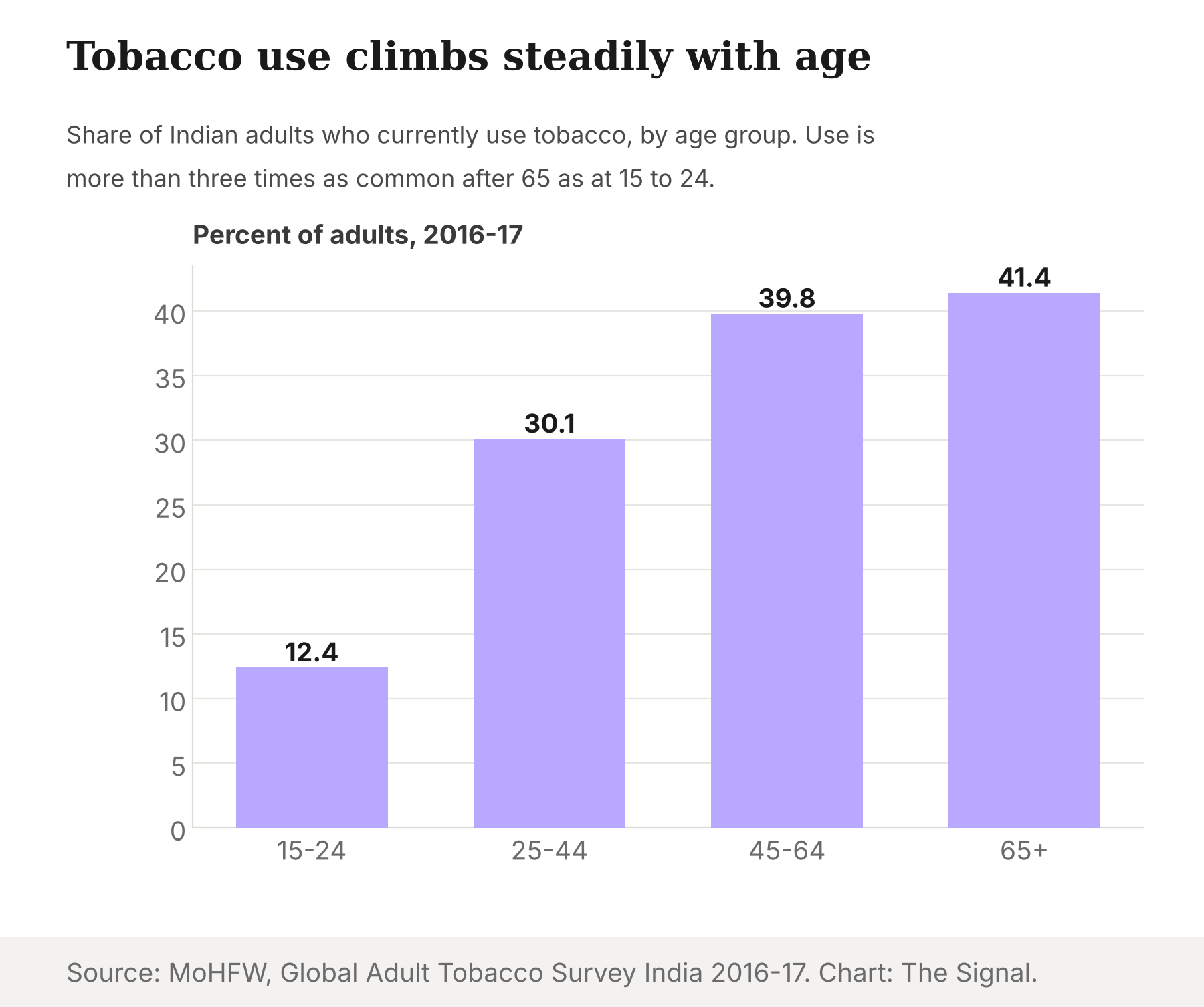
In that 2016-17 survey, current tobacco use was 12.4% among adults aged 15 to 24, 30.1% at 25 to 44, 39.8% at 45 to 64 and 41.4% at 65 and over. Use among people past 65 was more than three times the rate among the youngest group.
The newer national household survey points the same way. Data For India, drawing on NFHS-5 (2019-21), reports that more than half of men in their 30s and 40s use tobacco, compared with just over a quarter of men in their 20s. Two surveys a few years apart tell one story. The age gradient is steep and it is not an artifact of one questionnaire.
Most of the use is smokeless
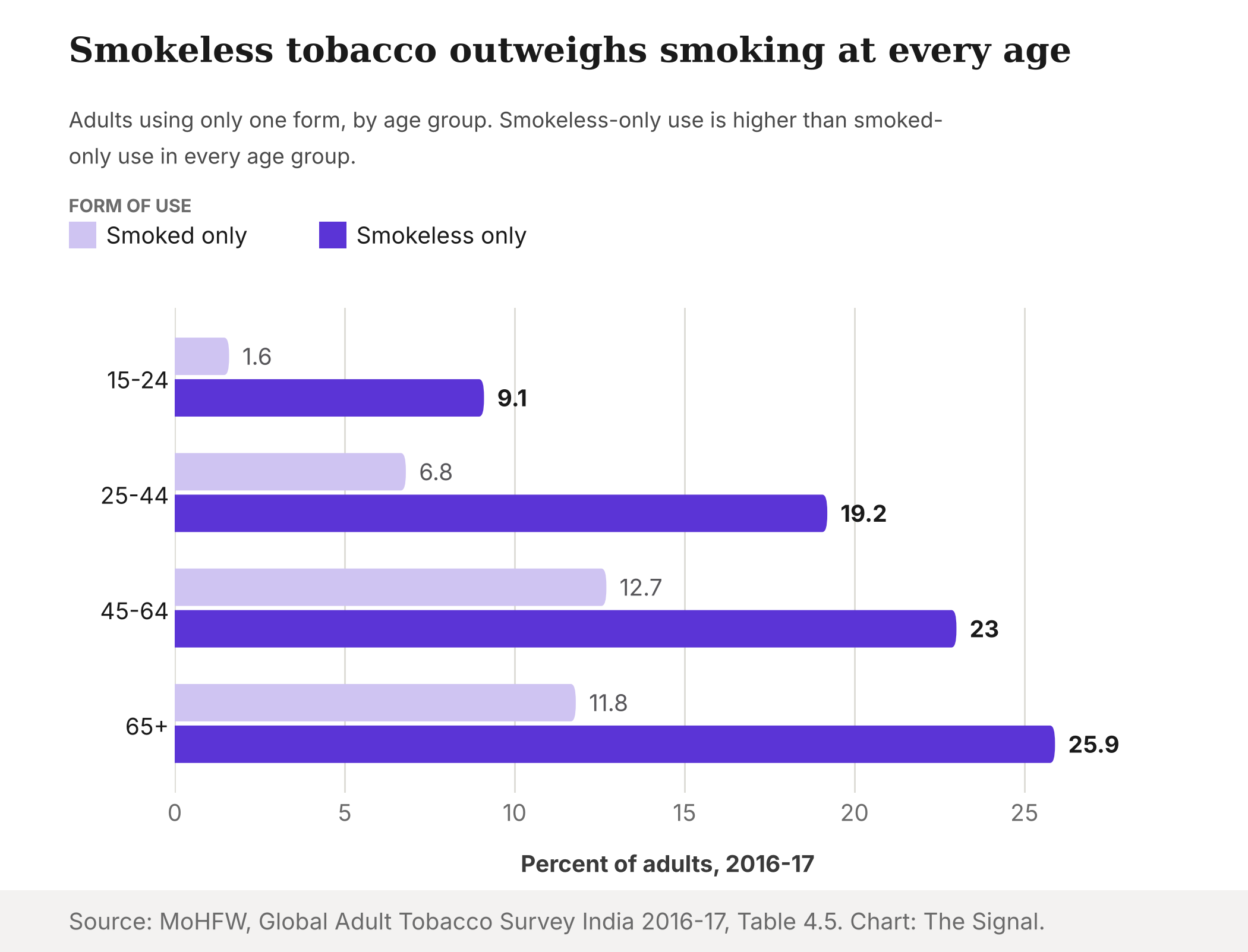
The form of use matters for who the users are. Overall, 17.9% of adults used smokeless tobacco without smoking, 7.2% only smoked and 3.4% did both. Smokeless-only use was about two and a half times smoked-only use.
The split holds in every age group: smokeless-only use was 9.1% among 15 to 24 year olds and 25.9% among those 65 and over, against smoked-only use of 1.6% and 11.8%.
| Age group | Smoked only (%) | Smokeless only (%) |
|---|---|---|
| 15 to 24 | 1.6 | 9.1 |
| 25 to 44 | 6.8 | 19.2 |
| 45 to 64 | 12.7 | 23.0 |
| 65 and over | 11.8 | 25.9 |
Adults using one form only, GATS-2 India, 2016-17. Source: MoHFW, Global Adult Tobacco Survey India 2016-17.
The cancer arrives late
Tobacco harm is slow, so the age of the users and the age of the cancers line up. ICMR-NCDIR reports that the age-specific incidence of cancer at tobacco-associated sites is highest at 70 to 74 for both sexes in most registries, and projected 427,273 such cancers for 2025, 27.2% of all cancers, with lung cancer the largest at 111,328. An earlier ICMR release estimated that tobacco-related cancers were 3.7 lakh, or 27.1%, of the 2020 cancer burden.
These are cancers at sites associated with tobacco, not all caused by it. Still, a registry peak at ages 70 to 74 describes people who started decades ago, and no rule on teenage sales can reach them.
The honest objection
The strongest answer to all this is that an age gradient is not a verdict. Older Indians grew up when use was higher, and each new cohort starts from a lower base, so a snapshot makes the old look worse than the young will become. That is right, and it is what prevention is for. The low rate of 12.4% among the youngest group is the policy working.
But it answers a different question. Prevention changes the burden of the decades ahead. The cancers projected for 2025 belong to adults who have already used tobacco for years. For them the lever that exists is quitting.
Quitting is the thinner side of the ledger
The survey shows willingness. 33.2% of smokeless tobacco users made a quit attempt in the 12 months before the survey. Roughly one in three tried, in a year, with whatever help was at hand.
What support exists is easy to name and hard to size. The government runs a national tobacco quitline at the Vallabhbhai Patel Chest Institute. The programme page lists a toll-free number and a missed-call number. The Signal found no published call volumes, quit rates or follow-up outcomes on it, so we cannot say whether capacity is matched to the size of the user base. That absence is itself the point: the prevention side of the ledger has survey numbers, and the quitting side does not show its own.
India is not alone in the pattern. WHO's October 2025 report says the number of tobacco users fell from 1.38 billion in 2000 to 1.2 billion in 2024, and it calls for expanding cessation services so millions more can quit. Falling prevalence does not by itself empty the clinics.
The data is old, and that matters
Be plain about the age of the evidence. The age-group figures above are from the 2016-17 survey, nine years old today. NFHS-5 is newer, from 2019-21, and points the same way. Use may well have fallen further since, and the age gradient may have flattened. A fresh national round would settle that, and until it arrives these are the best age-by-age numbers the country has.
The Signal
India's tobacco story has two timelines. On the first, fewer teenagers start and those who do start later, a real gain that will pay out over decades. On the second, adults who started long ago are using tobacco now and developing cancers now, with the registry peak at ages 70 to 74. Policy attention and policy evidence both sit on the first timeline.
Watch for two things. One is the next national survey after GATS-2, which will show whether the adult age gradient has begun to flatten. The other is whether the quitline and cessation services publish what they reach and how many quit, because a programme that does not report its outcomes cannot be steered. A country can win the race for the young and still lose the decade that matters to the old.
Reporting basis: the age-group prevalence, smoked and smokeless use, the 34.6% to 28.6% decline, the 17.9 to 18.9 year rise in the mean age at starting, and the quit-attempt figure are from the Ministry of Health and Family Welfare's Global Adult Tobacco Survey India 2016-17 report, read directly. The cancer projections are from ICMR-NCDIR's report on tobacco-associated cancer sites and its 18 August 2020 press release, both read directly. The NFHS-5 age comparison is per Data For India's presentation of NFHS-5 and rests on that single secondary source. The quitline description is from the National Tobacco Control Programme's website, and the global user counts are from WHO's October 2025 release. The multiples (more than three times, about two and a half times) are The Signal's calculations from those figures.