On October 17, India's drug pricing regulator capped trade margins on 137 anti-cancer drugs at 30 percent of the maximum retail price (MRP). The revised prices will come into effect on November 9 and remain in force until further orders, according to The Tribune's report on the order. The headline version is easy to write: cancer drugs get cheaper.
The number attached to it is harder to read. The regulator expects the cap to reduce MRPs broadly in the range of 20 to 70 percent, Business Today reported after the National Pharmaceutical Pricing Authority (NPPA) met on October 8. A regulator that only limits what wholesalers and chemists add on top of a price is forecasting cuts of up to 70 percent. That is only possible if the margin was a very large part of the price.
What the cap actually touches
The trade margin is the gap between what a distributor or chemist pays for a drug and the MRP printed on the pack. The cap says that gap cannot exceed 30 percent of the MRP. It does not set a price for any drug.
That is a different tool from the ceiling prices NPPA fixes for drugs on the essential medicines list. These 137 drugs are "non-scheduled", meaning they sit outside that list. The cap is a way to reach them without setting a price for each. The Tribune lists pembrolizumab, nivolumab, osimertinib, palbociclib, ribociclib, abemaciclib, atezolizumab and bevacizumab among the examples of covered drugs.
The figure that carries the argument
The existing markup explains the 70 percent. According to the NPPA meeting minutes as reported by Medical Dialogues, non-scheduled anti-cancer drugs carry an average trade mark-up of approximately 170 percent, based on Pharmarack market data.
Here is what that implies. Suppose the 170 percent markup is measured on the price the trade pays. The reports do not define the base, so this is an assumption. A drug the trade buys for ₹100 would then carry an MRP of ₹270, and ₹170 of that, about 63 percent, would be margin. A 30 percent cap means the same ₹100 can support an MRP of about ₹143. That is a fall of roughly 47 percent. Those are our calculations, and they land inside the 20 to 70 percent range the regulator quoted.
Strip the margin out and the cut needs no other explanation. That is also why the range is so wide: the 20 to 70 percent spread tracks how fat each drug's markup was.
Seven years of scope creep
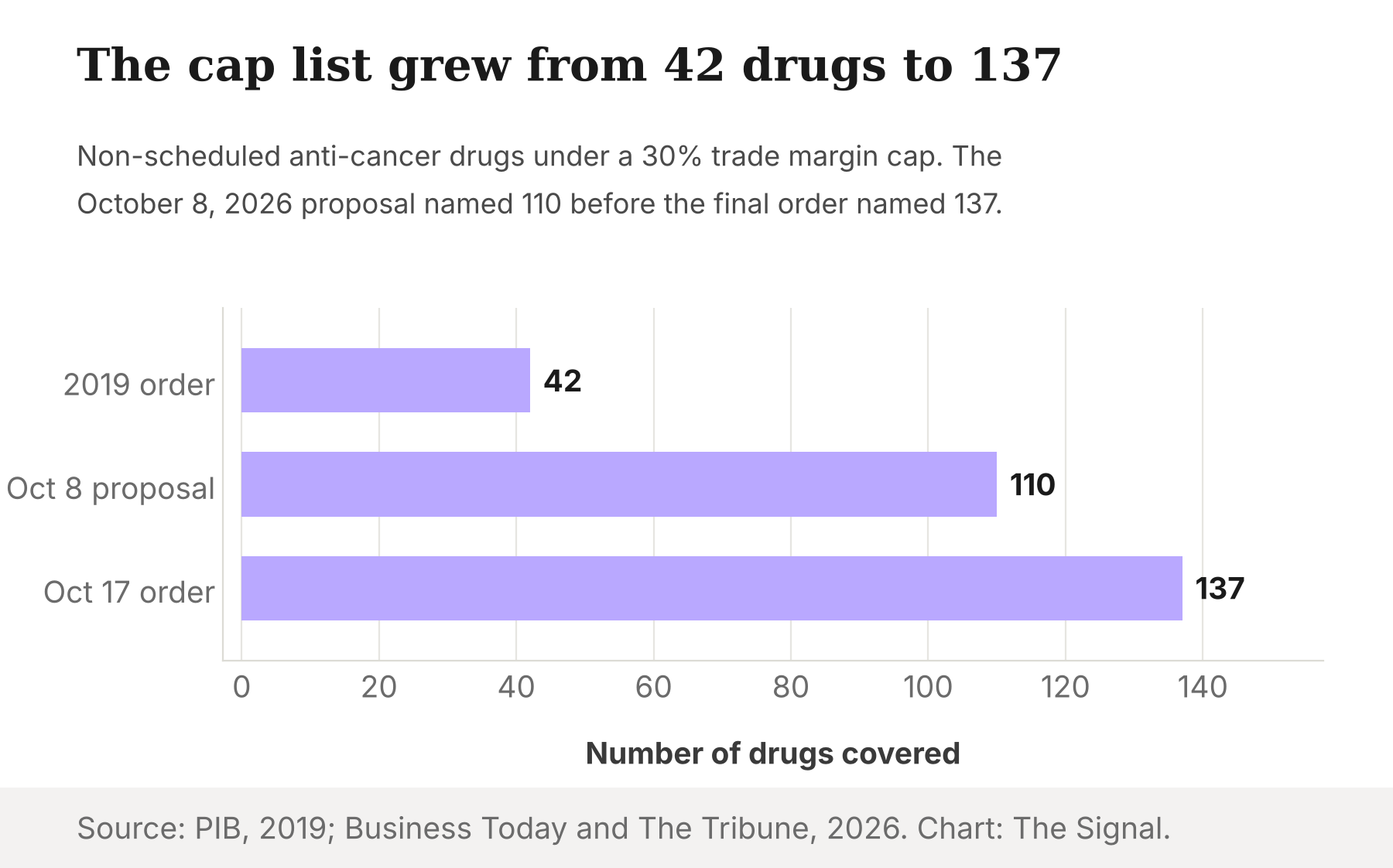
This is not NPPA's first cancer drug cap. In February 2019 it selected 42 non-scheduled anti-cancer medicines for a 30 percent cap, covering 72 formulations and 355 brands, according to the Press Information Bureau (PIB). The government described that order as a pilot for "proof of concept." By August 2021, PIB said the cap had produced a reduction of up to 90 percent in the MRP of 526 brands.
The 2026 list is more than three times as long. And it moved while the ink was wet: the October 8 proposal named 110 drugs, including 35 patented medicines. Nine days later the order named 137.
The savings estimate points the same way
The scale of the claimed savings tells the same story. The government estimates annual savings of ₹2,500 crore for cancer patients from the cap, Business Today reported. That estimate came with the 110-drug proposal.
The 2019 order carried a far smaller promise. PIB said there will be a minimum saving of Rs. 200 crore per annum to cancer patients from it. Divide each estimate by the drugs in its list and the 2019 figure is about ₹4.8 crore per drug against about ₹22.7 crore for the 2026 proposal. That is nearly five times as much per drug.
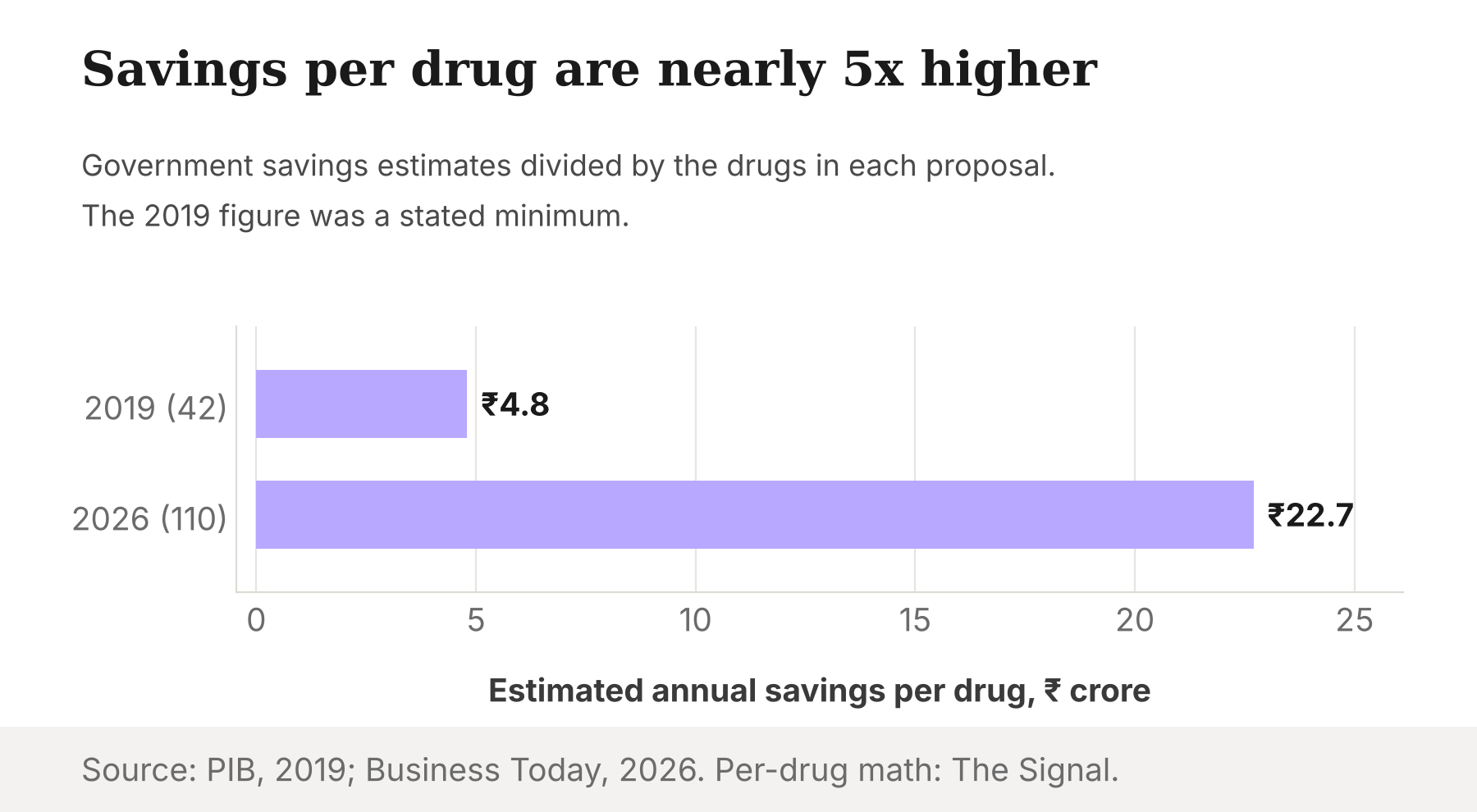
Two things could explain the gap. The 2019 number was a stated floor, so the true figure may have been higher. Or the newer list is full of expensive drugs. Several examples named in the order, pembrolizumab and nivolumab among them, are modern immunotherapy and targeted drugs, where a given percentage margin is worth far more rupees per pack. Both can be true at once.
The honest objection
The strongest case against reading too much into these numbers is that all of them are government projections. The 70 percent is a ceiling for the best case, not an average. The ₹2,500 crore is an estimate made before the list grew. Nothing in the reports describes what happens after November 9: whether chemists absorb the lower margin, whether manufacturers reprice, or whether hospital pharmacies pass savings to patients.
That objection is fair, and it is why the piece rests on the arithmetic rather than the promise. Even if the realised cuts come in well under the ceiling, the regulator's own range of 20 to 70 percent says something about how the price was built. The 2019 experience also counts for something. PIB's 2021 account reported cuts of up to 90 percent across 526 brands, not a one-off headline.
The Signal
The cap is a statement about where cancer drug prices come from. If a 30 percent ceiling on distribution can move shelf prices by anything like the figures quoted, then a large share of what patients paid was never the cost of the drug. It was the cost of getting the drug to them.
Watch two things after November 9. The first is the list of revised MRPs manufacturers must file; the spread between the biggest and smallest cuts will show how uneven the markups were. The second is whether the 137 become 200, as 42 became 137. The regulator has now twice reached for the margin as its lever. A shelf price is a story about who stood between the maker and the patient.
Reporting basis: the 137-drug order, its November 9 start date and the example drugs are per The Tribune, reporting the order; the NPPA notification itself could not be retrieved. The October 8 meeting figures (the price-cut range, the savings estimate and the proposal size) are per Business Today, reporting a government statement. The average markup is per Medical Dialogues, citing NPPA minutes that in turn cite Pharmarack data, and rests on that single secondary source. The 2019 and 2021 figures are from Press Information Bureau releases. The implied margin share, the implied price cut, the per-drug savings figures and the comparison between them are The Signal's calculations from those figures.