
On 7 October 2026 the World Health Organization published its guideline on the integrated management of obesity in children, with a companion guideline for adolescents. The headline recommendation is a prohibition. WHO does not recommend pharmacological interventions for obesity management for children 0–9 years of age, and the recommendation is rated strong. The easy read is that WHO has slammed the door on weight-loss drugs for young children.
It is worth slowing down on that. The strength of a recommendation is not the strength of the evidence behind it. WHO rates the evidence for the drug ban as low, and the reason is telling. The WHO-commissioned Cochrane review "did not identify any studies that included children under 6 years of age. Eight studies included children 6 years or older; seven assessed metformin and one assessed liraglutide". The guideline says no to drugs because no one has shown they are safe for growth and development in this age group, not because trials found harm.
A line drawn at age 10
The same logic runs through the surgery recommendation. WHO does not recommend bariatric surgery and weight-loss or weight-management devices for children 0-9 years of age, and rates the evidence there as none at all.
At age 10 the posture changes. In the adolescent guideline, WHO suggests drugs for ages 10-19 with obesity and related complications "only after a structured and supervised programme of multimodal lifestyle modification has failed". That is a conditional recommendation, not a ban.
| Age band | WHO position on obesity drugs | Strength |
|---|---|---|
| 0 to 9 years | Not recommended | Strong |
| 10 to 19 years | Suggested only after lifestyle programme fails | Conditional |
Source: WHO guidelines on the integrated management of obesity in children and in adolescents, October 2026. Table: The Signal.
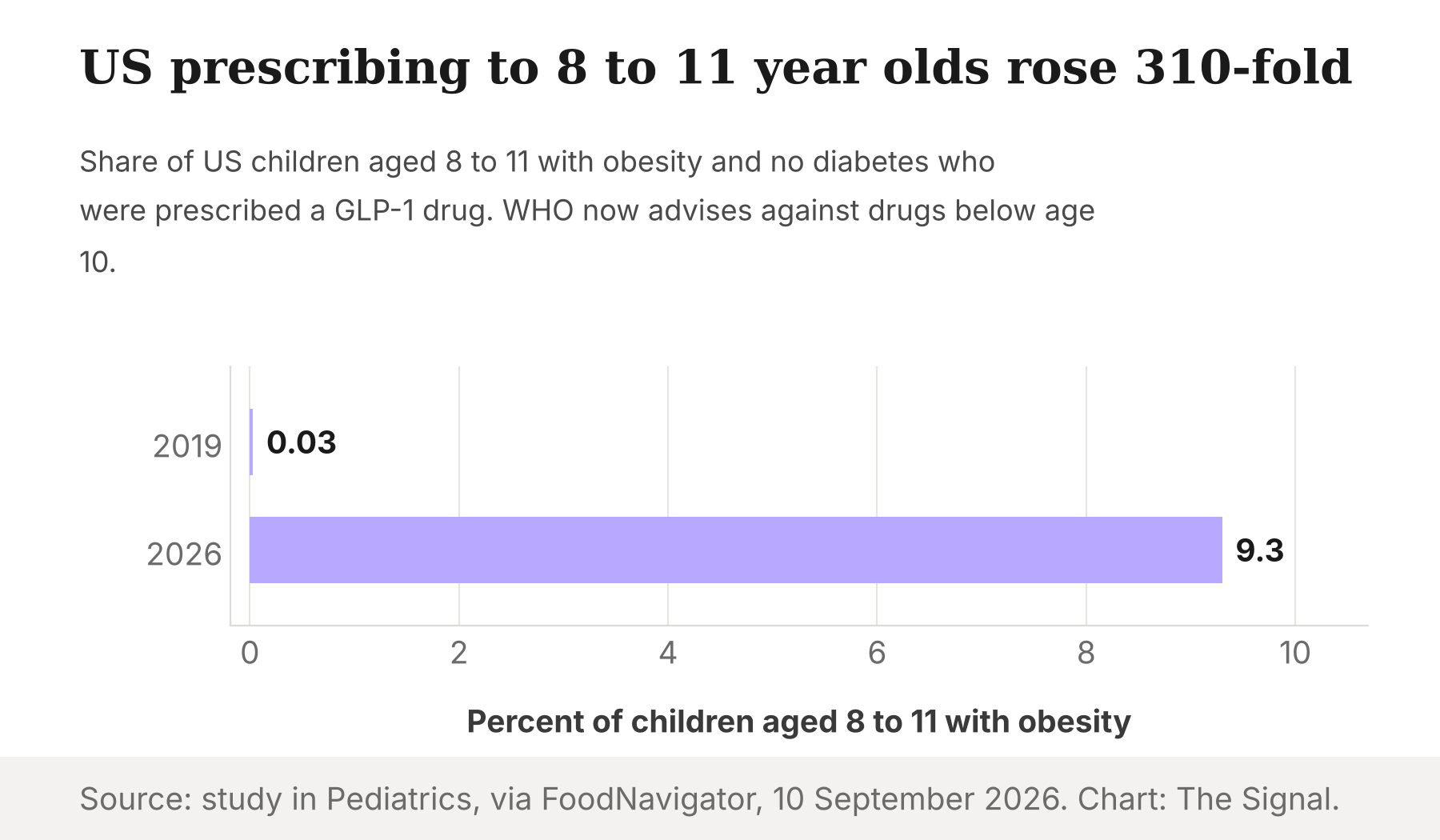
The line at 10 matters because of where prescribing has been moving. A US study published in Pediatrics found GLP-1 prescribing to children aged 8-11 with obesity and without diabetes rose from 0.03% in 2019 to 9.3% in 2026. That is a 310-fold increase in seven years. The age band of that surge straddles WHO's new line: ages 8 and 9 fall under the ban, ages 10 and 11 under the conditional rule.
Why India reads this differently
India has no equivalent prescribing data. Two other facts are on record: the burden is climbing, and the price barrier is lower.
On the burden, UNICEF India reports that overweight and obesity among under-five children rose 127 percent, from 1.5 to 3.4 percent, between the third National Family Health Survey in 2005-06 and the fifth in 2019-21. It also projects that India will be home to over 27 million children and adolescents aged 5 to 19 living with obesity by 2030. Globally, WHO's guideline cites a 2024 pooled analysis counting about 160 million children and adolescents with obesity, expected to grow to more than 250 million by 2030.
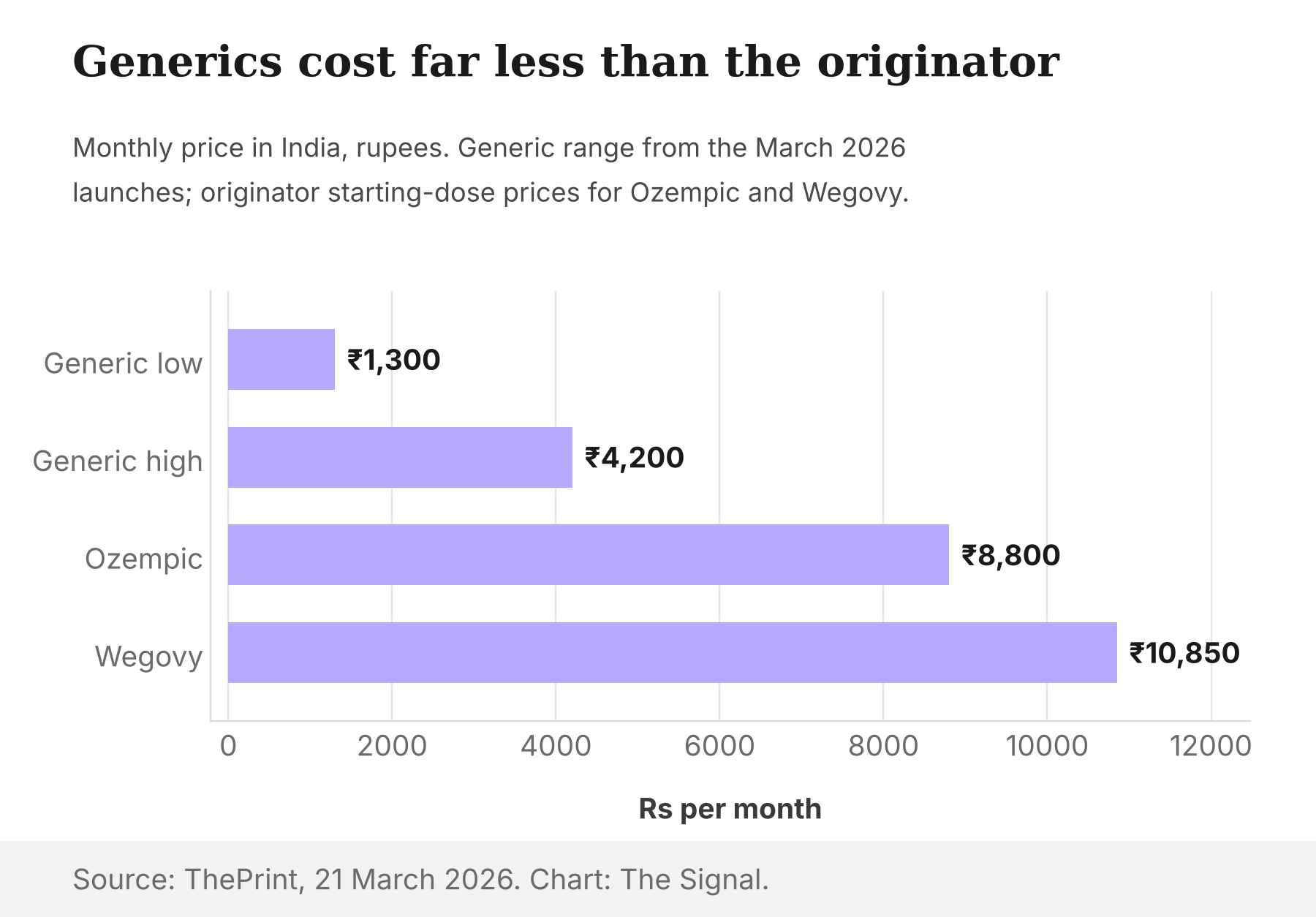
On price, the patent on semaglutide, the drug in Ozempic and Wegovy, lapsed in India in March 2026. ThePrint reported that the first six generic launches on 21 March carried prices ranging from Rs 1,300 to Rs 4,200 a month. Novo Nordisk's Ozempic and Wegovy are priced at Rs 8,800 and Rs 10,850 a month for starting doses. Even the dearest generic, at Rs 4,200, costs less than half of Ozempic's starting price, and the cheapest costs about one-eighth of Wegovy's. Outlook Business, citing the companies' launch announcements, described the generic prices as "considerably lower than the prices of the innovator, Novo Nordisk".
WHO itself names cost as the hurdle. In the adolescent guideline it notes that access to pharmacological interventions "may be hampered due to cost, lack of coverage by public and/or private health insurance packages, or logistics". In India, one of those three hurdles has just got much lower.
The honest objection
The strongest case against reading the guideline as a brake is that it barely binds anything new. Obesity drugs are not marketed for children under 10 to begin with: only two GLP-1 drugs, Wegovy and Saxenda, are licensed for children 12 and older, according to FoodNavigator's report on the US study. The Indian generics launched as diabetes and chronic weight-management brands. On this view, a ban on a use nobody is licensed to offer is a statement of principle.
That case is partly right, and it is why the US number matters. Off-label prescribing is exactly how a drug reaches an age group its label excludes, and the US data show it happening fast in the 8 to 11 band even though licences start at 12. A rule that costs nothing to follow is not the same as a rule that is never tested. The test comes when a drug that is cheap, widely stocked and familiar to adult patients sits within reach of a worried family and a willing prescriber. WHO's answer, in the adolescent guideline, is to require a specialised multidisciplinary setting and a lifestyle programme first. Whether India's prescribers follow that sequence is the open question.
The Signal
Price used to do part of the regulating. Originator starting doses cost Rs 8,800 to Rs 10,850 a month, a bill that would keep many families out of the market whatever their doctor thought. At Rs 1,300 to Rs 4,200 a month, that filter is weaker, and WHO's age line becomes the main thing standing between a child with obesity and a prescription pad. The evidence behind that line is thin, and the US study shows what a soft line allows: a 310-fold rise in seven years in the age group next to it.
Two things to watch. First, whether India's regulator or its paediatric societies write the under-ten line into their own rules. Second, whether anyone in India starts counting such prescriptions in children, because a guideline can only restrain what someone is counting.
Reporting basis: the child and adolescent recommendations, the Cochrane review description and the pooled prevalence figure come from the two guidelines themselves (children, adolescents), the latter as the guideline cites it. The under-five and projected obesity figures are from UNICEF India, drawing on national family health surveys. Generic and originator prices are per ThePrint, with Outlook Business relaying company launch announcements; both rest on the same launch events, so count them as one pricing origin. The prescribing rise and the licensing statement are per FoodNavigator reporting on a Pediatrics paper that The Signal has not read directly. The price comparisons are The Signal's calculations from the cited prices.