
The headline from the World Health Organization this week is a reassuring one. Global life expectancy was 73.3 years in 2023, against 73.4 years in 2019, so the world has almost clawed back what the pandemic took. WHO's own series puts the 2021 trough at 71.5 years.
India looks even better on the same dataset. WHO's Global Health Observatory estimates India's life expectancy at 70.5 years in 2019 and 68.1 years in 2021, a fall of 2.4 years. For 2023 it gives 71.0 years. On the point estimates, India lost 2.4 years, then gained back all of it and half a year more, while the world is still 0.1 year short. A reader could stop there and conclude that India rebounded faster than the rest of the planet.
The number comes with a range
It is worth slowing down on that. WHO publishes each estimate with a 95 percent uncertainty interval, and the intervals tell a different story from the headline figures.
For 2019, WHO's interval for India runs from 69.3 to 71.7 years, a band 2.4 years wide. For 2023 the interval runs from 67.4 to 74.5 years, a band 7.1 years wide. That is roughly three times as wide.
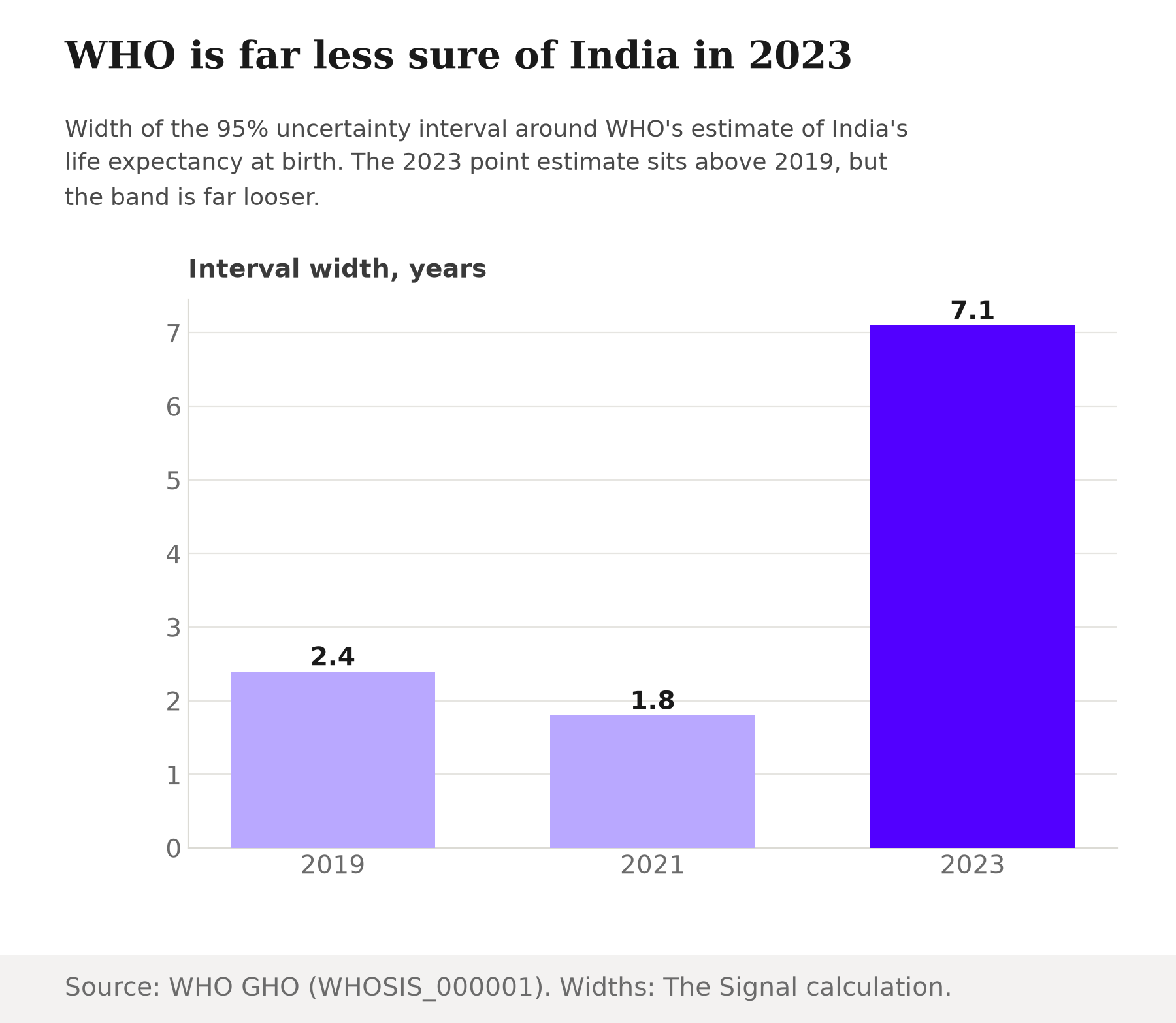
The consequence is plain. The whole 2019 interval sits inside the 2023 interval, and the 2023 interval reaches 1.9 years below the bottom of the 2019 range. WHO's data are consistent with India having recovered fully. They are equally consistent with India still being up to three years short of its 2019 point estimate. The 71.0 is a midpoint, not a measurement.
Why would the range widen? The most likely reason is that the latest year has the least data behind it. WHO's 2021 interval for India was only 1.8 years wide, so the pandemic years were not the problem. The newest year is. That is a reading of the published intervals, not a statement WHO makes in the release, and we flag it as inference.
What the world comparison hides
The global series behaves the same way. WHO puts global life expectancy at 73.4 years in 2019, with an interval of 72.1 to 74.5, and at 73.3 years in 2023, with an interval of 70.7 to 75.8. A 0.1 year gap sits inside a 5.1-year band. "Almost back to pre-Covid levels" is a fair summary of the midpoint and a stronger claim than the interval can carry.
The chart below shows WHO's point estimates side by side. India's dip was deeper and its 2023 figure is higher relative to its own 2019. It is also still 2.3 years below the world average of 73.3.
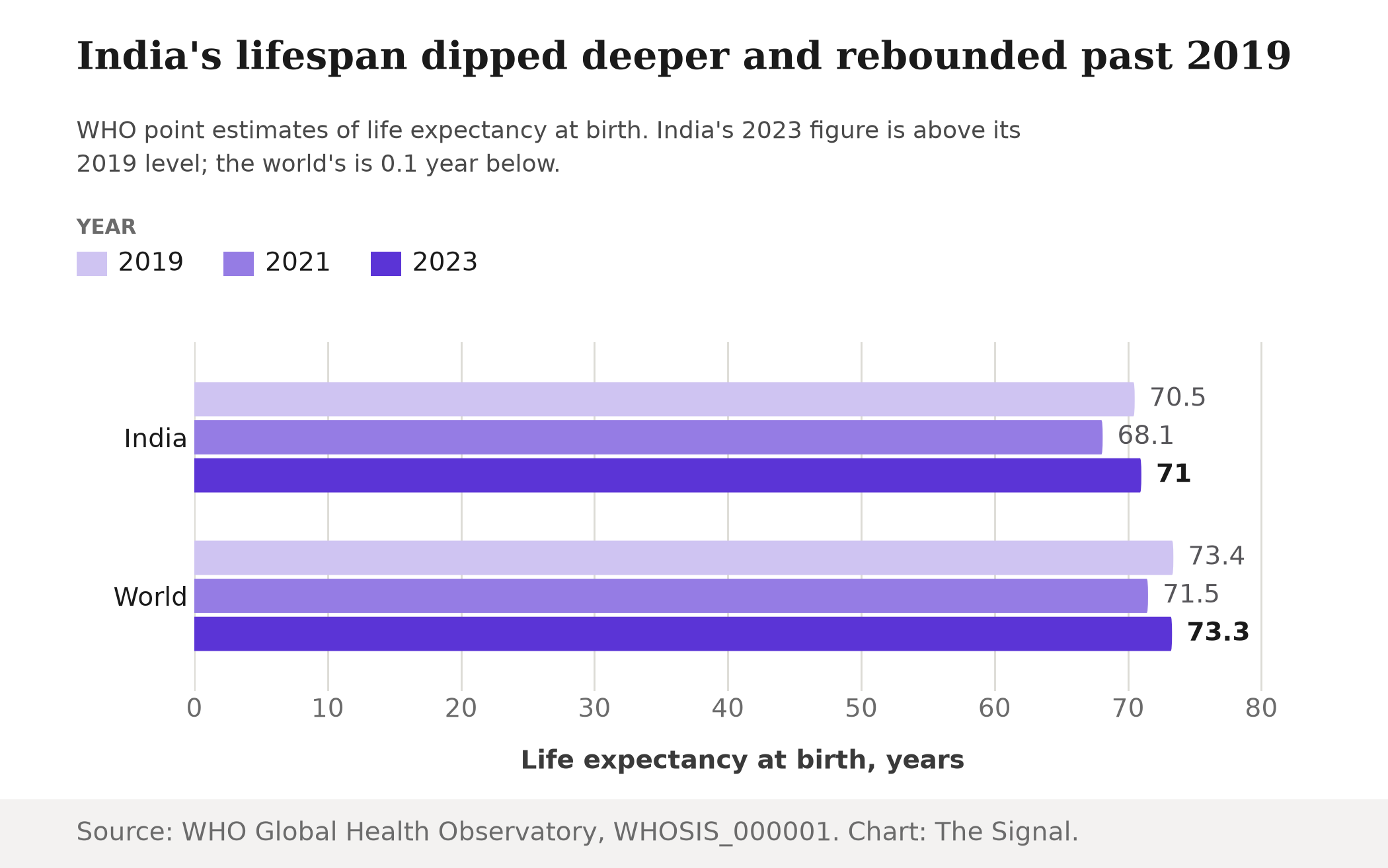
The depth of India's dip matters for a second reason. A May 2024 WHO release said the South-East Asia region, which includes India, lost about 3 years of life expectancy and 2.5 years of healthy life expectancy between 2019 and 2021. Regional and national modelled series are only as good as the death counts under them.
India disputes the death counts underneath
Those death counts are contested. A Lancet study led by the University of Washington's Institute for Health Metrics and Evaluation estimated 40.7 lakh excess deaths in India across 2020 and 2021, about 22 percent of the global total, according to ThePrint's account. The same report says India's health ministry rejected such claims, asserting a robust death-reporting system.
We have not verified the ministry's statement or the study's methods directly, so we treat the dispute, as ThePrint reports it, as unresolved. The point for this piece is narrower. A life expectancy figure for India depends on how many Indians died in the pandemic years, and the two main estimators disagree about that by a wide margin. A wide 2023 interval is the honest reflection of that disagreement.
Years lived versus years lived well
WHO's other headline is about quality of life. Global healthy life expectancy was 62.8 years in 2023, which is 0.4 years below its 2019 level. Life expectancy has recovered faster than healthy life expectancy.
India shows no such lag in the point estimates. WHO puts India's healthy life expectancy at 60.6 years in 2023 against 60.5 in 2019. But the 2023 interval runs from 55.3 to 66.0 years, a band of 10.7 years, against 7.1 years for 2019's interval of 56.8 to 63.9. The uncertainty around healthy years is wider still.
Set the two series side by side and the gap between lifespan and healthy lifespan for India is 10.4 years in 2023 (71.0 minus 60.6), against 10.5 years for the world (73.3 minus 62.8). By these numbers, the average Indian life ends with roughly a decade of ill health, much as the average global life does.
The honest objection
The strongest case against this reading is that point estimates are the best single guess, and WHO produced them with a method designed to handle sparse data. A midpoint of 71.0 is more probable than any other single value, and the interval is a standard feature of any modelled series rather than a sign of failure. That is right. And a figure above 2019 is still more likely than a figure below it.
But "more likely" is not the claim in the headlines. "Back above pre-Covid" is stated as fact, on a 2023 point estimate. The most defensible statement is that India's life expectancy has probably recovered, by an amount WHO cannot pin down, and that the question depends on death counts India's government itself disputes.
The Signal
The WHO release answers whether the pandemic's damage has been undone, and the honest answer for India is "probably, by an unknown margin." Watch two things. First, whether WHO's next revision narrows the 2023 band as more registration data arrives. A shrinking interval would turn a hopeful guess into a finding. Second, whether healthy life expectancy follows the headline figure, because that is the number that says how many of those years are lived well. A recovery that no one can measure to within seven years is a good headline and a poor basis for policy.
Reporting basis: global and India life expectancy and healthy life expectancy figures, and their uncertainty intervals, are from WHO's Global Health Estimates, via this week's WHO release and the WHO Global Health Observatory data service. The South-East Asia regional losses are from an earlier WHO release. The Lancet excess-death estimate rests on a single secondary source, ThePrint's report on the study, and the health ministry's response is as reported there; we did not review the study or the ministry statement directly. Interval widths, the gap between lifespan and healthy lifespan, and the comparison with the world are The Signal's calculations from those figures.