
Tuberculosis preventive treatment, a short course of antibiotics given to someone who has been exposed to TB but is not yet sick, is built on a simple premise: complete the course once, and the protection lasts. That premise is why national programmes treat it as a durable shield rather than a temporary patch, and why global health officials have spent political capital scaling it up. Only 15.5 million of the 30 million people the world's governments promised to reach with TB preventive treatment between 2018 and 2022 actually received it, a shortfall that made delivery, not durability, look like the problem.
A new 24-country analysis says durability was never guaranteed either.
A pooled analysis of 44 cohort studies across 24 countries between 1998 and 2023, covering more than 85,000 people with a TB infection, of whom 1,080 went on to develop active disease, finds that this protection does not last the same length of time everywhere. In low-burden countries it holds for at least 13 years, and in medium-burden countries for at least eight. In high-burden countries, the tier defined in the study as more than 100 TB cases per 100,000 people a year, it starts waning after just one year.
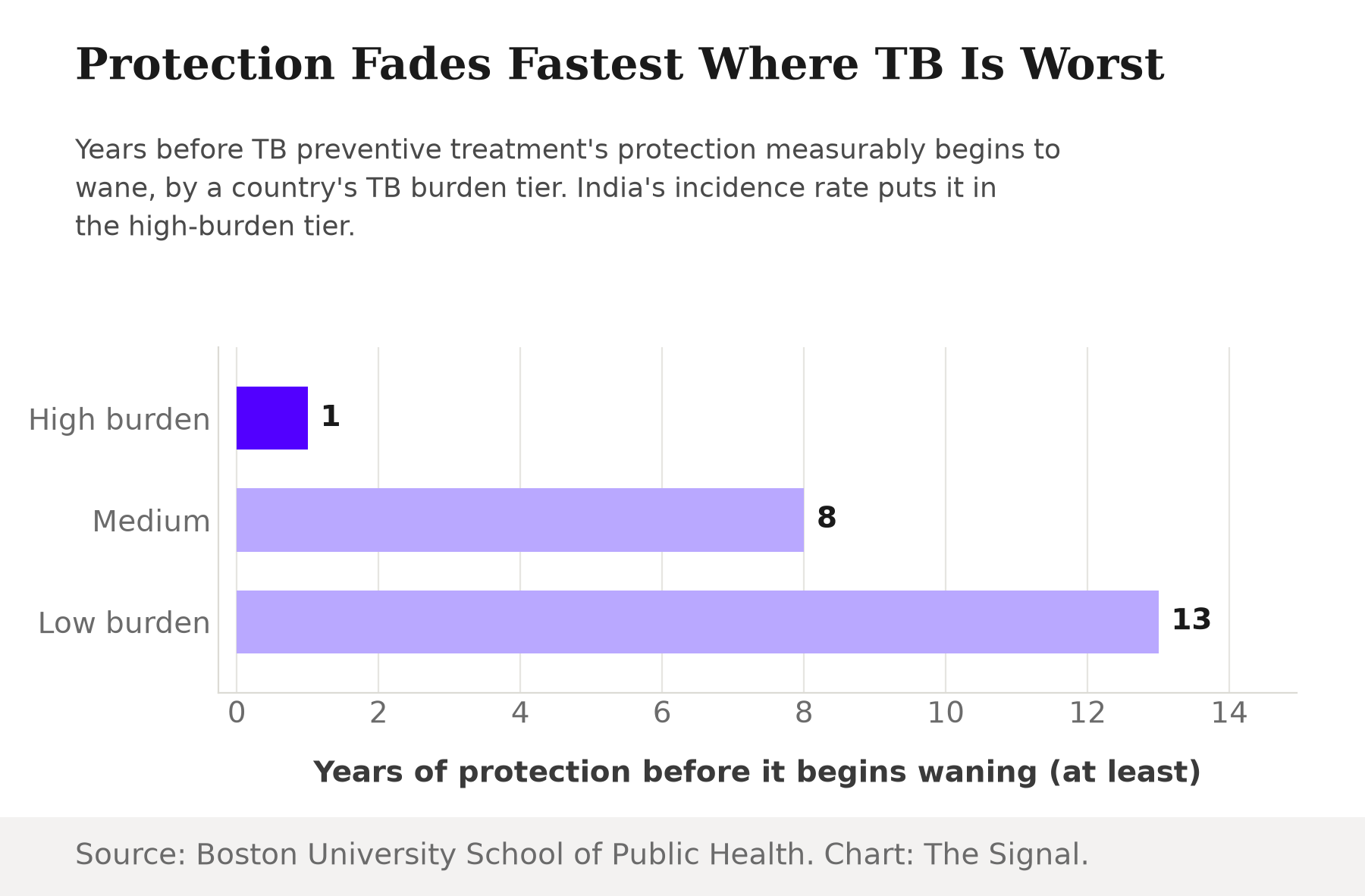
It is worth slowing down on why the split runs that way. The study's lead author attributes it to re-exposure rather than a flaw in the drugs themselves: people in high-burden settings are simply more likely to encounter TB again after finishing treatment, and to be reinfected. The pills did their job. The environment they were handed back into did not stay clear.
Where India sits in that split
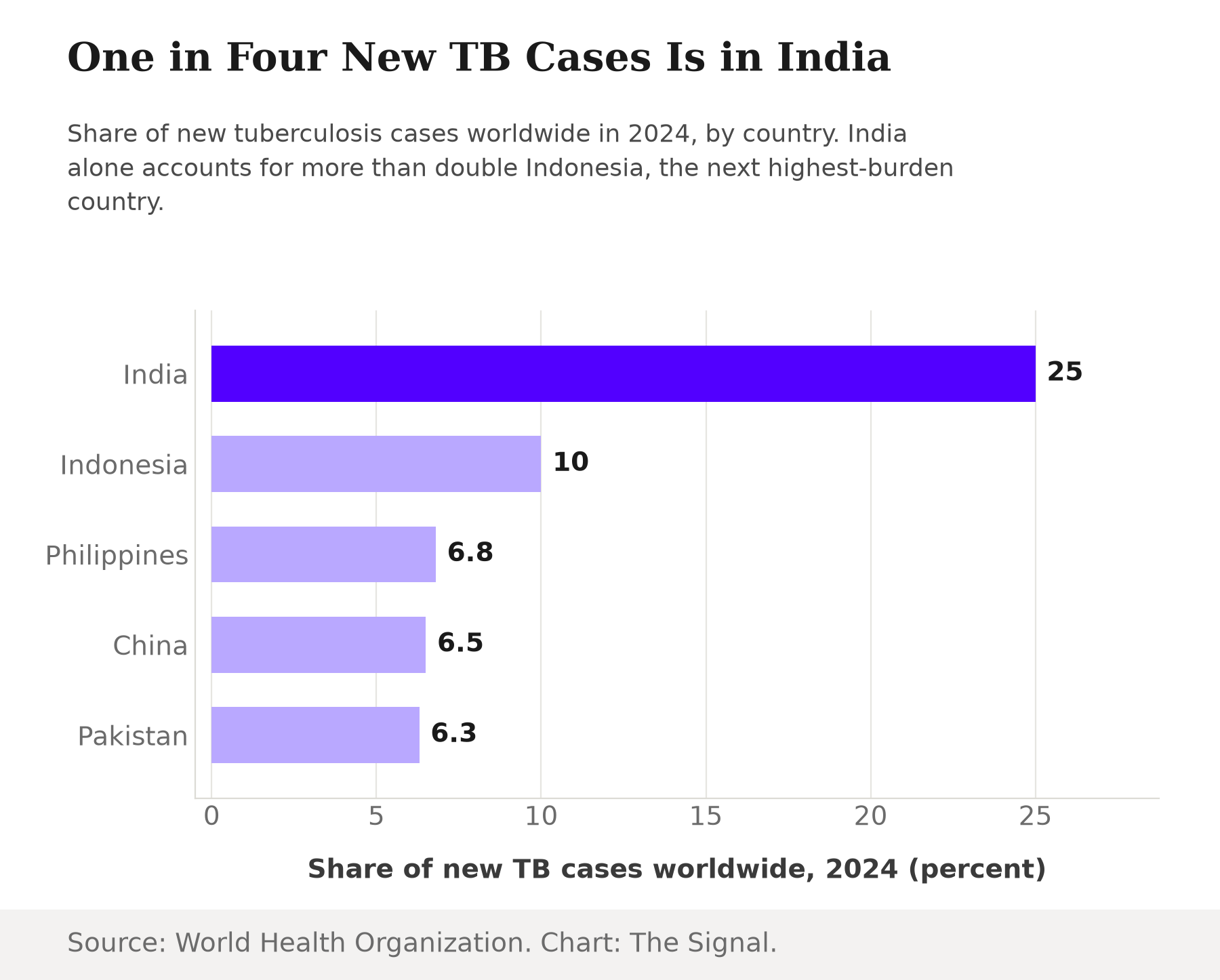
India accounts for 25 percent of new TB cases worldwide, more than double the share of Indonesia, the next highest-burden country at 10 percent. The world recorded an estimated 10.7 million new TB cases and 1.23 million deaths from the disease in 2024. That alone places India inside the tier where the new study says protection fades fastest, not the medium- or low-burden tiers where it holds for a decade or longer.
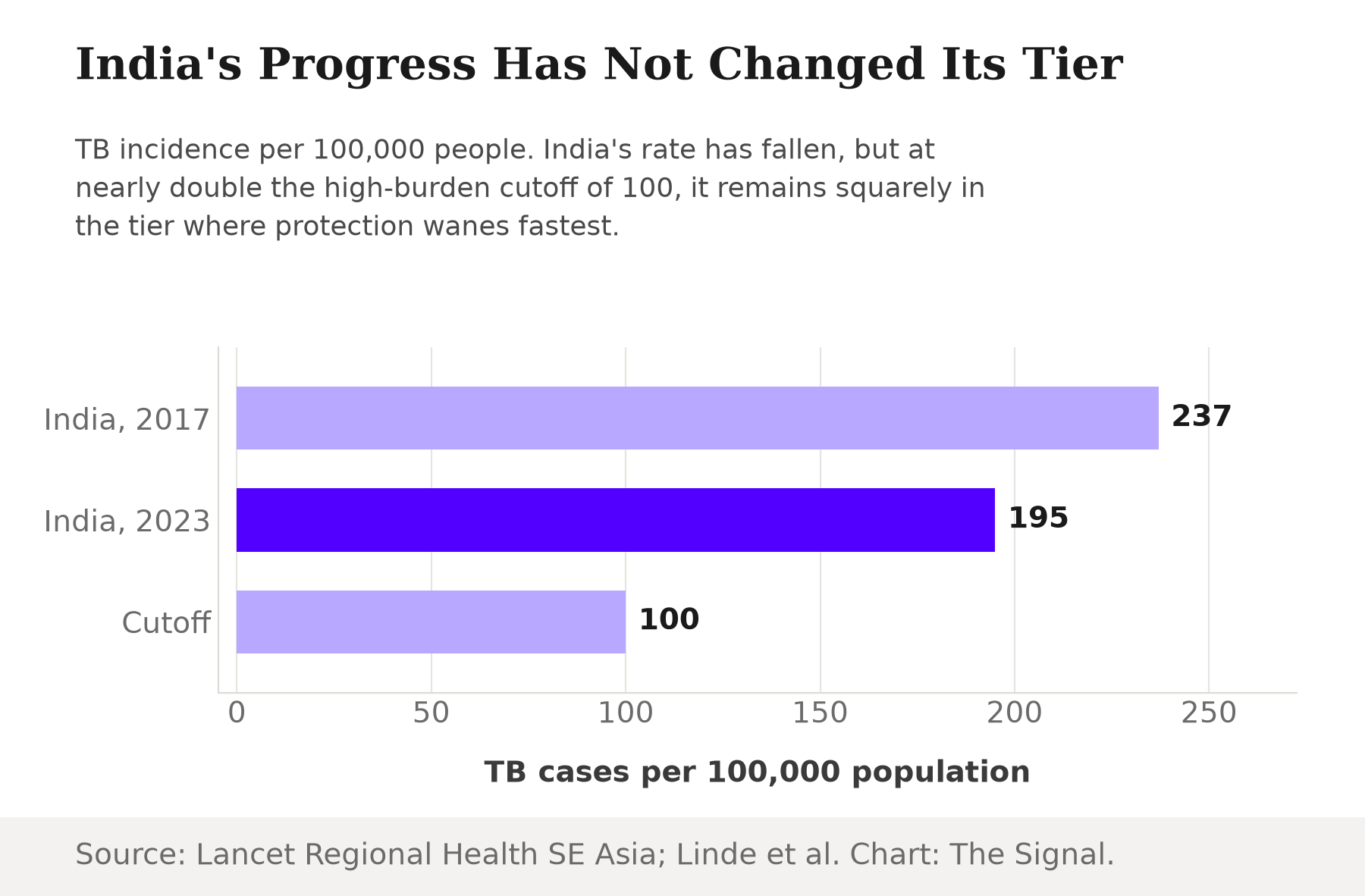
India's own numbers have been improving. The country's TB incidence fell from 237 cases per 100,000 people in 2017 to 195 in 2023, a decline of about 18 percent. But high-burden countries in the new study are those with more than 100 TB cases per 100,000 people a year, so at 195, India sits at nearly double that line. A decade of genuine progress has not moved it out of the tier where the new finding applies.
The programme leaning on this shield
TPT is not a peripheral tool in India's TB strategy. It is a load-bearing one. Since 2021, the National TB Elimination Programme has been scaling up short-course preventive regimens, 3HP and 3RH, into a universal strategy covering every household contact of a confirmed pulmonary TB patient, regardless of age. The programme's own clock leaves little room for a shield that needs repeating: the Government of India set a target to eliminate TB by 2025, five years ahead of the global target of 2030. That target year has already come and gone.
Reaching everyone eligible was already the harder half of the job before durability entered the picture. India could only put around 24 percent of its enlisted household contacts on TB preventive treatment, close to the global rate of 21 percent, according to the Central TB Division's own India TB Report 2023. A drug that needs repeating in a high-burden country is a harder sell when roughly three in four eligible contacts have not reliably received it even once.
The honest objection
The strongest case against reading too much into the global finding is India's own data on a related, high-risk group. In a cohort of 4,706 people with HIV followed for a median of 4.8 years across three high-burden districts of Andhra Pradesh, TB preventive treatment combined with antiretroviral therapy was associated with an 87 percent reduction in TB and a 94 percent reduction in all-cause mortality, and 94.6 percent of participants completed the full course. That is a benefit sustained well past the one-year mark the global study flags for high-burden settings.
The two findings are not necessarily in conflict. The Andhra Pradesh cohort paired TPT with continuous antiretroviral therapy and close clinical follow-up, a level of sustained contact the general household-contact population the global analysis pools does not get. It shows what preventive treatment can still achieve in a high-burden setting under the right conditions, not that protection in the general population lasts as long as it does for a closely monitored group already on lifelong HIV treatment. It is also worth naming a gap the global study leaves open: it does not identify which of its 24 countries were included, so whether an Indian cohort specifically informed the high-burden estimate, or whether that estimate rests entirely on other countries in India's burden tier, is not something this dataset can settle.
The Signal
TB preventive treatment still works. Every dataset here agrees on that, powerfully, in the near term. What has changed is what "once" buys: a programme built to reach people a single time and move on has just been told that a single course covers only a fraction of the protection needed in the places carrying the heaviest TB burden. India built a universal TPT policy and a self-imposed elimination deadline on the assumption that one completed course does the job. The practical question ahead is whether the programme budgets for repeating that course, not simply for handing it out once more widely. A shield that needs renewing is still a shield, but only for as long as someone plans to hand out the second course.
Reporting basis: the global findings on TB preventive treatment's duration by burden setting, the pooled analysis's scope, and the mechanism attributed to re-exposure and reinfection are from Boston University School of Public Health's press release on work led by Lauren Linde and Leonardo Martinez, published in The Lancet Respiratory Medicine. World and India TB case and death counts, and the shortfall in the world's 2018-2022 preventive-treatment target, are from the World Health Organization. India's incidence trend and the description of the National TB Elimination Programme's universal preventive-treatment policy are from a peer-reviewed analysis in The Lancet Regional Health, Southeast Asia, which in turn cites the World Health Organization's Global Tuberculosis Report 2024 for the incidence figures. India's household-contact enrollment rate is from a separate peer-reviewed analysis in PLOS Global Public Health, citing the Central TB Division's India TB Report 2023. The Andhra Pradesh cohort data on people with HIV is from a single Clinical Infectious Diseases paper by researchers at the US Centers for Disease Control and Prevention, SHARE India, and the Andhra Pradesh State AIDS Control Society, and is the only source for those figures. India's 2025 elimination target is from the Government of India's Directorate General of Health Services. The percentage decline in India's incidence, the comparison of India's current rate to the high-burden threshold, the share of eligible contacts not reached, and the doubling comparisons between countries are The Signal's calculations from those figures.