
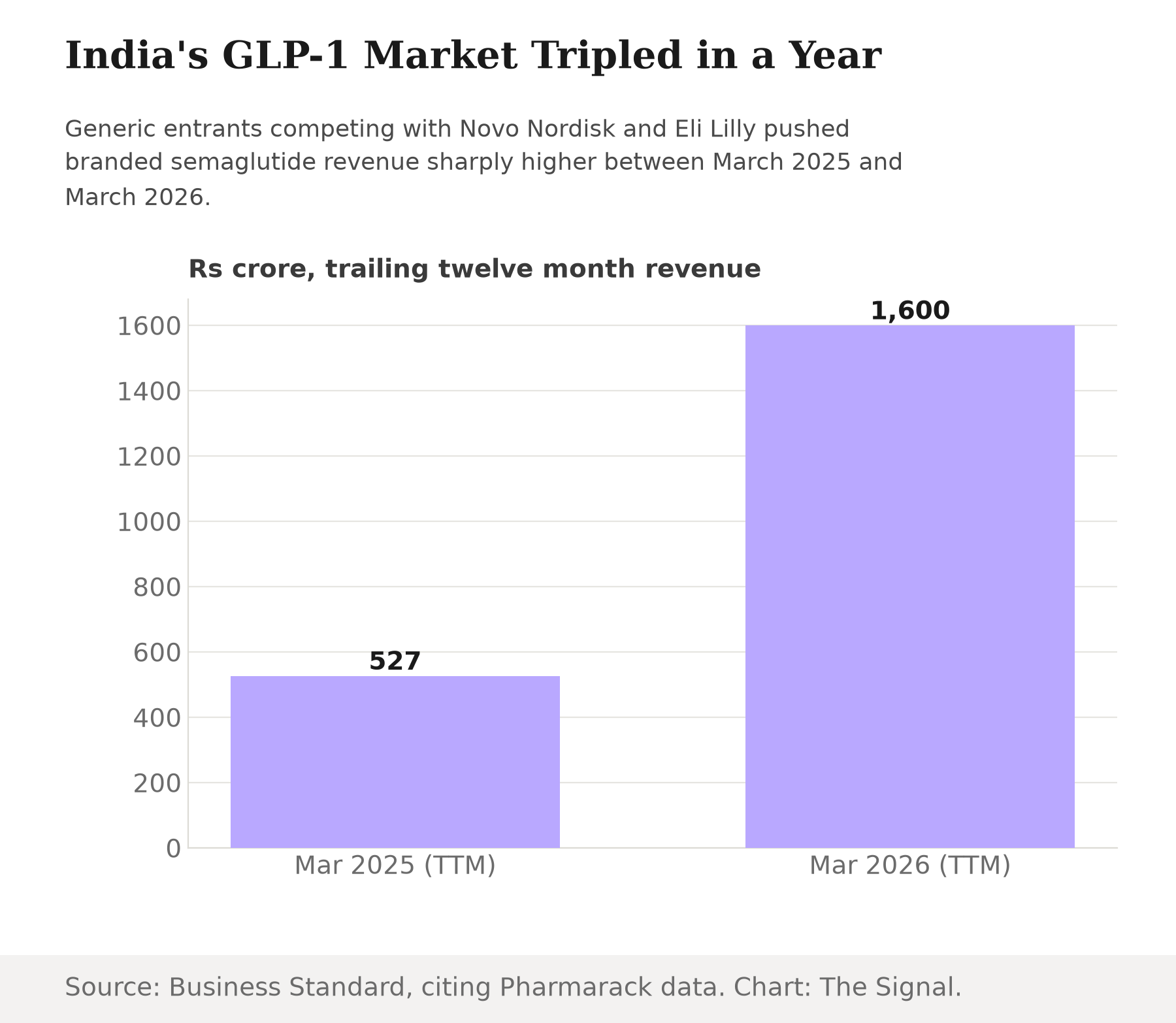
Sales of GLP-1 weight loss drugs in India are moving the way every growth story in this category eventually does: fast, then faster. Branded semaglutide revenue climbed from about Rs 527 crore in the year to March 2025 to around Rs 1,600 crore in the year to March 2026, more than tripling in twelve months as generic entrants crowded in alongside Novo Nordisk and Eli Lilly. Read only that line and the story is simple: a drug that suppresses appetite at the source is finally reaching a country where, per the National Family Health Survey conducted in 2019-21, 24% of women and 23% of men are already overweight or obese.
It is worth slowing down on what that revenue line does not show: how long any one patient actually stays on the drug. In a US cohort of nearly 49,000 people who started a GLP-1 receptor agonist for obesity rather than diabetes, followed through December 2023, 64.8% had discontinued it within a year. India's version of that problem is blunter. Branded GLP-1 injections here run roughly Rs 15,000 to Rs 22,000 a month, a price high enough that a clinic operator quoted by AFP described patients abandoning treatment midway rather than sustain it for the months a course needs. A market can triple in size while the typical user inside it never finishes the regimen.
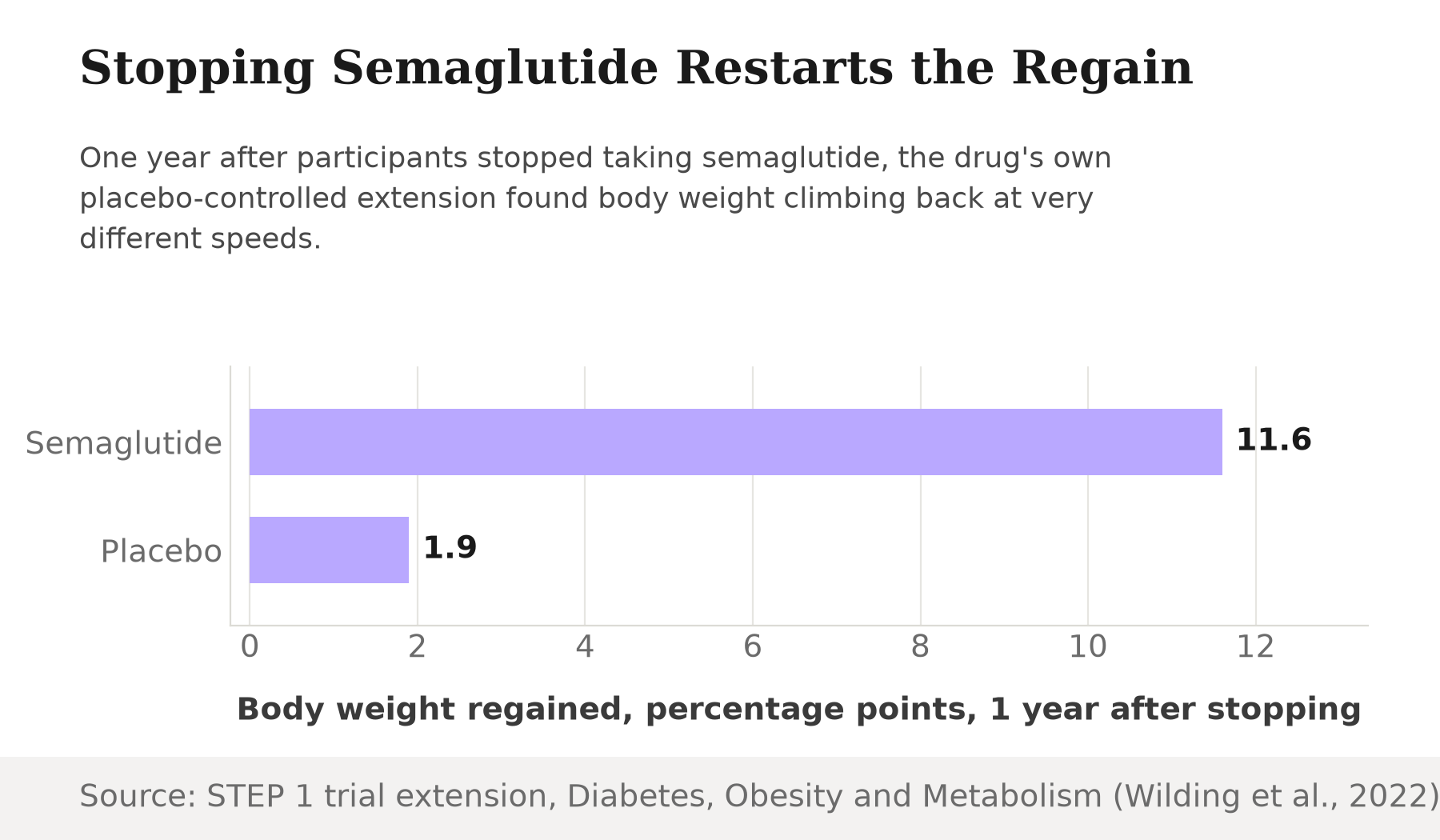
That would be a minor footnote if stopping the drug simply returned a patient to where they started. It does not. The STEP 1 trial's own extension found that participants who stopped semaglutide regained a mean of 11.6 percentage points of body weight within a year, against 1.9 percentage points for those who had been on placebo the whole time, leaving the drug group holding onto a net loss of just 5.6% of their original weight. Semaglutide patients regained weight at more than six times the rate of placebo patients doing nothing but dieting. Stopping the drug did not freeze the clock. It restarted it, faster than diet alone ever had.
The switch that never flips back
Until this month, the honest answer for why regain happens this fast was a shrug: appetite comes back, old habits return, the body wants what it wanted before. A study published in Cell Reports on September 11, 2026 gives a sharper answer. Researchers at Case Western Reserve University found a persistent epigenetic switch in fat cells that keeps the hunger hormone asprosin elevated even after the excess weight and the inflammatory trigger behind it are both gone, and current GLP-1 drugs do nothing to reset that switch. The weight comes off. The fat cell's setting does not change with it.
That finding lines up with two other results the matrix behind this piece independently confirms. An August 2026 study at Yale, published in the Proceedings of the National Academy of Sciences, found that semaglutide's ability to sustain weight loss depends entirely on a specific set of hunger neurons in the brain called AgRP neurons: when researchers removed them in mice, the drug could no longer sustain any weight loss at all, even though it still suppressed how much the mice ate. The drug is not creating a new, durable appetite setting. It is leaning on the same circuit the fat cell's asprosin switch also feeds, and when that circuit is gone or reactivated, the drug's effect goes with it.
The pattern holds even without any drug in the picture. A UT Southwestern Medical Center report on a peer-reviewed iScience study found that mice which had lost weight through plain caloric restriction kept overeating for up to a month after being allowed to eat freely again, compared to mice that had never been made obese in the first place. Diet, drug, it does not matter which lever produced the weight loss. The rebound signal is the same signal.
Three independent lines of evidence now describe one mechanism, not three.
| Finding | What it shows | As of | Origin |
|---|---|---|---|
| Fat-cell asprosin switch | Stays flipped after weight and inflammation normalize; GLP-1 does not reset it | September 2026 | Case Western Reserve, Cell Reports |
| AgRP neuron requirement | Semaglutide cannot sustain weight loss in mice lacking these neurons | August 2026 | Yale, PNAS |
| Post-diet hyperphagia in mice | Overeating persists up to a month after weight loss from caloric restriction alone | May 2026 | UT Southwestern, iScience |
Source: Case Western Reserve University; Yale University; UT Southwestern Medical Center, all reporting peer-reviewed studies. Table: The Signal.
India's boom meets an old problem
None of this makes India's GLP-1 boom a mistake. It makes the boom's fine print matter more than its headline. The 24% of Indian women and 23% of Indian men already overweight or obese, as measured by the National Family Health Survey in 2019-21, is the population the market is now selling into. Revenue nearly tripling to around Rs 1,600 crore in the year to March 2026 means more people starting the drug than ever before. And a monthly cost of Rs 15,000 to 22,000, high enough that patients report quitting mid-course, means a large share of that new population is going to stop early, for reasons that have nothing to do with the drug working or not working.
The biology says early stopping is not a neutral outcome. It is the trigger for the same rebound the STEP 1 trial's extension measured and the fat-cell switch identified in the Cell Reports study explains. A country adding patients faster than it can keep them on the drug is not expanding a solution. It may be running the regain experiment at national scale, one unaffordable month at a time.
The honest objection
The strongest case against this reading is that most of the mechanism evidence sits in mice, not people, and none of it was gathered in India. The fat-cell asprosin switch, the AgRP neuron requirement, and the post-diet hyperphagia finding are all rodent studies. Someone could reasonably ask whether a mouse's fat cell tells us anything about a patient in Mumbai who stops an injection because the pharmacy bill outran the household budget.
That case has real force, but it is answered by the one part of the matrix that is neither a mouse nor a lab construct: the STEP 1 trial's human extension, in which real semaglutide patients regained weight at more than six times the placebo rate within a year of stopping. The mouse work explains a pattern already visible in people. And the discontinuation problem itself is not an India-specific artifact of cost either: 64.8% of a US cohort of nearly 49,000 patients quit within a year, in a market with far deeper insurance coverage than India's out-of-pocket model offers. If patients stop this often even where affordability is less of a barrier, India's steeper price only adds a second reason to a pattern that was already the norm.
The Signal
The consensus read on India's GLP-1 boom is a supply story: more companies, more competition, more Indians able to afford a drug that finally works. The mechanism story is a demand story in disguise. What the market is actually selling is a temporary suppression of a switch that, per the Cell Reports finding, does not turn off on its own. Every patient who starts the drug over the next year is implicitly betting they can either afford it indefinitely or make peace with the same rebound a dieter without any drug already faces. Watch what the market does next: if prices fall enough that patients can stay on the drug for years rather than months, India's boom becomes a genuine public health gain. If the price stays where it is and the discontinuation curve mirrors the US cohort's 64.8% one-year rate, the tripling revenue line is measuring a bigger population cycling through the same unfinished course, not a bigger population getting well.
Reporting basis: the September 2026 fat-cell mechanism finding is per Case Western Reserve University's report on the peer-reviewed Cell Reports study. The AgRP neuron finding is per Yale University's report on the peer-reviewed PNAS study. The post-diet hyperphagia finding in mice is per UT Southwestern Medical Center's report on the peer-reviewed iScience study. The semaglutide withdrawal regain figures are from the STEP 1 trial's published extension in Diabetes, Obesity and Metabolism. The one-year discontinuation rate is from a peer-reviewed cohort study in JAMA Network Open. India's overweight and obesity prevalence is from the National Family Health Survey-5, via a Press Information Bureau release. India's GLP-1 market revenue is per Business Standard, citing Pharmarack market-research data. India's monthly treatment cost and patient discontinuation over affordability are per an Agence France-Presse wire report carried by Gulf News. The sixfold regain comparison is The Signal's calculation from the STEP 1 trial's own reported figures.