
On 21 September 2026, India's Central Drugs Standard Control Organisation sent prescribers a circular on a familiar problem: painkillers and antibiotics, used carelessly, damage kidneys. CDSCO's circular states that "the lowest effective dose for the shortest appropriate duration should be considered when prescribing NSAIDs, particularly in patients at increased risk of renal impairment." Read as a headline, this looks like a regulator doing exactly its job: a dated instruction, issued this month, telling doctors to be careful with a drug class already tied to kidney harm.
It is worth slowing down on what the circular does not say. Nowhere in the text does CDSCO mention fixed-dose combinations, the pills that pair an NSAID with paracetamol or another ingredient in a single tablet. The circular addresses how a doctor writes a prescription. It has nothing to say about which painkillers are still allowed to be manufactured, marketed and sold, combination or otherwise.
The number that carries this story is 61.
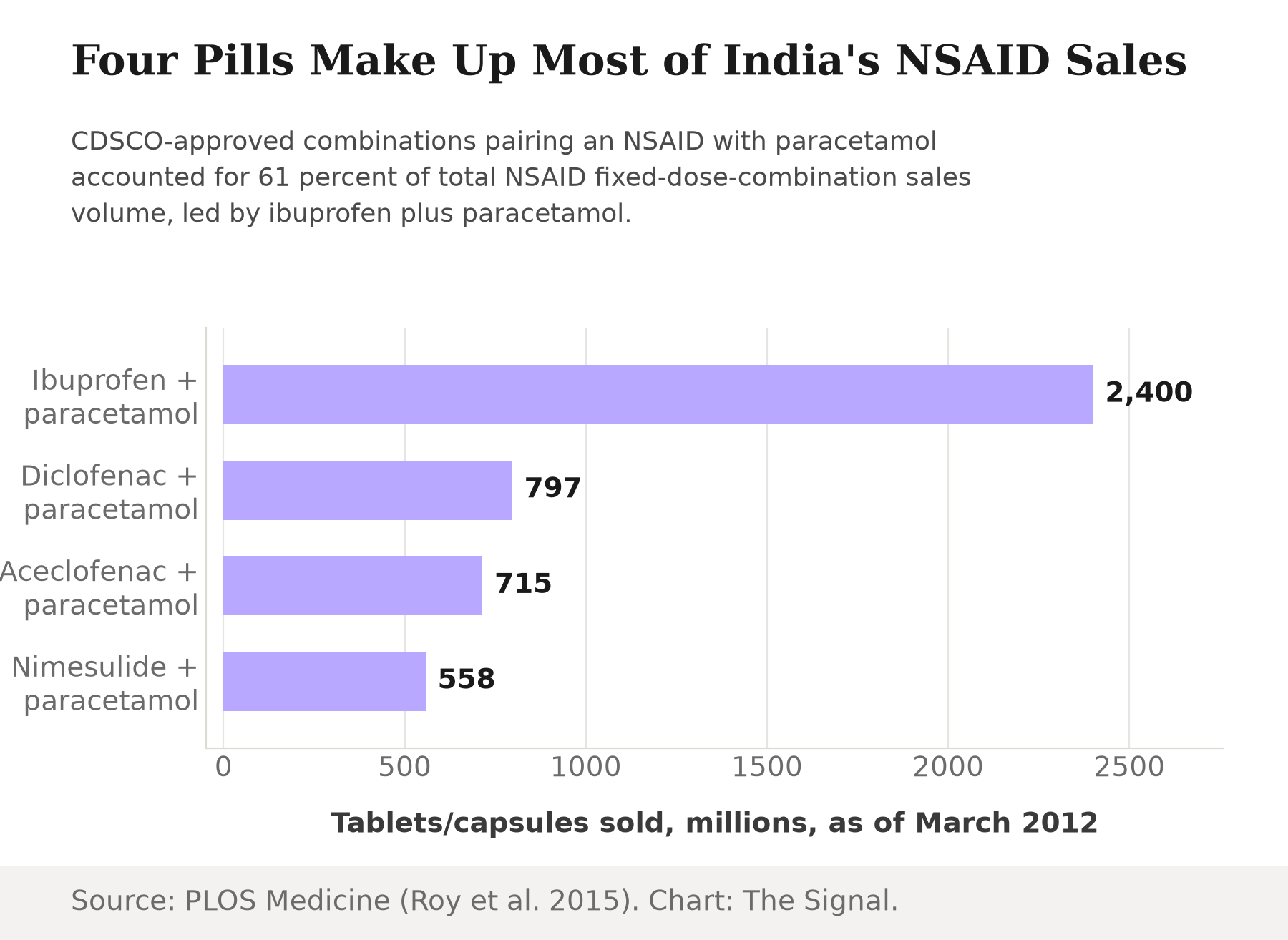
A PLOS Medicine study of CDSCO approval and national sales-audit data found that four CDSCO-approved combinations, each pairing paracetamol with one NSAID (ibuprofen, diclofenac, aceclofenac or nimesulide), accounted for 61 percent of total NSAID fixed-dose-combination sales volume, in the last public breakdown of that market, as of March 2012. Ibuprofen plus paracetamol led at 2.4 billion tablets and capsules, ahead of diclofenac plus paracetamol at 797 million, aceclofenac plus paracetamol at 715 million and nimesulide plus paracetamol at 558 million, more than the other three combined. These are not obscure products the circular overlooked by accident. They are formulations the regulator itself approved, and by the last available reading of the market, they carried most of the category's volume.
How India's bans actually work
India does ban fixed-dose combinations, so it would be wrong to say regulators never act on this category. What they do not do is retire a whole class of drug at once. Each action names specific formulations, milligram strengths included, and leaves the rest of the category standing.
Every ban on record targets a named formulation, not the combination class it belongs to.
| Date | Regulatory action | Scope |
|---|---|---|
| March 2016 | Banned 344 fixed-dose combinations found to lack therapeutic justification | A broad crackdown spanning many drug categories |
| 2 August 2024 | Banned Aceclofenac 50 mg + Paracetamol 125 mg, tablet and oral liquid, by name | One specific NSAID-paracetamol formulation |
Sources: a 2025 peer-reviewed commentary on India's FDC regulation, citing the Ministry of Health and Family Welfare's 2016 notification; the government's 2 August 2024 gazette notification, reproduced by the Goa state government.
The four NSAID-paracetamol combinations that made up 61 percent of FDC sales volume were not on either list. None of the ingredient pairs behind ibuprofen, diclofenac, aceclofenac or nimesulide plus paracetamol has been banned as a class. Individual strengths and brands can still be removed one at a time, as the August 2024 action shows, but the pairing itself remains an approvable, sellable category.
Antibiotics show the same pattern for longer
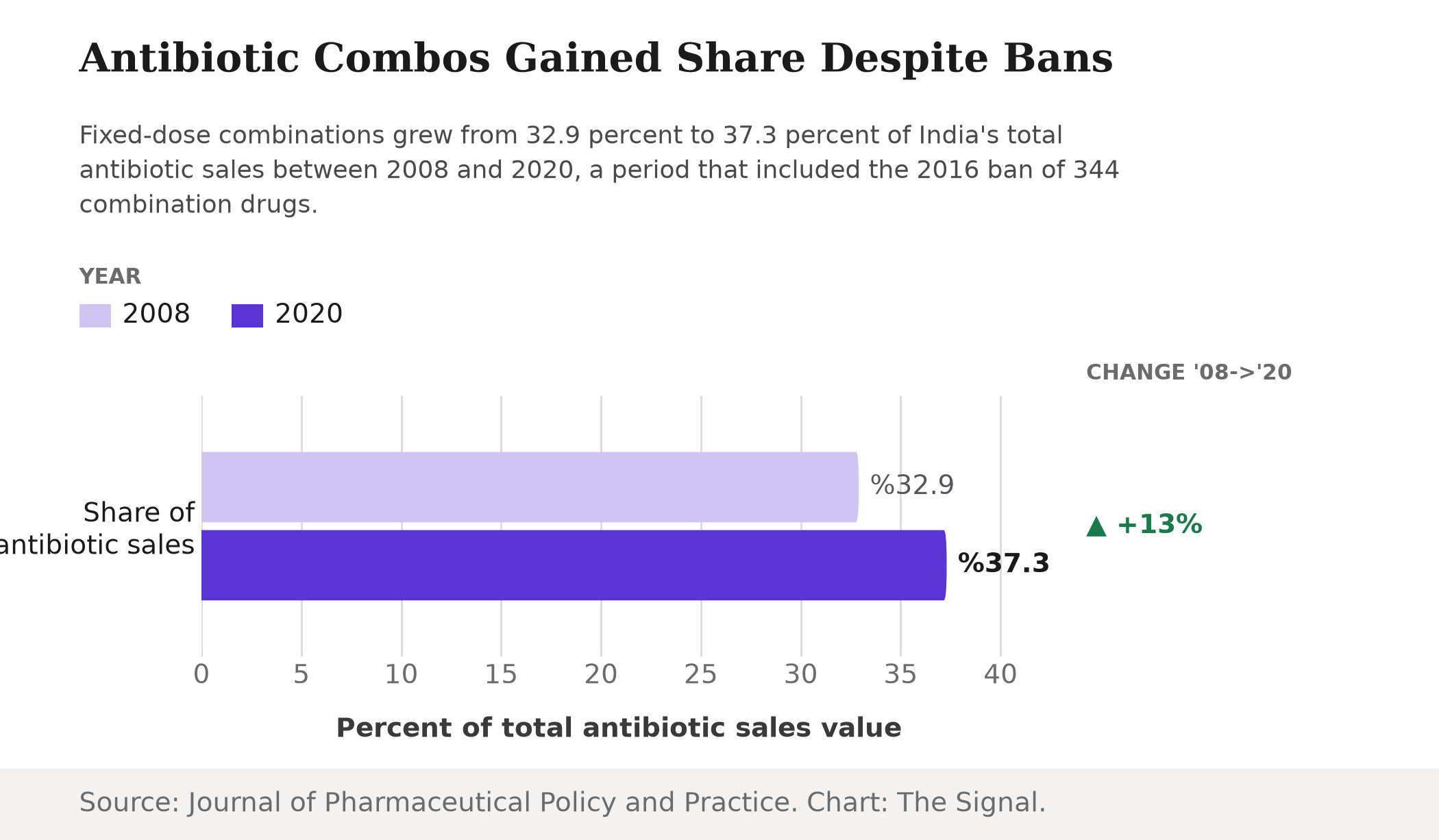
The mechanism is not unique to painkillers. A peer-reviewed case study in the Journal of Pharmaceutical Policy and Practice found that fixed-dose combinations grew from 32.9 percent of India's total antibiotic sales in 2008 to 37.3 percent in 2020, a stretch that includes the 2016 ban of 344 combination drugs. Enforcement happened. The share of the market held by combination antibiotics grew anyway.
Antibiotics are not painkillers, and the specific drugs banned in 2016 were not all antibiotic combinations. But the pattern is the same one visible in the NSAID numbers: formulation-by-formulation bans coexist with a rising or dominant combination-drug share in the categories regulators are trying to discipline. A ban that removes named products does not, by itself, shrink the appetite for combination pills in general.
The burden the advisory is meant to prevent
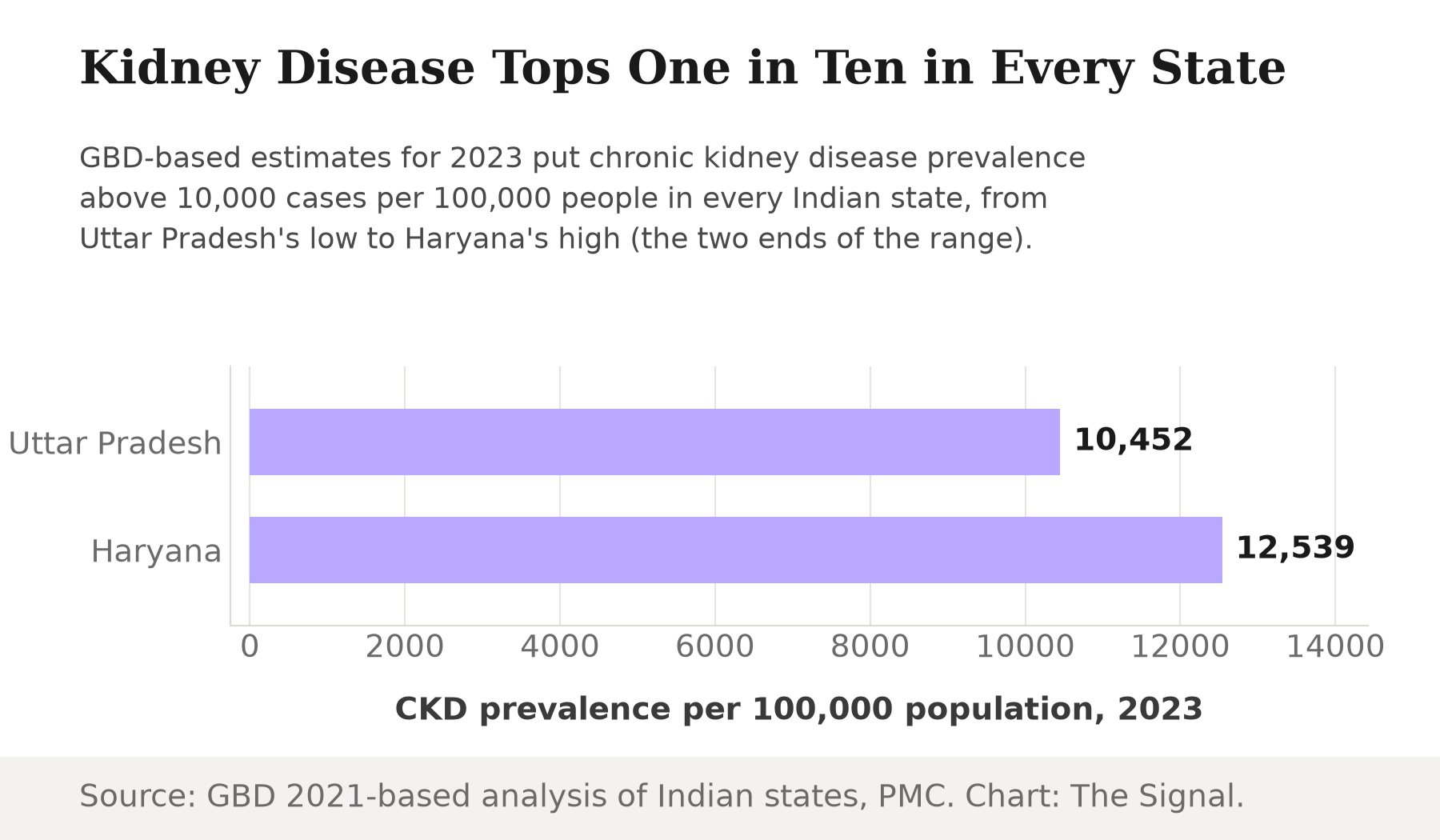
The stakes behind CDSCO's caution are not abstract. A Global Burden of Disease-based state-level analysis of India finds that chronic kidney disease prevalence exceeded 10,000 cases per 100,000 population, more than one in ten residents, in every Indian state in 2023, ranging from 10,452 per 100,000 in Uttar Pradesh to 12,539 per 100,000 in Haryana.
Antibiotic misuse carries its own toll. A peer-reviewed Global Burden of Disease-based analysis of India's infectious-disease and AMR burden reports that in 2021, antimicrobial-resistant infections were associated with 163,129 deaths linked to Streptococcus pneumoniae, 142,310 linked to Escherichia coli and 121,623 linked to Klebsiella pneumoniae, the three pathogens carrying India's highest AMR-associated death counts that year.
These three pathogens alone accounted for well over 400,000 AMR-associated deaths in India in a single year.
| Pathogen | AMR-associated deaths, India, 2021 |
|---|---|
| Streptococcus pneumoniae | 163,129 |
| Escherichia coli | 142,310 |
| Klebsiella pneumoniae | 121,623 |
Source: peer-reviewed Global Burden of Disease Study 1990-2021 analysis for India, PMC.
Much of this exposure never passes through a prescriber at all. A systematic review and meta-analysis reports that the pooled prevalence of self-medication in India was 64.4 percent, drawing on studies through October 2023. A circular addressed to what a doctor writes on a prescription pad reaches only part of how these drugs actually reach patients.
The honest objection
The strongest case for CDSCO's approach is that dosing guidance is exactly the right tool for what it targets: a clinical decision inside a doctor-patient relationship, where a circular can plausibly change behavior the next time a prescription is written. Formulation bans are a slower instrument by design, and the record shows regulators willing to use it. The 2016 crackdown banned 344 combination drugs outright, and the government named a specific NSAID-paracetamol formulation as recently as August 2024. On this reading, the circular and the bans are two arms of one policy, moving at two different speeds, and faulting the circular for not doing the bans' job misreads the division of labor.
That case holds for prescribed care. It says less about the 64.4 percent of use that research finds is self-medicated, and less still about a combination-drug segment in which four approved products alone made up 61 percent of sales volume years before this circular existed. A dosing instruction changes what happens when a patient sees a doctor. It has no bearing on the patient who buys a combination pill without one, or on a formulation approved long before anyone asked whether it still belonged on the shelf.
The Signal
CDSCO's circular is not wrong. It is narrow. It corrects a real risk in exactly the setting where a regulator's words can be most directly obeyed: the prescription pad. But the volume math says the larger exposure sits elsewhere, in combination pills approved years ago that, by the last public accounting, made up most of a major painkiller category's sales, and whose antibiotic counterparts gained share even through a formal ban. Watch what CDSCO does next, not what it just said. A formulation-level review of the NSAID-paracetamol combinations behind that 2012 sales breakdown would signal the harder problem has reached the agenda. Another circular telling doctors to be careful would signal it has not.
Reporting basis: the triggering event, CDSCO's 21 September 2026 circular on NSAID prescribing, is drawn directly from the regulator's own published document. The 2 August 2024 ban of a named aceclofenac-paracetamol combination is from the Ministry of Health and Family Welfare's gazette notification, as reproduced by the Goa state government. The 2016 ban of 344 combination drugs is per a 2025 peer-reviewed commentary on India's FDC regulation, citing the ministry's original notification. The 61 percent NSAID-FDC sales-volume figure and the four named formulations are from a peer-reviewed PLOS Medicine study (Roy et al., 2015) analyzing CDSCO approval records against IMS Health sales-audit data as of March 2012, the most recent such public breakdown found for this piece. The antibiotic FDC sales-share figures for 2008 and 2020 are from a peer-reviewed case study in the Journal of Pharmaceutical Policy and Practice. Chronic kidney disease prevalence by state is from a peer-reviewed Global Burden of Disease Study 2021-based analysis of India. The AMR-associated mortality figures for 2021 are from a separate peer-reviewed Global Burden of Disease Study 1990-2021 analysis of India. The self-medication prevalence figure is from a systematic review and meta-analysis of Indian studies published through October 2023. The comparison of ibuprofen-paracetamol's sales volume against the other three approved combinations combined, and the combined AMR-associated death total for the three named pathogens, are The Signal's calculations from those figures.