A patient with a torn knee cartilage or a painful shoulder is told, reasonably, that surgery fixes the mechanical problem an X-ray or scan can see. Cut, repair, close, recover. That is the model every consent form implicitly sells, and it is why elective surgery is a routine, trusted transaction in medicine: a defined procedure for a defined complaint.
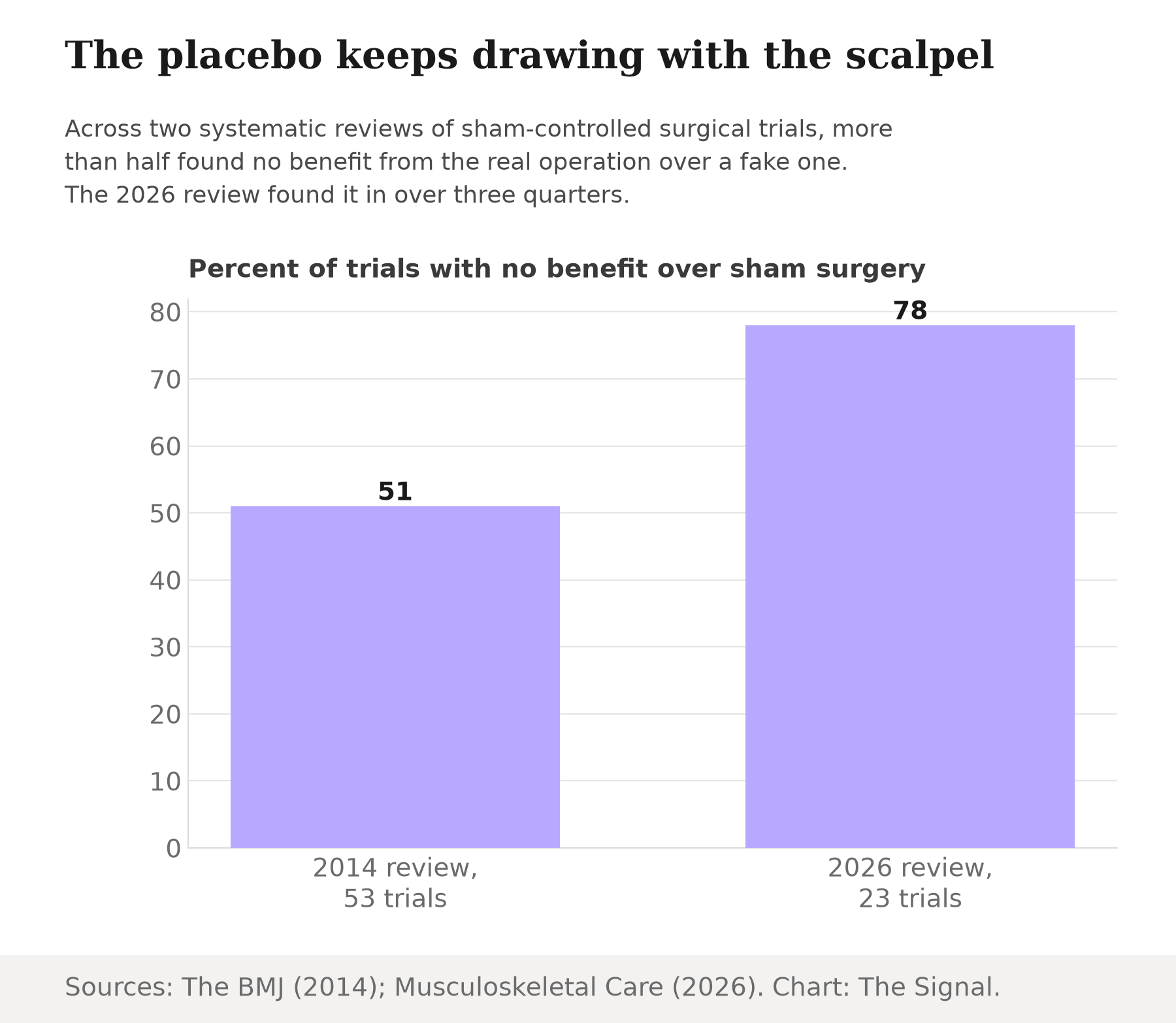
A systematic review and meta-analysis published in the peer-reviewed journal Musculoskeletal Care in September 2026 pooled 23 randomized trials that tested a real musculoskeletal operation against a sham, placebo version of the same operation on 2,412 patients combined. In 18 of those 23 trials, 78 percent, the real procedure was no better than the fake one, and in some trials the sham group did better. That is not a fringe result. It is the freshest entry in a run of findings that goes back more than two decades.
The pattern predates this year's review
It is worth slowing down on the word "new." A 2014 systematic review in The BMJ examined 53 placebo-controlled surgical trials and found that in 27 of them, 51 percent, the effect of the sham procedure did not differ from that of the real surgery. Strip the two reviews' 12-year gap out and the story does not move: in 2014 a coin flip's worth of surgical trials showed no edge over a fake operation, and in 2026 the share is closer to four in five. The newer, larger share matters because it means the pattern has not faded as trial design and reporting have improved. It has sharpened.
The trials that keep failing this test
The 2014 and 2026 reviews are pooled totals. The individual trials behind them are what a reader can actually picture: a named procedure, a named journal, a clean finding.
| Procedure | Trial | Finding |
|---|---|---|
| Knee arthroscopy for osteoarthritis | Moseley et al., New England Journal of Medicine, 2002 | Outcomes after arthroscopic lavage or debridement were no better than after a placebo procedure |
| Meniscectomy for a degenerative tear | Sihvonen et al. (FIDELITY trial), New England Journal of Medicine, 2013 | Outcomes were no better than after a sham surgical procedure at 12 months |
| Vertebroplasty for osteoporotic fracture | Buchbinder et al., New England Journal of Medicine, 2009 | No significant advantage over sham on any measured outcome, at any time point |
| Shoulder decompression for subacromial pain | Beard et al. (CSAW trial), The Lancet, 2018 | Surgical decompression offered no extra benefit over placebo (arthroscopy-only) surgery |
| Renal denervation for resistant hypertension | Bhatt et al. (SYMPLICITY HTN-3 trial), New England Journal of Medicine, 2014 | No significant reduction in blood pressure versus sham at 6 months |
| Coronary stenting (PCI) for stable angina | Al-Lamee et al. (ORBITA trial), The Lancet, 2018 | No significant difference in exercise time between the PCI and placebo groups |
Six placebo-controlled surgical and interventional trials spanning knees, shoulders, spine, kidneys and hearts, published between 2002 and 2018. Full citations for every trial are in the sources list below.
Six different specialties, six different journals, one repeated result. This is not a claim that surgery never works. Many patients in these trials improved after their real operation, sometimes substantially. The finding is narrower and stranger: patients given the fake version, the incision without the fix, the catheter without the burn, the arthroscope without the trim, often improved by nearly as much.
What surgery buys in India
This is not an abstract methods debate where it collides with India's hospital economics. Surgery is a very large line item in the country's flagship public insurance scheme, and it sits disproportionately with private providers.
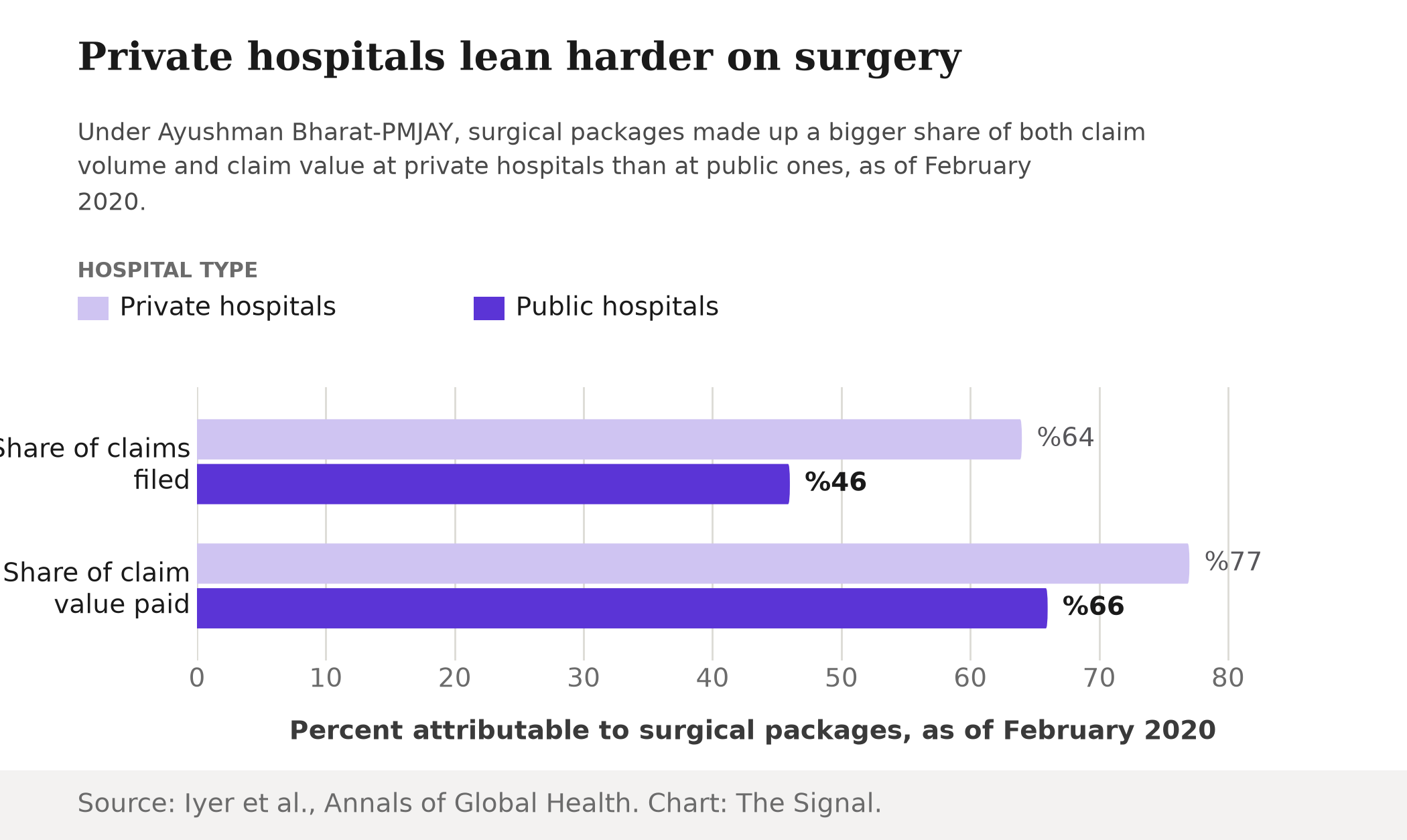
A peer-reviewed analysis of claims data from Ayushman Bharat-PMJAY, published in Annals of Global Health, found that through February 2020, surgical packages accounted for 64 percent of claims filed at private hospitals versus 46 percent at public hospitals, and for 77 percent of the claim value reimbursed to private hospitals versus 66 percent at public hospitals. Private hospitals were not just doing more surgery under the scheme in relative terms. They were being paid a larger share of every claim rupee for it.
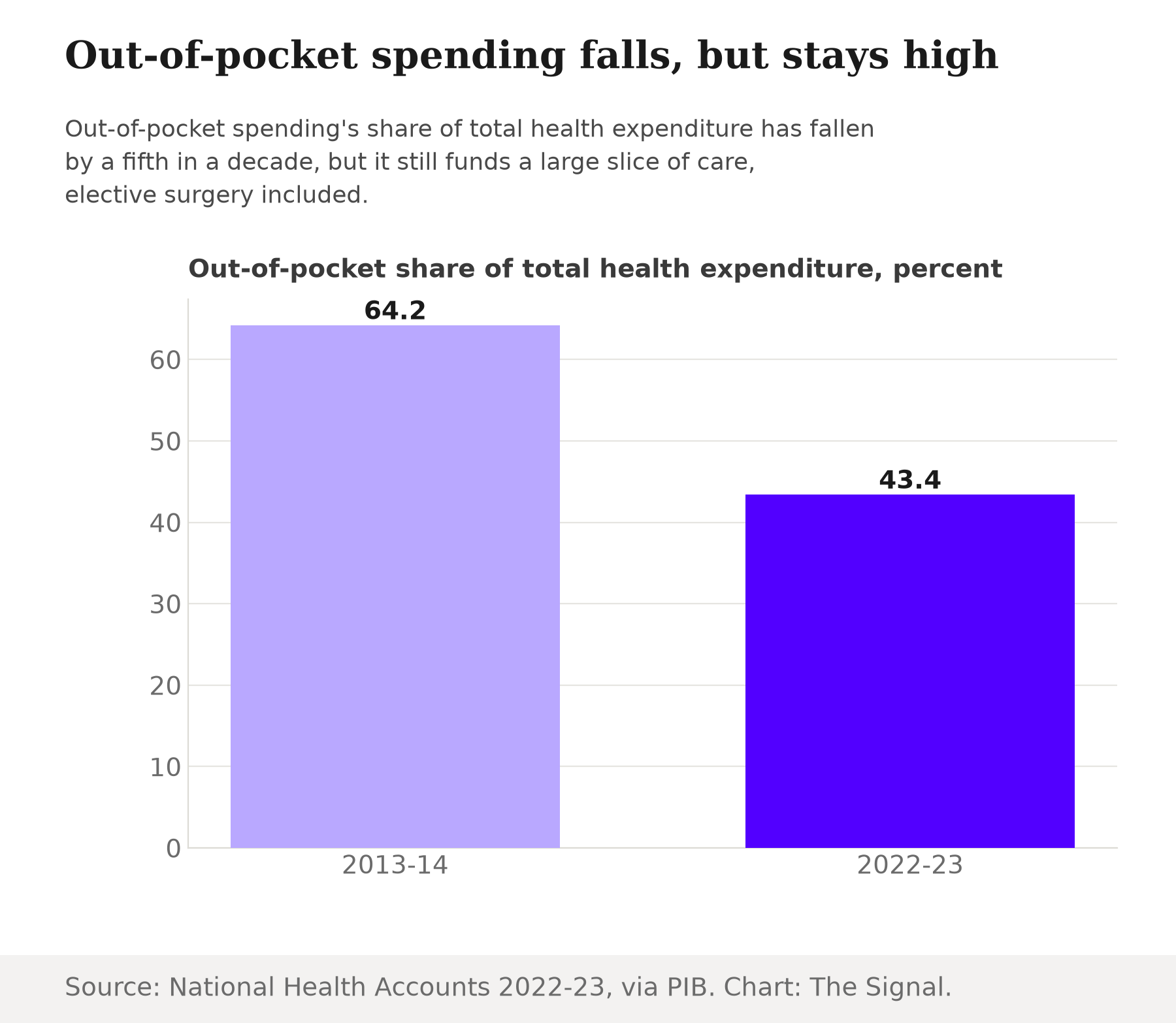
None of this means Indian surgeons are performing the specific operations named above without cause, and there is no claims data here on any individual Indian hospital or procedure. What it establishes is the setting the sham-surgery evidence lands in: an insurance architecture that rewards surgical volume, in a system where the patient rarely bears the full bill directly but the household still funds a large share of care overall. India's National Health Accounts estimates for 2022-23, released by the Union Health Ministry, show out-of-pocket spending fell to 43.4 percent of total health expenditure, down from 64.2 percent in 2013-14. That is real progress, and it is still nearly half.
Where a national insurer pays a package rate for an operation, a private hospital's incentive to recommend that operation does not bend toward the sham-surgery literature. It bends toward the package.
One of the six sham-tested procedures in the table above has an India-specific figure behind it. An analysis of cardiac-procedure claims under PMJAY found 242,580 cardiac procedures were performed nationally from 2018-19 to 2021-22, and that when researchers applied clinical appropriate-use criteria to a sample of the PCI cases among them, 33 percent were classified as "rarely appropriate" interventions. On that reclassification, the resulting unnecessary spending on cardiovascular procedures in 2021-22 alone was estimated at between 277 crore and 461 crore rupees. That is a domestic appropriateness problem, assessed by India's own clinical criteria, in the same procedure ORBITA tested against a placebo and found added no exercise-time benefit for stable angina.
The honest objection
The strongest case against reading too much into this is that "no better than sham" is not the same as "does nothing." Patients in several of these trials, on both arms, improved from their pre-surgery baseline: expectation, attention, anesthesia and the ritual of an operating room are not nothing, and a trial designed to detect a difference between two arms can still show a real, if unexplained, clinical benefit in both. A surgeon pointing to satisfied patients after a knee arthroscopy or a shoulder decompression is not lying about the outcome. And nothing here says these specific procedures are performed inappropriately in India, or names any Indian hospital, insurer or surgeon; the trials are Western in origin, and generalizing a UK spine or heart trial to every operating table is its own kind of overreach.
That case holds for a single trial. It strains once the same result repeats across six unrelated procedures, two decades and, in a 2026 systematic review, 18 of 23 pooled trials. A patient's satisfaction cannot distinguish a real mechanical fix from a well-delivered placebo, which is exactly why these trials use a sham arm in the first place. The honest reading is not that surgery is fraudulent. It is that for a specific, recurring category of procedures, the mechanism doctors describe to patients and the mechanism actually producing the improvement are not reliably the same thing, and only a trial with a fake-surgery control group can tell the two apart.
The Signal
Sham-controlled trials are the one tool that separates the healing of a cut from the healing of a belief, and by that tool, a large and growing share of common surgical procedures cannot prove they clear that bar. The 2026 review putting the figure at 78 percent, up from 51 percent in the 2014 review, means better trial design keeps finding this problem, not fixing it. For a health system like India's, where surgical packages already dominate insurance claims at private hospitals and households still fund a large share of care directly, that evidence has a direct question attached: before a patient signs a consent form for an elective operation, has anyone checked whether that specific procedure has ever been tested against a fake one. Most surgery has never had to answer that question, because most surgery has never been asked.
Reporting basis: the 2026 pooled finding on musculoskeletal procedures is from a systematic review and meta-analysis in Musculoskeletal Care (Dutra et al.), whose literature search reached August 2024 ahead of its September 2026 publication. The 2014 pooled finding across specialties is from a single systematic review in The BMJ (Wartolowska et al.), a single source for that figure. The six individual trial results are each from their original publication in The New England Journal of Medicine or The Lancet: Moseley et al. (2002), Sihvonen et al. (2013), Buchbinder et al. (2009), Beard et al. (2018), Bhatt et al. (2014) and Al-Lamee et al. (2018). The PMJAY claims figures are from a single peer-reviewed analysis in Annals of Global Health (Iyer et al.) covering claims through February 2020; no newer equivalent breakdown is used here. The out-of-pocket expenditure figures are from the Union Ministry of Health and Family Welfare's National Health Accounts Estimates for India 2022-23, via a Press Information Bureau release. The PCI-under-PMJAY volume, appropriateness and unnecessary-spending figures are from a single analysis published in Economic and Political Weekly (Duggal, Gupta et al.), covering claims through 2021-22. The percentage-point comparisons between the 2014 and 2026 reviews, and between private and public hospital claim shares, are stated directly from the cited figures and require no further calculation.