On August 4, 2026, Eisai launched Leqembi in India, the second disease-modifying Alzheimer's drug to reach the country in under a year. Eli Lilly's donanemab, branded Lormalzi, had already secured CDSCO approval in November 2025 for adults with early symptomatic Alzheimer's, mild cognitive impairment or mild dementia, with confirmed amyloid pathology, dosed at 350 mg every four weeks by intravenous infusion. CDSCO cleared Eisai's lecanemab, branded Leqembi, in August 2026 for patients with mild cognitive impairment and mild dementia due to early Alzheimer's, on the condition that amyloid pathology is confirmed through cerebrospinal fluid or serum biomarker testing first. The plain reading is a milestone: for the first time, Indian doctors can prescribe medicines built to slow the disease itself, not just its symptoms.
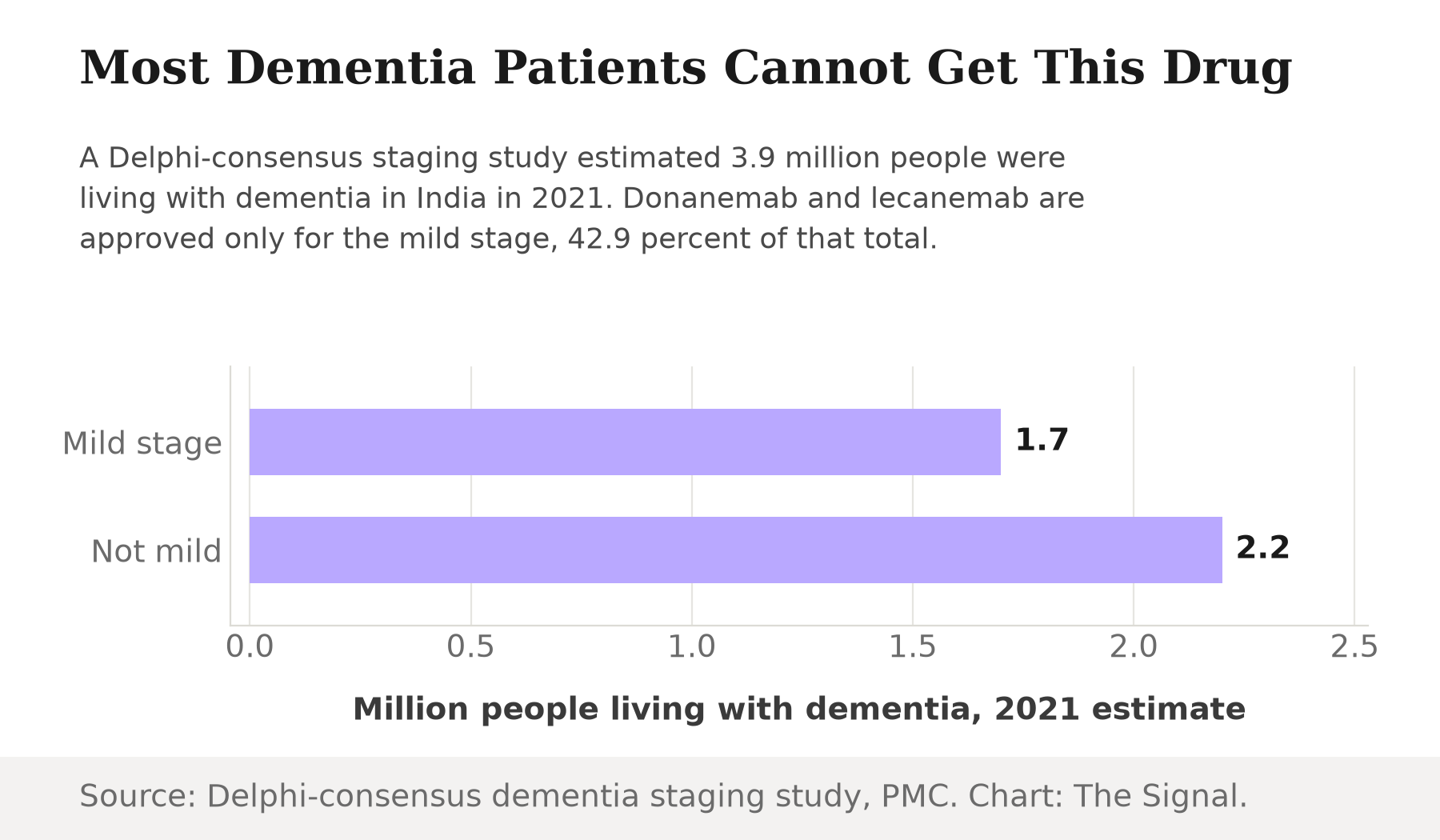
It is worth slowing down on that. A Delphi-consensus study on dementia staging in India, published in the peer-reviewed literature, estimates that approximately 3.9 million people were living with dementia in India as of 2021, and that only 42.9 percent of them, about 1.7 million people, were at the mild stage where a drug like donanemab or lecanemab is actually indicated. Another 31.9 percent, about 1.2 million, were already at the moderate stage, a population the new drugs are not approved to treat. Strip out everyone whose disease has already progressed past "mild" and the pool of patients these approvals apply to shrinks to a minority of India's dementia caseload, before price or infrastructure enter the picture at all.
The burden behind the approvals
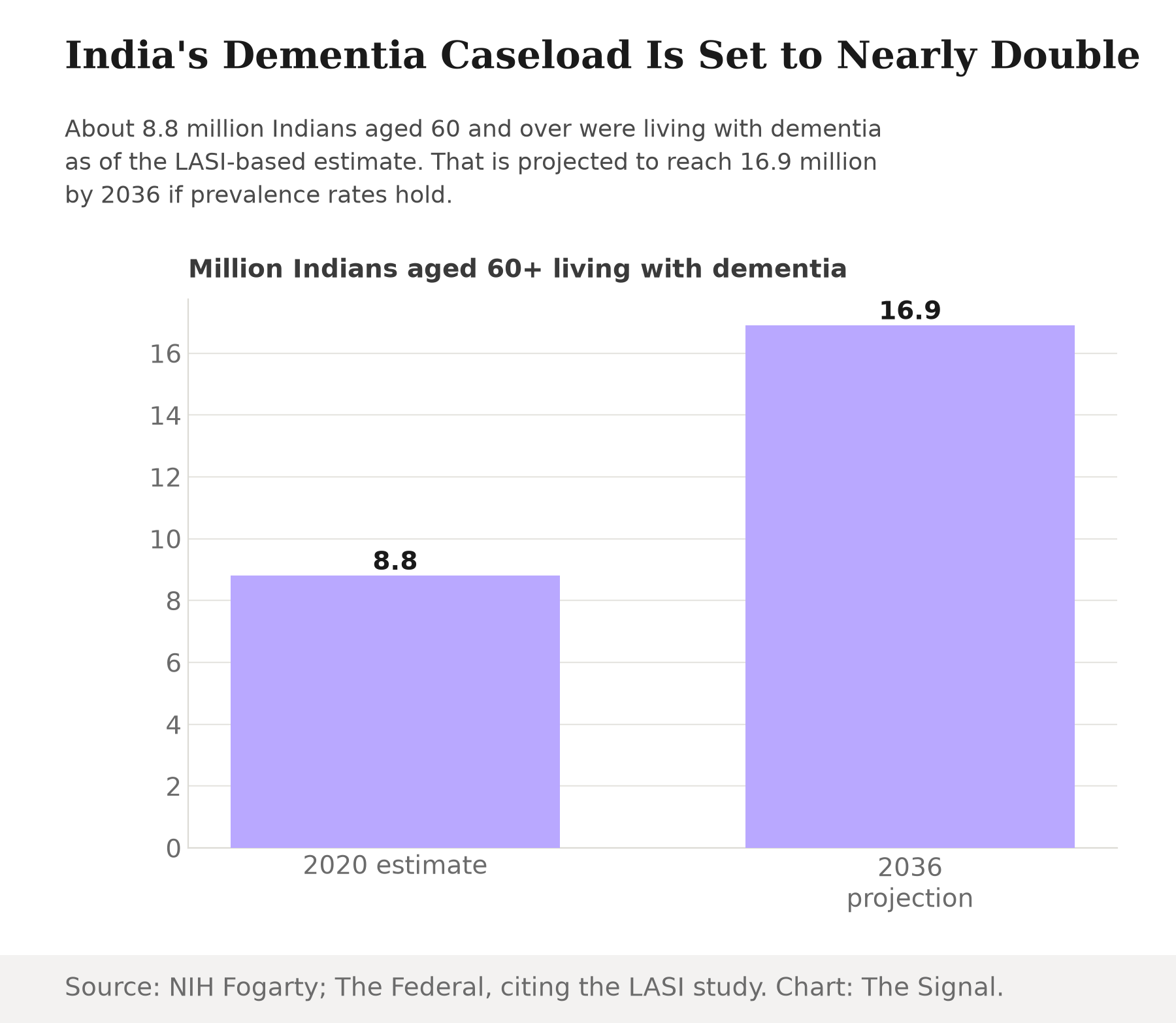
The scale of that caseload is why the approvals matter at all. An NIH Fogarty International Center writeup of Prof. Jinkook Lee's nationwide LASI-based study reports that dementia prevalence in India is 7.4 percent among adults over 60, meaning about 8.8 million Indians were living with dementia as of that study, a 2020 estimate. The Federal, citing the AIIMS-USC Longitudinal Ageing Study in India, reports that caseload is projected to reach 16.9 million by 2036 if prevalence rates remain unchanged, and that prevalence already runs higher among women, 9 percent, than men, 5.8 percent. That LASI-based estimate of 8.8 million and the Delphi-consensus staging study's estimate of 3.9 million come from different studies with different methods; they are not the same count of people and should not be subtracted from each other. What both agree on is direction: the disease is common, growing, and unevenly distributed, and the newly approved drugs reach only its earliest phase.
Dementia prevalence in rural India, 10.19 percent, is nearly double the urban rate of 6.07 percent, per a peer-reviewed machine-learning prevalence study using LASI Wave 1 data, a 2019 dataset. That matters because the infrastructure these drugs need is concentrated in cities, while the disease itself is heaviest in places that infrastructure barely reaches.
The price of admission
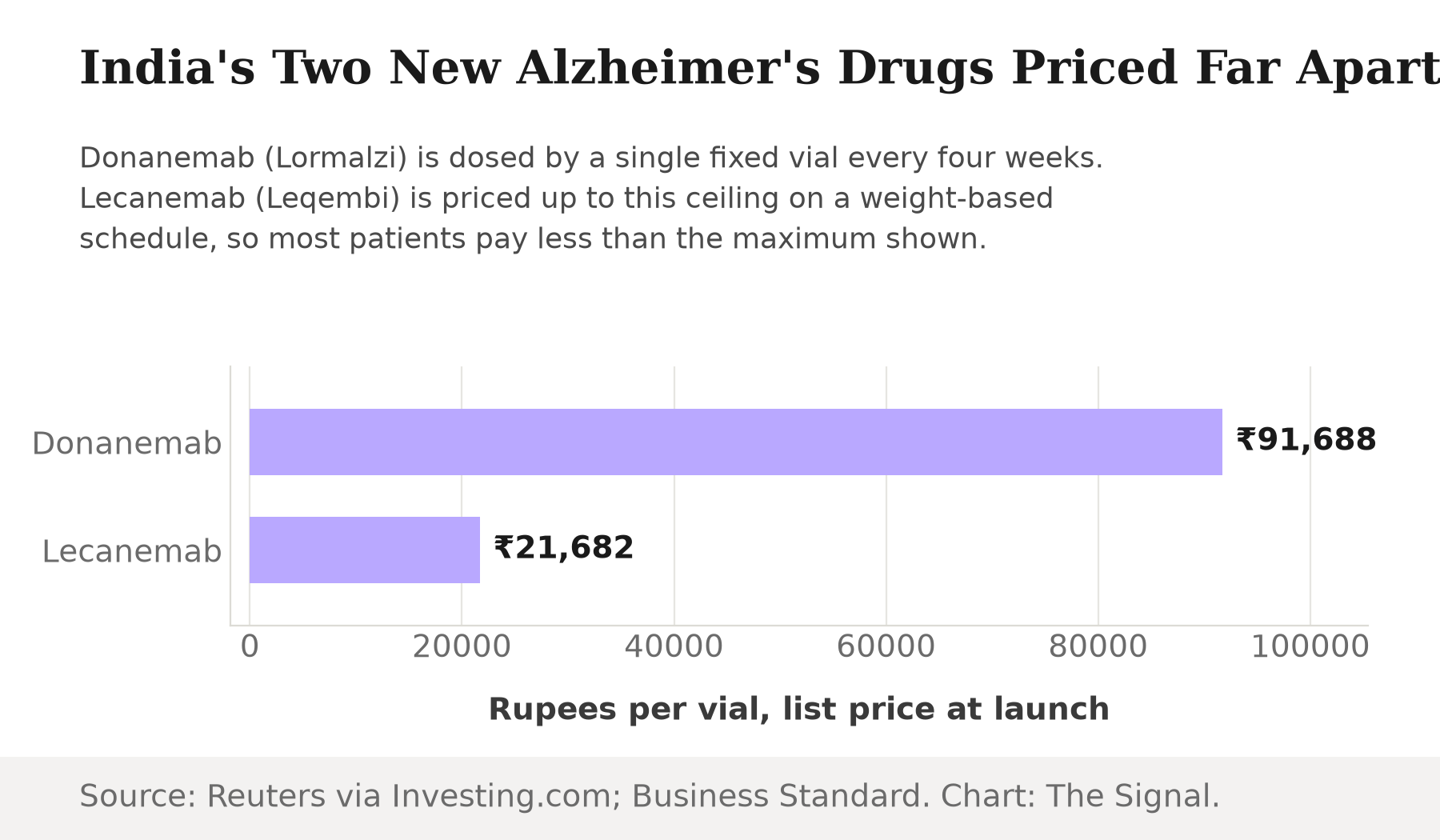
Even for the minority who qualify by stage, the two drugs ask very different things of a patient's wallet. When Eli Lilly launched donanemab in India in May 2026, it priced the 350 mg vial at 91,688 rupees, about $957, administered as an intravenous infusion once every four weeks, per Reuters, via Investing.com. At that dosing, a year of treatment runs to 13 infusions, or roughly 1,191,944 rupees (our calculation, from the per-vial price and the four-weekly schedule). Eisai priced lecanemab on a weight-based dosing schedule, with a maximum retail price of 21,682 rupees per vial, and said Indian patients were not included in the pivotal Phase III trial that supported the drug's approval, a global study that enrolled more than 800 patients; the company will run a Phase IV post-marketing study to generate efficacy and safety data in Indian patients, per Business Standard.
The two drugs treat the same disease but land at very different price points on day one.
| Donanemab (Lormalzi) | Lecanemab (Leqembi) | |
|---|---|---|
| CDSCO approval | November 2025 | August 2026 |
| Launch price | ₹91,688 ($957) per 350 mg vial, every 4 weeks by IV | Up to ₹21,682 per vial, weight-based dosing |
| India trial data | Not stated in the approval reporting | No Indian patients in the 800-plus-patient pivotal trial; Phase IV study now required |
Source: Medical Dialogues, Investing.com/Reuters, Business Standard.
The machines the drugs need
Price is not the only gate. A peer-reviewed case report in Alzheimer's & Dementia, from Tel Aviv Sourasky Medical Center, states that administering these drugs safely requires MRI, cerebrospinal-fluid or PET biomarker testing, and pre-treatment cognitive evaluations, and that establishing specialized medical infrastructure is crucial to enable the wide and safe administration of new treatments, a 2025 finding. That infrastructure exists because both drugs carry a real risk of brain swelling or bleeding, a side effect known as ARIA, which is why regular MRI monitoring is part of safe use, not an optional extra.
That is a heavier lift in exactly the settings with the thinnest specialist bench. The World Health Organization's Global status report on neurology finds that low-income countries have more than 80 times fewer neurologists than high-income nations, despite carrying a high burden of these diseases, a finding published in October 2025. India is not classified as low-income, but the pattern still applies to it: a 2024 review in the European Journal of Neurology counts India among the countries with fewer than one neurologist per million people, against a global average of three to four per million. Thin specialist capacity chasing a large and growing caseload is the constraint these approvals now run into: a drug that requires MRI-monitored infusion visits every four weeks is only as accessible as the nearest centre equipped to deliver it, and the nearest centre may be a long way off.
The honest objection
The strongest case for patience is that new drug classes always arrive before the delivery system catches up, and that is not a reason to withhold approval. Cancer immunotherapies, dialysis and coronary stenting all reached India years before district hospitals could offer them widely, and access still widened over time as private and public capacity built out to meet demand. On that view, CDSCO approving donanemab and lecanemab in 2025 and 2026 is the necessary first step, not a false promise, and the monitoring infrastructure will follow the way it has for other specialist therapies.
That case has real force, but it understates what is different here. A stent or a dialysis machine, once installed, treats any patient in need of it. A drug indicated only for the mild stage of a progressive, often-undiagnosed disease has a shrinking window: by the time a family in a district without a neurologist notices symptoms, seeks a diagnosis and locates a centre that can run amyloid and MRI testing, many patients will already have moved past the stage the drugs are approved to treat. Infrastructure that arrives late does not just delay treatment here; for a meaningful share of patients, it forecloses it.
The Signal
CDSCO's approvals are real medical progress: India now has access to drugs built to slow Alzheimer's disease itself, beyond merely masking its symptoms. An approval grants permission to prescribe; it does not build the system needed to deliver the drug. The number worth tracking over the next year is not how many hospitals list donanemab or lecanemab on their formulary. It is how many centres outside India's major cities can actually run the MRI and biomarker workup the drugs require before a patient's disease moves past the stage where either one still works.
Reporting basis: India's dementia prevalence and 2036 projection are from Prof. Jinkook Lee's LASI-based study, as reported by NIH Fogarty and, separately, by The Federal citing the AIIMS-USC Longitudinal Ageing Study in India; these are two write-ups of overlapping LASI research, not independent counts, and are cited as such. The rural-urban prevalence split is from a separate peer-reviewed machine-learning study using LASI Wave 1 data. The dementia-stage distribution (3.9 million total, mild versus moderate share) is from a separate Delphi-consensus staging study and uses its own denominator, distinct from the LASI prevalence figures; the two are never combined into a single ratio in this piece. The CDSCO approval details for donanemab and lecanemab are per Medical Dialogues' reporting on donanemab and on lecanemab; the donanemab launch price is per Reuters, via Investing.com; the lecanemab price and trial-enrollment details are per Business Standard. The infrastructure requirements for safe administration are from a peer-reviewed case report in Alzheimer's & Dementia. The neurologist-capacity comparison is from the World Health Organization's Global status report on neurology; the India-specific neurologist-density figure is from a 2024 review in the European Journal of Neurology. The annualized donanemab cost is The Signal's calculation from the reported per-vial price and dosing schedule.