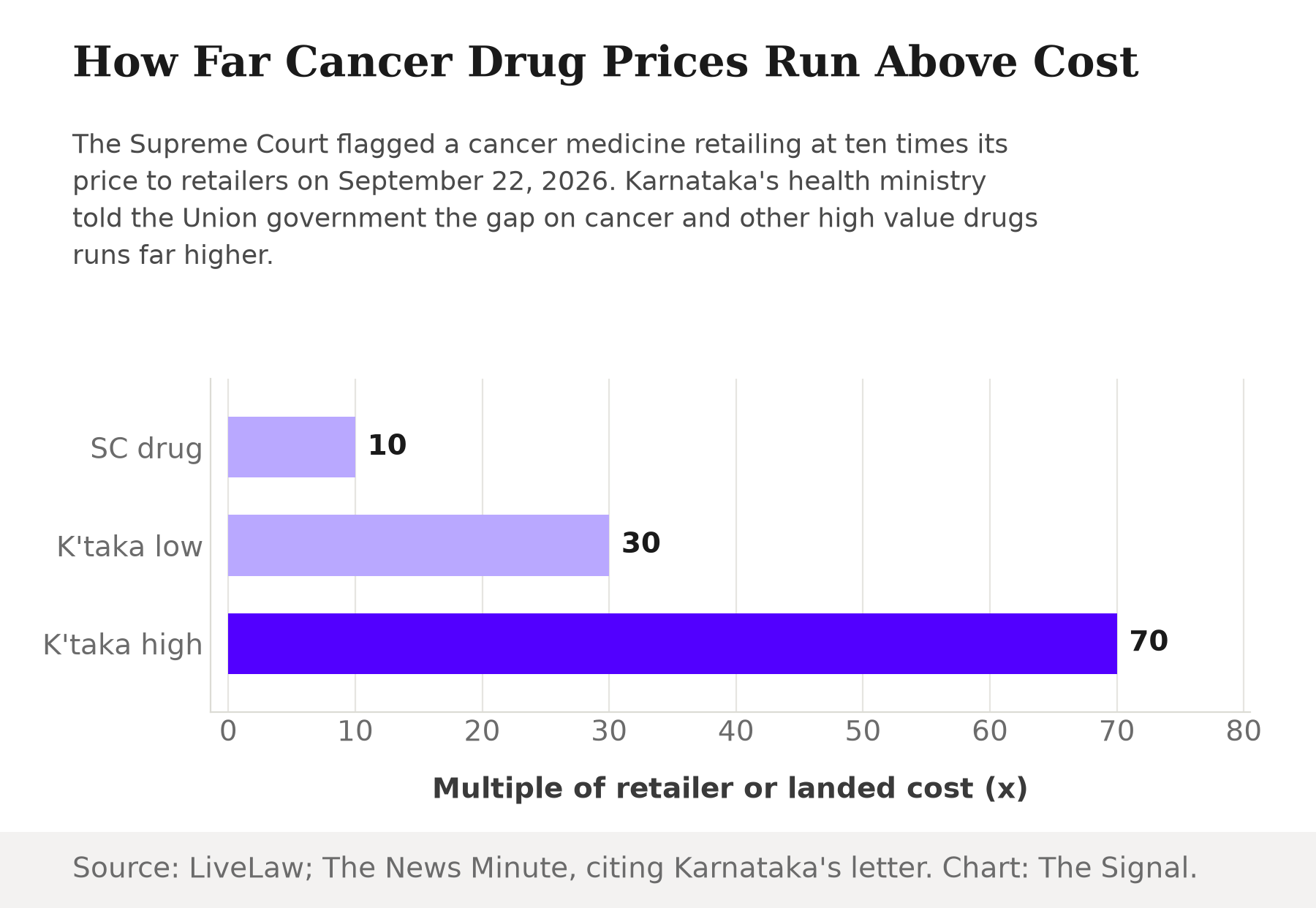
On September 22, 2026, hearing a pair of public-interest petitions on drug pricing, the Supreme Court zeroed in on a single medicine: an essential cancer drug priced to retailers at Rs 2,700 a unit but sold to patients at a maximum retail price of Rs 27,000, ten times over. LiveLaw reported the bench's reaction: "absolute rampage, carnage," and, more bluntly, "dacoity, broad daylight dacoity." The easy read is that cancer drug pricing in India runs unchecked, a market where markups this large simply happen.
That read misses the more specific problem. India built a rule for exactly this kind of markup back in 2019. The trouble is where that rule stops.
The Supreme Court's number was one case. Karnataka's government has been collecting many more. In a letter to the Union Health Ministry, Health Minister UT Khader wrote that the gap between what hospitals actually pay to receive cancer and other high-value drugs and the MRP printed on the pack can run from 30 to more than 70 times in some cases, The News Minute reported. Read the Supreme Court's tenfold figure next to Karnataka's 70-times figure and the ten-times case looks almost restrained.
The cap that already exists
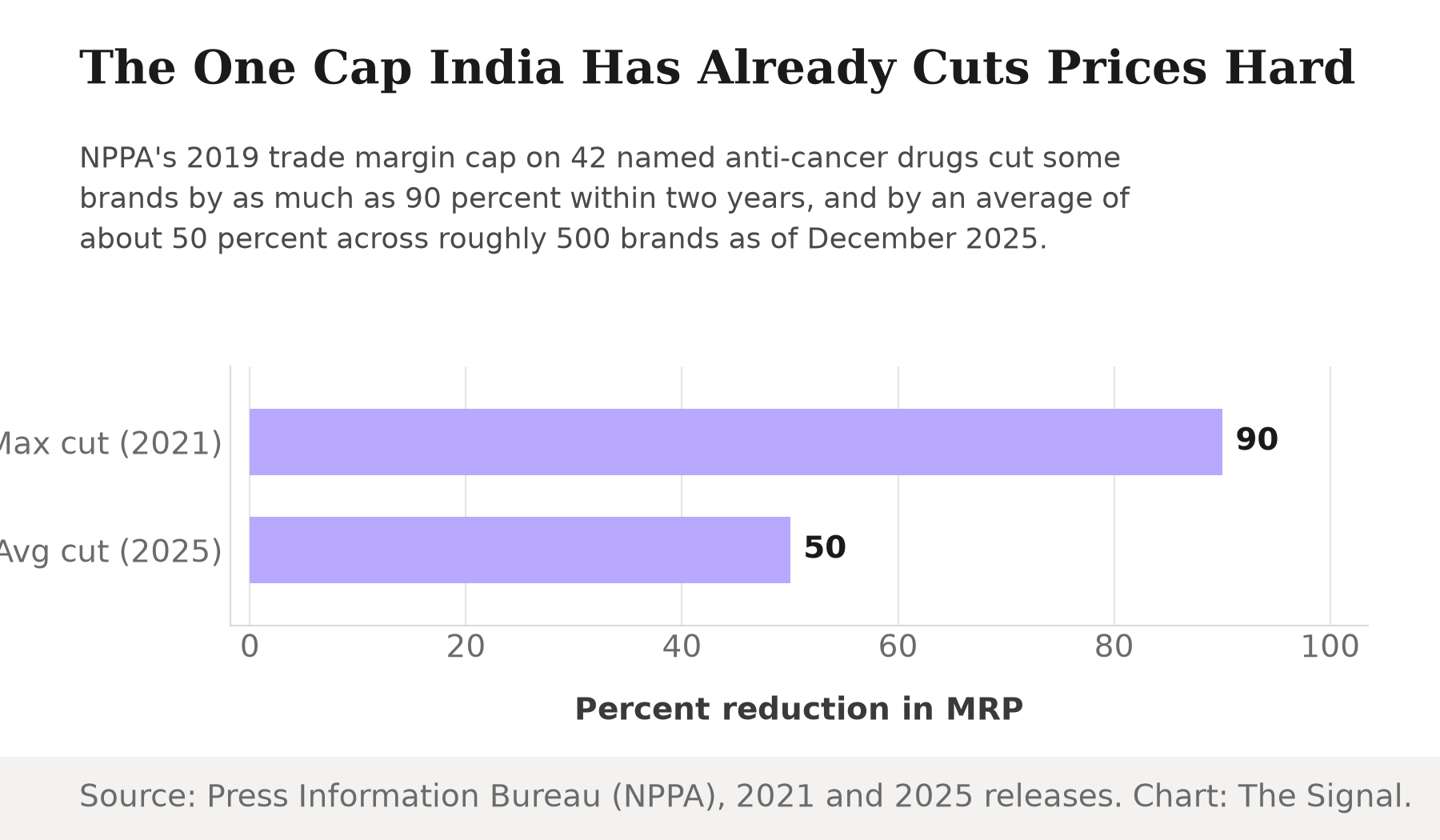
Here is the part the "unchecked market" framing leaves out. On February 27, 2019, the National Pharmaceutical Pricing Authority capped the trade margin on 42 named anti-cancer drugs at 30 percent, a Press Information Bureau release from the Ministry of Chemicals and Fertilizers states, after the regulator found that cancer patients' average out-of-pocket spending ran about 2.5 times that for other diseases. This was not a symbolic gesture. Within two years, the cap had cut the MRP of 526 brands of those medicines by as much as 90 percent, according to a separate PIB release dated August 2021. As of December 2025, the government was still citing the same mechanism at work: about 500 brands cut by an average of roughly 50 percent, for an estimated Rs 984 crore a year in savings to patients.
A 30 percent margin cap, applied since 2019, is already cutting cancer-drug prices by half or more.
That is the honest baseline. Where a margin cap applies, it works, and it works quickly. So why is the Supreme Court still looking at a tenfold gap, and why is Karnataka reporting gaps of up to 70 times, years after this cap took effect?
Forty-two drugs, and everything else
The answer is coverage, not compliance. The 2019 order named 42 specific anti-cancer drugs and never extended past that list. For every other non-scheduled drug formulation, branded or generic, cancer or otherwise, the Drugs Price Control Order 2013 sets no cap on the trade margin at all. The only constraint, per Para 20 of DPCO 2013, is that a manufacturer cannot raise the MRP by more than 10 percent in the preceding 12 months, a limit on how fast next year's price climbs, not on how large today's gap already is. A drug launched at 40 times its landed cost can stay there indefinitely without ever breaching that rule.
Named cancer drugs got a real cap. Almost everything else got only a speed limit on future increases.
| The 42 named anti-cancer drugs | Every other non-scheduled drug | |
|---|---|---|
| Trade margin cap | 30%, since February 2019 | None |
| What actually limits pricing | The 30% margin ceiling itself | Only a 10% cap on the MRP increase in the prior 12 months |
Source: PIB, February 2019 NPPA order; PIB, DPCO 2013 Para 20.
The scale of that second column is not small. A Parliamentary Standing Committee report on the NPPA, tabled August 7, 2026, flagged that non-scheduled formulations, priced by manufacturers themselves and only monitored rather than capped by the NPPA, make up about 82 percent of the Indian pharmaceutical market, ANI reported, citing the committee's findings. A rule that reaches 42 drugs by name, however well it works on those 42, is not built to touch a market where roughly four-fifths of everything sold sits outside it by design.
Even the cap that exists is hard to collect on
There is a second failure sitting underneath the coverage gap: enforcement of the cap India does have is itself slow. The same Standing Committee, in its 33rd report, found that Rs 8,526.10 crore of a total Rs 10,013.30 crore in overcharging demands the NPPA has raised across the industry, about 85 percent, was still unpaid as of September 30, 2025, ThePrint reported, with most of that sum tied up in litigation.
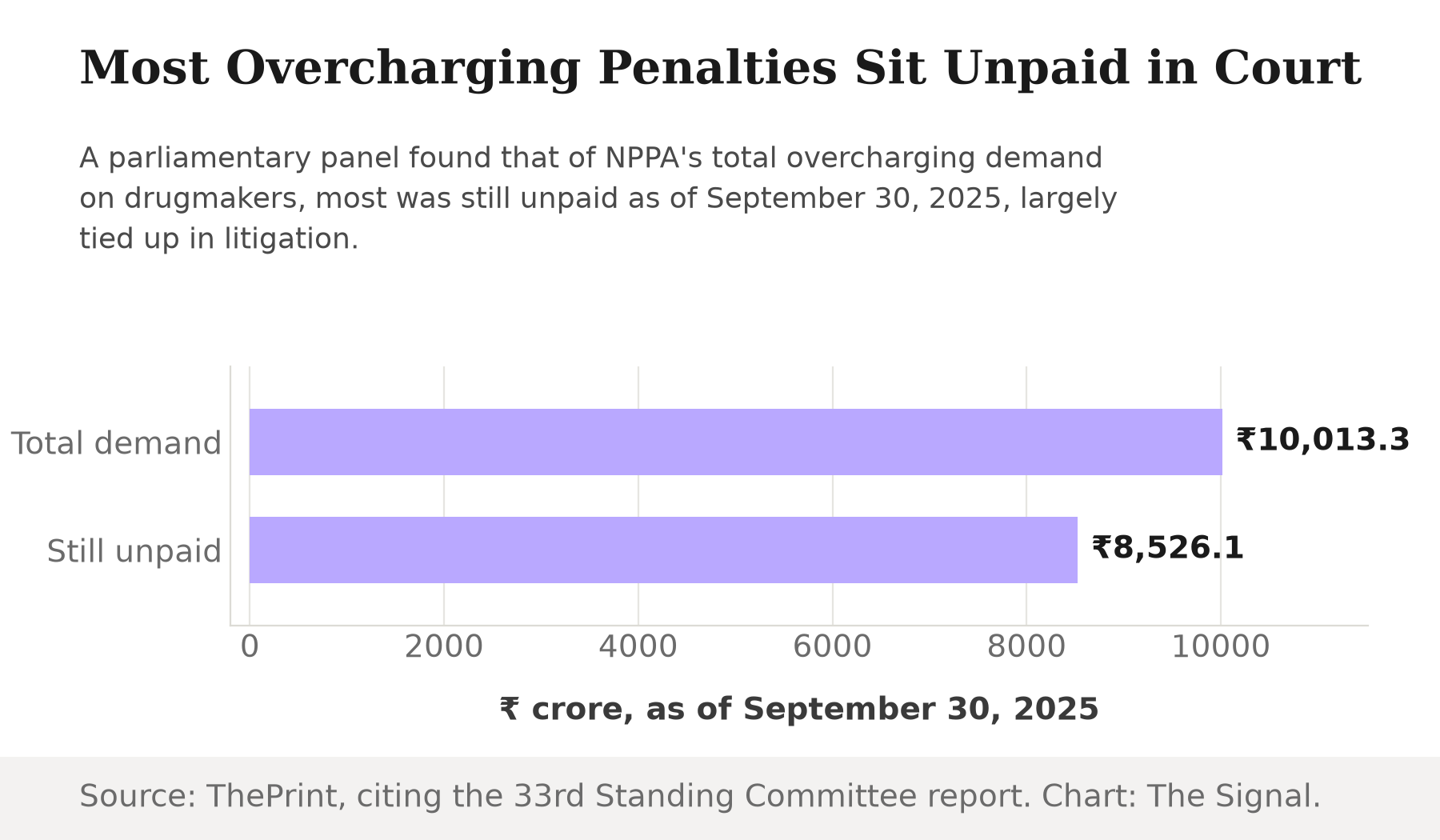
So the picture has two separate holes, not one. The 30 percent cap on 42 named drugs demonstrably worked where it applied. But most of the market was never inside that cap to begin with, and even the overcharging penalties the NPPA has actually issued mostly sit unpaid, tied up in litigation, rather than collected.
The honest objection
The strongest case against reading this as a design flaw is that price controls carry a cost. Squeeze margins too hard and distributors and small pharmacies, already on thin retail spreads, may simply stop stocking less profitable drugs, which could hurt availability without doing much for affordability. That trade-off is real, and it is arguably why NPPA's approach has been targeted rather than blanket: name specific drug categories one at a time rather than capping the whole market at once.
But that explains caution about expanding the list. It does not explain the size of the gaps Karnataka and the Supreme Court are now describing, on medicines that sit in the exact category the 2019 order was built to address. A targeted policy that still leaves cancer patients facing markups Karnataka itself put at 30 to more than 70 times landed cost, on drugs adjacent to but not on a 42-name list, is not exercising caution: it is leaving the patients the policy was written for exposed to the problem it was meant to solve.
The Signal
The 2019 cap is proof of concept, not proof of coverage. It shows a margin cap can cut prices by half or more within a few years, without collapsing the market for the drugs it covers. What it has not done is grow past its original 42 names into the rest of a market where, by the same committee's count, roughly four in five drugs sold carry no such ceiling at all. Watch what happens after the Supreme Court's next hearing, listed for September 29, 2026: whether the bench pushes the NPPA toward widening the list of capped drugs, or whether the case ends with tighter enforcement of the 42 names already on it. A cap that only reaches the drugs named eight years ago was never going to keep pace with a market that keeps launching new ones.
Reporting basis: the Supreme Court hearing and its remarks are per LiveLaw's court reporting. The landing-price-to-MRP gap is per The News Minute's report of a letter from Karnataka's health minister to the Union Health Ministry. The trade-margin cap, its brand-count and percentage results over time, and the DPCO Para 20 rule for other formulations are each from separate Press Information Bureau releases by the Ministry of Chemicals and Fertilizers, cited at the point each figure appears. The overcharging-arrears figure and the market-share figure share a single origin, the Parliamentary Standing Committee's 33rd report on the NPPA, as reported respectively by ThePrint and by ANI. No figure in this piece is The Signal's own calculation; every number is as stated in its source.