On 11 November 2025, India's High Commission in Suva handed Fiji's health ministry a consignment of antiretroviral drugs weighing more than three tonnes, the largest single gift of medicine India has ever made to the country, continuing donations it had already made in 2021, 2022 and 2023. Ten months later, on 16 September 2026, Fiji's Health Minister declared a national HIV crisis, with UNAIDS reporting that new infections had risen 12-fold since 2010. Read only the aid headlines and the story looks like a system working: India shipping medicine, Australia, New Zealand, the United States and others convening a Development Partners' Roundtable in June 2025 to coordinate funding, the machinery of global health responding to a small Pacific nation in trouble.
It is worth slowing down on that. India's largest-ever medicine shipment to Fiji landed in November 2025. The emergency was declared anyway in September 2026. Aid kept arriving and the epidemic kept accelerating, which means the thing actually driving new infections was never a shortage of pills.
Fiji had zero needle-syringe programmes as of July 2025, months into a crisis already driven by needle-sharing.
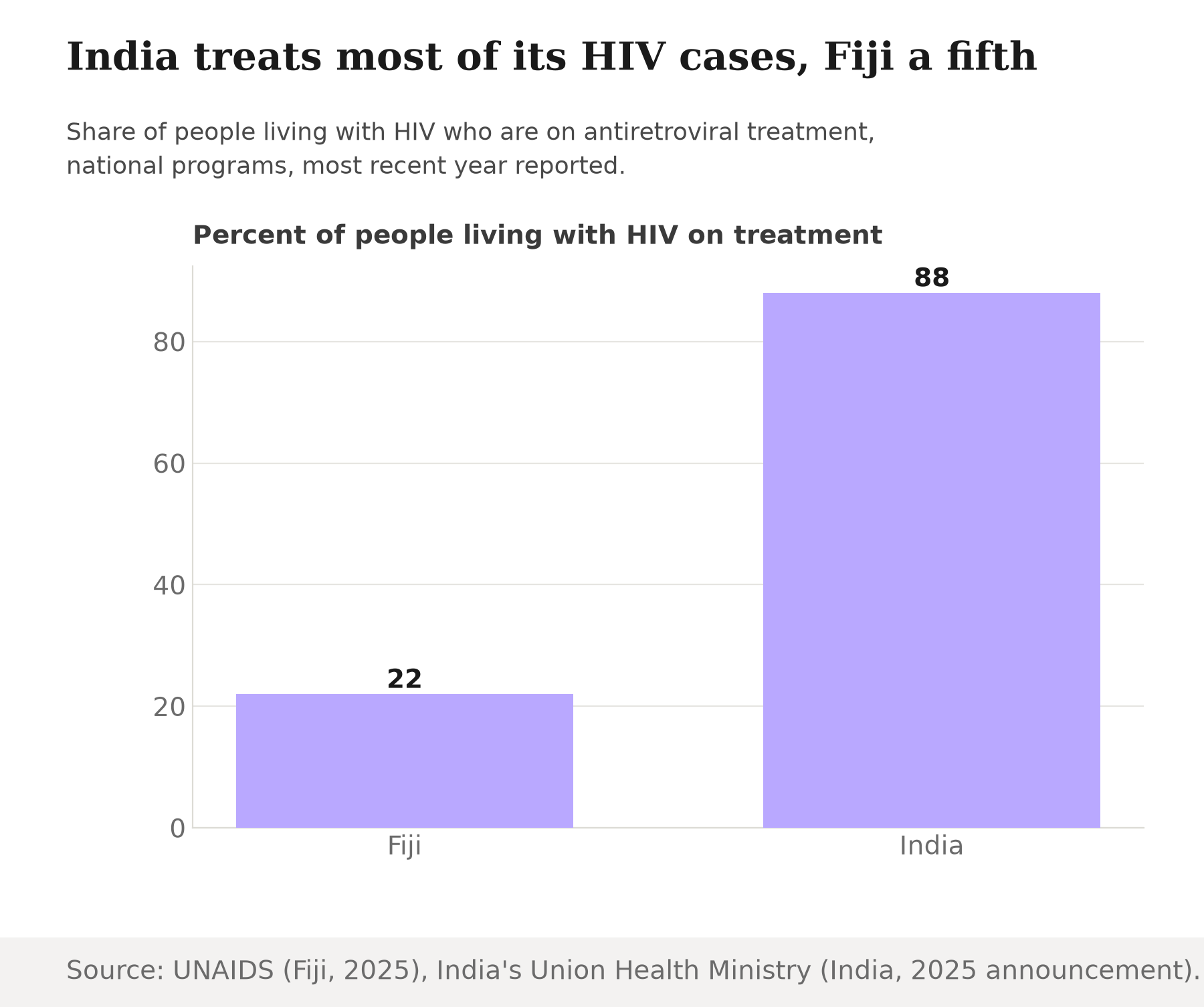
The reveal is in the mechanism, not the money. A UNAIDS feature published in July 2025 stated plainly that Fiji currently had no needle-syringe programmes operating, even as preliminary 2024 data showed that half of newly diagnosed people already on treatment had contracted HIV through sharing needles. By September 2026, UNAIDS attributed more than 42 percent of Fiji's cases with a known transmission route to injecting drug use, alongside over half from sexual transmission. An estimated 9,100 people were living with HIV in Fiji in 2025, but only 39 percent knew their status and just 22 percent were on antiretroviral treatment. Drugs help the 22 percent already diagnosed and treated. They do nothing for the needle-sharing route driving new cases into a population that mostly does not know it is infected.
The medicine kept arriving. The gap did not close
India's ARV shipments to Fiji are not new. The November 2025 delivery followed prior donations of ARVs and other medical supplies in 2021, 2022 and 2023, a running bilateral relationship, not a one-off emergency response. India was also one of the international partners, alongside Australia, New Zealand, the United States, the European Union and others, at Fiji's June 2025 Development Partners' Roundtable convened specifically to coordinate HIV response funding. None of that assistance, arriving well before the September 2026 declaration, closed the needle-syringe gap that UNAIDS had already flagged by name more than a year earlier.
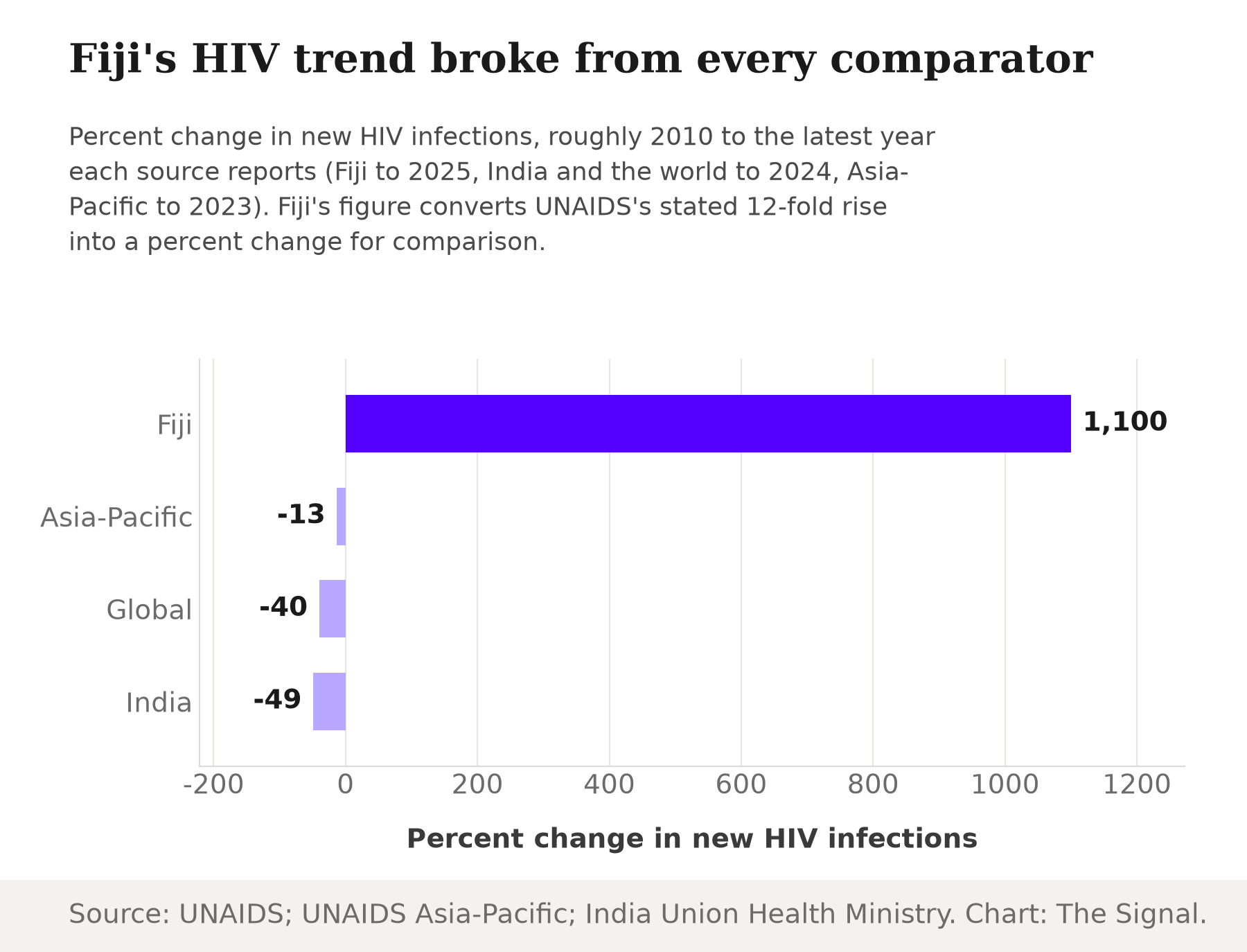
That divergence holds against every available comparator. UNAIDS says Fiji's new infections rose 12-fold between 2010 and 2025, a figure The Signal converts to roughly a 1,100 percent increase for comparison. Over almost the same span, global new infections fell 40 percent, from 2.2 million to 1.3 million in 2024, and India's fell 49 percent between 2010 and 2024, alongside an 81 percent drop in AIDS-related deaths. India's own decline beat the global rate. It also beat its own region by a wide margin: Asia-Pacific's new infections fell only 13 percent between 2010 and 2023, the weakest showing of any region UNAIDS tracks, and the one Fiji belongs to.
India's success sits inside the same fragile system
India's Union Health Ministry says HIV status awareness has reached 85 percent and treatment coverage stands at 88 percent, against Fiji's 22 percent on treatment. That gap has less to do with willpower or competence than with funding architecture. UNAIDS's Asia-Pacific regional office says India is one of just ten countries in the region that receive direct PEPFAR funding for HIV programmes, the same US-funded architecture whose 2025 freeze the office warned could set back the region's weakest-in-the-world progress further still.
India treats most of its HIV cases. Fiji treats a fifth.
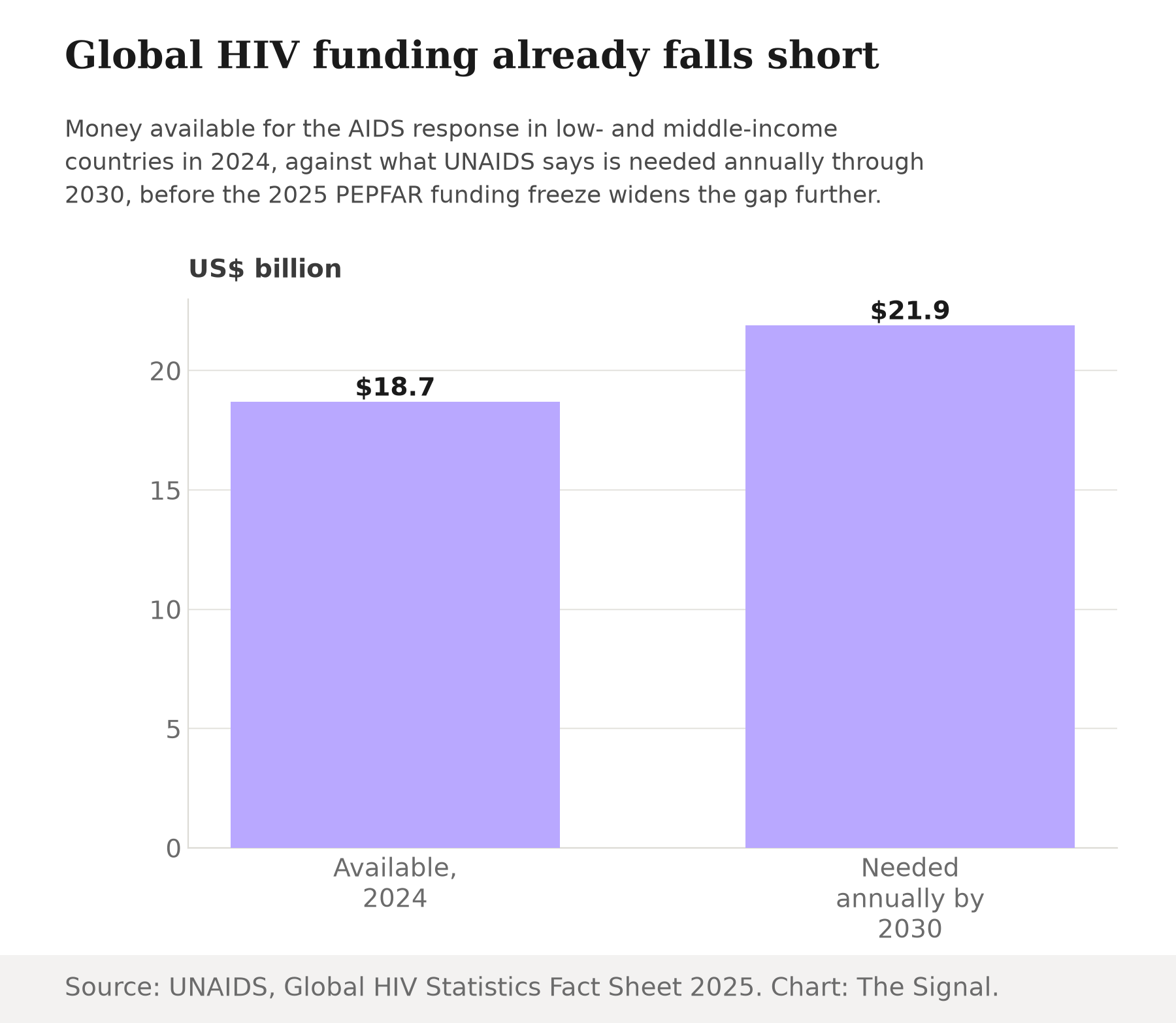
India's 49 percent decline and 88 percent treatment coverage are the product of a domestic program built over two decades, not a guarantee that runs forever. UNAIDS's 2025 fact sheet states that US$18.7 billion was available for the AIDS response in low- and middle-income countries in 2024, 17 percent short of the US$21.9 billion needed annually through 2030, and warns that a PEPFAR funding freeze could widen that gap significantly if funding does not return to 2024 levels. Some of the same money that keeps India's program running sits inside a budget line that is already short and now less certain. India's numbers look nothing like Fiji's today. They rest on a funding base with the same kind of fragility Fiji's collapse just made visible.
The honest objection
The strongest case against reading this as a funding-model failure is that the response system worked exactly as it should: Fiji's government declared an HIV outbreak on 23 January 2025, WHO and UNDP commissioned a joint rapid assessment, funded by the Global Fund, to find out why, India sent its largest-ever drug shipment to Fiji in November 2025, and international partners had already convened a funding roundtable in June 2025, months before the formal crisis declaration. On that reading, Fiji shows a system responding fast to a genuinely explosive domestic outbreak, driven by injecting drug use dynamics no donor could have prevented from outside, not a story of neglect.
That case is real, and it explains why medicine, assessments and money arrived quickly. It does not explain why the WHO-UNDP assessment's own finding, that people who inject drugs in Suva face syringe scarcity and unsafe injecting practices, and the needle-syringe gap UNAIDS had already named in writing by July 2025, were still the headline findings when the crisis was formally declared in September 2026, twenty months after the outbreak was first declared in January 2025. A response system that can commission an assessment, mobilise three tonnes of drugs and convene a multi-country funding roundtable inside a year, and still not stand up a single needle-exchange programme, is fast at moving money and assessments and slow at moving the one intervention the transmission data said mattered most.
The Signal
Fiji is the visible failure. The less visible risk is that its funding architecture is the same one still working, for now, everywhere else. India's own HIV program sits inside a regional system whose average decline is far weaker than India's own, funded in part by a PEPFAR budget line UNAIDS has flagged as being in retreat. What Fiji shows is not that aid does not matter. It is that the composition of aid matters more than the volume: drugs treat the people already diagnosed, while an epidemic spreading through shared needles needs a different kind of intervention entirely. The number to watch next is not more tonnes of medicine arriving in Suva, but whether Fiji's national emergency produces its first needle-syringe programme, and whether the countries whose success stories currently look nothing like Fiji's are quietly running the same gap.
Reporting basis: Fiji's crisis declaration, prevalence and treatment figures, and the 12-fold and global infection-decline figures are from UNAIDS press releases and its 2025 Global HIV Statistics Fact Sheet. The needle-syringe programme gap and Fiji's 2024 treatment data are from a UNAIDS feature story published in July 2025. Fiji's outbreak-declaration date is from the United Nations in the Pacific, and the WHO-UNDP joint rapid assessment is from a WHO feature story. India's decline in new infections and AIDS deaths, and its awareness and treatment coverage figures, are from India's Union Health Ministry, as reported by News on Air. The Asia-Pacific regional decline rate and India's status as a direct PEPFAR recipient are from UNAIDS's Asia-Pacific regional office. India's ARV shipment history is from the High Commission of India in Suva, and the June 2025 Development Partners' Roundtable is from the United Nations in the Pacific. The percent-change conversion of Fiji's stated 12-fold rise, and the framing of Fiji's numbers against India, the region and the world side by side, are The Signal's own calculations and compilation from those figures.