
For women, the standard clinical story about heart disease has a clear hinge point. Estrogen is protective while it lasts, the story goes, so a woman's cardiovascular risk stays comparatively low until menopause strips that protection away. Screening and prevention effort follows the same logic: watch more closely once menopause arrives, because that is when the risk turns up.
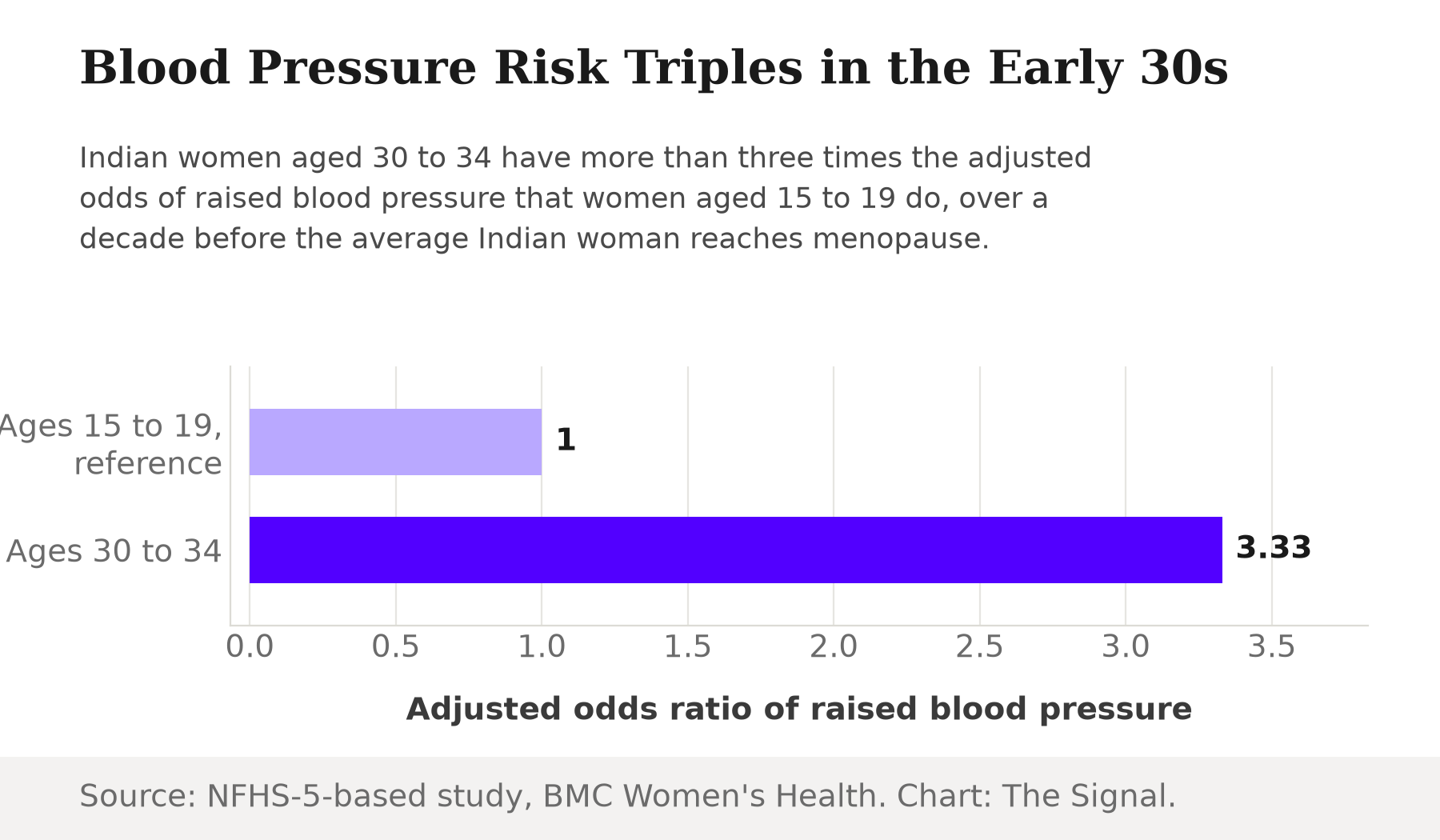
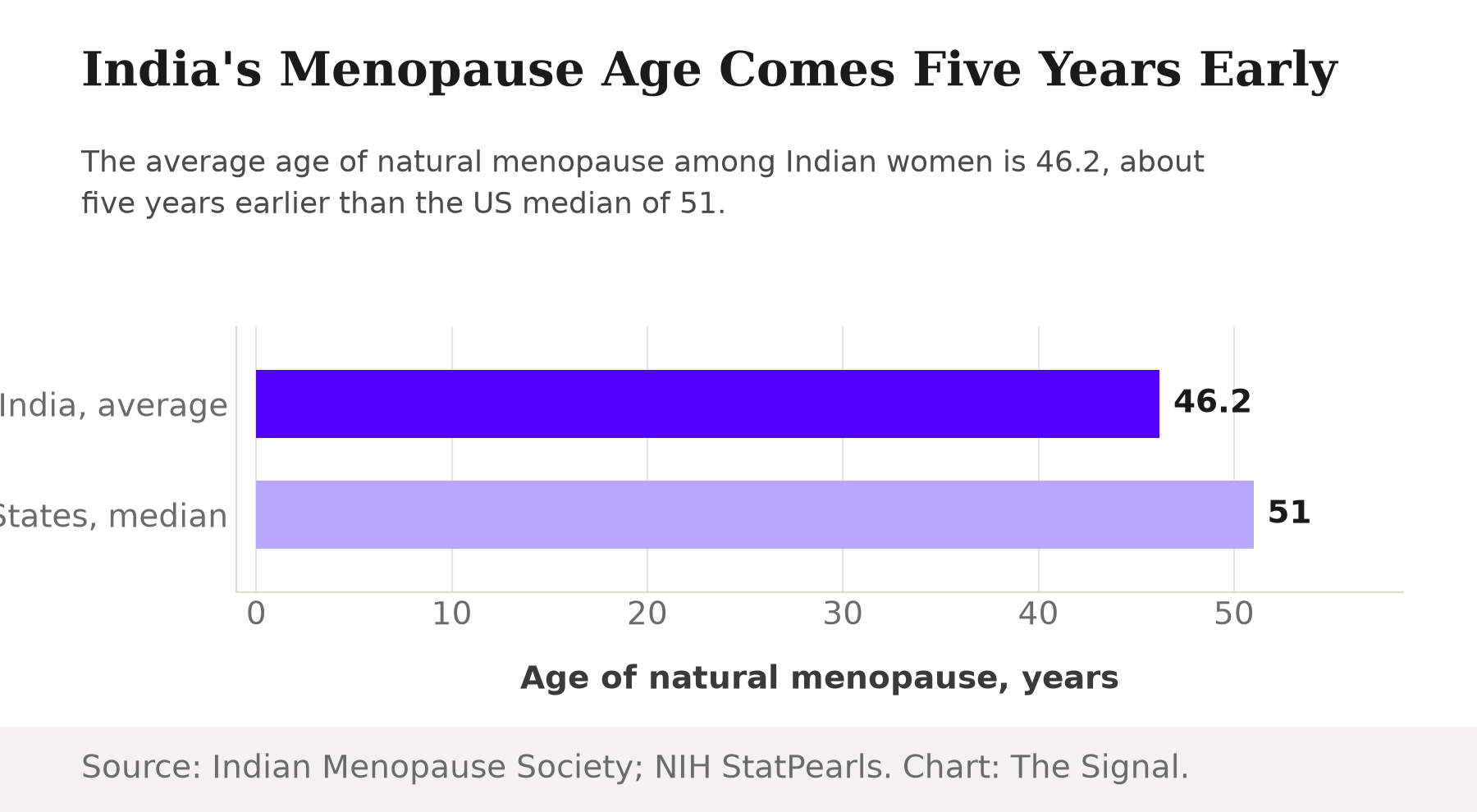
It is worth slowing down on that hinge. In India, the marker clinicians wait for arrives, on average, at 46.2 years. A pan-India survey by the Indian Menopause Society, the largest of its kind, put the average age of natural menopause among Indian women at 46.2 years, based on fieldwork reported in 2016. But the blood pressure data do not wait for 46. An NFHS-5-based nationwide study, published in BMC Women's Health, found that Indian women aged 30 to 34 already carry more than three times the adjusted odds of raised blood pressure that women aged 15 to 19 do, using survey data collected in 2019 to 2021.
By their early thirties, Indian women's blood pressure risk has already tripled.
That is well over a decade before Indian women reach the 46.2-year menopause milestone screening is built around.
So the practical question is not whether menopause matters for heart risk. It is whether it should be the signal that starts the watching, when the watching already needed to have started.
The guideline machinery has its own gap
This is not a uniquely Indian design flaw; it is baked into how cardiology guidelines are built. The 2018 ACC/AHA/Multisociety cholesterol guideline calls for cardiovascular risk-factor assessment to begin at age 20, which sounds early enough to cover the window the Indian blood pressure data describe. But that same guideline's formal 10-year ASCVD risk calculators and statin-initiation decisions, the tools that actually translate a risk factor into a treatment decision, apply only to adults aged 40 to 75. Between 20 and 40, a patient is told to watch her risk factors; she is not yet inside the machinery that decides what to do about them. In India, where blood pressure risk has already tripled by the early thirties and the average woman reaches menopause at 46.2, that twenty-year assessment-only zone in the guidelines covers almost the entire gap between rising risk and any menopause-based prompt to act.
The gap would matter less if India's menopause timing lined up with the guideline machinery's assumptions. It does not, in either direction. The median age of natural menopause in the United States is 51, per NIH's StatPearls clinical reference, current as of 2026. Indian women reach the same marker, on average, about five years earlier. A screening habit built for a population that reaches menopause at 51 already starts its formal risk-scoring closer to that marker. In India, where average menopause lands at 46.2 and blood pressure risk has already tripled by the early thirties, that same habit leaves an even longer stretch of elevated risk unaddressed.
When menopause timing itself is the marker
None of this means menopause timing is irrelevant to heart risk. It is a real, load-bearing signal, just not a sufficient one on its own. A JAMA Cardiology study following more than 10,000 US women since 1964 found that premature menopause, defined as before age 40, was associated with a 40 percent higher lifetime risk of coronary heart disease than menopause at a typical age, in an analysis published in March 2026. That is a genuinely large effect, and it is the strongest single piece of evidence that menopause timing carries prognostic weight.
The trouble is how few women that marker actually flags. An NFHS-5-based study published in Scientific Reports estimated that 2.2 percent of Indian women experience premature menopause, before age 40, and a further 16.2 percent experience early menopause, between 40 and 44, from the 2019 to 2021 survey round. Add those two groups together and fewer than one in five Indian women hit menopause before 45. For the more than four in five who do not, a screening trigger keyed to menopause timing has nothing to say until their late forties at the earliest, even though their blood pressure risk was already elevated fifteen years earlier.
The gap shows up downstream
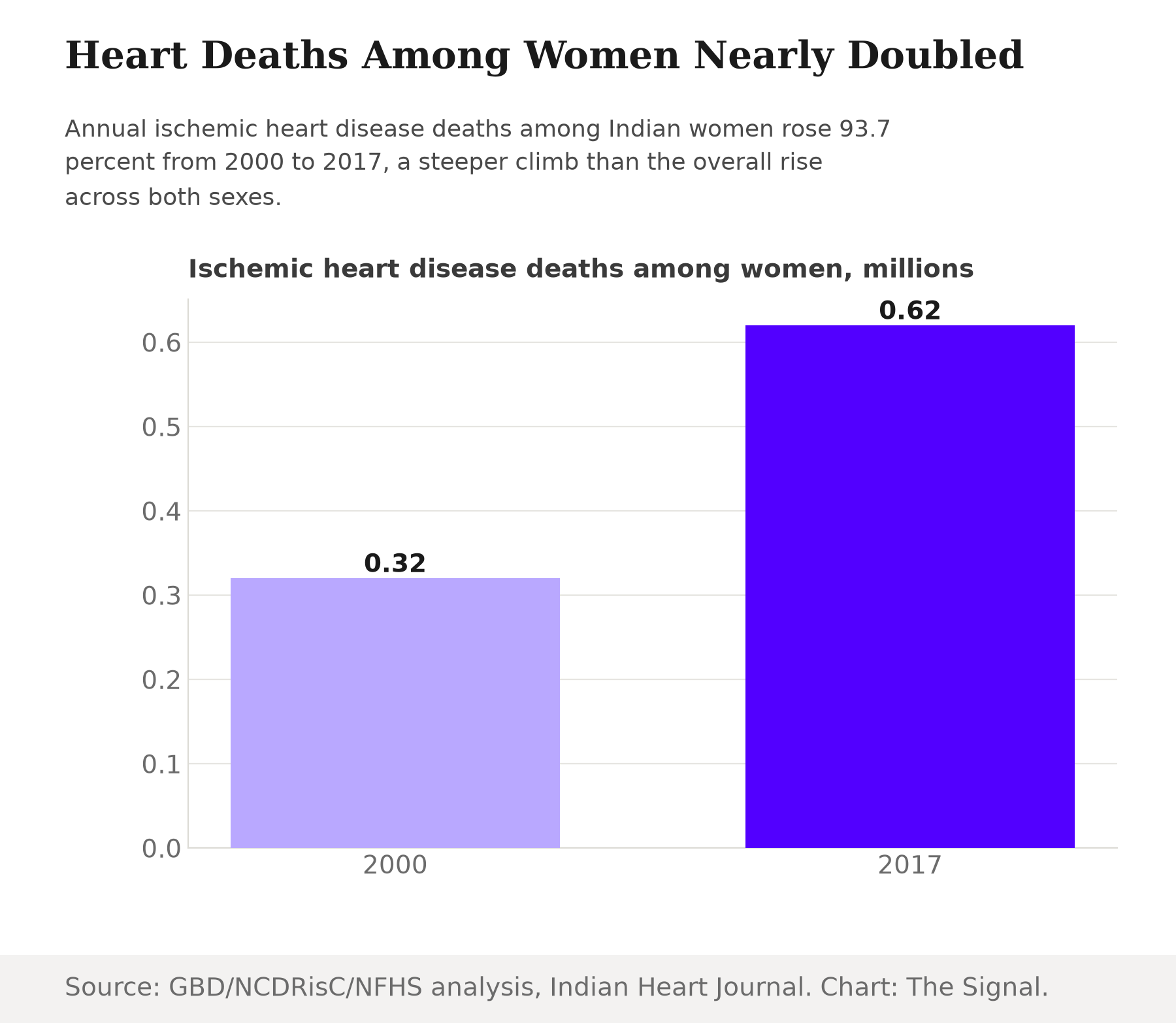
The consequence of screening built around the wrong marker is not abstract. A peer-reviewed analysis of GBD, NCDRisC and NFHS data found that annual ischemic heart disease deaths among Indian women rose from 0.32 million in 2000 to 0.62 million in 2017, a 93.7 percent increase, with a greater increase in women than in men over the same period.
The undertreatment does not stop once a woman actually has a heart attack. When it happens, it is harder to recognize and less aggressively treated. A 2008 study of India's DEMAT registry, spanning 10 tertiary centers, compared how men and women present with suspected acute coronary syndrome:
| Presentation pattern | Women | Men |
|---|---|---|
| Classic STEMI heart-attack pattern | 38% | 55% |
Source: India's DEMAT registry study, 2008, a 10-center Indian registry of suspected acute coronary syndrome patients. Chart: The Signal.
Women in that same 2008 registry more often showed the harder-to-recognize non-STEMI pattern instead, per the DEMAT registry study, a presentation that is more easily missed or delayed in a busy emergency setting. And treatment after diagnosis lags too: a peer-reviewed review on gender disparities in ischemic heart disease reports that women are 15.8 percent less likely than men to receive high-intensity statins after a heart attack, part of a broader, persistent pattern of underdiagnosis and undertreatment documented as of 2025. A screening system that starts late feeds a diagnosis and treatment pipeline that is already unevenly built for women; each stage compounds the one before it.
The honest objection
The strongest case for keeping menopause as the trigger is that it is a real biological marker, not an arbitrary administrative cutoff, and the JAMA Cardiology finding shows exactly why: when menopause arrives early, it correctly flags a woman already carrying meaningfully higher lifetime risk. On that view, refining the trigger by using its early-arrival cases, rather than discarding it, is the right fix.
That case survives for the minority it targets. It does not survive as a general screening design, because the typical case, not the premature one, is what a population-wide protocol has to serve. Indian women who are neither premature nor early menopause cases, well over four in five of them by NFHS-5's count, get no benefit from a marker that only sharpens for early arrivals: their blood pressure risk had already tripled in their early thirties, well before their unremarkable, on-time menopause. A trigger that only works well for its exception cases is not a trigger, it is a footnote.
The Signal
None of the individual numbers here is new to cardiology. What they add up to is a mistimed trigger. Blood pressure risk in Indian women has already tripled by the early thirties. The guideline machinery built to act on that risk does not fully engage until 40. The marker clinical screening habits wait for, menopause, arrives well into a woman's forties in India, and even then only flags real extra danger for the minority that reaches it early. Everyone else's risk clock has been running for over a decade before anyone official starts watching. Watch what regulators and professional bodies do next: if India's clinical guidance shifts toward age-anchored risk assessment starting in the early thirties rather than a menopause-anchored one, the gap this piece describes is closing. Keep the trigger at menopause instead, and the prevention window that matters will keep closing before the screening does.
Reporting basis: the ischemic heart disease mortality trend and the blood pressure odds ratios come from two separate peer-reviewed analyses, one published via PMC drawing on GBD, NCDRisC and NFHS data, the other an NFHS-5-based analysis in BMC Women's Health. The Indian and US menopause ages come from the Indian Menopause Society's pan-India research and NIH's StatPearls clinical reference, respectively, two independent origins. The 2018 ACC/AHA/Multisociety cholesterol guideline is the origin for the age-20-versus-age-40 gap in formal risk assessment. The premature-menopause lifetime-risk figure is from a single JAMA Cardiology cohort analysis of US women, and the premature and early menopause prevalence figures in India are from a separate, independently published NFHS-5-based analysis. The STEMI presentation comparison is from a 2008 analysis of India's DEMAT registry, a ten-center clinical network, and the statin-treatment gap is from a separate, more recent peer-reviewed review of gender disparities in ischemic heart disease management. The characterization of the gap between when risk rises and when formal screening engages is The Signal's own synthesis of those figures.