Earlier this month, a laboratory result out of Bengaluru read like the answer to one of India's oldest public-health failures. A study published in Science Translational Medicine reports that a new antivenom built from nanobodies, engineered by IISc Bengaluru's Centre for Ecological Sciences with the Technical University of Denmark (DTU), protected mice against venom from spectacled cobras, monocled cobras, and both of India's king cobra species. It worked even when injected 30 minutes after the venom itself, a delay that mimics the real gap between a bite in a field and a needle in a clinic. Coverage of the finding has understandably leaned on the promise: broad-spectrum, lab-grown, engineered to outlast the antibody-based antivenom India has used for decades.
It is worth slowing down before calling this the fix. A nationally representative mortality survey published in eLife found that India had roughly 1.2 million snakebite deaths, an average of 58,000 a year, between 2000 and 2019. That is not a shortage of a good-enough drug in a laboratory. It is a country where a treatable poisoning kills a person roughly every nine minutes, and the reasons trace less to the antivenom molecule than to everything that happens, or fails to happen, between the bite and the vial.
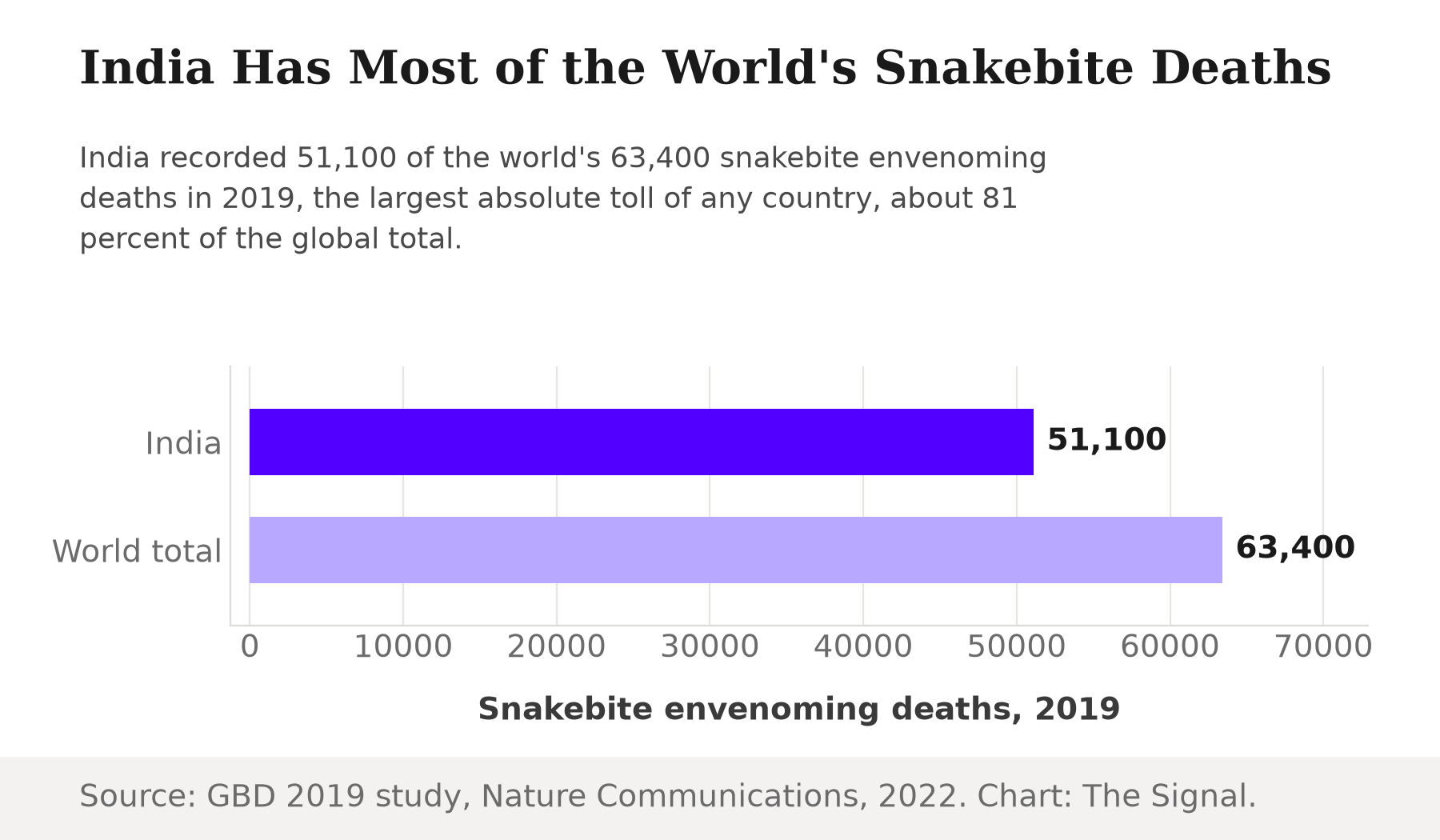
The scale is not a rounding error either. A Global Burden of Disease study in Nature Communications found that India recorded 51,100 of the world's 63,400 snakebite envenoming deaths in 2019, the largest absolute toll of any country and roughly 81 percent of the global total that year. A better antivenom molecule genuinely matters against a burden this concentrated. It just is not, on its own, where most of that burden comes from.
The old drug never covered every snake that bites
India's current antivenom already has a documented blind spot that has nothing to do with molecular design and everything to do with geography. A study in PLOS Neglected Tropical Diseases found that the commercial polyvalent antivenom, made mainly from venom milked from Tamil Nadu cobras, was completely ineffective at protecting mice against lethal doses of venom from the desert population of the Indian spectacled cobra in Rajasthan, even at the highest doses tested. Same species, same antivenom label, different regional venom chemistry, and the treatment simply did not work. A snakebite patient in Rajasthan and a snakebite patient in Tamil Nadu can receive an identical vial with very different odds.
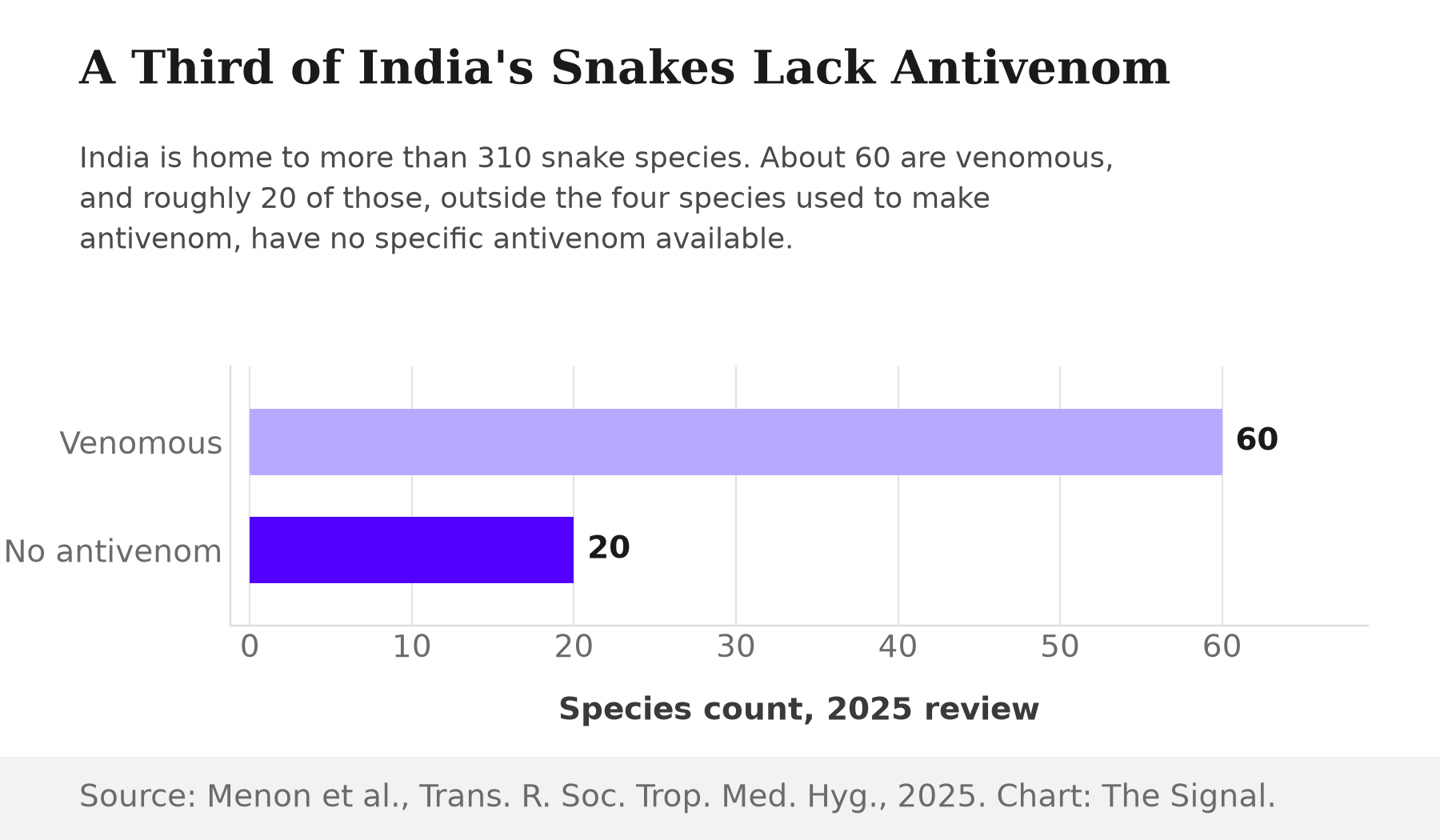
The coverage gap is wider than one desert population. A review in Transactions of the Royal Society of Tropical Medicine and Hygiene found that India is home to more than 310 snake species, of which about 60 are venomous, and that roughly 20 of those, outside the four species used to raise antivenom, have been implicated in medically significant envenoming with no specific antivenom available for them at all. One in three of India's venomous species sits entirely outside what any antivenom, old or new, is built to neutralise. The IISc-DTU study tested four species. It is real progress on those four. It does not touch the other twenty.
Two ways the treatment itself goes wrong
Even when the right antivenom reaches the right patient, it is not a clean fix. A study in the Indian Journal of Critical Care Medicine found that among children treated for snake envenomation at a Puducherry hospital, serious adverse reactions to antivenom occurred in 42.6 percent of patients and contributed to 36.3 percent of the deaths observed in that cohort, in a study published in 2021. That is not a rare side effect. It is closer to a coin flip on whether the cure itself becomes a second emergency, a legacy of antivenom made from purified animal antibodies that a nanobody-based product is specifically designed to avoid, though that promise has so far been demonstrated only in mice. This is not a single-hospital artefact either. A nationwide cross-sectional survey published in Nature Communications found, across 25 districts in 11 states and roughly 60 million people, that 17.2 percent of patients who received antivenom nationally had an adverse reaction to it, serious enough to force doctors to stop the infusion in 6.3 percent of those cases.
Before any antivenom is given, someone has to correctly identify the snake, and that step fails often enough to matter. A scoping review in PLOS ONE found that snakes were identified to species or genus level in only 53 percent of documented snakebite cases across the studies it reviewed, and that in one Indian study, expert re-examination of dead snakes initially identified by hospital staff turned up misidentifications in 17 of 44 cases. Get the species wrong and the treatment decision that follows, which antivenom, how much, how urgently, is being made on a guess.
The medicine never reaches the clinic
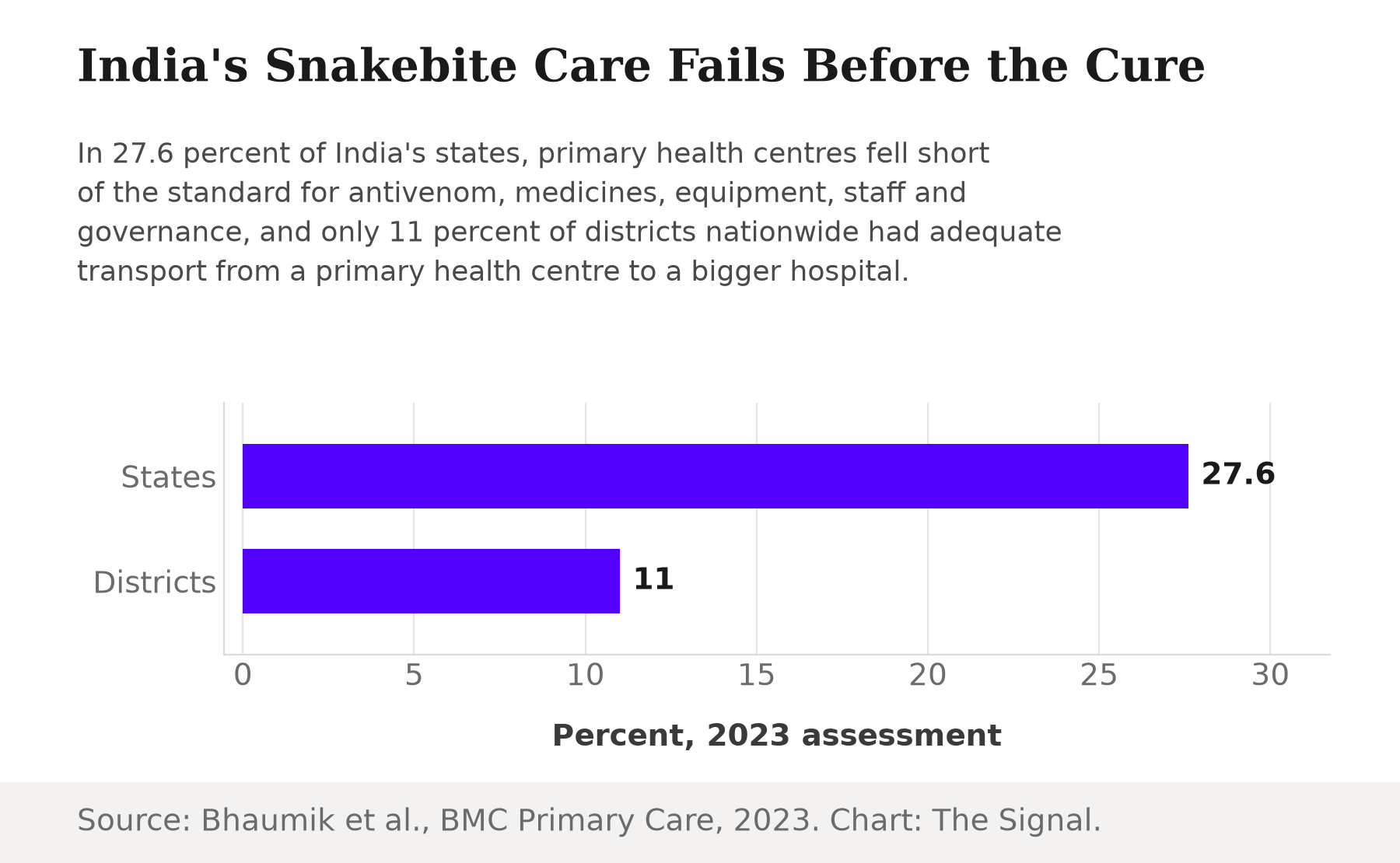
The last and largest gap sits below all of this, in the buildings where a bitten patient actually shows up. A cross-sectional assessment in BMC Primary Care found that antivenom and other essential snakebite medicines, along with equipment, staffing and governance, fell short of the standard at primary health centres in 27.6 percent of India's states, and that in 2023, only 11 percent of districts nationwide had adequate transport arranged to move a patient from a primary health centre to a bigger hospital. A rural clinic without the current antivenom in stock, or without a vehicle to send a patient onward, will not have the new nanobody antivenom either, once it eventually clears trials and reaches production. The molecule is not the bottleneck. The building is.
The honest objection
The strongest case for the breakthrough is that better science upstream eventually reshapes everything downstream. A nanobody antivenom can, in principle, be produced more cheaply and stored more easily than the horse-serum antivenom India relies on today, since nanobodies are smaller, more stable proteins that do not require the same cold-chain handling. If that manufacturing promise holds once the product moves past mice, a cheaper, hardier antivenom could reach more primary health centres precisely because it is easier to stock and ship, narrowing the last-mile gap rather than sitting beside it.
That case is real, and worth watching. But it answers a distribution problem with a distribution hope, not a distribution fact: the Science Translational Medicine study measured mouse survival against four cobra species, not storage life, manufacturing cost, or supply reach. A treatment engineered to be easier to distribute is not the same as a treatment that has been distributed. Every gap documented here, the venom-geography mismatch, the uncovered species, the adverse-reaction rate, the misidentification rate, the district-level transport shortfall, exists today, with the current antivenom, and none of it resolves until a drug is actually sitting in a rural clinic's refrigerator.
The Signal
The IISc-DTU antivenom is a genuine scientific advance for a disease this neglected. But India's snakebite death toll was never mainly a story about the antivenom molecule. It is a story about a desert cobra's venom not matching a Tamil Nadu-derived antivenom, about the species no antivenom is built for, about a coin-flip adverse-reaction rate, about a dead snake misidentified two decades into modern toxinology, and about a primary health centre unlikely to have a vehicle when a patient needs one. A better vial changes none of that by itself. Watch what happens to those numbers, not the headline about the mouse study, to know whether this breakthrough actually reaches the person it was built to save.
Reporting basis: the nanobody antivenom findings are per the original study in Science Translational Medicine, describing research from IISc Bengaluru's Centre for Ecological Sciences and the Technical University of Denmark. India's snakebite mortality estimates for 2000-2019 are from the Million Death Study, published in eLife; the 2019 global comparison is from the GBD 2019 Snakebite Envenomation Collaborators' study in Nature Communications. The venom-geography mismatch is from a study in PLOS Neglected Tropical Diseases; the species-coverage gap is from a review in Transactions of the Royal Society of Tropical Medicine and Hygiene. The paediatric adverse-reaction data are from a single-hospital study in the Indian Journal of Critical Care Medicine; the nationwide adverse-reaction rate is from the ICMR National Task Force Project's cross-sectional survey in Nature Communications, a different, broader measure (any reaction, not just serious ones) across a different population. The misidentification figures are from a scoping review in PLOS ONE. The primary health centre capacity data are from a cross-sectional assessment in BMC Primary Care. The one-in-three species-coverage share is The Signal's calculation from the review's reported figures.