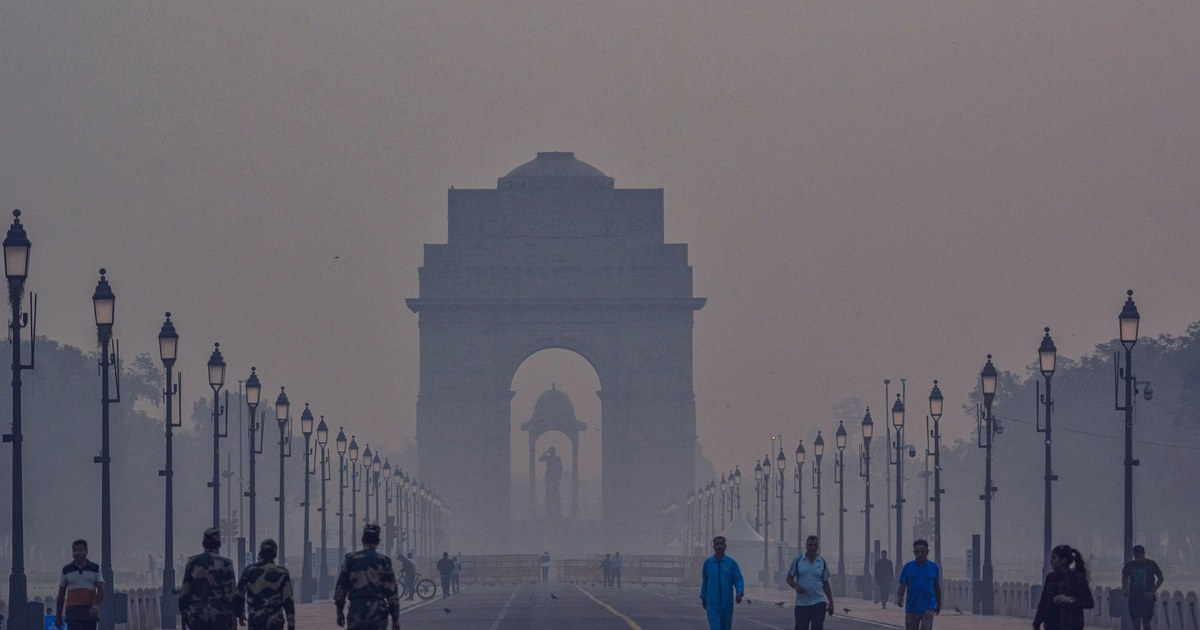
Every winter, India's air pollution crisis gets covered the same way: as a story about lungs and hearts. Doctors warn of asthma and bronchitis. Cardiologists warn about heart attacks. Pollution gets filed under respiratory and cardiovascular disease. That framing has never been wrong, just incomplete.
A pooled-data review published on September 15, 2026 in the Journal of Epidemiology and Community Health examined 29 studies on air pollution and suicide, and found that fine particulate matter (PM2.5), coarser particulate matter (PM10) and nitrogen dioxide (NO2) carried the greatest suicide and suicidal-thought risk among the environmental exposures the researchers studied. The team, from Queen's University Belfast, was not describing a new kind of harm. It was adding a new organ to the ledger: the brain.
An earlier meta-analysis, published in 2021, had already put a number on that risk: each interquartile-range increase in daily PM2.5 was associated with a 2 percent rise in suicide risk, a relative risk of 1.02, PM10 with a 1 percent rise (1.01), and NO2 with a 3 percent rise (1.03). Those are small shifts for any one person on any one day. Multiplied across a population that breathes the same air every day of the year, they stop looking small.
Air pollution's suicide-risk signal is modest per person and constant for anyone breathing it.
How dirty air reaches the mind
The mechanism is not vague hand-waving about stress. Researchers behind the September 2026 review point to a specific pathway: air pollutants, including PM2.5, PM10, NO2, sulfur dioxide and ozone, are linked to chronic inflammation and nerve damage that can impair brain function and influence mood and stress resilience. A separate 2026 peer-reviewed review in the journal iScience traces the chain further for PM2.5 specifically: the particles trigger microglial activation and the release of pro-inflammatory cytokines, including interleukin-1 beta, interleukin-6 and tumor necrosis factor alpha. Those cytokines disrupt the synaptic plasticity and monoaminergic neurotransmission that sit at the center of depression's biology. Put plainly: the same particles that inflame the lungs also appear to inflame the brain.
The same three pollutants show up, in the same direction, across two independent bodies of research.
| Pollutant | Risk increase per IQR rise | Relative risk (95% CI) |
|---|---|---|
| PM2.5 | 2% | 1.02 (1.00-1.05) |
| PM10 | 1% | 1.01 (1.00-1.03) |
| NO2 | 3% | 1.03 (1.00-1.07) |
Source: Heo, Lee and Bell (2021), International Journal of Environmental Research and Public Health. IQR: interquartile range, the middle 50 percent of daily readings in the underlying studies.
The world's most polluted air sits in India
This is not a hypothetical exposure level. 76.8 percent of India's population was already breathing an annual average of PM2.5 above the country's own air quality standard of 40 micrograms per cubic meter as of 2017, with Delhi, Uttar Pradesh, Bihar and Haryana all averaging above 125 micrograms per cubic meter, more than three times the legal limit. By 2024, India's population-weighted average PM2.5 stood at 50.6 micrograms per cubic meter, more than ten times the World Health Organization's annual guideline, and Byrnihat, in India, was the world's most polluted metropolitan area at 128.2 micrograms per cubic meter. India was home to six of the world's nine most polluted cities in 2024.
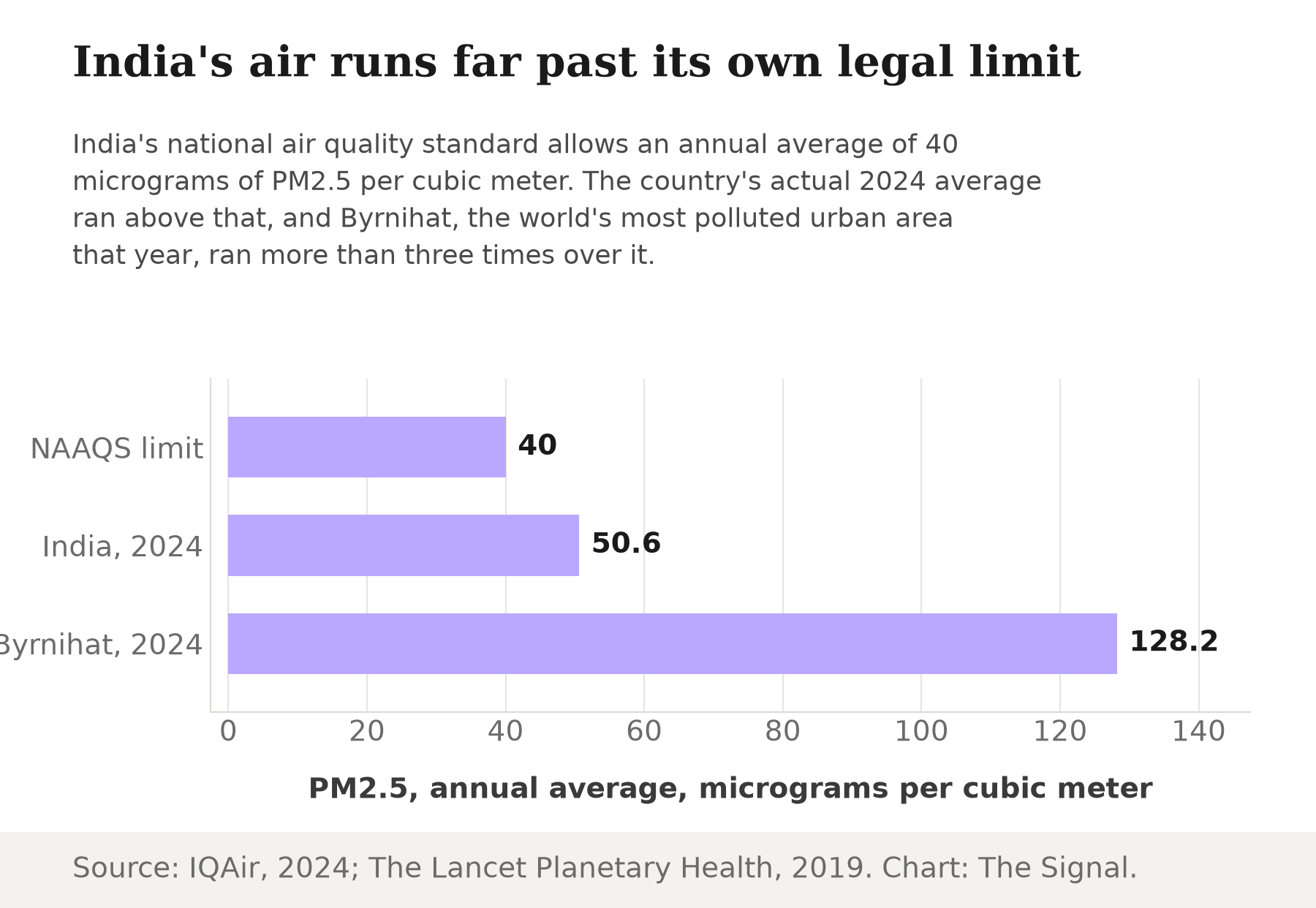
Source: India State-Level Disease Burden Initiative, The Lancet Planetary Health (national standard, 2017 data); IQAir World Air Quality Report 2024 (2024 figures). Chart: The Signal.
That is the honest state of the evidence: two well-documented facts sitting side by side, with no research yet asking whether the two move together within India specifically. The pollutants a 2026 review just flagged for suicide risk are the same ones India's own regulator already knows its air routinely exceeds.
A suicide toll air policy has never counted
India recorded 170,924 suicides in 2022, an increase of 4.2 percent over 2021, according to National Crime Records Bureau data. The World Health Organization puts the global annual toll at more than 720,000. Different reporting years, but the only global benchmark available: divide one figure by the other and India's 2022 count alone works out to close to a quarter of the world's estimated annual total.
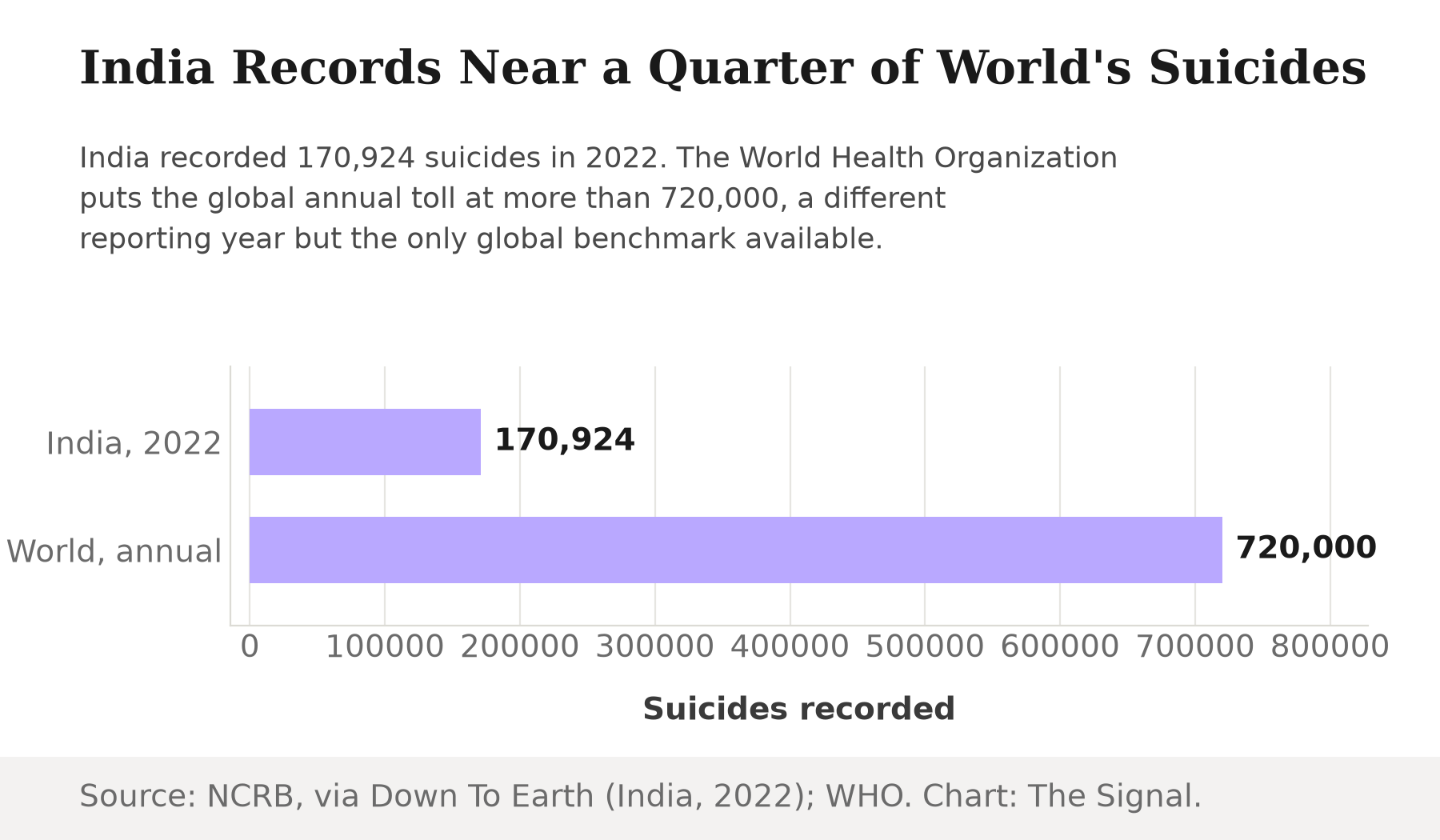
Source: National Crime Records Bureau data, via Down To Earth; World Health Organization. Chart: The Signal.
Air quality policy in India is built and defended on respiratory and cardiovascular grounds: hospital admissions, lost workdays, life expectancy. None of India's air quality standards, monitoring networks or public health messaging currently treats clean air as a mental health intervention. The new research does not prove that changing that framing would move the suicide count, but it does mean the framing, as it stands, is missing a channel the evidence says exists.
The honest objection
The strongest case for caution sits in the numbers themselves. A relative risk of 1.02 to 1.03 per interquartile-range increase is a small effect, and the researchers behind the new review describe air pollution only as a factor worth weighing, not a proven trigger: their own language calls for treating environmental exposures as "potentially modifiable risk factors in suicide prevention strategies," not an established cause. Suicide has economic, social and psychiatric drivers that dwarf any single environmental exposure, and no study behind these figures followed individual Indians from exposure to outcome.
That case is real, and it is why this piece treats the India numbers as a juxtaposition, not a proof. But a modest, repeatable association across 29 studies and two independent reviews, in a country that already fails its own air quality standard for much of its population, is not nothing: it is a plausible contributing factor sitting inside a public health system that has never gone looking for it.
The Signal
The consensus read on India's air pollution has always been correct as far as it goes. It damages lungs and hearts, on a scale that six of the world's nine most polluted cities make hard to ignore. What changed on September 15, 2026 is the ledger that damage gets filed under. If the mechanism researchers describe, chronic inflammation and nerve damage reaching the brain, holds up under further study, then a country breathing some of the dirtiest air on the planet and recording close to a quarter of the world's suicides has a research question sitting between those two facts that nobody has yet been funded to answer directly. Watch whether the next study asks it in India, rather than leaving India to infer the answer from everyone else's data.
Reporting basis: the September 2026 review and its neurological mechanism are as reported by the Deccan Chronicle and the Irish Times respectively, both relaying the same Queen's University Belfast-led review in the Journal of Epidemiology and Community Health; the primary journal page could not be verified directly. The PM2.5 neuroinflammation mechanism is from a peer-reviewed 2026 review in iScience. The quantified relative-risk figures are from Heo, Lee and Bell's 2021 meta-analysis in the International Journal of Environmental Research and Public Health. India's pollution-exposure figures are from the India State-Level Disease Burden Initiative's analysis in The Lancet Planetary Health, reporting 2017 data, and from IQAir's 2024 World Air Quality Report. India's suicide count is National Crime Records Bureau data, as reported by Down To Earth; the global suicide toll is from the World Health Organization. The share of the world's suicides that India's 2022 count represents is The Signal's calculation from those two figures, across different reporting years.