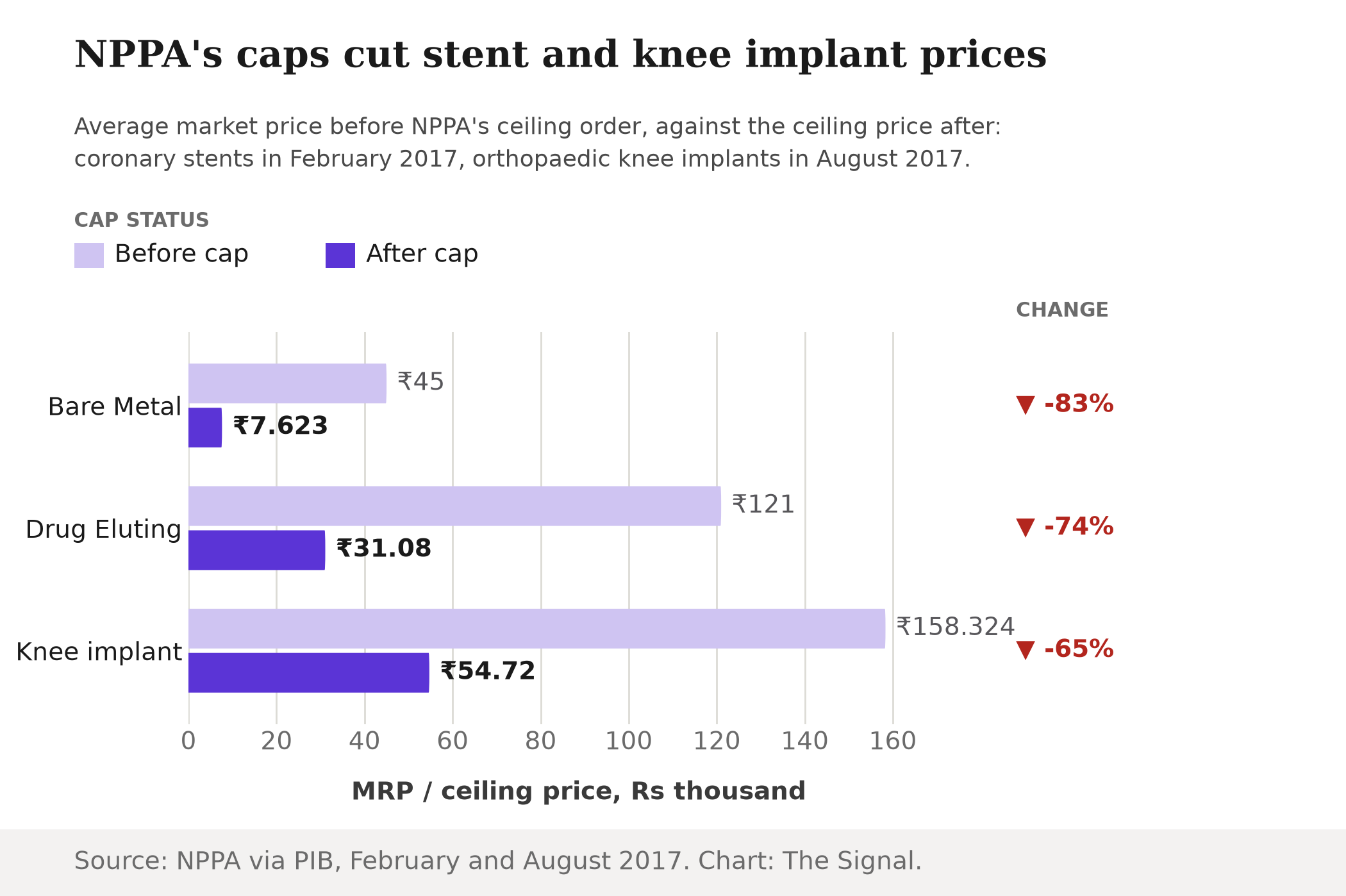
India's drug-price regulator has a genuine win to point to. In February 2017, the National Pharmaceutical Pricing Authority fixed ceiling prices for coronary stents, cutting the average market price of a Bare Metal Stent from Rs 45,000 to Rs 7,623 and a Drug Eluting Stent from Rs 1,21,000 to Rs 31,080, for an estimated Rs 4,450 crore of relief to patients in the first year alone. Six months later it did the same for knee implants, cutting the price of the most widely used Cobalt Chromium implant by 65 percent, from an average Rs 1,58,324 to a ceiling of Rs 54,720, saving patients an estimated Rs 1,500 crore a year across the 1 to 1.5 lakh knee procedures done in India annually. Read the two orders together and the story writes itself: India took on hospital markups on medical devices, and won.
It is worth slowing down on that. Stents and knee implants are two device categories, not medical devices in general. As of February 2026, the Department of Pharmaceuticals told Parliament that only four device categories, coronary stents, IUDs and condoms, carry an NPPA ceiling price under the Drug Price Control Order's Schedule I, with knee implants added separately in 2017 and six pandemic-era devices brought under trade-margin caps in 2021. Every other medical device sold in an Indian hospital falls under DPCO's Para 20, which does one thing only: it stops a manufacturer from raising an existing MRP by more than 10 percent in a year. It says nothing about the margin already sitting inside that MRP the first time it is set.
Only four device categories carry an NPPA price ceiling. Everything else is capped only on how fast its price can rise, not on the price itself.
| Device category | How NPPA regulates it | What the rule actually limits |
|---|---|---|
| Coronary stents, IUDs, condoms | DPCO Schedule I ceiling price | Sets a fixed maximum retail price |
| Orthopaedic knee implants | Ceiling price order outside Schedule I | Sets a fixed maximum retail price |
| Oxygen concentrators and five other COVID-era devices | DPCO Para 19 trade-margin cap | Caps the distributor's trade margin |
| Every other device, including IV sets and cannulas | DPCO Para 20 (the default rule) | Limits the annual MRP rise to 10 percent. Does not cap the margin already in that MRP |
Source: Department of Pharmaceuticals, via Press Information Bureau, February 2026.
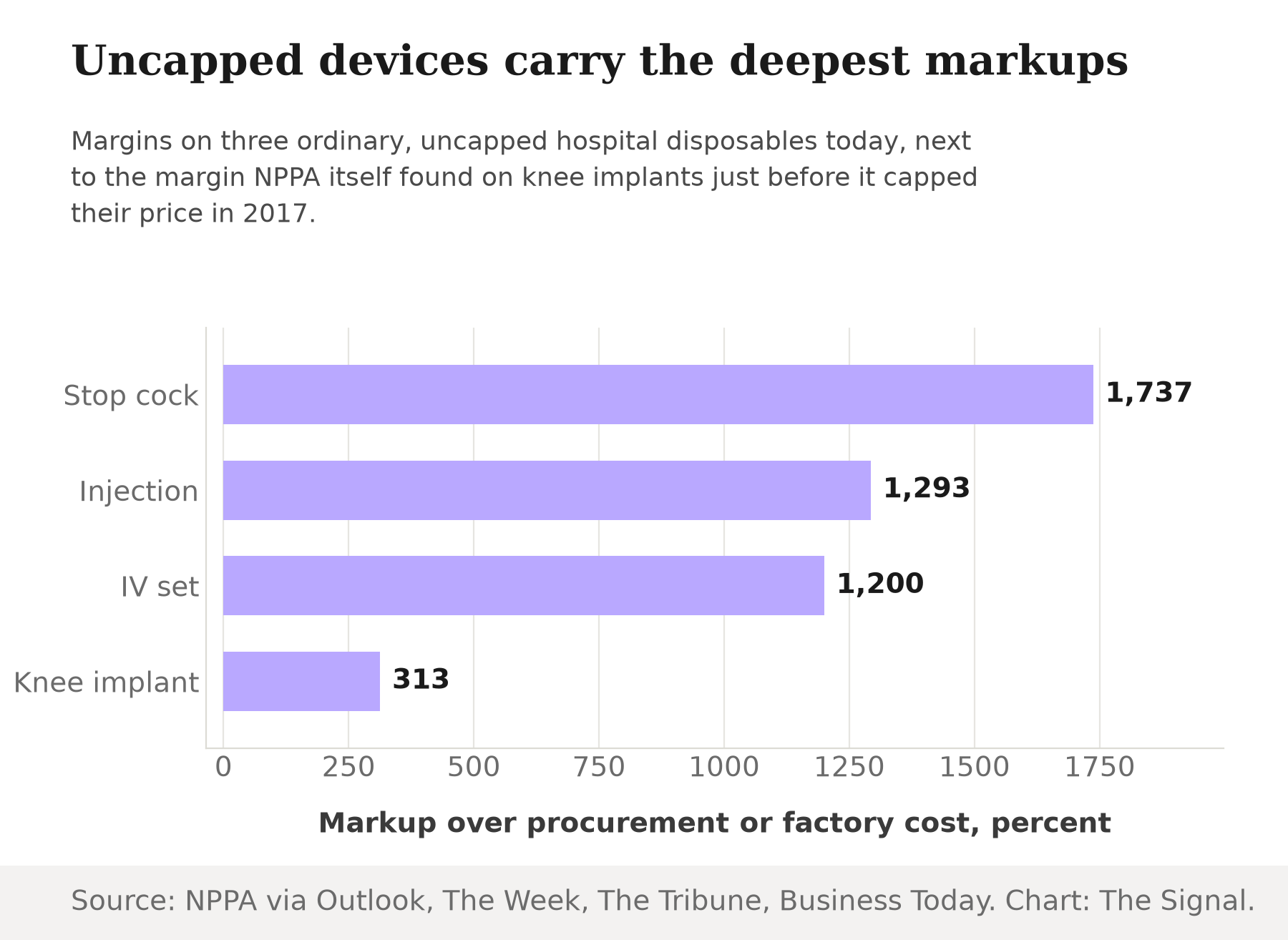
IV sets and cannulas carry the markup nobody capped: the plastic tubing and needles that deliver a saline drip or a routine injection have a factory cost of Rs 5 to Rs 10 and are billed to patients at Rs 80 to Rs 120, a markup of 800 to 1,200 percent, according to industry data compiled by the Association of Indian Medical Devices Industry and reported by Business Today in April 2026. That is not an isolated finding. An NPPA audit of billing at four large private hospitals in Delhi-NCR found a three-way stop cock valve bought for Rs 5.77 billed to patients at a 1,737 percent margin over its procurement price, and the same audit found an ordinary injection bought for Rs 13.64 billed at Rs 189.95, a markup of roughly 1,293 percent. None of these three products carries a price cap of any kind.
Source: Business Today, April 2026; The Tribune; The Week; Outlook. Injection markup is The Signal's calculation. Chart: The Signal.
Put that beside the market NPPA actually regulated. Before it capped knee implants in 2017, NPPA's own data showed the total trade margin on a knee-implant kit ran to 313 percent, with individual components marked up by as much as 450 percent, the figures the government cited to justify stepping in. That 313 percent is smaller than the uncapped markup on a stop cock valve, an ordinary injection, or an IV set today. NPPA capped the categories with the highest markup and the strongest public case first. It never wrote a general rule for devices as a class.
Caps work. NPPA just adds devices to the list slowly
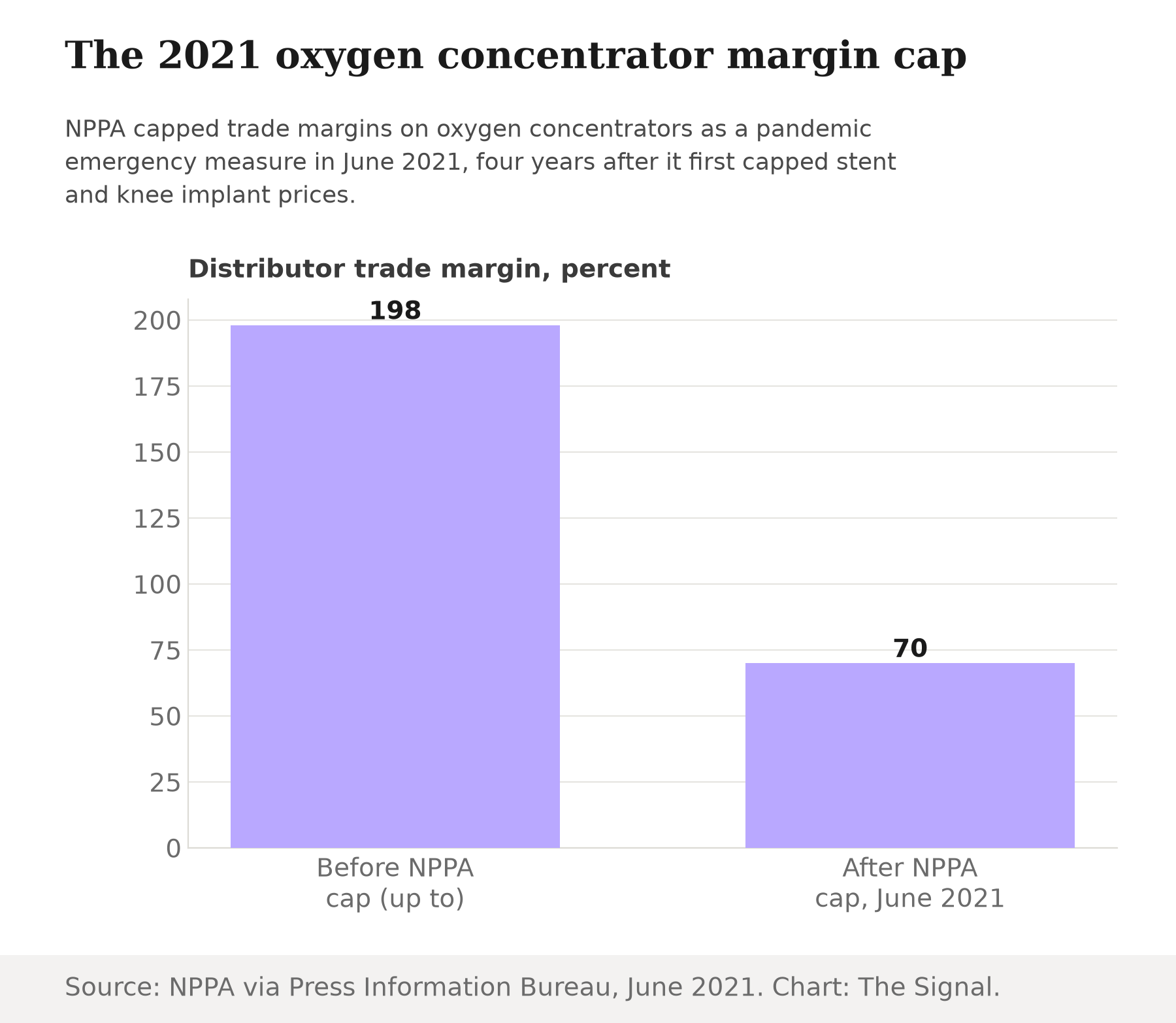
The clearest evidence that the narrow scope is a design choice, not an oversight, is what happened to oxygen concentrators. Distributor margins on them ran as high as 198 percent, and NPPA capped that margin at 70 percent only in June 2021, four years after the stent and knee-implant orders, and only by invoking DPCO's emergency Para 19 power during the pandemic's oxygen shortage.
Source: Press Information Bureau, June 2021. Chart: The Signal.
Set that beside the price cuts capping actually achieved for stents and knee implants.
Source: Press Information Bureau, February 2017; Press Information Bureau, August 2017. Bare Metal Stent and Drug Eluting Stent percentage declines are The Signal's calculations. Chart: The Signal.
The mechanism across all three interventions is the same: NPPA adds a device category to the capped list only after a specific, visible crisis makes the existing margin politically indefensible, the way the pandemic-era oxygen shortage triggered the 2021 order on concentrators. IV sets and cannulas have not yet had that moment. An 800 to 1,200 percent markup on a Rs 5 tube has never produced the kind of scandal or emergency that triggers a Para 19 order.
Capping the price doesn't cap the bill
Even in the categories NPPA did cap, the savings have not fully reached the patient. A March 2026 report by the Rajya Sabha's Committee on Petitions found that NPPA's caps have cut cardiac stent prices by up to 85 percent and knee implant prices by up to 70 percent, an estimated Rs 5,900 crore in annual savings nationwide, but that unregulated procedural and ancillary charges still make up 60 to 70 percent of a patient's total treatment cost, keeping the final bill high regardless of the device's own price. A price cap on one line item does not cap the invoice underneath it.
The government's own timeline through 2026 shows it moving toward that fix in stages, not in one leap. Asked in the Rajya Sabha in March 2026 whether a nationwide device price cap was coming, the Department of Pharmaceuticals said no "One Nation, One Price" framework or blanket price cap for medical devices was under consideration, leaving NPPA's device-by-device orders and state-level Price Monitoring and Resource Units, including in Maharashtra, as the only checks on overcharging. In April 2026, though, the Ministry of Health and Family Welfare was reported to be weighing a narrower mechanism instead, one that would cap what private hospitals bill over market cost specifically for items including syringes and cannulas, and was consulting health insurers before a final decision. That narrower, bill-side mechanism, not a fresh MRP ceiling, is the one that appears to have shaped what came next.
In August 2026, the Parliamentary Standing Committee on Health and Family Welfare recommended that the gap between a medical device's landing price and its MRP should not exceed 20 percent, an implicit acknowledgement that this gap runs far wider today for the device categories NPPA has not yet capped. A blanket 20 percent ceiling, applied to every device rather than four categories at a time, would be a bigger intervention than anything NPPA has done since 2017, and it would finally reach the IV set.
The honest objection
The strongest case for NPPA's device-by-device approach is that it is easier to enforce. Stents and knee implants are complex, low-SKU-count products with well-documented average prices, so a single ceiling figure is easy to set and check. IV sets, cannulas, syringes and stop cocks are the opposite: thousands of near-identical SKUs from dozens of manufacturers, each with a different landing cost, harder to write one ceiling price for. Going after documented, high-margin categories first, and expanding only when a crisis forces the issue, is a defensible way to build regulatory capacity rather than write a rule nobody can enforce.
That case is real, but the March 2026 Committee on Petitions finding on procedural charges cuts against it as much as for it. NPPA capped stent and knee-implant prices precisely, and hospitals still kept bills high by shifting the margin onto an uncapped line, procedural charges. A blanket 20 percent rule on devices, if it arrives, risks the same displacement: the margin moving to whatever line stays uncapped, not disappearing. Incrementalism was never really the flaw. The absence of any rule that follows the margin, rather than the device, is.
The Signal
NPPA is not blind to the loophole. Its own newest findings call for closing it. What is in question is not whether India can cap a device price: the 2017 stent order and the 2017 knee-implant order prove it can, by 65 to 83 percent in a single order. It is whether the government now expands what counts as a device worth capping, faster than hospitals can move the margin somewhere else. A blanket MRP cap is officially off the table, but a narrower bill-side mechanism naming cannulas by name has already reached the ministry's own consultation stage. Until that consultation becomes an actual order, the tubing on a hospital drip stand stays the cheapest object in the room and the most inflated line on the bill. Watch for the next NPPA order less for which device it names than for whether it caps a margin instead of a single product line, because that is the only fix hospitals cannot route around.
Reporting basis: the 2017 stent and 2017 knee-implant price-cap figures, the 2021 oxygen-concentrator trade-margin cap, the February 2026 count of NPPA-regulated device categories, and the March 2026 denial of a nationwide device price cap are all from National Pharmaceutical Pricing Authority orders and Parliament replies, via Press Information Bureau releases. The March 2026 finding on procedural charges is from the Rajya Sabha's Committee on Petitions, and the August 2026 recommendation on a landing-price-to-MRP gap is from the Parliamentary Standing Committee on Health and Family Welfare, both via Press Information Bureau releases. The April 2026 report on the health ministry's hospital-billing-margin consultation is from The Sentinel. The IV set and cannula markup is industry data compiled by the Association of Indian Medical Devices Industry, as reported by Business Today; the stop cock valve and injection markups are from a single 2018 NPPA hospital-billing audit, as reported separately by The Tribune and The Week; and the pre-2017 knee-implant trade-margin figures are NPPA data as reported by Outlook. The percentage price cuts for the Bare Metal Stent and Drug Eluting Stent, and the injection markup, are The Signal's calculations.