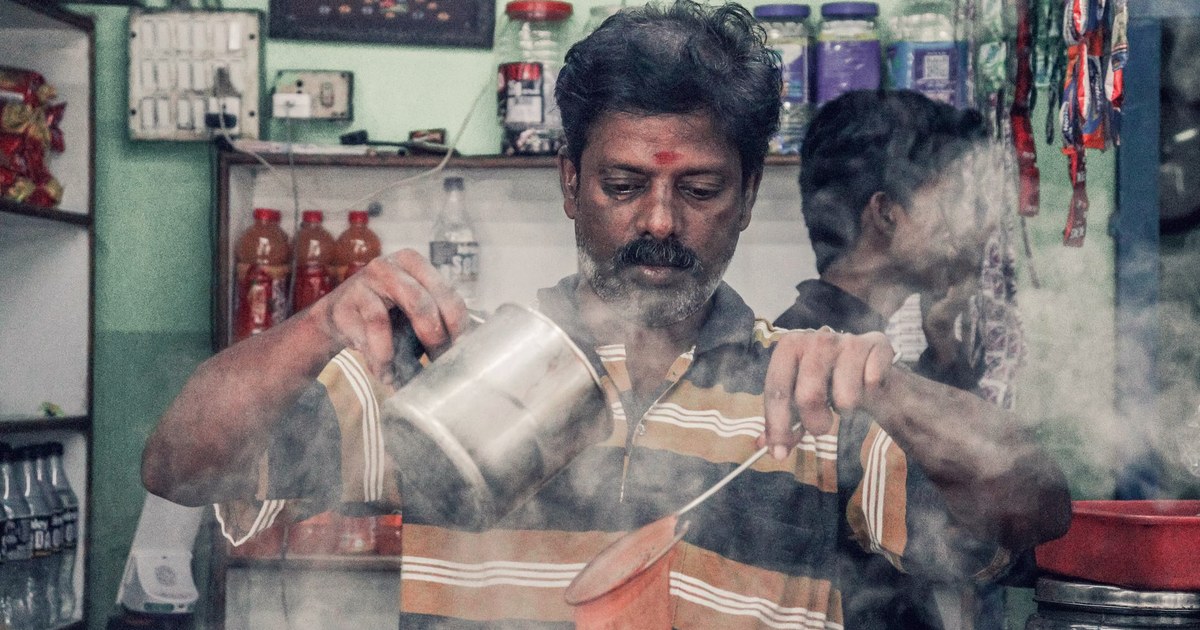
Serve chai lukewarm in India and it reads as an insult. The glass arrives scalding, poured from height to raise a froth, handed over still too hot to sip, and that is the point: heat signals that the tea was made fresh, for you, with care. Every roadside stall and every home kitchen runs on the same unwritten rule. Hotter is more generous.
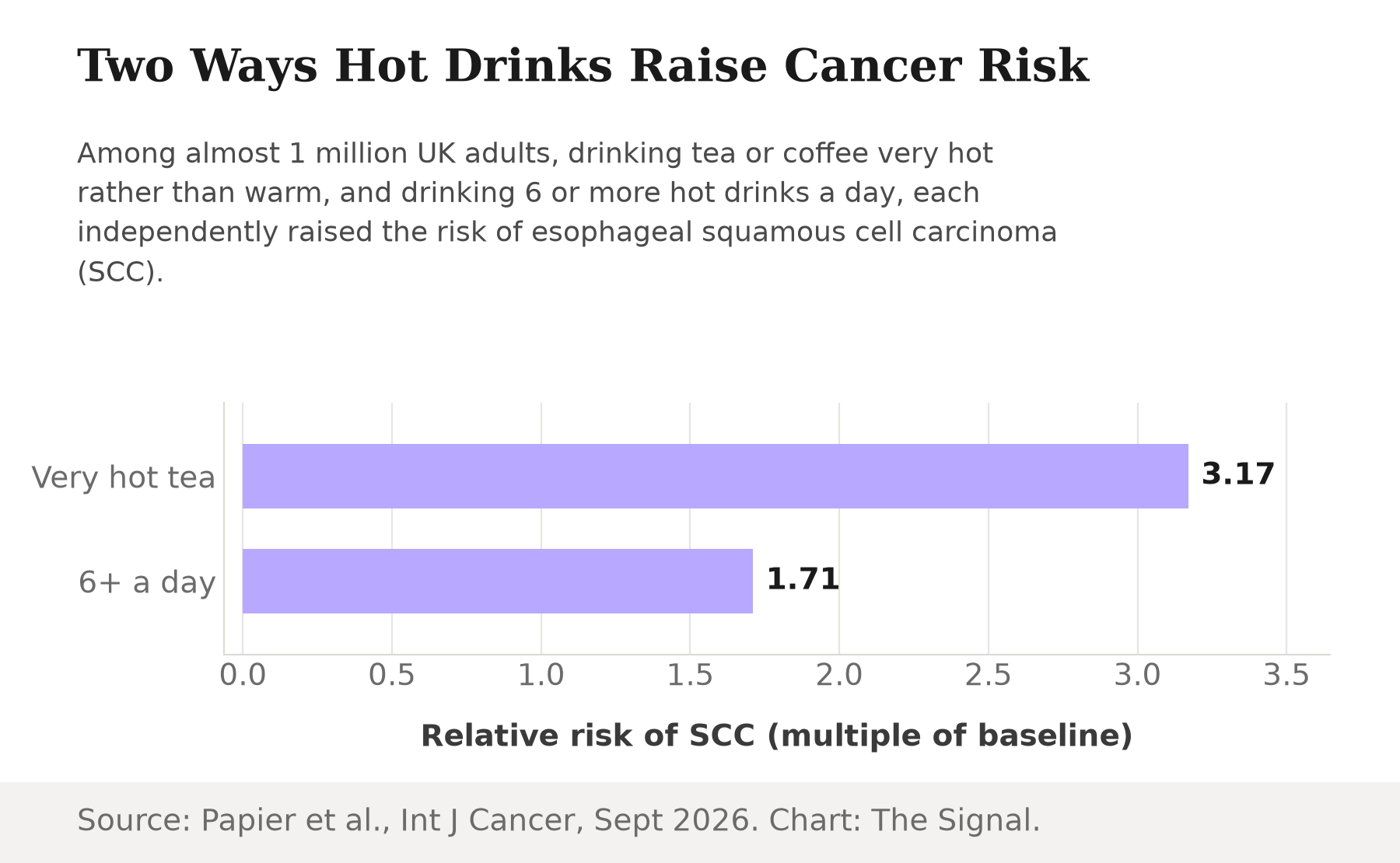
It is worth slowing down on that virtue. A study of nearly 1 million UK adults, published this month, found that people who preferred their tea or coffee "very hot" rather than "warm" had more than three times the risk of one type of cancer of the food pipe: a relative risk of 3.17 for esophageal squamous cell carcinoma. The exact habit India treats as hospitality is the exposure the study just measured.
The number behind the headline
The study, led by researchers at Oxford Population Health and published in the International Journal of Cancer, pooled two large UK cohorts, the Million Women Study and UK Biobank, covering 977,282 participants. Preferring drinks at a "very hot" temperature over "warm" was associated with a 3.17-fold higher risk of esophageal squamous cell carcinoma (SCC), with no meaningful link to the other main type, adenocarcinoma. That specificity matters: a general confounder, like smoking rates or something else about heavy tea drinkers as a group, would be expected to move both cancer types together. Temperature moved only one.
The same study found a second, independent driver: people who drank 6 or more hot drinks a day, regardless of temperature, had a 71% higher SCC risk than those drinking fewer than 6, a relative risk of 1.71. Temperature and frequency were each adjusted for the other, so this is not one effect double-counted as two.
Even a modest, low-cost shift in habit has a measurable payoff. The same authors estimate that 14% of UK esophageal SCC cases could be avoided if people who drink their tea or coffee "very hot" instead drank it at a cooler "hot" temperature, a temperature range still well above room temperature, just not scalding.
This is not one study
The UK result is fresh, but the underlying finding is not new. The World Health Organization's cancer agency, IARC, classified drinking very hot beverages, defined as above 65C, as probably carcinogenic to humans back in 2016, a Group 2A finding built on studies from China, Iran, Turkey and South America, where tea or mate is traditionally drunk at around 70C and esophageal cancer risk rose with drinking temperature. India was not among the countries in that original evidence base, but the mechanism IARC described, hot liquid repeatedly injuring the esophageal lining, does not stop at a border.
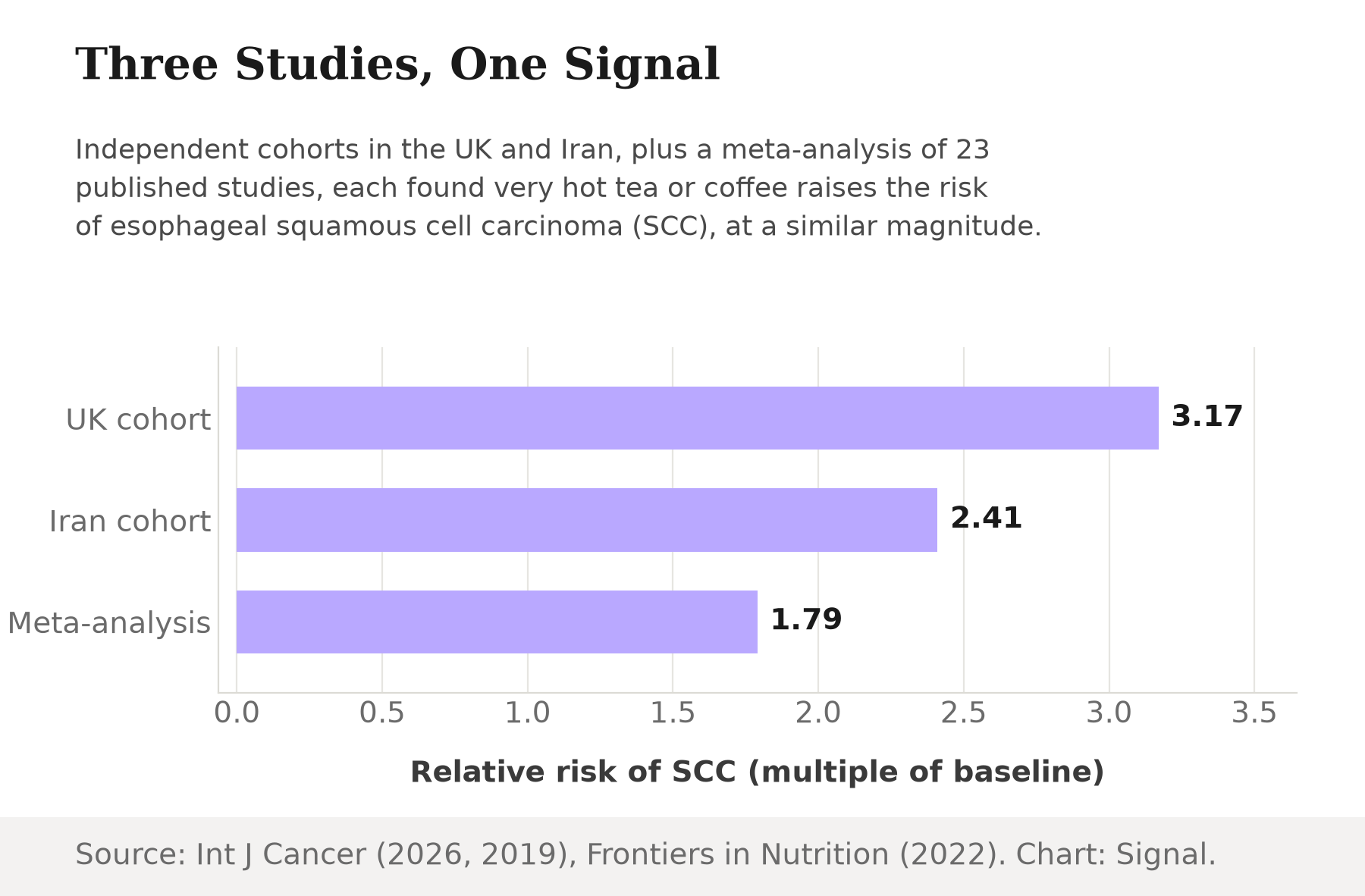
A 2019 study of Iran's Golestan Cohort, tracking 50,045 adults, found that objectively measured tea temperature of 60C or higher, versus below 60C, carried a 41% higher risk of esophageal SCC, and that people who self-reported a preference for "very hot" tea had more than double the risk of those drinking it cold or lukewarm. A 2022 meta-analysis pooling 23 studies, 5,050 cases and 10,609 controls, found drinking tea at a higher temperature carried a 79% greater risk of esophageal cancer overall, again concentrated in squamous cell carcinoma rather than adenocarcinoma.
Three independent research efforts, on different continents, using different methods, land on the same conclusion. Self-reported preference and objectively measured temperature both point the same direction, which rules out simple recall bias as the explanation.
The stakes in a country that runs on tea
No source in this piece measured Indian chai served on a stall or in a kitchen at a specific temperature in Celsius. What does exist is direct Indian case-control evidence pointing the same direction as the UK and Iran. A 2023 hospital-based case-control study of 72 esophageal cancer cases and 72 controls in Assam found a statistically significant, roughly fourfold higher risk of esophageal cancer among people who drank very hot beverages rather than mild ones, an odds ratio of 4.1. A larger 2025 case-control study of 380 esophageal cancer cases and 760 matched controls in Punjab found drinking burning-hot tea carried an adjusted odds ratio of 1.81 for esophageal cancer, close to the risk the same study measured for alcohol use. Neither is a population cohort on the scale of the UK Biobank or Golestan, and neither measured drinking temperature in degrees rather than self-reported categories. But both are Indian patients, studied in India, and the direction matches everywhere else researchers have looked.
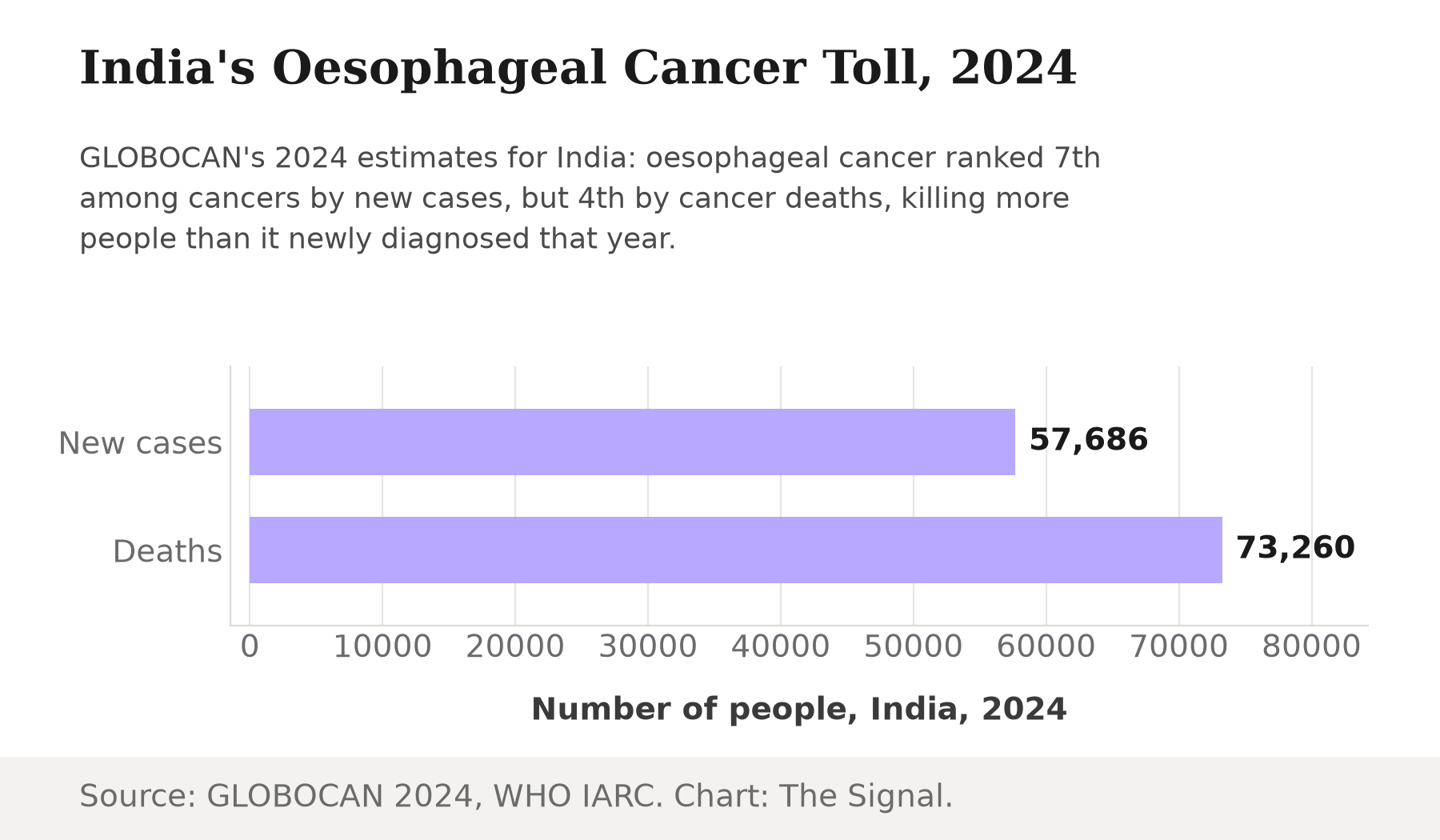
That is the scale of what is at stake if the mechanism applies here too. GLOBOCAN's 2024 estimates put oesophageal cancer as India's 7th most common cancer by new cases, with 57,686 diagnosed that year, and its 4th leading cause of cancer death, with 73,260 deaths: more people died of it in 2024 than were newly diagnosed with it, a gap that reflects how often the disease is caught late and how poor survival still is once it is found.
Globally, oesophageal cancer caused an estimated 494,320 new cases and 441,994 deaths in 2024, and Asia accounted for 72.0% of the cases and 72.8% of the deaths. India's own burden sits inside a region that already carries most of the world's cases, for reasons that include diet, tobacco, alcohol and infection alongside anything to do with drinking temperature. Temperature is not the whole explanation for any of these numbers, but in the Punjab case-control study it was not a minor one either: very hot tea carried a population attributable fraction of 16.72%, ahead of tobacco use at 10.75% and within a percentage point of alcohol use at 16.48%, the two risk factors India's public health messaging already targets hardest. On that single Indian study's reckoning, hot tea is not a footnote next to tobacco and alcohol. It is roughly the same size.
The fix nobody has tried at scale
The Golestan Cohort's own authors put it plainly: since there is no known health benefit from drinking very hot beverages, it is reasonable to advise people to wait for their tea to cool before drinking it. That advice costs nothing. It requires no new drug, no screening infrastructure, no subsidy.
It is also not hypothetical as behavior change. A 2016 educational campaign among Iranian schoolgirls, run over two months, produced a significant drop in hot-tea consumption and in favorable attitudes toward drinking tea hot, in the intervention group compared with controls. The sample was small and specific, and it does not prove a national campaign would work the same way. But it demonstrates the exposure is not fixed. People who are told why they should let their tea cool, and shown how, actually do it.
The honest objection
The strongest case for skepticism used to be that none of this evidence came from India. That case is weaker now, though not gone. India's tea culture, spanning cutting chai in Mumbai, Assam-style milk tea, and South Indian filter coffee, is different enough from a British cup of tea or an Iranian glass of black tea that the UK and Iran findings might not transfer cleanly on their own. Cup size, milk content and drinking speed all vary, and none of that has been measured against a thermometer here. The Assam and Punjab case-control studies are hospital-based and modest next to a cohort of a million people; they narrow the gap without closing it.
That objection is fair, and it is exactly why this piece does not claim a specific measured temperature for Indian chai. But the mechanism the studies describe, repeated thermal injury to the esophageal lining from liquid served scalding, is not culture-specific. It held in a UK cohort measuring tea and coffee together, in an Iranian cohort measuring tea specifically, in a meta-analysis spanning studies from multiple countries and drink types, and now in two Indian case-control studies measuring the same exposure by category rather than degree. A finding that reproduces across four independent methods, on four kinds of evidence and populations this different, is not fragile. What is genuinely missing is not a reason to doubt the mechanism, but an Indian cohort and an Indian thermometer that have not yet been produced.
The Signal
The evidence says the exposure is real, the mechanism is not exotic, and the fix costs nothing but a few minutes of patience. The mechanism does not lack proof. What is missing is a population-scale Indian cohort and an actual measured serving temperature. Two modest Indian case-control studies, in Assam and Punjab, already find hot-tea drinkers at higher esophageal cancer risk, with hot tea's attributable share of the disease in the Punjab data landing close to alcohol's, ahead of tobacco's. Neither study is built at the scale of the UK Biobank or Golestan, and both relied on a self-reported category rather than a thermometer reading. Until a study that size exists, the honest position is that a scalding cup carries a plausible, mechanistically grounded risk that international and now domestic evidence keeps finding, in a country that already logs 73,260 oesophageal cancer deaths a year and a culture that prizes tea served as hot as it can be poured. The chai does not have to get colder to solve this. It just has to sit for a minute before anyone calls it ready.
Reporting basis: the temperature and frequency findings, and the 14 percent avoidable-case estimate, are from Papier, Gaitskell, Floud and Reeves' analysis of the Million Women Study and UK Biobank, published in the International Journal of Cancer in September 2026. The original "very hot beverages" classification is from IARC's 2016 Monographs evaluation. The Iranian findings on measured and self-reported tea temperature are from the Golestan Cohort Study, and the authors' cooling recommendation is from the same paper, both published in the International Journal of Cancer in 2019. The pooled meta-analysis figure is from a 2022 Frontiers in Nutrition paper synthesizing 23 prior studies. The schoolgirls' intervention is from a 2016 Asian Pacific Journal of Cancer Prevention study of a single Iranian campaign, a smaller and more limited source than the rest. India's and the world's case and death counts are GLOBOCAN 2024 estimates from the WHO's International Agency for Research on Cancer, for India and globally. The two Indian case-control studies are a 2023 study from Assam and a 2025 study from Punjab, the source for both the hot-tea odds ratio and the population-attributable-fraction comparison against alcohol and tobacco. No source in this piece measured Indian chai-drinking temperature in degrees, and that gap is stated plainly in the text rather than papered over.