Walk down the sugar-free shelf of an Indian pharmacy and xylitol turns up everywhere: tablets, chewing gum, blends sold specifically for people managing diabetes. The reason is real. Xylitol barely moves blood glucose the way ordinary sugar does, which is why it earns packaging labels like "keto-friendly," "diabetes-friendly," "sugar-free" or "calorie-free". India is precisely the market that label is built for. The country carries the world's largest diabetic population, 10.1 crore people, per the 2023 ICMR-INDIAB study, and xylitol sits in FSSAI's approved polyol sweetener category, the same group as sorbitol, mannitol, isomalt, lactitol and maltitol, cleared for use under standard manufacturing practice.
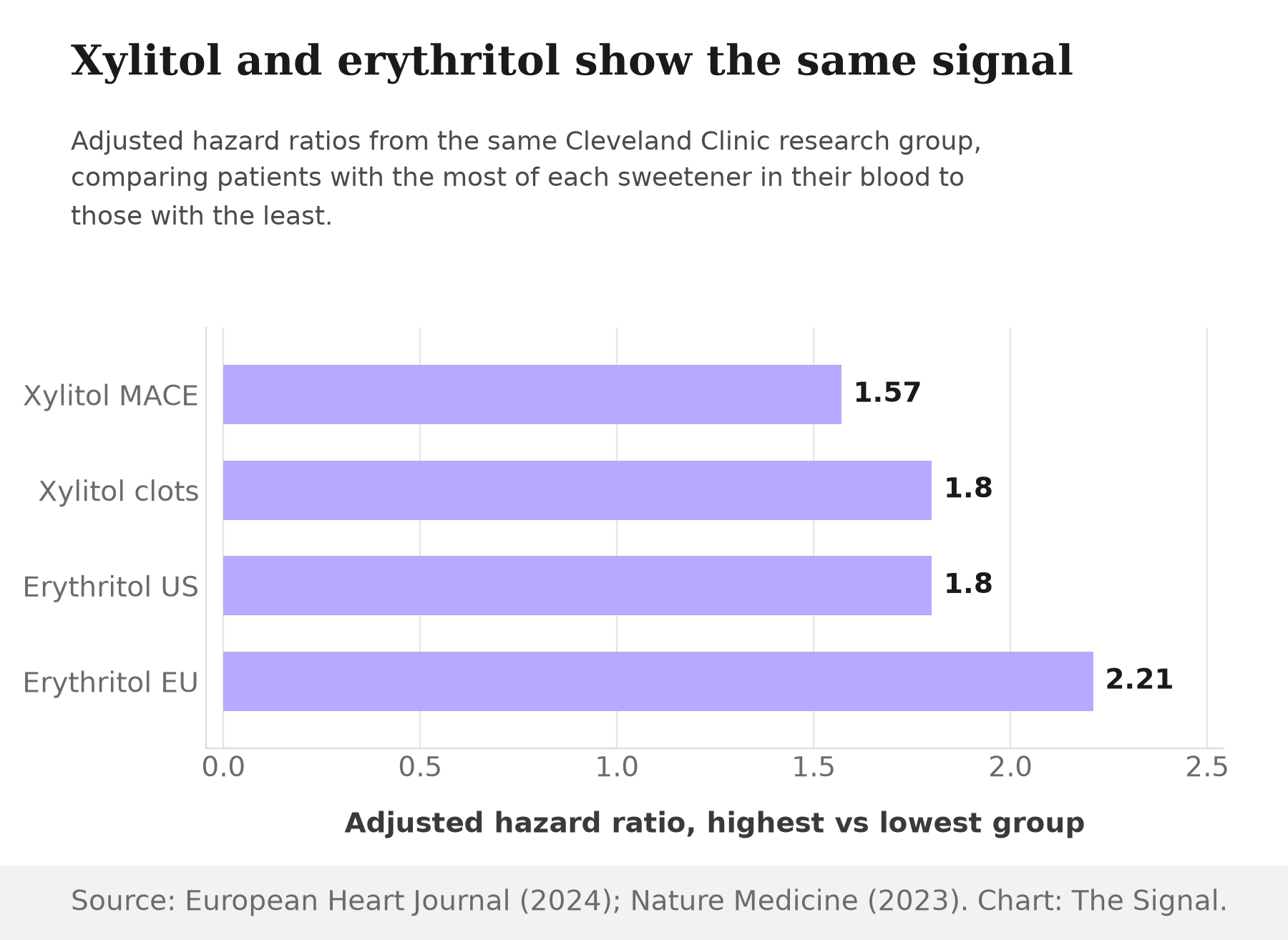
It is worth slowing down on what that label actually measures. Glycemic index tracks one thing: how fast a carbohydrate raises blood sugar. It says nothing about what a molecule does to the cells that clot blood, and before 2024 nobody had systematically checked xylitol against that question either. A 2024 study in the European Heart Journal found elevated xylitol levels were linked to a 57% higher three-year risk of major cardiovascular events in stable cardiac patients, and an 80% higher risk of thrombotic events specifically, comparing patients with the most xylitol in their blood to those with the least.
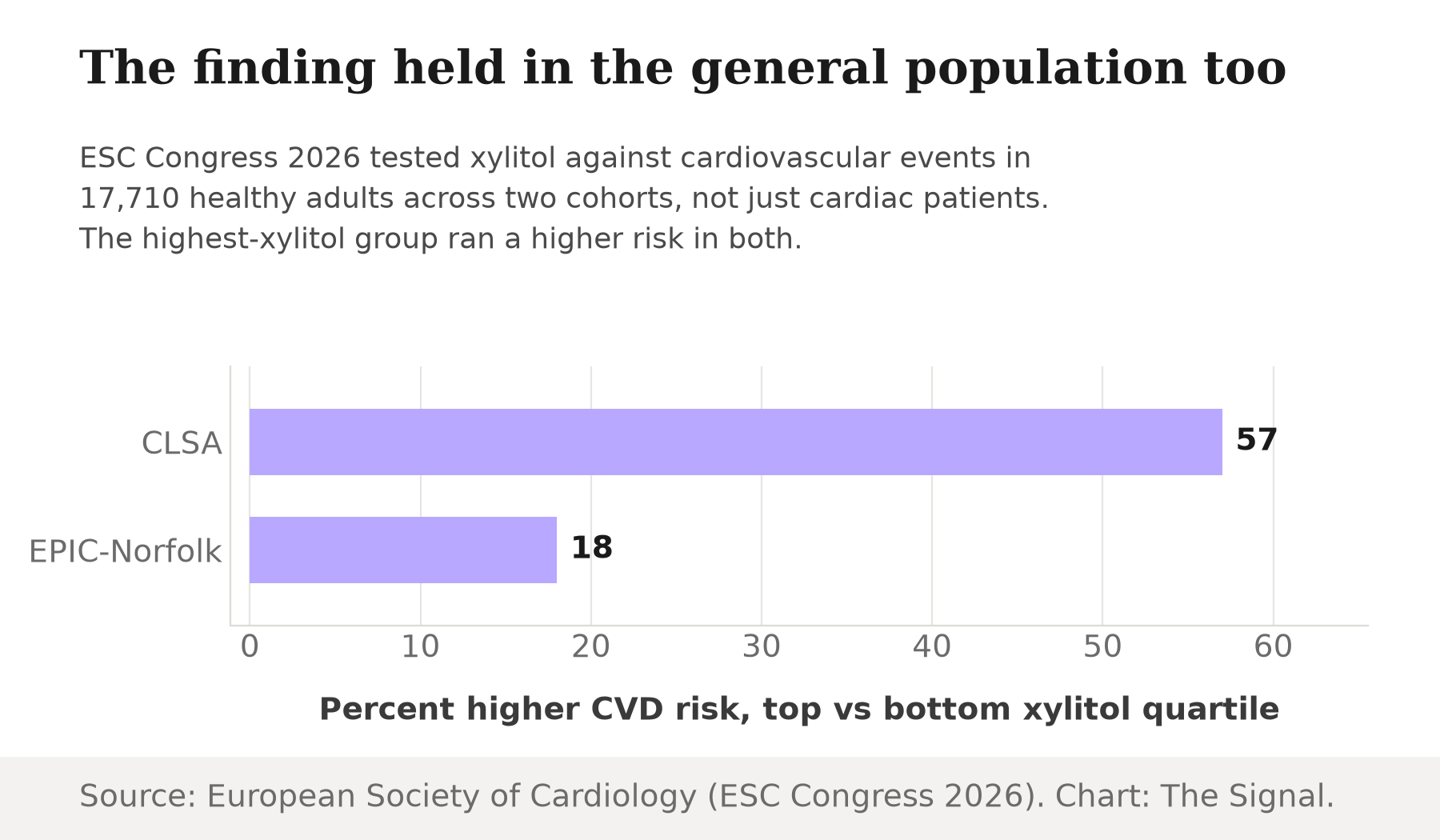
That finding did not stay confined to a cardiac ward. At ESC Congress 2026 in Munich on August 29, researchers presented results from 17,710 people across two general-population cohorts, Canada's CLSA and the UK's EPIC-Norfolk: the highest-xylitol quartile carried a 57% higher cardiovascular-event risk over six years in the Canadian cohort and an 18% higher risk over thirty years in the British one, compared with the lowest-xylitol quartile in each. The result was presented at the congress and is not yet a peer-reviewed published paper, but it moves the same signal from people already being monitored for heart trouble to people who were not.
The mechanism the label never tested
Every question a "sugar-free" label answers is not the question that turned out to matter.
| Question | Tested by | Answer |
|---|---|---|
| Does it raise blood glucose like sugar? | Glycemic index | No |
| Is it covered by WHO's 2023 sweetener guidance? | WHO guideline scope | No, polyols are excluded |
| Does it raise platelet clotting activity? | 2024 human oral-challenge trial | Yes, within 30 minutes |
| Does it raise cardiovascular-event risk? | ESC Congress 2026, 17,710 people | Yes, in both cohorts tested |
Source: Cleveland Clinic; World Health Organization and its guideline background document; European Heart Journal editorial, 2024; European Society of Cardiology, ESC Congress 2026.
The 2024 paper did not stop at association. Researchers tested xylitol directly: in lab and animal work it increased platelet reactivity to ADP, thrombin and a collagen trigger, and shortened the time to vessel blockage in a mouse model of carotid thrombosis. Then they tried it on people. In ten volunteers, a single 30-gram oral dose of xylitol, about what one sweetened drink contains, measurably increased platelet reactivity within 30 minutes: a dose small enough to pass any glycemic-index test still moved the cells that form clots.
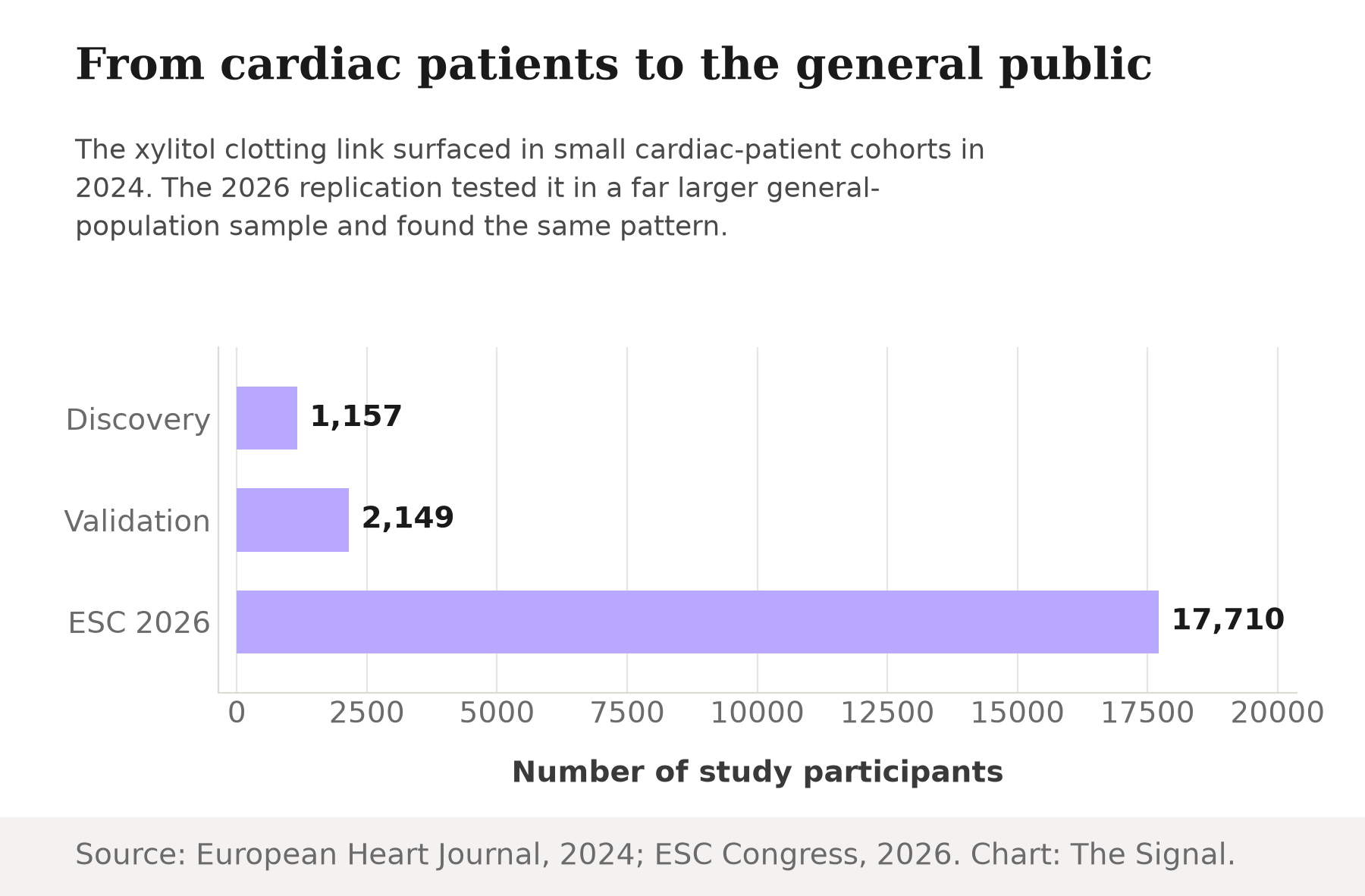
That gap is the whole finding. Glycemic index correctly reports that xylitol will not spike blood glucose. It was never designed to detect an effect on platelets, and nothing in a diabetes-friendly label checks for one either. The original discovery cohort ran to 1,157 patients, with an independent validation cohort of 2,149 more, before the 2026 congress result tested the same question in a cohort of 17,710 people who were not cardiac patients at all.
A second sweetener, the same signal
Xylitol is not the first sugar alcohol this research group has flagged. A 2023 study in Nature Medicine, using an overlapping patient cohort, found erythritol, a chemically similar sugar alcohol also marketed as diabetic-safe, independently associated with a comparably elevated three-year cardiovascular-event risk: an adjusted hazard ratio of 1.80 in a US validation cohort and 2.21 in a European one, working through the same platelet and thrombosis pathway. Two different molecules, tested years apart by the same lab, land on the same mechanism.
The guideline that does not cover this
The World Health Organization's 2023 guideline already advises against non-sugar sweeteners for weight control or disease prevention, citing evidence of a higher long-term risk of type 2 diabetes and cardiovascular disease. It would be reasonable to assume that guidance already covers xylitol. It does not. The guideline's own background document excludes polyols such as xylitol from its scope entirely, because they contain calories and are not classified as "non-nutritive" sweeteners: the exact category diabetics are steered toward is the one current global sweetener safety guidance does not address at all.
The honest objection
The strongest case for caution here is that none of this is a randomized trial of heart attacks. The human evidence is a platelet-reactivity response measured 30 minutes after one drink, not a clinical outcome, and the general-population replication is a congress presentation that has not yet cleared peer review. Glycemic control itself is a genuine, life-extending benefit for people with diabetes, and no single sweetener finding should outweigh that.
That case is real, but it does not explain why the same pathway shows up twice, in two different sugar alcohols, across cardiac patients and the general population, using three separate methods: blood biomarkers in stable patients, a mouse thrombosis model, and a human feeding challenge. A single surprising result could be noise. The same mechanism appearing in xylitol in 2024, in erythritol in 2023, and in a fresh cohort of 17,710 people in 2026 is a pattern, not a fluke.
The Signal
This finding does not mean glycemic-index labelling is wrong. It means the label was never built to answer this question, and nothing in India's food-additive rulebook currently asks it either: xylitol simply sits on the approved polyol list, next to sorbitol and mannitol, with no separate clotting check attached. Watch two things next: whether the ESC Congress 2026 result survives peer review once it is published in full, and whether any regulator, in India or elsewhere, moves polyols into the sweetener-safety conversation the WHO's 2023 guideline explicitly left them out of. Until one of those happens, the label on the packet answers a question nobody is arguing about, and stays silent on the one that now has two studies behind it.
Reporting basis: the platelet-reactivity and thrombosis mechanism, the discovery and validation cohort sizes, and the three-year cardiovascular and thrombotic risk figures are from the Witkowski et al. study and its accompanying editorial in the European Heart Journal, 2024. The general-population replication (17,710 participants, the CLSA and EPIC-Norfolk cohorts) is per the European Society of Cardiology's press release on the ESC Congress 2026 presentation, delivered by the same lead author; it has not yet appeared as a peer-reviewed paper. The mechanistic testing, including the mouse thrombosis model and the human oral-challenge result in ten volunteers, is from the same European Heart Journal editorial. Cleveland Clinic's Consult QD, reporting on the trial run by its own researchers, is the source for Stanley Hazen's comment on who is most exposed. The erythritol comparison is from a 2023 Nature Medicine study by the same research group. India's diabetes prevalence is from the ICMR-INDIAB study as reported by the Ministry of Health and Family Welfare via the Press Information Bureau. FSSAI's Appendix A is the source for xylitol's regulatory classification as a permitted polyol. The World Health Organization's 2023 non-sugar-sweetener guideline and its background scope document are the source for what current global sweetener guidance does and does not cover. No figure in this piece is The Signal's own calculation; all are as reported by these sources.