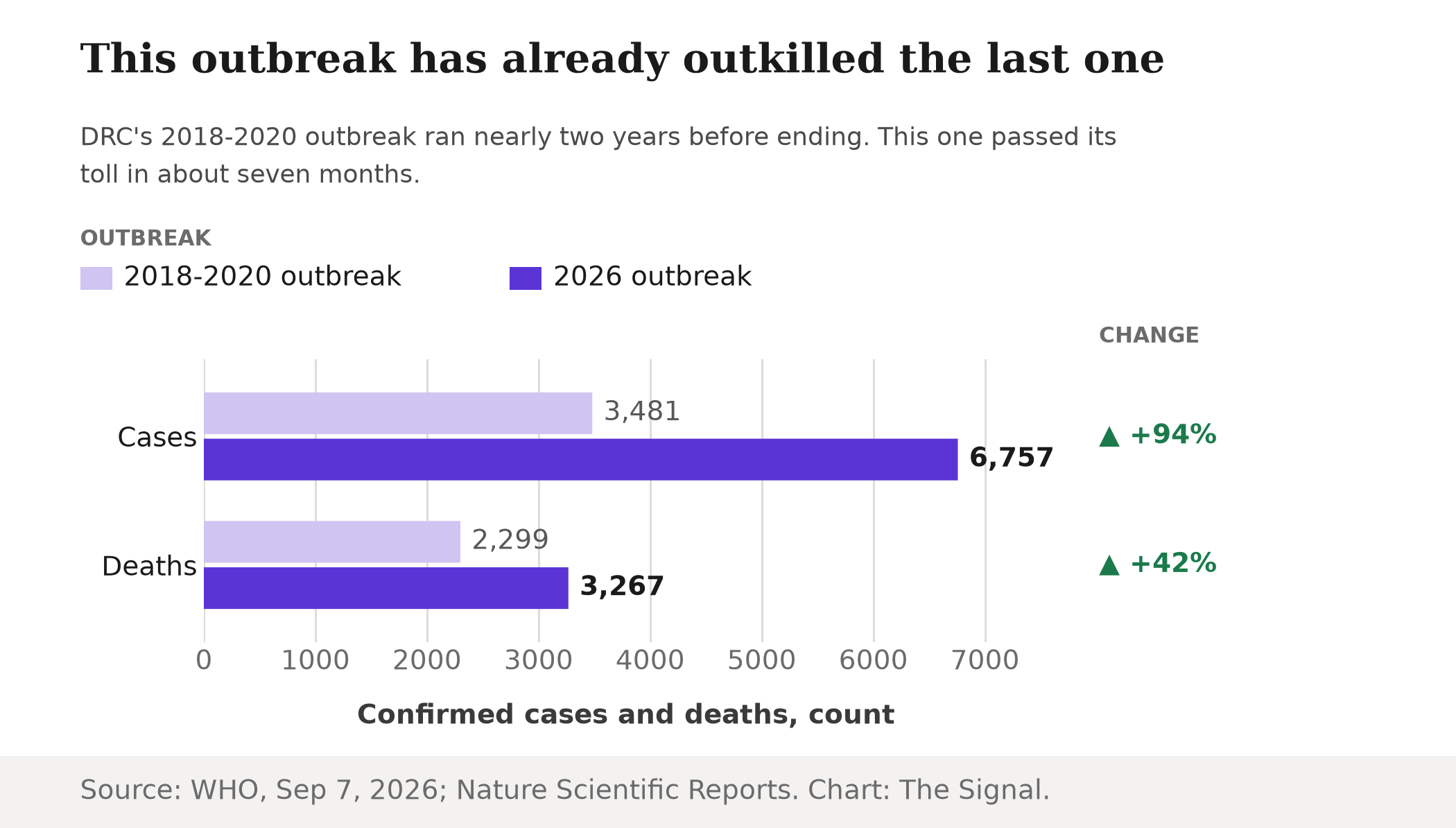
By 7 September 2026, the Democratic Republic of the Congo had reported 6,757 confirmed cases of Ebola in its current outbreak, including 3,267 deaths, a crude case fatality ratio of 48.3 percent, the WHO reports. Two and a half weeks earlier, on 21 August 2026, the US CDC had already called it the second largest Ebola outbreak ever recorded, noting that the roughly 5,000 cases reported in the outbreak's first hundred days made the growth rate unprecedented. The response running against those numbers is the one that worked before: vaccinate the contacts of every confirmed case in a ring around them, trace those contacts fast enough to stay ahead of the next infection. That approach, built around the vaccine Ervebo, ended the country's 2018-2020 North Kivu outbreak, which closed at 3,481 cases and 2,299 deaths. Read the current case count against that history and the story looks straightforward: DRC beat Ebola with this playbook before, so it can do so again.
This outbreak has already killed more people than the last one, in a fraction of the time.
The 2018-2020 outbreak ran from its August 2018 emergency declaration to its close in June 2020, nearly two years, to reach that toll. This one had already passed roughly 5,000 cases within its first hundred days, a pace the CDC calls unprecedented. DRC's Ministry of Public Health officially declared the current outbreak on 15 May 2026, ten days after WHO was first alerted to unexplained deaths in Ituri Province's Mongbwalu health zone. That declaration puts the 7 September toll at 115 days old, a fraction of the time the 2018-2020 outbreak took to reach a smaller one.
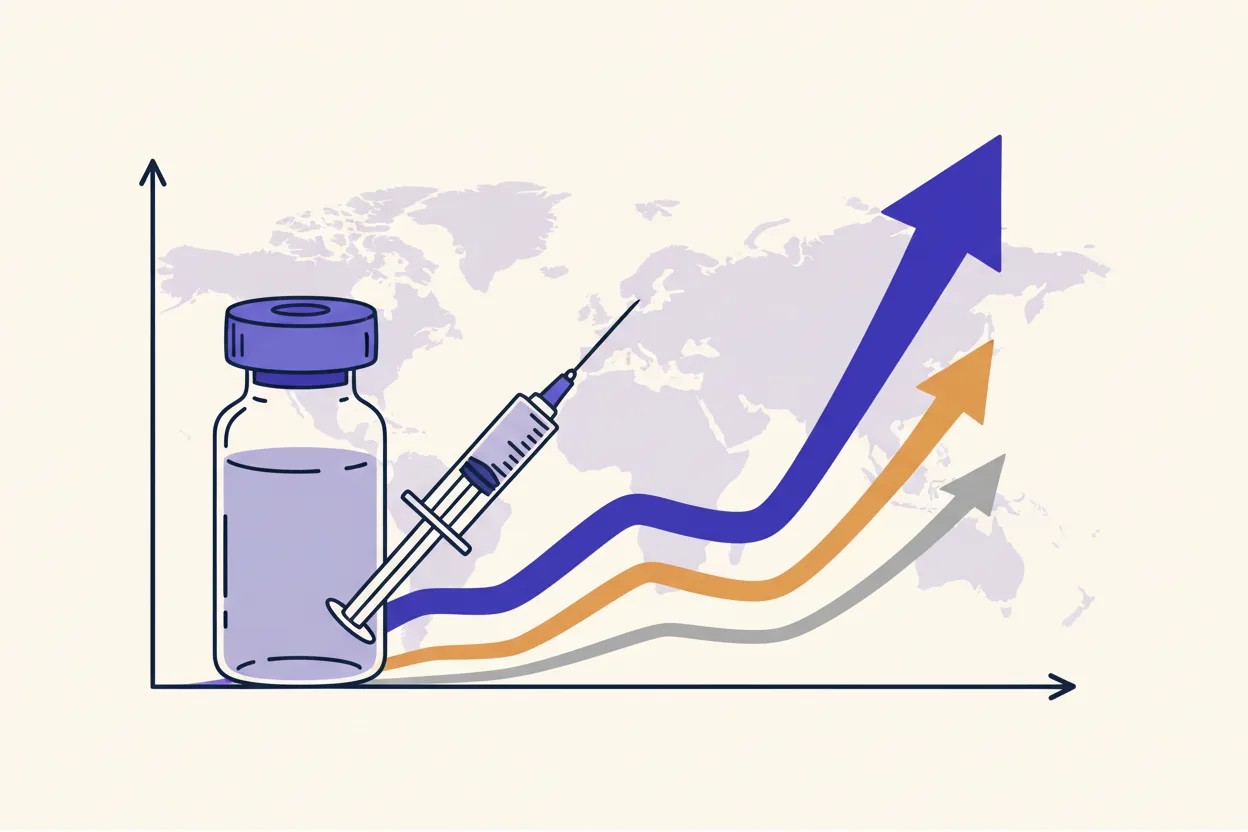
It is worth slowing down on the playbook comparison, because the disease itself has changed. WHO reports that the current outbreak is Bundibugyo virus disease, caused by Bundibugyo virus, one of the Orthoebolavirus species, and a distinct virus from the Zaire ebolavirus that drove the 2018-2020 outbreak. Ervebo's record comes entirely from that other virus: in the Lancet's Ebola Ca Suffit! ring-vaccination trial, the vaccine's efficacy was 100 percent, a result measured against Zaire ebolavirus. Nobody has that number for Bundibugyo virus, because it has never been tested at that scale.
WHO's own vaccine advisers have already ruled on the gap. The Strategic Advisory Group of Experts on Immunization states that the available evidence remains insufficient to determine whether Ervebo provides clinically meaningful protection in humans against this virus, and recommends the vaccine be used only within research protocols, not deployed the way it was in 2018-2020. A separate panel reached the same conclusion earlier in the outbreak: on 31 July 2026, WHO's Technical Advisory Group on Candidate Vaccine Prioritization recommended that Ervebo be tested in a formal Phase 3 study inside the current outbreak, rather than deployed as a proven tool, because cross-protection against Bundibugyo virus was still unproven. The playbook that ended the last outbreak has a vaccine at its center that cannot legally be handed to a vaccination team this time.
| 2018-2020 outbreak | 2026 outbreak | |
|---|---|---|
| Virus | Zaire ebolavirus | Bundibugyo virus |
| Vaccine efficacy trial result | 100% (Ervebo, Lancet) | Insufficient evidence (WHO SAGE) |
| Vaccine deployment | Ring vaccination, general use | Research protocols only (WHO SAGE) |
| Final/latest cases | 3,481 | 6,757 as of 7 Sep 2026 |
| Final/latest deaths | 2,299 | 3,267 as of 7 Sep 2026 |
Vaccine deployment status is per WHO's SAGE guidance; efficacy and case figures are per the sources cited above in the table. Comparison assembled by The Signal.
Conflict is the other half of the problem
A strain mismatch is not the whole explanation, and it would be dishonest to treat it as one. WHO states directly that insecurity and displacement in the affected provinces disrupt access to health care, restrict access for response teams, and impede surveillance, case investigation and contact follow-up. That is not a vague backdrop: in Ituri province, the outbreak's epicenter, certain administrative entities are outside state control. M23, the Rwanda-backed armed group, controls Goma and the southern part of North Kivu province, one of the six provinces carrying cases. Ring vaccination and contact tracing both assume a response team can reach a named village; a control map like that is the specific reason some cannot. That shows up in the numbers meant to catch every chain of transmission before it spreads further: contact follow-up improved from just 9 percent of identified contacts in the outbreak's first week to 84 percent by 18 August 2026, according to WHO's Regional Office for Africa. That is real progress, and it is also a nine-times gap the response spent weeks closing while the virus kept moving.
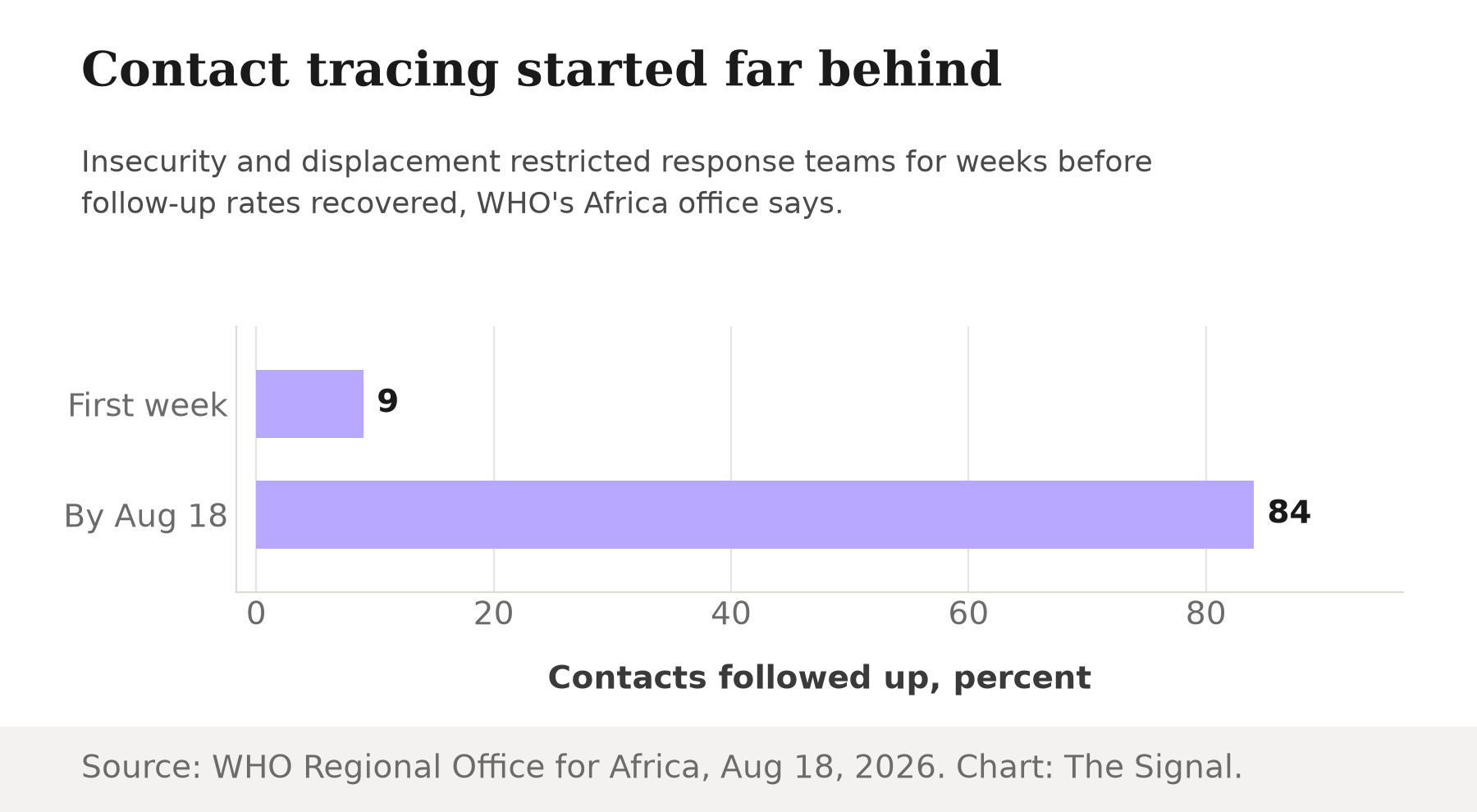
So the outbreak is running two deficits at once, not one. Physical access to contacts started at 9 percent and has been fought back up to 84 percent over the second half of 2026. Evidentiary access to a proven vaccine has not moved at all, because the question SAGE and TAG-CVP are answering is not about reaching people. It is about whether the shot works on this virus, and reaching every contact in the country would not change that answer.
India already built the backup, but it cannot be deployed either
The vaccine world's answer to a strain mismatch is a strain-specific candidate, and that candidate already exists in bulk. The Serum Institute of India manufactured and stockpiled approximately 620,000 doses of the ChAdOx1 BDBV vaccine candidate in two weeks, an Oxford-designed shot built specifically for Bundibugyo virus, backed by CEPI funding. That is a serious manufacturing feat: a stockpile roughly 18 times the size of DRC's entire confirmed case count, built in about the time it takes to plan a vaccination campaign.
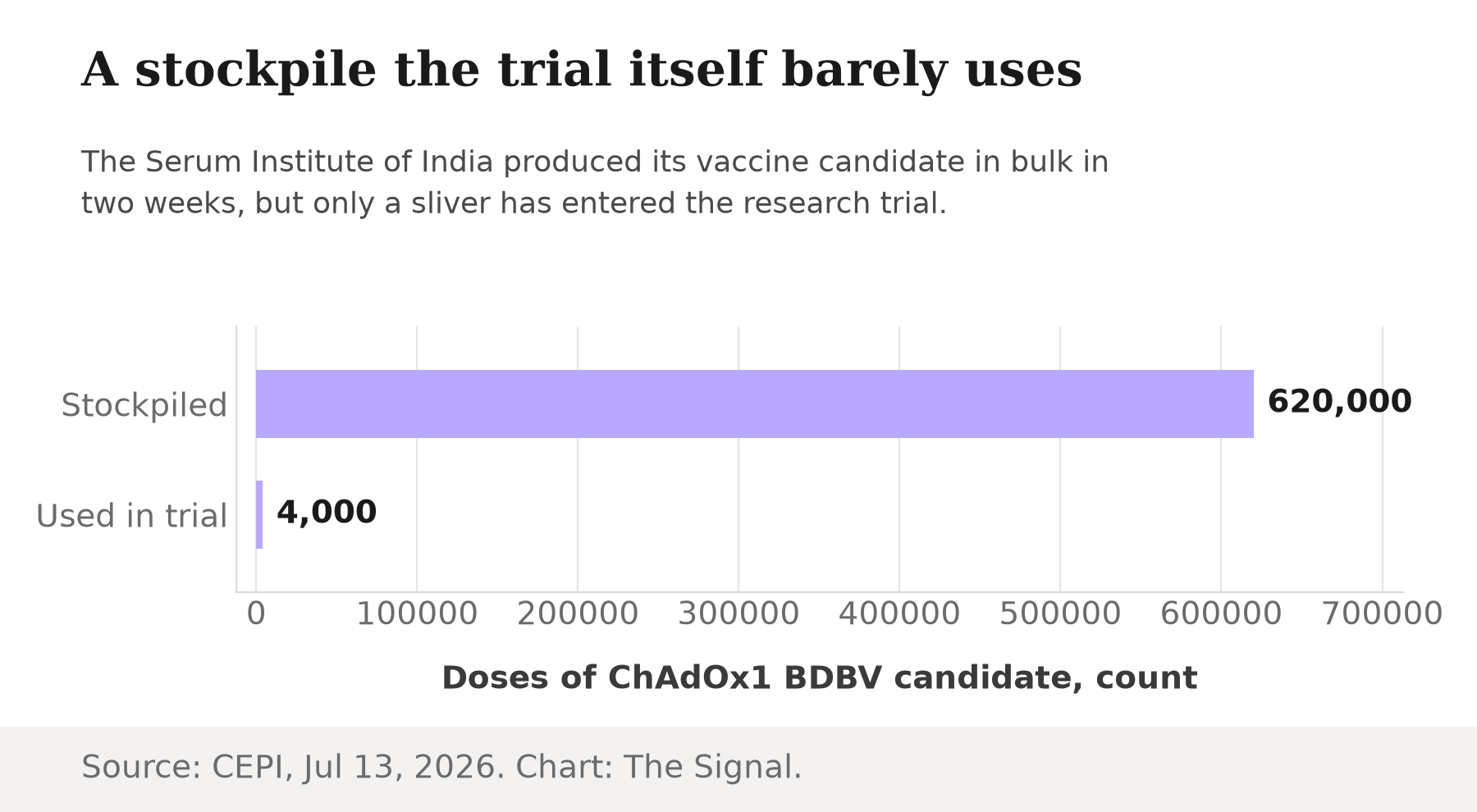
But the same CEPI announcement that reports the stockpile also reports that the Serum Institute has supplied just 4,000 investigational doses for the current Phase I trial. The other 616,000 doses are sitting in storage, not because India cannot ship them, but because a Phase I trial has to clear before a Phase III study can even begin, which is the step WHO's TAG-CVP has already said Ervebo itself still needs for this virus. Manufacturing scaled in two weeks. Proof takes longer, and the outbreak is not waiting for it.
The honest objection
The strongest case against the strain-mismatch framing is that DRC's response has visibly worked before insecurity was ever solved. Contact follow-up going from 9 percent to 84 percent in a matter of weeks shows that a conflict-constrained health system can still be pushed to near-complete coverage without waiting for the security situation to resolve. On that view, the vaccine gap is a secondary concern: isolation, supportive care and thorough contact tracing can bend an outbreak curve even without a proven shot, and DRC has now shown it can deliver that tracing at scale.
That case is real. It is also incomplete. Even fully resourced, a contact-tracing team with 84 percent coverage still has nothing to inject into the contacts it finds beyond a vaccine restricted to research protocols. Access and evidence are different bottlenecks, and DRC has only shown it can fix one of them. The 48.3 percent case fatality ratio recorded through 7 September 2026 is what an outbreak looks like when tracing works but the vaccine cannot be deployed as a general tool.
The Signal
An outbreak-response playbook is only as good as the assumption that the next outbreak looks like the last one. DRC's did not: same country, same disease name, same ring-vaccination doctrine on paper, and a virus species the doctrine's own proof was never built for. Fixing conflict-driven access, which DRC has partly done, closes exactly one of the two gaps this outbreak opened. The other gap closes only when a trial finishes, not when a checkpoint clears. Watch what happens to the 620,000 doses sitting in an Indian stockpile: if Phase I data lets the Bundibugyo-specific candidate move to wider use before this outbreak ends, the stockpile becomes the model for how fast a strain-specific vaccine can be readied. If the outbreak's own curve closes first, the doses will have proven a manufacturer can outrun a virus without a trial system able to keep pace with either.
Reporting basis: outbreak case, death and case-fatality figures for both the 2018-2020 and 2026 outbreaks are drawn from WHO's Disease Outbreak News series, the US CDC's Morbidity and Mortality Weekly Report, and a peer-reviewed Scientific Reports study using DRC Ministry of Health data. The virus-classification and vaccine-restriction findings are from two separate WHO technical bodies, the Strategic Advisory Group of Experts on Immunization and the Technical Advisory Group on Candidate Vaccine Prioritization, each reporting its own review. The 2015-2017 Ervebo efficacy result is from The Lancet's published ring-vaccination trial results. Contact-tracing coverage and the description of insecurity's effect on response access are from WHO's Regional Office for Africa and WHO's Disease Outbreak News respectively. The Serum Institute of India's stockpile and trial-dose figures are from CEPI, the trial's funder. The stockpile-to-case-count comparison is The Signal's calculation from those figures.