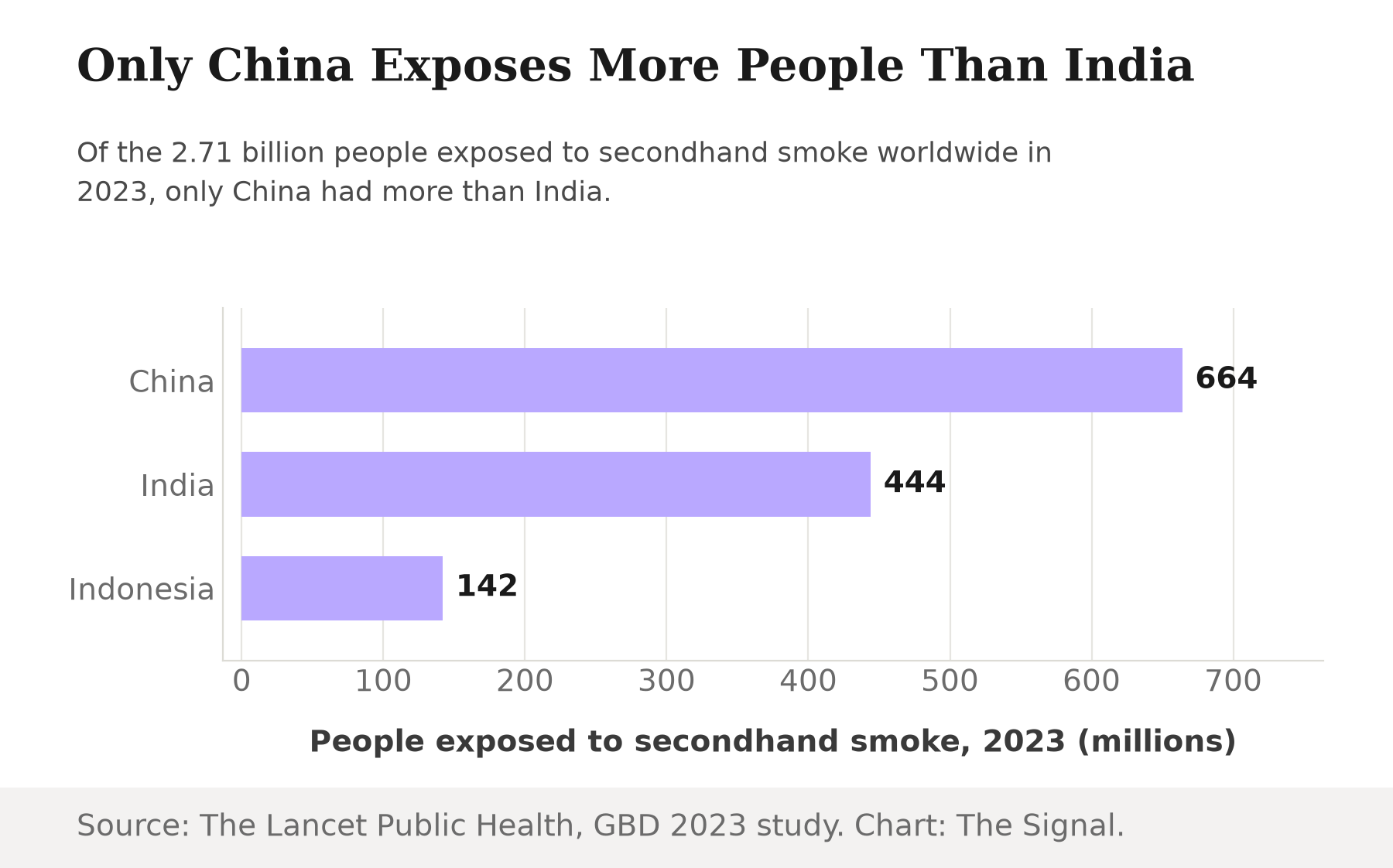
In September 2026, the Global Burden of Disease study's secondhand-smoke researchers published new country estimates in The Lancet Public Health. Worldwide, an estimated 2.71 billion people were exposed to secondhand smoke in 2023, including 767 million children, and India had the world's second-largest exposed population, an estimated 444 million people in 2023, behind only China's 664 million and ahead of Indonesia's 142 million, a scale this piece returns to below. Set against India's own tobacco surveys, that number sits oddly next to a genuine success story. Active smoking prevalence among Indian adults fell from 14.0 percent in 2009-10 to 10.7 percent in 2016-17, and the share of men using any tobacco product fell from 45.5 percent to 40.8 percent between the National Family Health Survey's fourth and fifth rounds, 2015-16 to 2019-21, while the share of women fell from 6.8 percent to 4.0 percent. Two national surveys, using different methods, tell the same story: fewer Indians smoke than a decade ago.
Yet the region the GBD study groups India into, South Asia, still saw its secondhand-smoke death toll rise 48.6 percent between 1990 and 2023, to 428,000 deaths a year, even though the underlying mortality rate fell there as it did in every world region. Taken alone, a rate that falls while a death count rises is not much of a puzzle. The same pattern shows up globally: age-standardised exposure prevalence fell 22.2 percent since 1990, but not fast enough to outrun population growth, so the number of people exposed worldwide has barely moved. A region can get cleaner per person and still bury more people, if it also has more people living in it. That is arithmetic, not a story.
The real question is what happened inside India, in the specific places where secondhand smoke actually gets breathed in. There, the country's own surveys point somewhere the population math cannot reach.
The venue that did not follow the trend
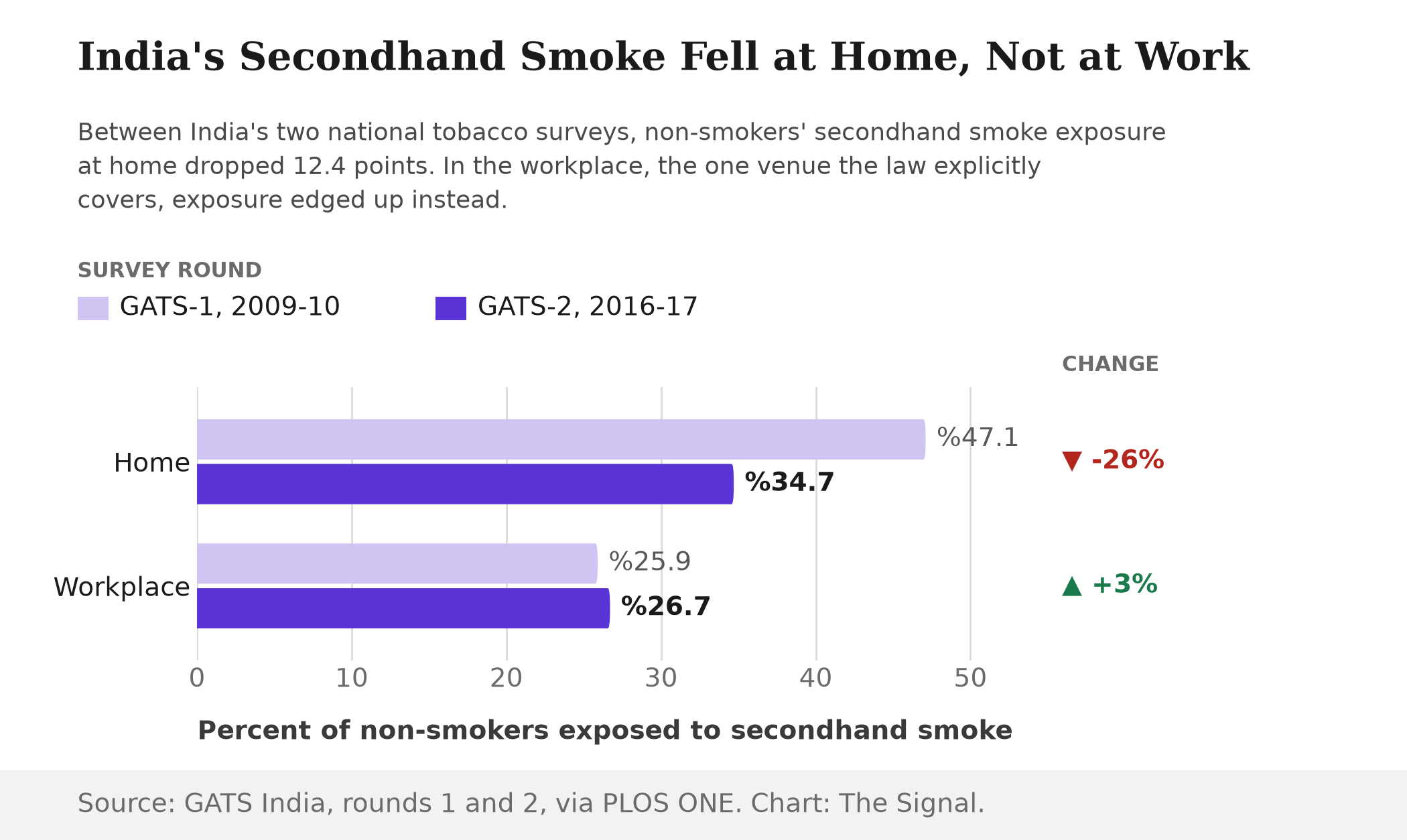
Between India's two Global Adult Tobacco Surveys, a decade apart, non-smokers' exposure to secondhand smoke at home fell from 47.1 percent in 2009-10 to 34.7 percent in 2016-17, a drop of 12.4 percentage points. In the workplace, over the same years, exposure did not fall. It rose, marginally, from 25.9 percent to 26.7 percent.
That is the opposite of what the popular explanation for a rising death toll alongside falling smoking rates usually predicts. The standard story about smoking bans is that they push the habit out of sight: public places and offices go smoke-free, so people light up at home instead, and secondhand smoke migrates from the regulated space into the unregulated one. If that were true in India, home exposure should have tracked with workplace exposure rather than moving in opposite directions. It ran the other way. The venue India's law does not reach, the home, improved the most, while the one it was written for got marginally worse.
The law was supposed to work here
India's tobacco-control law, the Cigarette and Other Tobacco Products Act's Section 4, bans smoking in public places and workplaces, and a systematic review of studies conducted between 2010 and 2020 pooled compliance with that section at 71.97 percent nationally. That is not the near-zero enforcement a pure displacement story would need. On average, roughly three in four observed venues were complying with a law that has been on the books since 2003.
The same body of research addresses the displacement question directly, and the picture is mixed rather than settled. Some studies do find smoking pushed into homes after workplaces and public places go smoke-free; others find the opposite, smoke-free legislation nudging households toward smoke-free homes too. India's own trend lines up with the second group, not the first: home exposure fell, it did not rise.
So compliance with the law is real, averaging roughly seven in ten venues, and home exposure moved down rather than up. What that compliance figure cannot explain is why the workplace, the one venue Section 4 explicitly targets, is the one place secondhand-smoke exposure did not follow the rest of the country downward.
What the numbers can and cannot say
The honest caveat is that the 71.97 percent compliance figure is not broken out by venue. It pools workplaces with every other space Section 4 covers, drawn from studies using different methods across a full decade, 2010 to 2020. Workplace-specific compliance could sit well below that pooled average even as other covered venues, restaurants and transit hubs among them, pull the national number up. The GATS researchers themselves describe the workplace shift as marginal rather than a clear reversal, and with a single percentage point of movement, some of it could be survey noise rather than a genuine change in exposure.
But noise cuts both ways. If workplace exposure were tracking the law the way home exposure fell by 12.4 points alongside roughly 72 percent compliance, a decade should have produced some visible decline. Instead the number sits essentially where it started: the only venue in India's own data that did not improve while active smoking, home exposure, and, per the GBD study worldwide, mortality rates were all moving in the healthier direction.
The exposure that remains
National averages also hide who is still exposed once the overall trend looks better. That is truest for women specifically: globally, women's age-standardised secondhand-smoke exposure prevalence was estimated at 37.3 percent in 2023, against 30.6 percent for men, and the venue driving that gap is the one India's own data says improved the most. Among non-smoking pregnant women, using the same 2016-17 survey round, 36.9 percent reported secondhand-smoke exposure at home, against 26.5 percent exposed outside the home: the home remains the single largest exposure venue for exactly the group with the most to lose from it. Worldwide, secondhand smoke was estimated to cause 1.66 million deaths and 44.8 million lost healthy life-years in 2023, and lower respiratory infections, not heart disease, were the leading harm specifically among the 767 million exposed children.
India's active-smoking decline shows up across two independent national surveys, using different questionnaires and years.
| Measure | Earlier round | Later round | Change |
|---|---|---|---|
| Adult active smoking, GATS | 14.0% (2009-10) | 10.7% (2016-17) | -3.3 points |
| Men, any tobacco use, NFHS | 45.5% (2015-16) | 40.8% (2019-21) | -4.7 points |
| Women, any tobacco use, NFHS | 6.8% (2015-16) | 4.0% (2019-21) | -2.8 points |
| Home secondhand-smoke exposure, GATS | 47.1% (2009-10) | 34.7% (2016-17) | -12.4 points |
| Workplace secondhand-smoke exposure, GATS | 25.9% (2009-10) | 26.7% (2016-17) | +0.8 points |
Sources: GATS decomposition analysis, PLOS ONE via PMC; NFHS-4/NFHS-5 analysis, PubMed; GATS I/II secondhand-smoke analysis, PLOS ONE via PMC.
Here is how South Asia's regional death toll compares with the rest of the world.

And here is where India sits in the global exposed population that opened this piece.
The honest objection
The strongest case against reading anything into the workplace number is that it may simply be measurement noise: a single percentage point of movement, in two survey rounds fielded seven years apart with different fieldwork teams. On that view, workplace exposure did not really change, it stayed flat within the survey's own precision, and there is no puzzle beyond compliance not making things worse.
That case is fair, and this piece cannot rule it out with confidence intervals GATS itself did not publish for these particular figures. But it does not settle the question either way. A flat reading still means the workplace is the one venue, among the ones GATS actually measured, that shows no improvement over a decade in which home exposure fell by 12.4 points and roughly 72 percent of observed venues were complying with the ban meant to cover offices too. Whether that is a real stall or a measurement plateau, it is not the pattern a working smoke-free law is supposed to produce.
The Signal
The two obvious explanations for India's rising secondhand-smoke death toll both look weaker once its own surveys are opened up. The population math explains why the world's toll keeps climbing even as exposure rates fall everywhere; it explains South Asia's aggregate number, not what changed inside Indian homes and workplaces specifically. The displacement story, bans pushing smoke from the office into the living room, is contradicted outright: home exposure fell, it did not rise. What is left is a narrower, more useful puzzle. A law with roughly 72 percent pooled compliance covers exactly the one venue that failed to improve, while the venue it does not touch improved the most. The next GATS round, whenever India fields it, will show whether that workplace number was noise or a genuine stall. Until then, the figure worth watching is not the exposure rate for the whole country. It is the one for the room the law was actually written for.
Reporting basis: the global and South Asia exposure and mortality estimates are from the GBD 2023 Second-hand Smoke Collaborators study, published in The Lancet Public Health on 7 September 2026, cited here via its full-text article, its PDF appendix tables, its PubMed abstract, and a summary from the Institute for Health Metrics and Evaluation, the study's co-producing institution, all one origin. India's active-smoking decline and its home-versus-workplace secondhand-smoke figures are from India's Global Adult Tobacco Survey, rounds 1 (2009-10) and 2 (2016-17), fielded by the Ministry of Health and Family Welfare, as analysed in two separate peer-reviewed papers in PLOS ONE. COTPA Section 4 compliance is from a systematic review and meta-analysis of published compliance studies conducted between 2010 and 2020, via PubMed Central. Exposure among pregnant women is from a peer-reviewed analysis of the same GATS-2 round, via PubMed Central. The additional confirmation of India's active-smoking decline comes from the National Family Health Survey's fourth and fifth rounds, run by the Ministry of Health and Family Welfare and the International Institute for Population Sciences. The percentage-point changes, and the comparison across venues and survey rounds, are The Signal's calculations from those figures.