
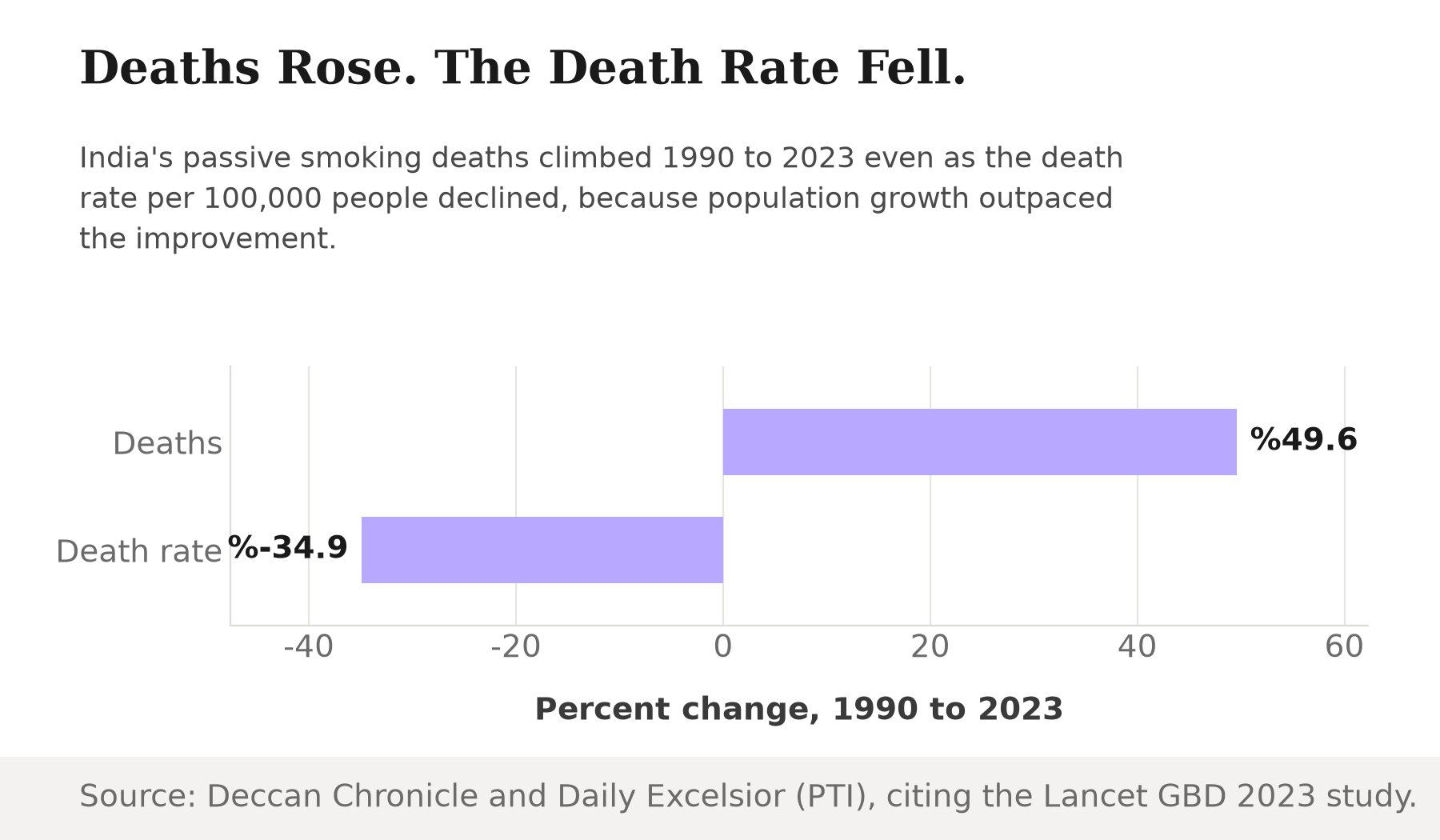
On 7 September 2026, a GBD 2023 systematic analysis across 204 countries and territories found that secondhand smoke exposed about 2.71 billion people worldwide and caused an estimated 1.66 million deaths in 2023. Indian coverage moved fast on the domestic number: 444 million Indians were exposed to secondhand smoke in 2023, up from 375 million in 1990. Deaths in India attributable to passive smoking rose from 217,700 in 1990 to 325,600 in 2023, a jump of roughly 50 percent. Two days later, PMK president and former Union Health Minister Anbumani Ramadoss publicly called on central and state governments to strictly enforce the existing public-place smoking ban. Read in sequence, the story writes itself: a 23-year-old law is losing ground, and the fix is to enforce it harder.
It is worth slowing down on that framing. India's secondhand-smoke death rate actually fell about 35 percent, from 46.1 to 30 per 100,000 people, between 1990 and 2023, even as the absolute toll climbed, because population growth outran the improvement in risk per person.
That is a genuine nuance, but it is not the number that explains where enforcement actually stalled. That number is not a mortality statistic at all. It is close to 90.
The law was built for a workplace nine in ten workers do not have
The Cigarettes and Other Tobacco Products Act, 2003, nationally prohibits smoking in any public place under Section 4, with narrow carve-outs only for large hotels, restaurants and airports. In practice, a rule like that is enforced the way most workplace regulation in India is enforced: through an establishment with a name on a register, a manager who can be fined, and an inspector who knows where to show up. Offices, chain restaurants, airports and licensed transport hubs fit that description. Most Indian workplaces do not.
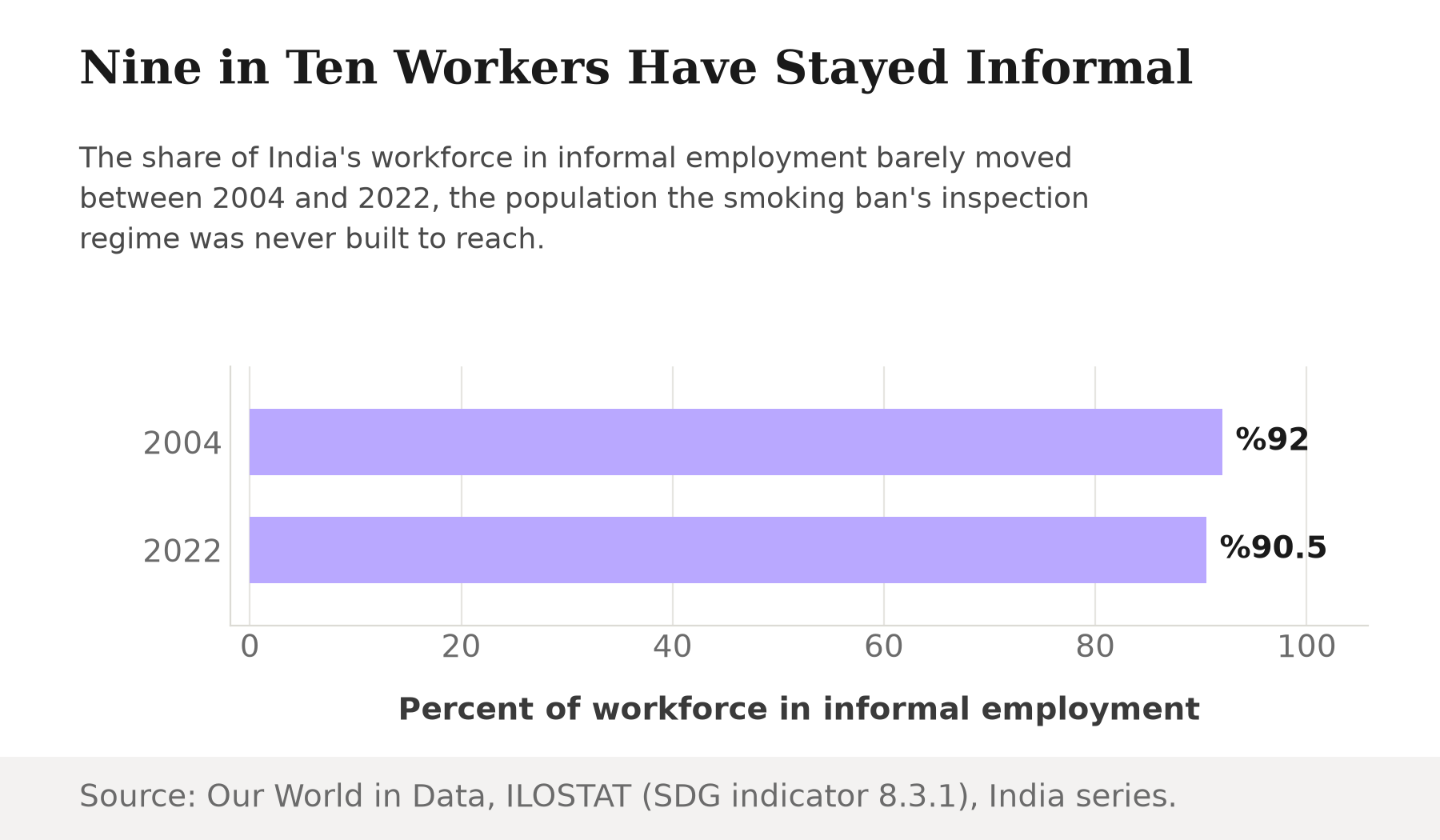
Nearly 90 percent of India's workforce is informally employed, and about 82 percent works within the informal sector, the ILO and the Institute for Human Development found in their 2024 India Employment Report, using 2022 data. That includes dhabas, wholesale markets, construction sites, small workshops and home-based work, none of which carries the payroll structure a smoking-ban inspection regime is built around. That is not a temporary gap the economy is closing. India's share of workers in informal employment has barely moved in two decades, easing only from 92.0 percent in 2004 to 90.5 percent in 2022.
Where the law can reach, it works. Where it can't, it hasn't moved
India does have a live before-and-after on this. Between two national tobacco surveys, GATS-1 in 2009-10 and GATS-2 in 2016-17, overall current smoking prevalence among Indian adults fell from 14.0 percent to 10.7 percent, and secondhand-smoke exposure fell with it in the settings where enforcement has some footing.
Home and public-place exposure fell sharply. Workplace exposure did not move.
| Setting | GATS-1 (2009-10) | GATS-2 (2016-17) |
|---|---|---|
| Home | 52.3% | 38.7% |
| Public place | 29.0% | 23.0% |
| Workplace | 29.9% | 30.2% |
Source: WHO/Ministry of Health and Family Welfare, GATS India 2016-17 factsheet.
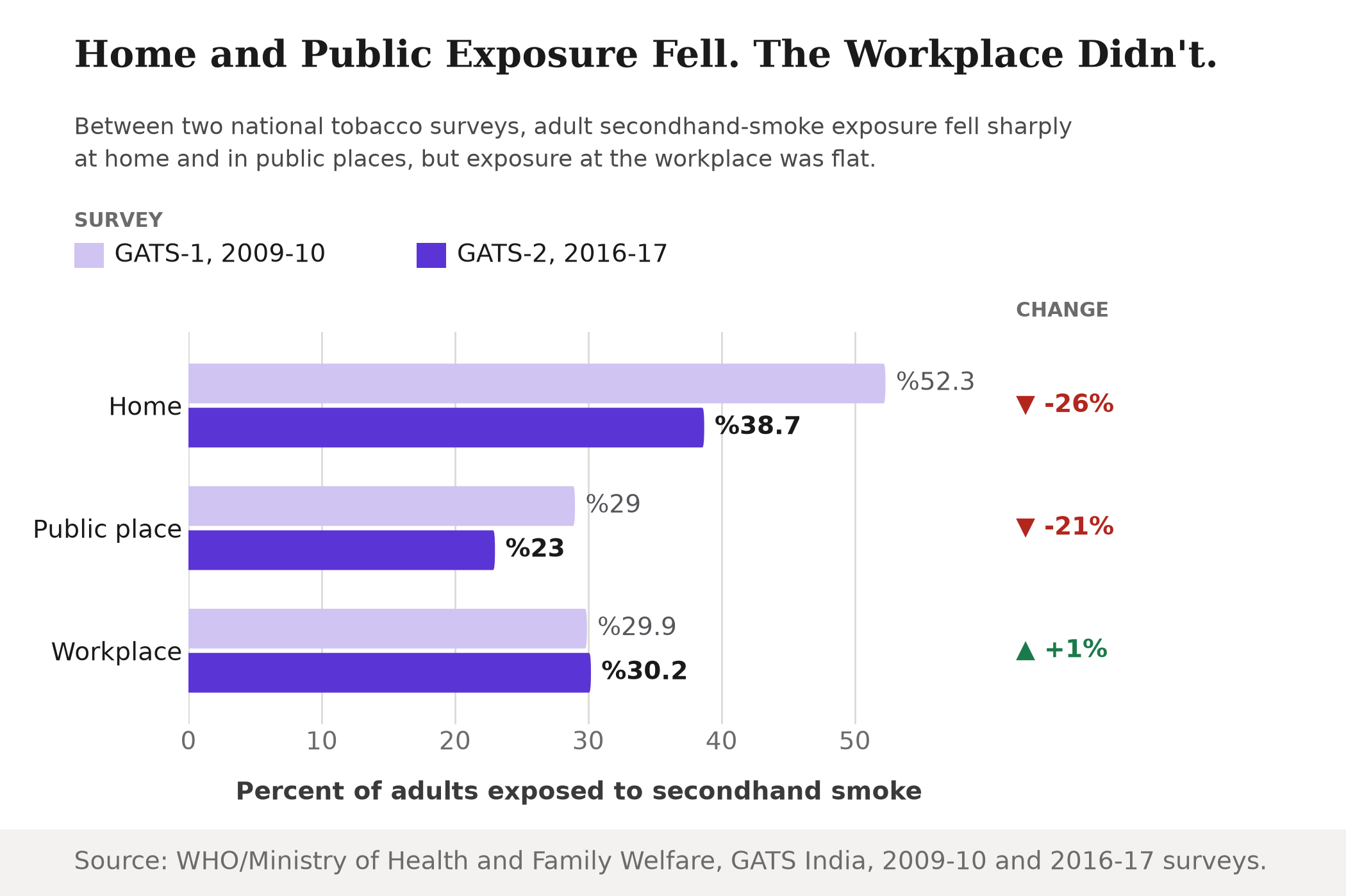
Exposure at home fell from 52.3 percent to 38.7 percent and exposure in public places fell from 29.0 percent to 23.0 percent, but exposure at the workplace barely moved, from 29.9 percent to 30.2 percent, across the same seven years. The drop at home likely reflects social pressure and awareness campaigns, no inspector required. Public-place exposure fell where COTPA's carve-outs and enforcement actually apply: airports, licensed restaurants, transport terminals with a managing authority. At the workplace, exposure simply did not fall, because most Indian workplaces are exactly the settings the law was never built to police.
The compliance check nobody needed a national survey to run
A newer, smaller study makes the same point at ground level. A 2025 peer-reviewed cross-sectional compliance study in Deoghar, Jharkhand found non-compliance with COTPA's Section 4 smoke-free-place rules at 52 percent of the 50 surveyed public sites, including 100 percent non-compliance at transport hubs.
Section 4 compliance failed at more than half the sites checked, and all of the transport hubs.
| Site type | Non-compliance with COTPA Section 4 |
|---|---|
| All surveyed public sites (n=50) | 52% (26 of 50) |
| Transport hubs | 100% |
Source: 2025 Cureus cross-sectional compliance study, Deoghar, Jharkhand.
More than two decades after COTPA became law, the sites where India's informal workers actually spend their working hours, bus stands, taxi ranks, market lanes, are still the sites least likely to comply.
The honest objection
The strongest case against calling this an enforcement failure is that the numbers above also describe real, measurable progress. Smoking prevalence fell by nearly a quarter in seven years. Home exposure fell by roughly a quarter over the same period, and public-place exposure fell by roughly a fifth. On that reading, India is not failing to enforce COTPA; it is enforcing it in the order any resource-constrained regulator would: start where compliance is checkable, and let the harder, informal tail catch up over time. Ramadoss's call for stricter enforcement does not show the law is stuck. It is, instead, a normal push to keep a working policy moving.
That case would be more convincing if the workplace number were merely lagging, the way home exposure lagged before it fell. Instead it has not moved at all across seven years of national survey data, and a site-level compliance study conducted in 2025 still finds the majority of ordinary public locations out of compliance. A regulation that is catching up shows a trend, even a slow one. COTPA's workplace numbers show none. The honest reading is not that enforcement is working slowly. It is that enforcement was never designed to reach the workplaces where nine in ten Indian workers spend their day.
The Signal
COTPA's smoke-free-place rule is not wrong on its face. It correctly bans smoking in public places, and where an inspector can plausibly show up, it has moved real numbers. Its blind spot is structural, not administrative: the law assumes an employer who can be named, registered and fined, and nine in ten of India's workers do not have one. Every fresh call to "enforce more strictly", including the one that followed this week's findings, is aimed at a compliance mechanism that has no jurisdiction over a dhaba's kitchen, a market stall or a construction site. Watch what happens to the workplace-exposure number the next time it is measured. If it finally moves, India will have built a way to police work that has no register. If it sits exactly where it sat before, the country will have spent another cycle enforcing a law written for the tenth of its workforce that was never the problem.
Reporting basis: the global secondhand-smoke totals are from the GBD 2023 Second-hand Smoke Collaborators' study in The Lancet Public Health. India's exposure and death figures for 1990 and 2023 originate from the same study and reached readers via a single PTI wire report, carried consistently by Telangana Today, Deccan Chronicle and Daily Excelsior; the enforcement quote from Anbumani Ramadoss is Deccan Chronicle's own separate report. The COTPA statute text is the Government of India's Act, accessed via a state tourism department's hosted copy. Workplace, home and public-place exposure trends are from the WHO and Ministry of Health and Family Welfare's GATS India factsheets for 2009-10 and 2016-17. Informal-employment shares are from the ILO and Institute for Human Development's India Employment Report 2024 and from Our World in Data's ILOSTAT-derived series. The Deoghar compliance figures are from a 2025 peer-reviewed study in Cureus. The percent changes in deaths, the death rate and the chart's period-on-period shifts are The Signal's calculations from those reported figures.