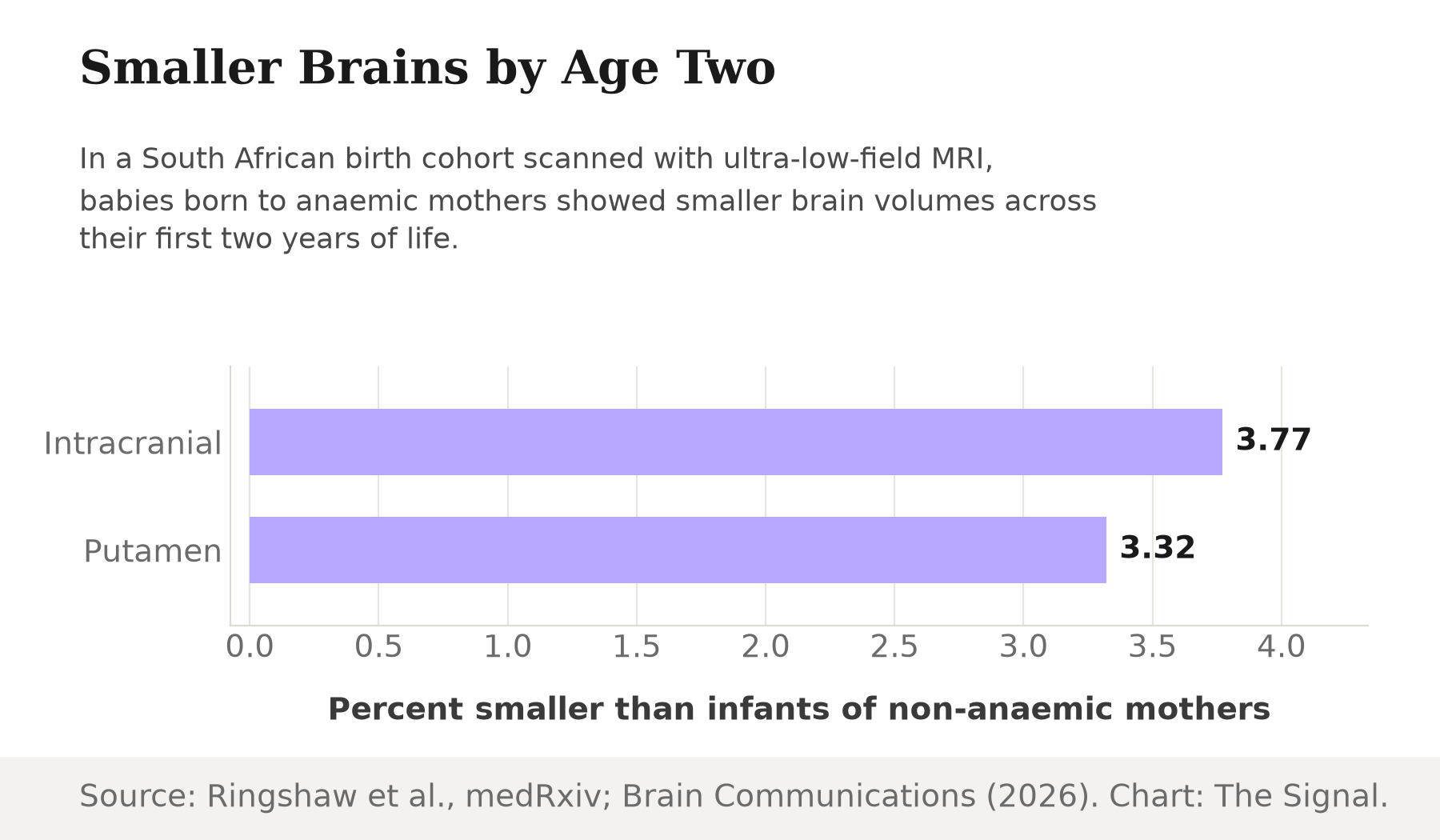
Today, in the peer-reviewed journal Brain Communications, the University of Cape Town's news office reports the publication of a PhD study on antenatal maternal anaemia and infant brain structure, the culmination of several years of neuroimaging work on a South African birth cohort. The underlying result is specific and easy to state. A study posted on medRxiv, whose peer-reviewed version is the one out today, reports that in an ultra-low-field MRI subsample, infants born to anaemic mothers had 3.77% smaller intracranial volume and 3.32% smaller putamen volume across their first two years of life, with the gap first detectable around 12 months. Read that plainly: a structural difference in the brain, measurable on a scan, tracks whether a baby's mother was anaemic during pregnancy.
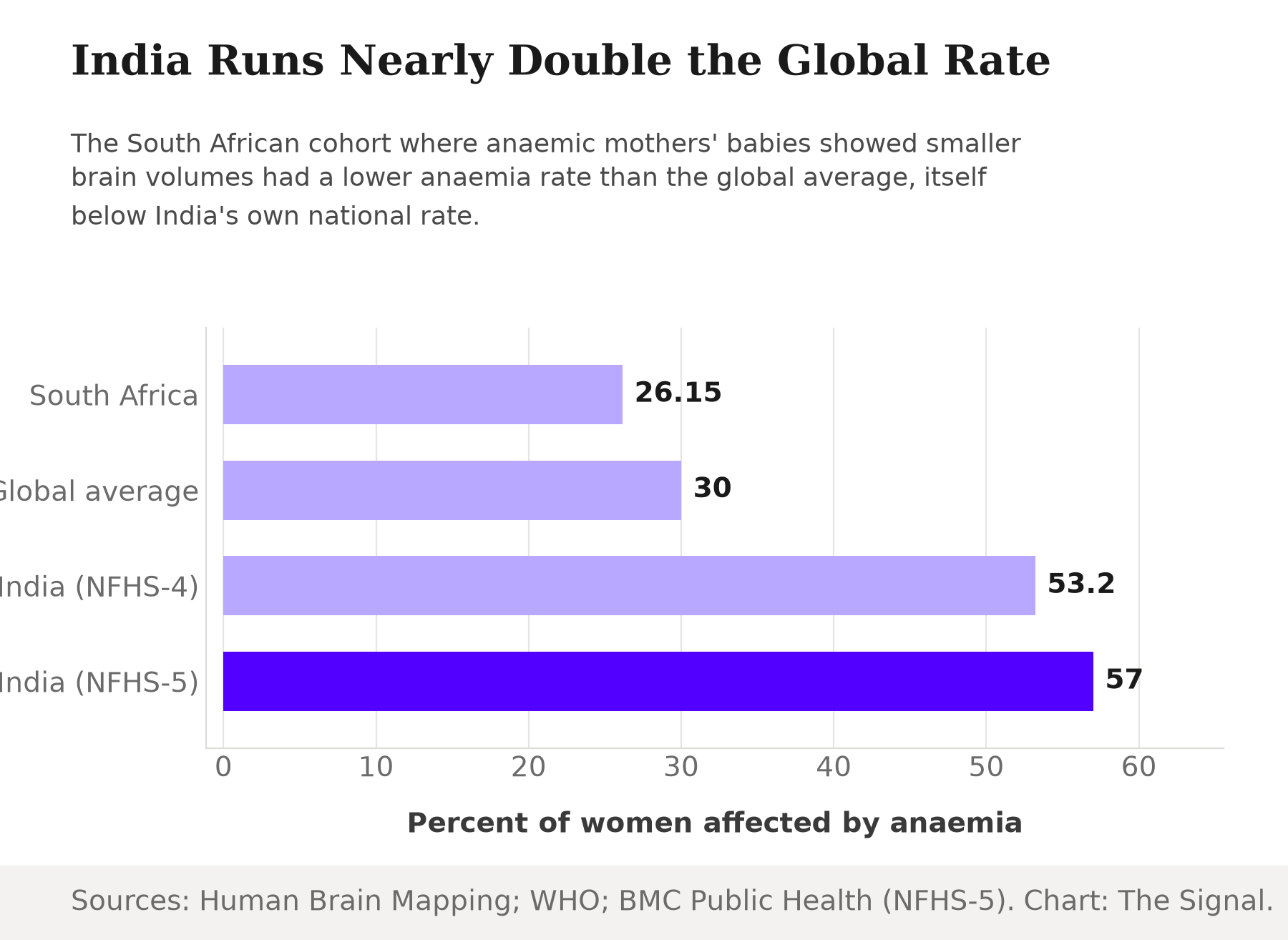
It is worth slowing down on exactly where this was measured. The finding comes from South Africa, not India. In that same birth cohort, only 26.15% of the mothers with hemoglobin data were anaemic during pregnancy, a rate researchers there treat as unremarkable enough to report almost in passing. There is no equivalent brain-imaging study of Indian mothers and infants in this evidence base. But the exposure this cohort is measuring against, maternal anaemia during pregnancy, is one India carries at a scale this study never had to contend with.
The number that carries the thesis is the gap between 26 and 57.
India's most recent national health survey put anaemia among women aged 15 to 49 at 57%, up from 53.2% in the prior round, a rise from NFHS-4 in 2015-16 to NFHS-5 in 2019-21. That is not just higher than the South African study cohort. It runs nearly double the 30% global average for non-pregnant women that the World Health Organization recorded in 2019. A biological effect detectable at roughly a quarter of mothers exposed is not a number that quietly disappears when the exposure rate more than doubles. It is a reason to take the finding seriously well beyond the country where it was measured.
Not a one-time snapshot
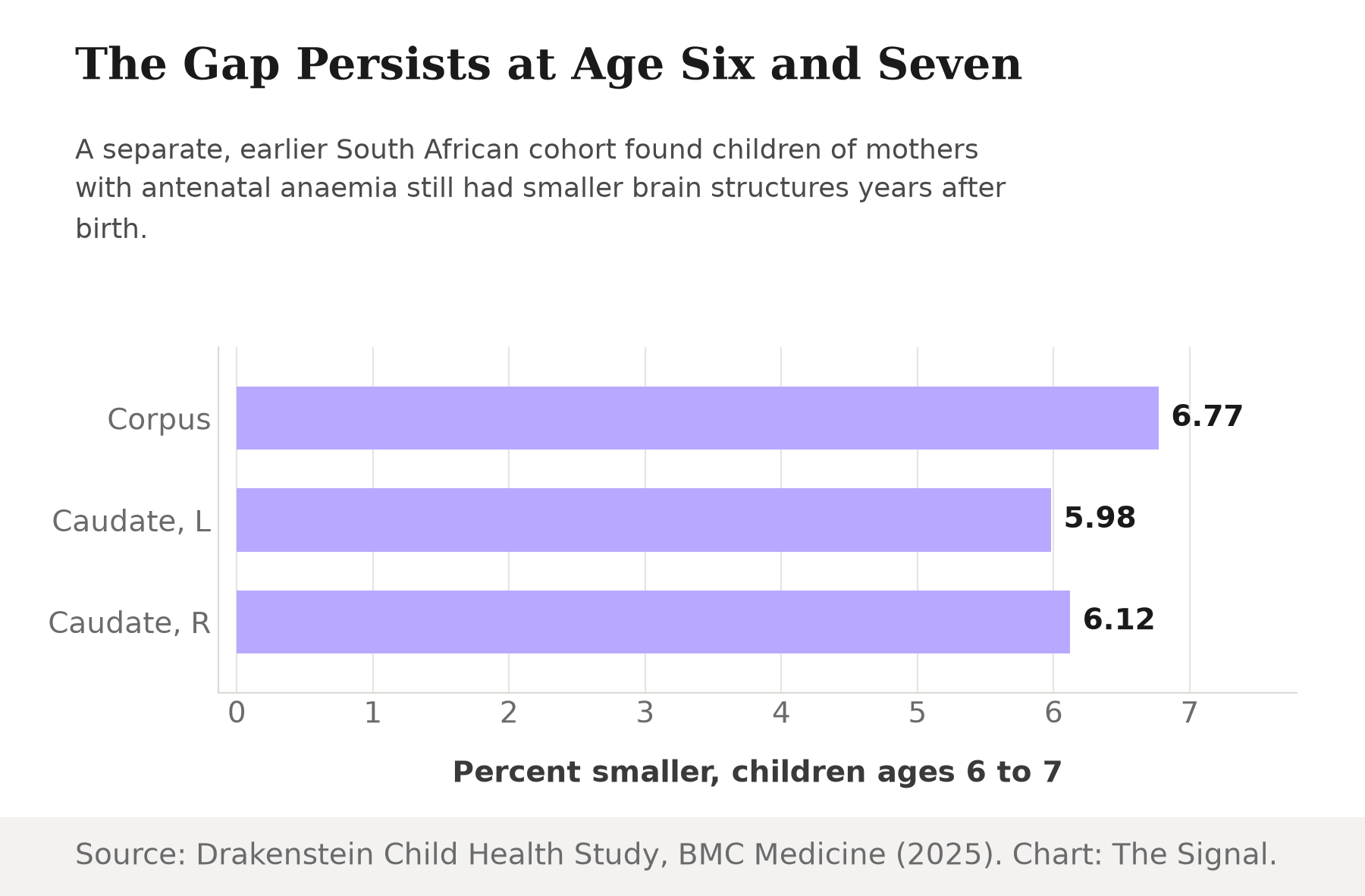
The infancy finding could, in principle, be a transient artefact of early brain growth that closes with time. A separate, earlier South African cohort suggests otherwise. In the Drakenstein Child Health Study, children whose mothers had antenatal anaemia had 6.77% smaller total corpus callosum volumes by ages 6 and 7, along with 5.98% smaller left caudate nucleus volumes and 6.12% smaller right caudate nucleus volumes, all reported as adjusted percentage differences. This is a different cohort from the one published today, but it answers the obvious follow-up question: does a structural gap measured in infancy still show up years later, closer to school age. It does, and the gap is larger, not smaller.
More coverage, same direction
India's own response to anaemia has not been passive. Under the government's Anemia Mukt Bharat programme, iron and folic acid supplementation coverage among pregnant women rose from 77.7% in 2017-18 to 90.3% in 2019-20. That is a real gain in program delivery. It did not show up in the outcome the program exists to move.
Coverage went up. Anaemia prevalence went up with it.
| Indicator | Earlier round | Later round |
|---|---|---|
| Anaemia among women 15-49, NFHS survey | 53.2% (NFHS-4, 2015-16) | 57% (NFHS-5, 2019-21) |
| Iron-folic acid coverage, pregnant women, Anemia Mukt Bharat | 77.7% (2017-18) | 90.3% (2019-20) |
Sources: NFHS-4/NFHS-5 analysis, BMC Public Health; evaluation of Anemia Mukt Bharat programme data. The Signal's compilation.
This is not only an Indian pattern. A study in the Bulletin of the World Health Organization projects India's anaemia prevalence among women of reproductive age at 50.3% in 2025 and places India among 15 high-burden countries, none of which is on track to meet the global nutrition target of halving anaemia prevalence in women by 2025 from a 2012 baseline. That 50.3% figure is a model-based projection, not a household survey result like NFHS-5's 57%, and the two should not be read as measuring the identical thing at the identical moment. But they agree on the direction that matters: whichever way it is measured, India is not closing this gap, and neither is anyone else near the top of the list.
The workforce clock
The reason this lands harder on India than the arithmetic alone suggests is timing. India's working-age population, ages 15 to 64, is projected to grow by 8 percentage points as a share of the total population between 2001 and 2036, after which that share starts shrinking, with the overall dependency ratio beginning to rise after 2041. A child born this year turns 15 in 2041, the same year that dependency math starts working against the country rather than for it. The cohort of newborns being born into India's current anaemia exposure is, on this projection, the cohort that has to carry the narrowing window, not the one that gets to wait it out.
The honest objection
The strongest case against reading too much into this is that none of the underlying research was done on Indian mothers or infants, and none of it is a randomised trial. These are observational cohort studies in a different country, where anaemia sits alongside other forms of maternal undernutrition, infection burden and socioeconomic disadvantage that also independently shape a child's brain development. Isolating iron deficiency specifically, as opposed to the broader package of deprivation anaemia often travels with, is exactly the kind of claim a single cohort cannot settle.
That case is real, and it is why the childhood cohort study reports adjusted percentage differences rather than raw ones, an attempt to separate the anaemia signal from at least some of the confounders around it. It does not make the finding an Indian finding. It does mean the honest response to a result like this is not to wait for an Indian cohort to confirm it before treating maternal anaemia as more than a routine health statistic. India's exposure to the thing being studied is already established beyond dispute; the brain-structure consequence of that exposure, on the best evidence available today, is plausible enough that assuming it away would be the more reckless read.
The Signal
The study published today was never going to be about India. Its number and its cohort are both South African, and its authors are careful about what it does and does not show. What makes it worth an India-anchored reader's attention is a comparison the study itself never makes: the population where this effect appeared was less exposed to the risk factor than India is, by roughly half. India has spent years raising iron supplementation coverage without lowering the anaemia rate it was built to fix, and the newborns living through that gap now are the same cohort the country is counting on to carry its shrinking demographic window after 2041. The next test is not whether South Africa's finding replicates elsewhere. It is whether anyone runs the equivalent study here before that cohort is already grown.
Reporting basis: the peer-reviewed publication date and framing of the underlying PhD study are per the University of Cape Town's news office. The infancy brain-volume findings (intracranial and putamen volumes) are per the medRxiv-posted study whose peer-reviewed version published the same day in Brain Communications. The childhood brain-volume findings (corpus callosum and caudate nucleus, ages 6 and 7) are from a separate, earlier cohort, the Drakenstein Child Health Study, published in BMC Medicine, and should not be read as the same children as the infancy study. The South African cohort's own anaemia prevalence is from a Human Brain Mapping validation study of the Khula cohort. India's NFHS-4 and NFHS-5 anaemia figures are from a peer-reviewed analysis in BMC Public Health; the global comparison figure is from the World Health Organization's anaemia fact sheet; the 2025 projection and 15-country comparison are from a study in the Bulletin of the World Health Organization. Anemia Mukt Bharat supplementation coverage figures are from a peer-reviewed evaluation of the programme's monitoring data. The demographic projections are from a macro-simulation study in SN Social Sciences. The observation that a child born in 2026 turns 15 in 2041 is The Signal's own calculation from that study's projected dates.