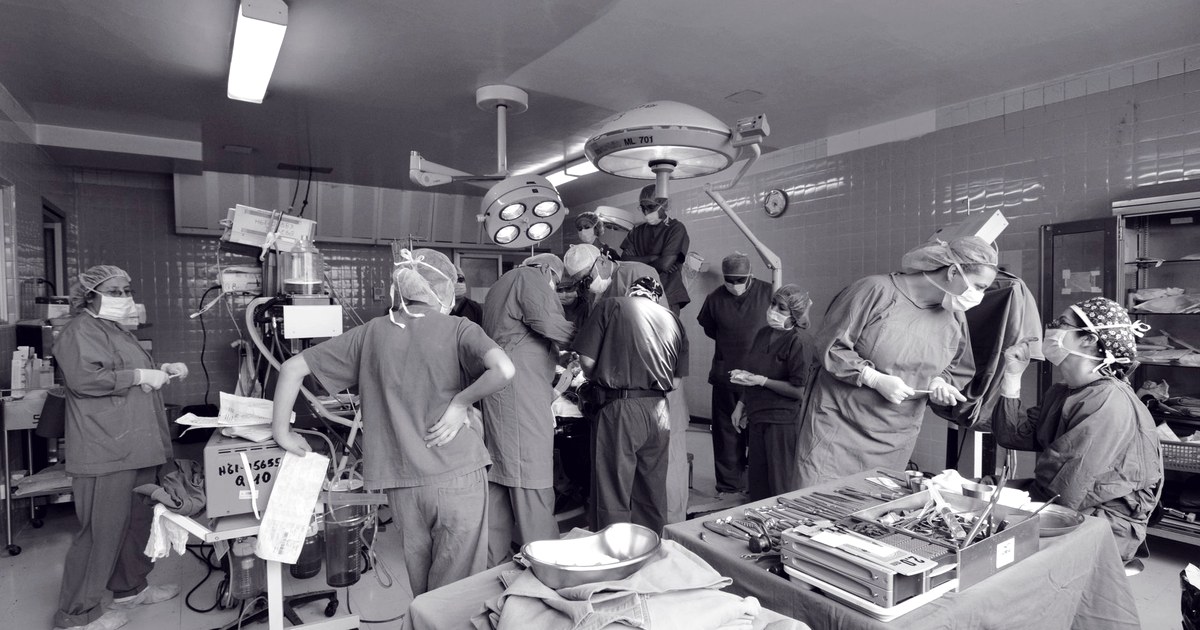
A study published in The Lancet this week reframed what a pig kidney can do for a human patient. Tim Andrews received a genetically edited pig kidney with 69 genomic modifications, and it kept him off dialysis for 271 days. When the pig kidney began to fail, it was removed, and he received a human kidney from a deceased donor: the first documented case of a xenotransplant patient bridging to a human transplant. Read quickly, the story is a science headline: a pig organ worked inside a person for the better part of a year. That framing is not wrong, but it undersells the more useful read, which is what the case shows about time, not tissue.
It is worth slowing down on that. The pig kidney did not replace Andrews' need for a human donor organ. It replaced dialysis for 271 days while he waited for one. That distinction, bridge versus substitute, is the whole story, and it counts for more in exactly the places where the wait for a human kidney is longest.
271 days is the number that carries the thesis.
That is how long a genetically modified pig kidney kept the patient alive and off dialysis before a human kidney became available, a bridge sequence never documented before this case.
Why the wait is the real bottleneck
Xenotransplant research exists because human kidneys are scarce relative to demand, not because surgeons lack the skill to transplant them. As of March 2024, when Massachusetts General Hospital performed the first pig-kidney xenotransplant, more than 100,000 people in the United States awaited an organ transplant, 17 people died each day while waiting, and more than 1,400 patients were on MGH's own kidney-transplant waiting list alone. Andrews' own wait was worse than average for a specific, unlucky reason: his O-group blood type meant that while most patients wait 3 to 5 years for a kidney, those with O-positive or O-negative blood types often wait 5 to 10 years.
| Wait for a US kidney transplant | Typical duration |
|---|---|
| Most patients | 3 to 5 years |
| O-positive or O-negative blood type | 5 to 10 years |
Source: Mass General Brigham.
A bridge organ that buys nine months is not a small thing against a wait measured in years. It is the difference between surviving to the front of the queue and not.
The first patient did not make it this far
The case for caution sits one patient earlier. Rick Slayman, the first-ever recipient of a pig-kidney xenotransplant in March 2024, survived only about two months before dying of what his hospital described as sudden cardiac causes unrelated to the transplant. Andrews is the first patient to get far enough for the pig kidney to do its intended job: hold the line until a human organ arrived. Two years and several patients separate "first to receive one" from "first to be bridged by one," and that gap is a reminder that xenotransplantation is still a small, closely watched experiment, not a therapy with a track record.
Where the bridge would matter most
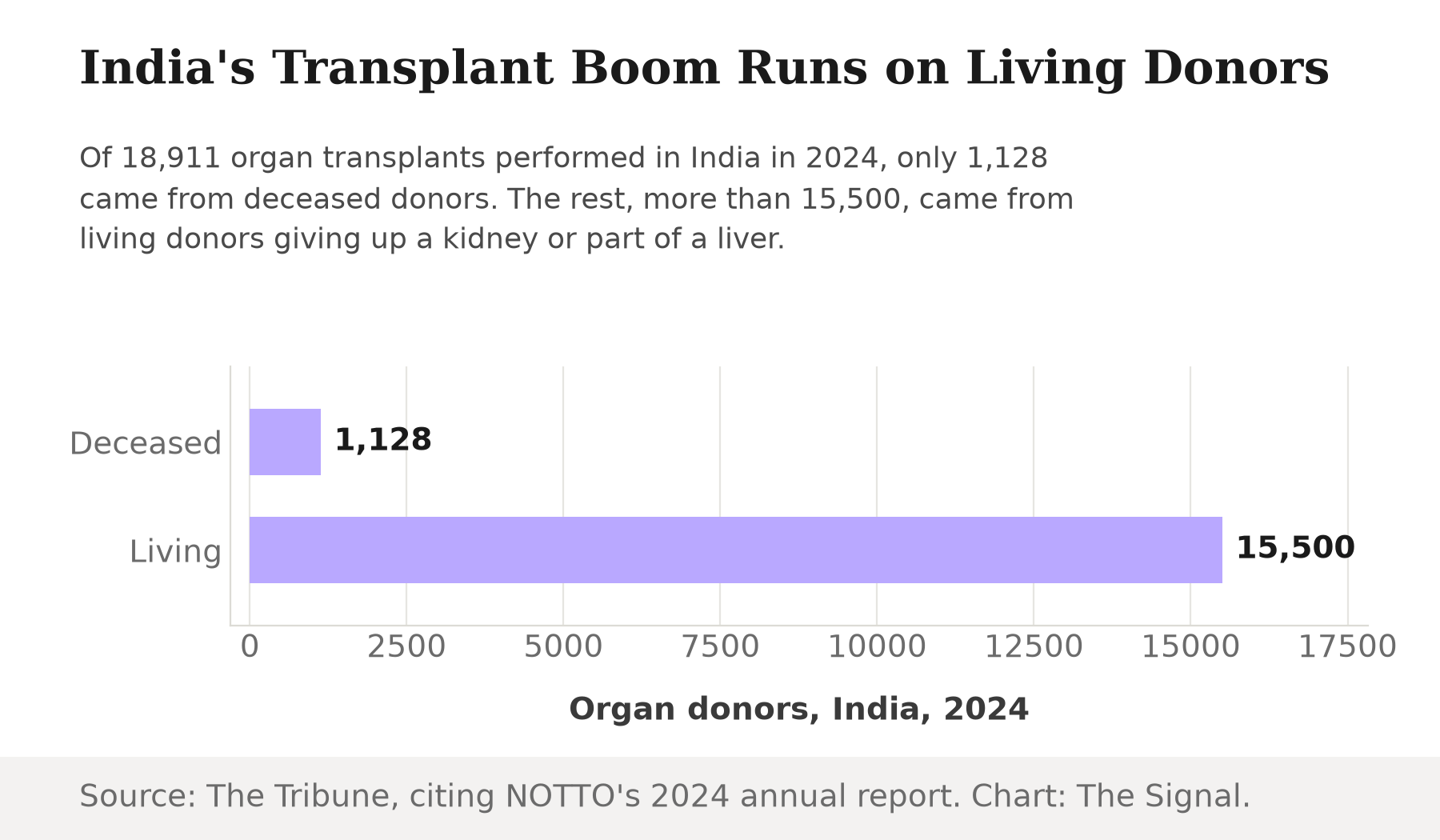
Source: The Tribune, citing NOTTO's 2024 annual report. Chart: The Signal.
India is the sharpest test of what a dialysis-free bridge would be worth, because India's transplant system has scale but not deceased donors. India performed more than 18,900 organ transplants in 2024, the highest ever recorded in a single year and a jump from fewer than 5,000 transplants in 2013, ranking India third globally in total organ transplants behind only the United States and China. That is not a capacity problem. Of India's 18,911 organ transplants in 2024, only 1,128 came from deceased donors versus more than 15,500 from living donors, putting India's deceased-donor rate at under 1 per million population, far behind Spain, the world leader at 48 per million. India has built the hospitals, trained the surgeons, and scaled the volume nearly fourfold in a decade. What it has not built is a deceased-donor pipeline, so almost every kidney or liver transplant depends on a living relative giving one up.
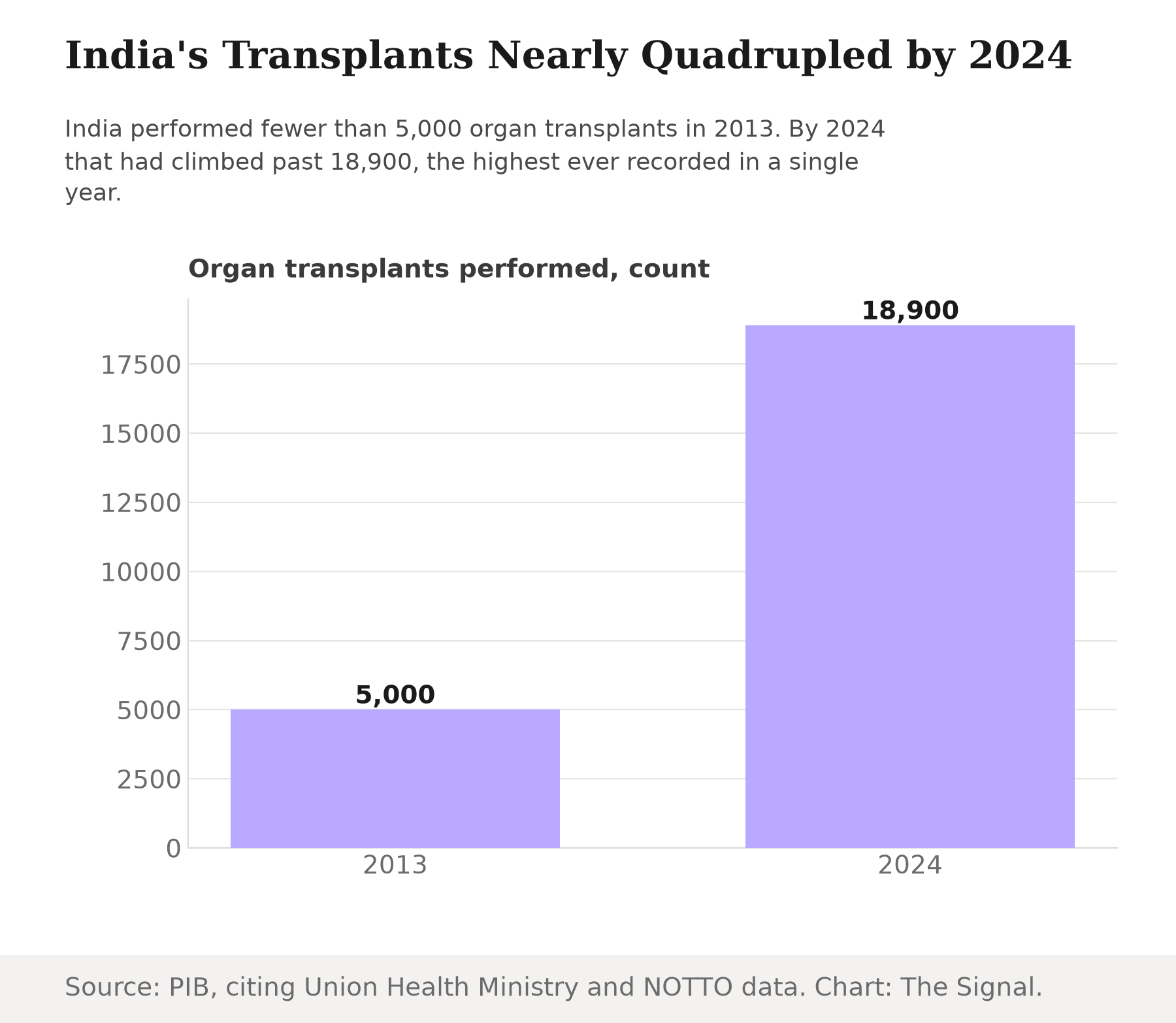
Source: Press Information Bureau, reporting Union Health Minister J.P. Nadda's remarks. Chart: The Signal.
That gap has a body count. As of 27 July 2026, 73,646 patients were on India's national kidney-transplant waiting list, and more than 200 people died in India in 2025 while waiting for a kidney transplant, with Delhi alone recording 132 of those deaths, the government told the Lok Sabha. Every one of those 73,646 people is waiting on the same scarce input as Andrews was: a deceased-donor organ, or a living relative willing and able to donate one. A xenotransplant bridge does not add a single deceased donor to that system. What it could do is keep a patient alive and off dialysis long enough to still be waiting when one becomes available, which in a system this donor-starved is not a minor benefit.
The honest objection
The strongest case against reading too much into this is that one bridged patient is not a treatment protocol. Rick Slayman's death two months after his transplant, and the fact that Andrews' own pig kidney began failing at 271 days rather than lasting indefinitely, both show that these organs are not yet durable enough to be an alternative to a human kidney, only a temporary stand-in. The genomic editing, post-transplant monitoring, and immunosuppression involved are resource-intensive in a way that has only been proven at a handful of elite US transplant centers, and nothing here shows the approach can be replicated at the scale India's waitlist would require. India's own track record with pig-organ transplants underscores the gap: the only one ever attempted was an unauthorized 1997 procedure in which a surgeon transplanted a pig heart into a patient in Assam, a case that ended in the patient's death and the surgeon's arrest for violating India's organ-transplant law, not a supervised research program of the kind behind Andrews' bridge.
That case is real, and it is why nobody credible is calling this a fix for the donor shortage today. But it answers a different question than the one this case actually settles. The question was never whether a pig kidney can permanently replace a human one; the data does not yet support that claim. The question was whether a xenotransplant can reliably hand a patient back to the human-donor queue instead of losing them before their turn comes. On that narrower, more useful question, Andrews is a data point that says yes.
The Signal
The consensus read on pig-organ transplants has always been "replacement, eventually." The Andrews case argues for a nearer-term, less glamorous role: bridge, now, for the specific patients whose real enemy is time rather than surgical risk. That role matters less in a system like the United States', where average waits, while long, are measured against a functioning deceased-donor pipeline. It matters far more in a system like India's, where the waitlist is large, the surgical capacity exists, and the deceased-donor supply that would actually clear it does not. Watch what comes next: not whether more pig kidneys get transplanted, but whether any of them are transplanted specifically to buy time in a donor-starved queue rather than at an elite research hospital with resources to spare. That is the test of whether this becomes a tool for the shortage, or stays a proof of concept for the few patients wealthy enough to reach it.
Reporting basis: the Tim Andrews case details are per Euronews' report on the Lancet-published Mass General Brigham case report. The US national waitlist figures and the March 2024 xenotransplant context are from Mass General Brigham's newsroom, as is the blood-type wait-time data from its report on the second xenotransplant procedure. Rick Slayman's outcome is as reported by Pharmaceutical Technology. India's 2024 transplant total and its rank among countries are from the Press Information Bureau, reporting the Union Health Minister's remarks; the deceased-versus-living donor split is from The Tribune, citing NOTTO's 2024 annual report. The current national kidney waitlist and 2025 waiting-list deaths are from Free Press Journal's report of a Lok Sabha reply by the Minister of State for Health and Family Welfare. India's own xenotransplant history is per the International Xenotransplantation Association's position paper in the journal Xenotransplantation. No figure in this piece is The Signal's own calculation.