
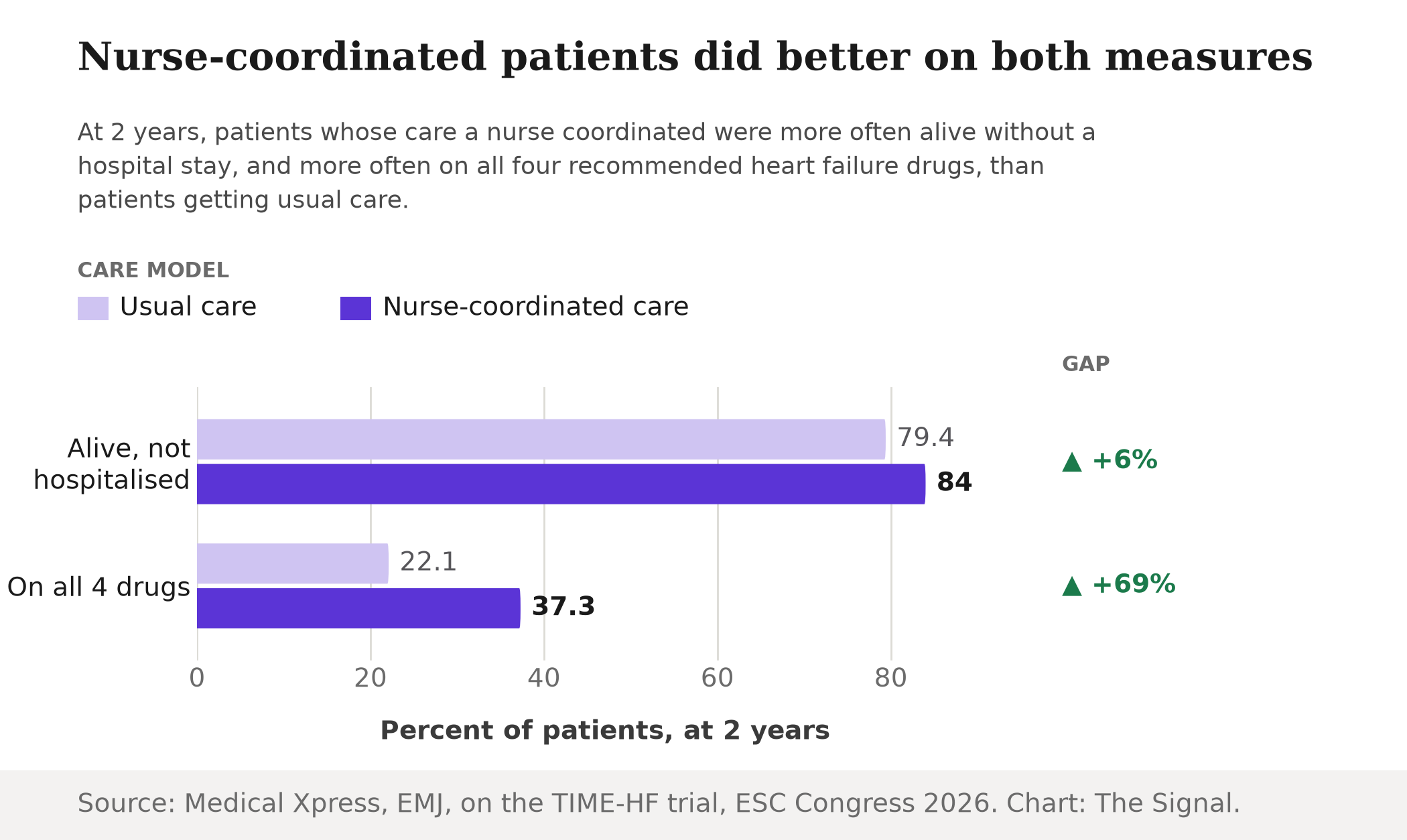
On August 31, investigators presented the results of the TIME-HF trial at the European Society of Cardiology's Congress, testing a model of heart failure follow-up built around a different kind of authority. More than 1,500 adults with weakened heart pumps were enrolled across 22 hospital units in India, coordinated by the Sree Chitra Tirunal Institute for Medical Sciences and Technology in Thiruvananthapuram, Kerala, and randomly assigned either to a nurse-coordinated collaborative care programme or to usual care. At two years, patients under nurse-coordinated care were more likely to be alive without a hospital stay, 84.0 percent against 79.4 percent for usual care. Read only that number, and the finding looks like a modest gain in one secondary marker of care quality.
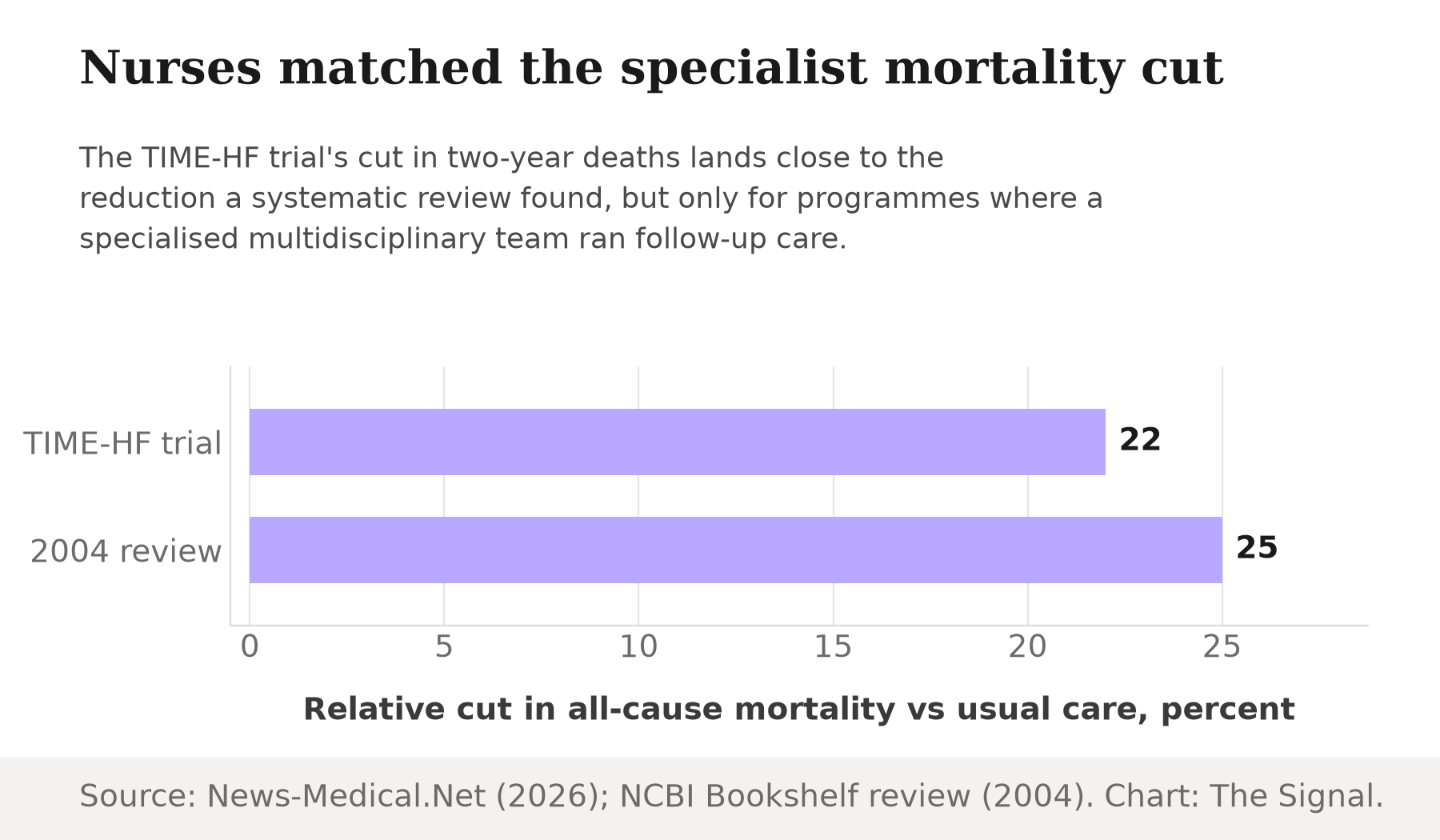
It is worth slowing down on that framing. Look at the primary endpoint and the difference is not modest: all-cause deaths at two years fell 22 percent in the nurse-coordinated arm compared with usual care.
Nurse-coordinated care cut two-year deaths by 22 percent.
How coordination changed what patients actually took
The trial did not give the nurse-coordinated arm a new drug. It gave them a different follow-up system, and the effect shows up in prescribing, not just survival. Use of all four guideline-recommended heart failure drugs at two years rose to 37.3 percent in the nurse-coordinated arm, against 22.1 percent under usual care.
Source: Medical Xpress; European Medical Journal. Chart: The Signal.
A nurse tracking a patient's file is not, on its own, a treatment. What it does is close the gap between what a cardiology guideline recommends and what a patient is actually taking after diagnosis: under usual care, close to four in five patients were still missing at least one of the four recommended drugs at two years.
Matching a benchmark set by specialist teams
That 22 percent is not a number invented for this trial. A systematic review of randomised heart failure trials found that follow-up programmes staffed by a specialised multidisciplinary team cut all-cause mortality by a relative 25 percent, an effect the review explicitly did not find in less-specialised disease-management programmes.
Source: News-Medical.Net; NCBI Bookshelf, DARE systematic review. Chart: The Signal.
A single trial from 2026 and a pooled review published in 2004 are not the same kind of evidence, and the review's programmes were not defined by whether a nurse or a doctor held the coordinating role. But the two figures land close enough that what seems to matter is the existence of structured, specialised follow-up, not the professional degree of the person running it.
The shortage this is a workaround for
India had only about 5,500 cardiologists nationwide as of 2021, roughly one for every 30,000 people. Nurses are scarce too, but nowhere near that scarce: a 2023 review put India's active health workforce density at just 5.0 doctors and 6.0 nurses and midwives per 10,000 population, both far short of the WHO's threshold of 44.5 combined doctors, nurses and midwives per 10,000, which still works out to roughly one active nurse or midwife per 1,700 people, about 18 times more plentiful than a cardiologist. A follow-up model that does not require a cardiologist to administer it scales very differently in a country with that ratio than in a health system with specialists to spare. TIME-HF is a test of whether the piece of specialist-team care that actually drives the mortality benefit (structured, protocol-driven follow-up) can be delivered by a workforce India already has in far greater supply.
What fewer hospitalisations are worth to a household
The clinical benefit has a financial shadow. Hospitalisation for heart disease carried a mean out-of-pocket cost of ₹40,947 to Indian households, and pushed 60 percent of affected households into catastrophic health expenditure, in the most recent nationally representative hospitalisation survey, fielded in 2014. Against that backdrop, the trial's gap in hospitalisation-free survival, 84.0 percent versus 79.4 percent, is not only a clinical statistic. Every admission avoided is a household that keeps more of that ₹40,947, in a country where six in ten heart disease hospitalisations already tip a family into catastrophic spending.
The honest objection
The strongest case against reading TIME-HF as a scalable fix is that the trial itself depended on a rare thing. SCTIMST is one of India's few institutes with the research infrastructure, protocol discipline and academic oversight to train and supervise coordinating nurses across 22 hospital units at once. Even inside the arm that worked, only 37.3 percent of patients ended up on all four guideline-recommended drugs at two years, which means most patients in the better-performing arm still did not receive complete guideline-directed therapy. A protocol run under a strong coordinating center's supervision is not automatically the same protocol run by an unsupported nurse in a district hospital with none of that scaffolding.
That case is real, and it is the right place to be skeptical. But it is an argument about implementation, not about the mechanism. It says the hard part of scaling TIME-HF is building the supervisory infrastructure elsewhere, not that nurse-coordinated follow-up itself failed to work.
The Signal
TIME-HF is not proof that any nurse can replace any cardiologist. It is evidence that when a health system fixes the follow-up problem (someone tracking a patient, escalating care and checking whether the guideline-recommended drugs are actually being taken), the resulting mortality benefit resembles what dedicated specialist teams have already shown, using a workforce India has in far greater supply than cardiologists. Watch two things next: whether this coordinating-nurse model gets written into national heart failure treatment protocols, and whether the next attempt to replicate it happens outside a hospital with SCTIMST's resources behind it. A result that only reproduces where the infrastructure to run it already exists is not yet a fix for the shortage it was built to test.
Reporting basis: the TIME-HF trial's design, patient count and coordinating institution are from the trial's published design and rationale paper, hosted on PubMed Central. Its results, presented in an ESC Congress 2026 Hot Line session and published simultaneously in Circulation, are reported here via three outlets that each covered the same presentation, Medical Xpress, News-Medical.Net and the European Medical Journal, with each figure cited to the specific outlet that reported it since none of the three is the primary trial publication. India's cardiologist count is from a European Heart Journal article on cardiology practice in India. India's active nurse and doctor workforce density is from a 2023 review article in the peer-reviewed journal Cureus, hosted on PubMed Central. The specialised-team mortality benchmark rests on a single 2004 systematic review hosted on NCBI Bookshelf. The out-of-pocket hospitalisation cost and catastrophic-expenditure share are from a PLOS ONE analysis of the National Sample Survey Organisation's 2014 hospitalisation data. The hospitalisation-free survival gap, the household cost comparison, and the roughly-1-in-1,700 nurse ratio and 18-times comparison are The Signal's calculations from those figures.