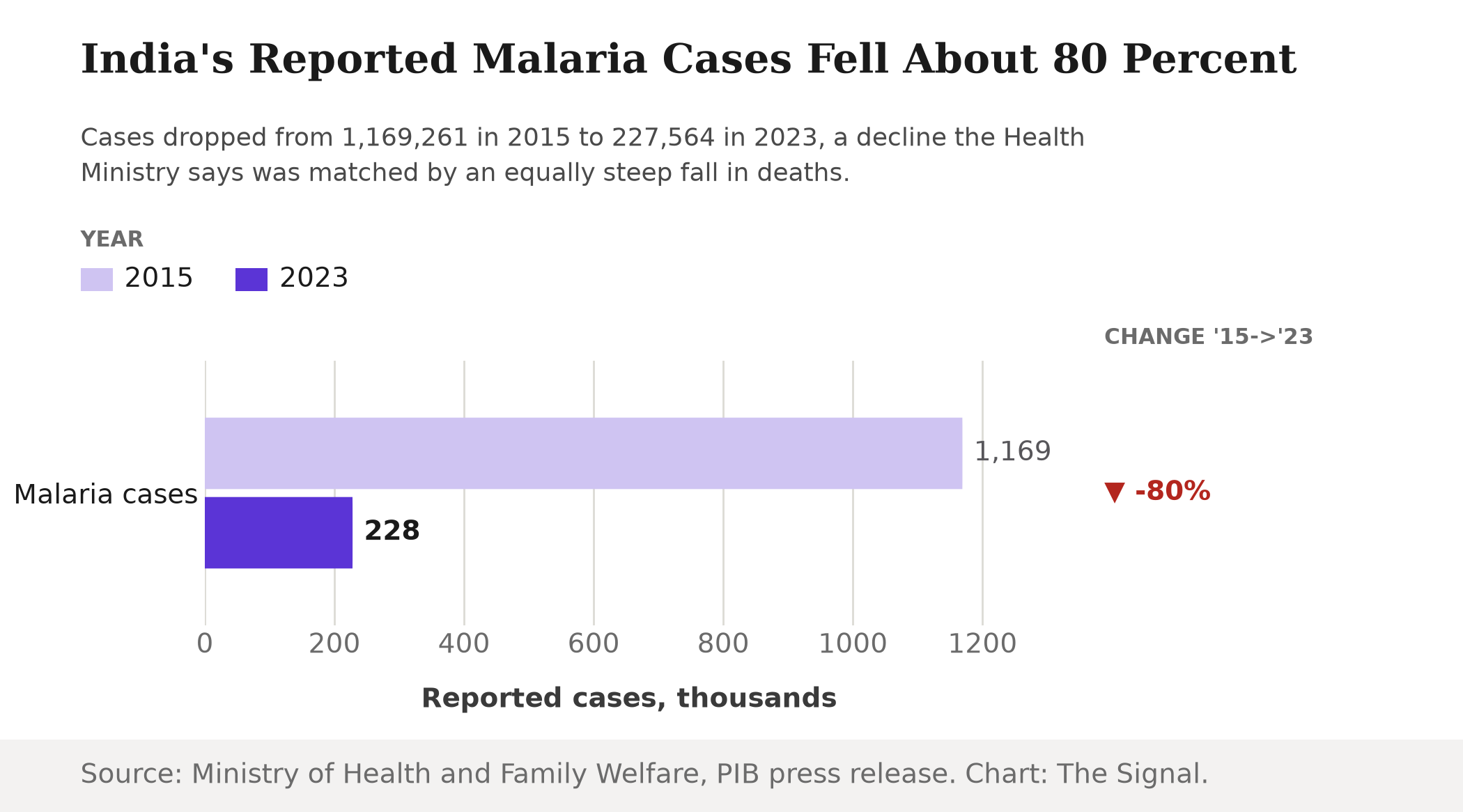
On August 28, 2026, India's Union Health Ministry reviewed the country's progress toward eliminating malaria, and the numbers read like an unambiguous win. Malaria cases and deaths fell by nearly 80 percent between 2015 and 2025, while the number of high-burden districts fell from 155 to 33, and 160 districts logged zero indigenous cases from 2022 through 2025. India's official target is zero indigenous cases by 2027 and full elimination by 2030. Read only the topline, and the fight looks close to won.
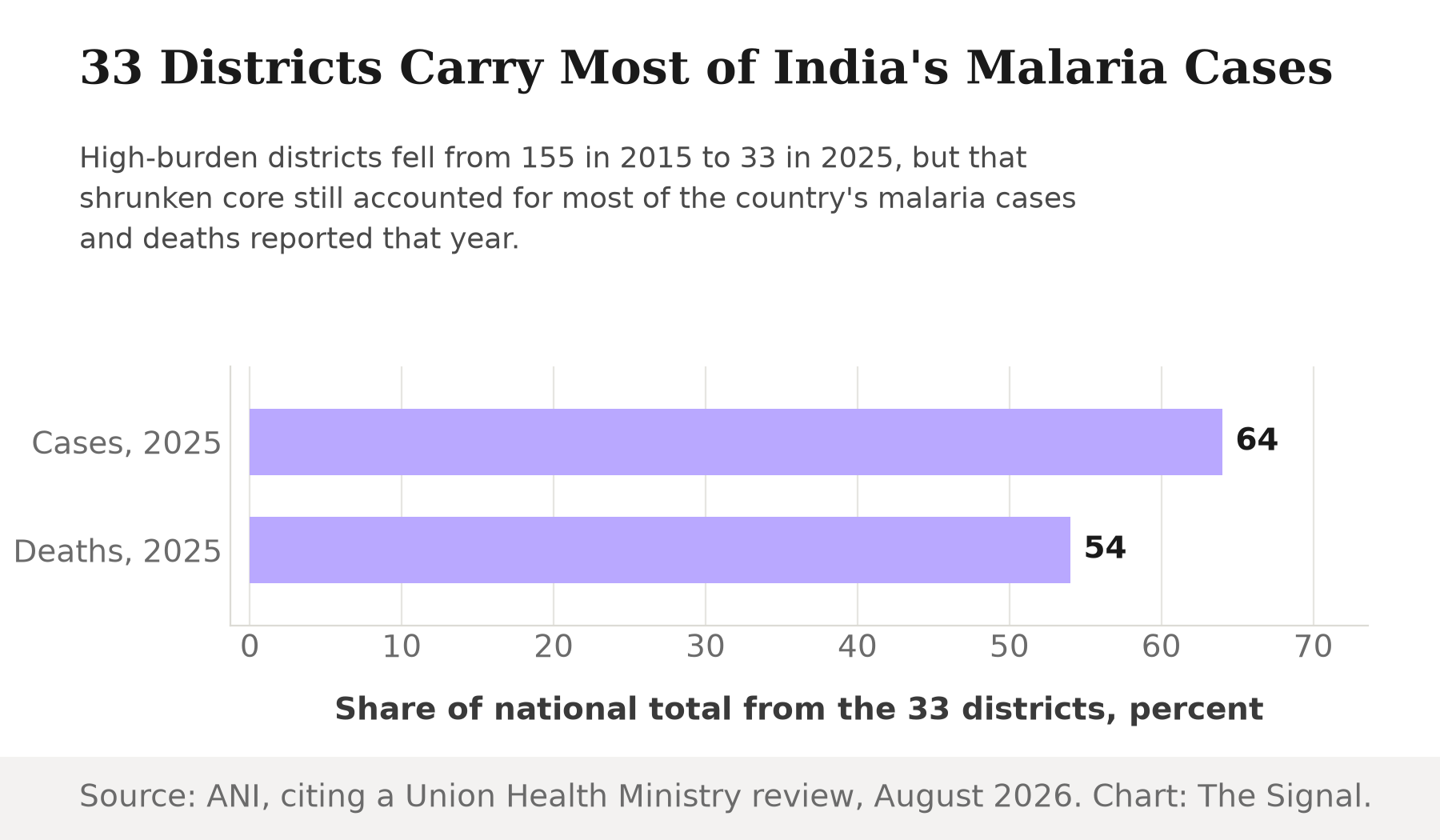
It is worth slowing down on that. The same review that celebrated an 80 percent decline also singled out a shrinking core of districts still fighting the disease. Cutting the high-burden list from 155 in 2015 to 33 in 2025 works out to a roughly 79 percent reduction in the number of districts still classified as hardest hit. But those 33 districts, barely a fifth of the original list, still accounted for 64 percent of India's malaria cases and 54 percent of its deaths in 2025. The country did not shrink its malaria problem by 80 percent. It concentrated most of what is left into a smaller and smaller map.
The last mile is the hardest to see
Part of why this stretch is dangerous is that India's own case count is a lower bound, not a full account. A peer-reviewed analysis in PLOS Global Public Health found that India's surveillance system, measured against the World Health Organization's 2017 methodology, captured only about 8 percent of the country's total malaria caseload, with much of the private-sector burden going unreported. The gap shows up when two official counts for the same year are placed side by side: India's health ministry reported 227,564 cases in 2023, while the WHO's own modeled estimate for that same year, published in its World Malaria Report 2024, put the figure at around 2 million, roughly nine times higher. A nine-fold gap between what is counted and what is estimated to exist means the last mile is hard to see clearly, not just hard to close.
The stakes extend past India's own borders. India accounted for 83 percent of estimated malaria cases and 82 percent of malaria deaths in the WHO's South-East Asia Region in 2020. What happens in India's last 33 districts effectively decides the region's numbers too.
India already lost this fight once
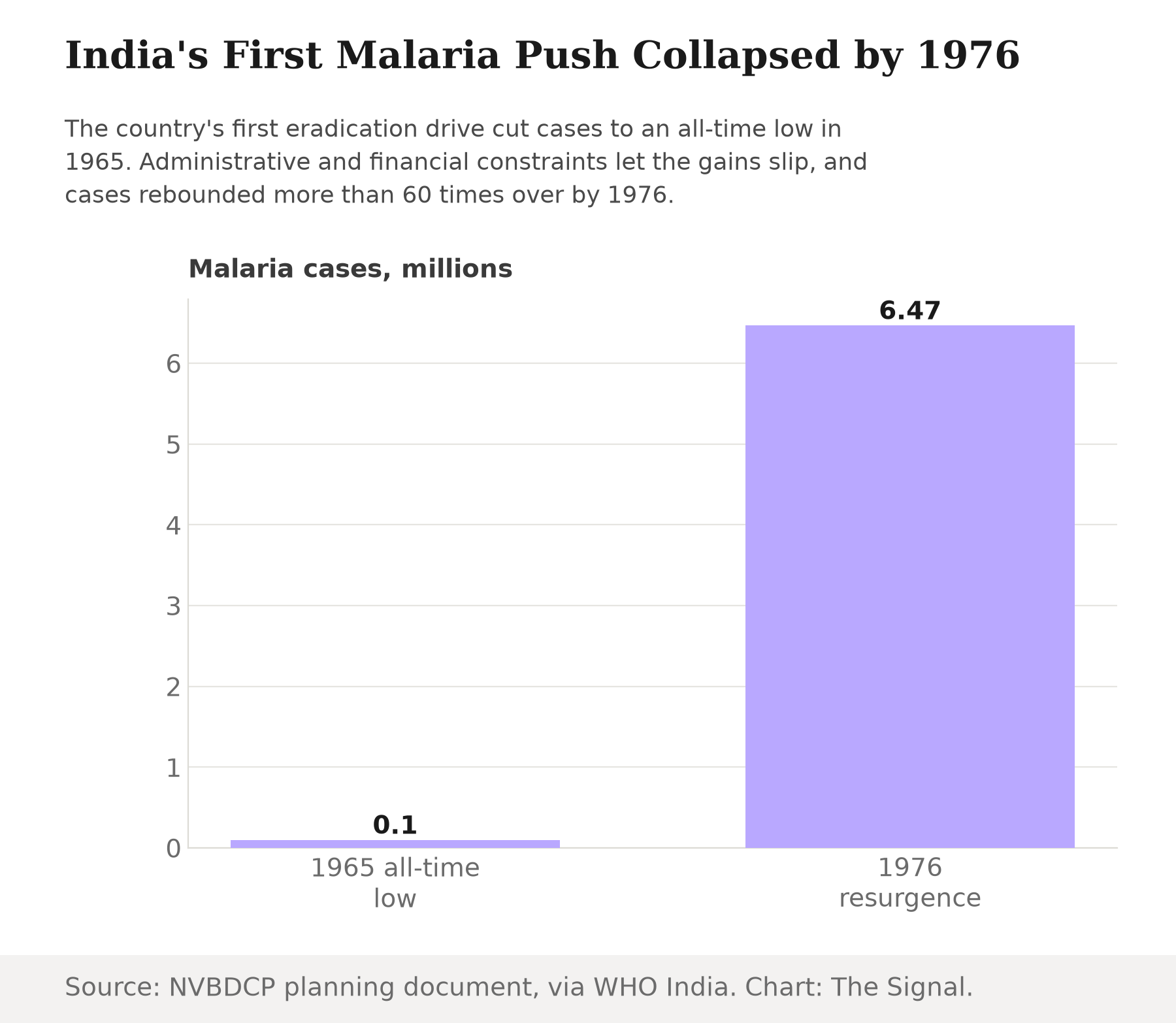
India has run this experiment before, and it did not end well. The country's first eradication drive cut annual malaria incidence to an all-time low of about 0.1 million cases by 1965, a level India would not approach again for decades. The National Vector Borne Disease Control Programme's own planning documents attribute what followed to technical, administrative and financial constraints that could not sustain the gains: by 1976, cases had rebounded to 6.47 million, more than 60 times the 1965 low. The 1965 collapse was not a failure to notice the disease was still present. It was a failure to keep funding and staff pointed at it once the headline number looked solved.
Sri Lanka's warning, and India's own
India is not the only country to have learned this the hard way. Sri Lanka, declared malaria-free in 2016, had itself neared elimination in the early 1960s before a resurgence of the disease between 1967 and 1969. Marking ten years of malaria-free status in 2026, the WHO's Sri Lanka office put it plainly: history has shown that success can be temporary if surveillance slips, and the risk of complacency is real even after nearing elimination.
Near-elimination has broken down before, in India and in Sri Lanka.
| Country | Near-elimination moment | What followed |
|---|---|---|
| India | Cases fell to an all-time low of about 0.1 million by 1965 | Technical, administrative and financial constraints let the gains slip; cases rebounded to 6.47 million by 1976 |
| Sri Lanka | Neared elimination in the early 1960s | A resurgence of malaria between 1967 and 1969, before the country eventually reached malaria-free status in 2016 |
Source: NVBDCP planning document, via WHO India; WHO Sri Lanka country office.
What sustaining the last mile costs
The last stretch of an elimination campaign is also the most expensive one to run, because active surveillance has to search out every remaining case across an entire district rather than treat a concentrated outbreak. The clearest early estimate of what that costs comes from 2018, when a study in the Indian Journal of Medical Research put the financial resources needed to run India's elimination programme at about 106 billion rupees over the 2017 to 2022 period, or more than 20 billion rupees a year. That funding window has already closed, so the figure is not what India spends today, though it does establish the order of magnitude the effort was judged to require. The newer number has not fallen: India's National Strategic Plan puts the requirement for 2026-27 alone at roughly ₹23 billion, a figure a Nature India analysis notes may need to rise further even as global donor funding for malaria has begun to decline and the financial burden increasingly falls on India itself. Eight years on and roughly 80 percent fewer cases later, the estimated yearly cost of running the programme has not shrunk. It has held roughly steady, which is exactly what a rising cost-per-case in the last mile would look like.
India's current programme at least names the problem specifically. The Intensified Malaria Elimination Project's third phase targets 159 high-burden districts, with a goal of zero indigenous cases by 2027 and full elimination by 2030. That figure comes from a different programme document than the August 2026 review's 33-district count and is not directly comparable to it, but both point the same way: fewer districts left, each one harder than the last.
The honest objection
The strongest case against reading any of this as a warning is that today's programme looks nothing like the one that collapsed in the 1970s. Zero indigenous cases for four straight years, 2022 through 2025, across 160 districts, is a sustained result, and a programme that names 159 specific high-burden districts with a 2027 target has more tracking built in than the 1960s campaign ever had. On that view, the 1965 comparison overstates the risk: this programme watches districts by name, not just the national aggregate.
That case is real, but it answers the wrong question. The 1965 programme did not fail because nobody was counting cases. The NVBDCP's own account blames technical, administrative and financial constraints for letting the gains slip once the numbers looked solved, and the WHO describes Sri Lanka's 1967 to 1969 resurgence in the same terms: not a monitoring blind spot, but attention and funding moving on once success seemed secured. Naming the last 33 or 159 districts does not protect them if the money and staff attached to that naming thin out the moment a review meeting reports an 80 percent decline as good news.
The Signal
The number worth tracking from here is not the national case count. That line was always going to keep falling as India worked through its easier districts first. It is whether the 33 districts the ministry itself flagged in August 2026, spread across nine states and union territories: Mizoram, Odisha, Tripura, Assam, Andhra Pradesh, the Andaman and Nicobar Islands, Chhattisgarh, Jharkhand and Maharashtra, keep shrinking as a share of the total, or whether they harden into a floor the way outbreaks did after 1965. The ministry has directed each of those states to run a District Action Plan in every one of the 33 districts, plus Village Action Plans in the villages with the highest incidence; whether that direction comes with money attached, in those nine states specifically, is the concrete version of the question below. A programme that can point to 160 districts at zero cases for four years running has more discipline than the one that collapsed in the 1970s. Whether it has more money, sustained at the last-mile rate rather than the easy-win rate, is the part no review meeting has yet answered. India has brought its malaria numbers down to something like this level exactly once before. It did not stay down.
Reporting basis: the 2015-2023 national case and death trend is from a Press Information Bureau release by India's Ministry of Health and Family Welfare, as is the description of the Intensified Malaria Elimination Project's third phase and its 2027 and 2030 targets, from a separate PIB release marking World Malaria Day 2025. The WHO's 2017-2023 estimates are as reported by News on Air, citing the WHO's World Malaria Report 2024. The account of India's 1965 low and 1976 resurgence is from a National Vector Borne Disease Control Programme planning document hosted by WHO India. The 2018 cost estimate for running the elimination programme is from a peer-reviewed analysis in the Indian Journal of Medical Research. The estimate that India's surveillance captures about 8 percent of the true caseload is from a peer-reviewed study in PLOS Global Public Health. India's share of malaria cases and deaths in the WHO South-East Asia Region is from a BMJ Global Health analysis citing the WHO's 2021 World Malaria Report. The 2015-2025 national case and death decline, the 2015-2025 district count, the 2025 concentration of cases and deaths in 33 districts, and the zero-case district count are as reported by ANI, citing a Union Health Ministry review meeting held in August 2026. The 2026-27 funding estimate and the note on declining global donor funding are from a Nature India analysis. The nine states and union territories holding the 33 high-burden districts, and the direction to implement District and Village Action Plans, are as reported by The Sunday Guardian on the same August 2026 review meeting. The gap between India's reported 2023 case count and the WHO's modeled estimate for the same year, the percentage reduction in high-burden district count, and the multiple by which cases rebounded between 1965 and 1976 are The Signal's calculations from those figures.