By the government's own accounting, India's health financing has been getting steadily fairer to patients. Out-of-pocket spending's share of the country's total health expenditure fell from 64.2% in 2013-14 to 39.4% in 2021-22, as the government's own share rose from 29% to 48% over the same period. Read only that line and the state has been quietly absorbing more of the national medical bill every year the accounts have been kept.
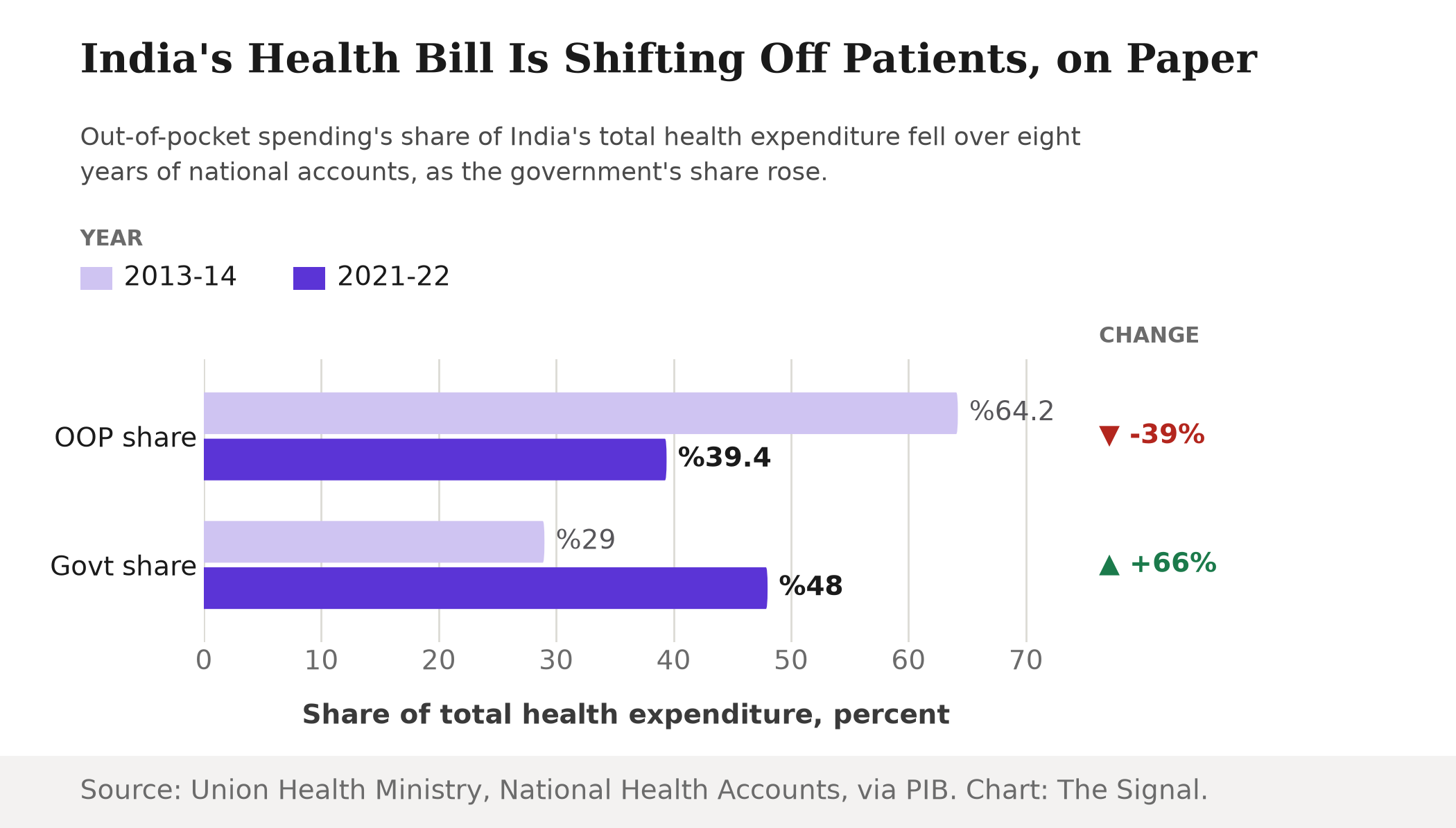
It is worth slowing down on that number. A national accounts share tells you how the total bill is split in aggregate. It says nothing about what happens to any one household mid-treatment. The most recent nationally representative survey to ask that exact question found the opposite trend: the share of Indian households whose out-of-pocket health spending exceeded a catastrophic threshold of their consumption rose from 10.94% in 2014 to 16.51% in 2018, the last year that survey covers. Both figures are real, for their own periods. But the survey that would tell us whether the household-level number kept rising after 2018, even as the aggregate share kept falling, has not been repeated since.
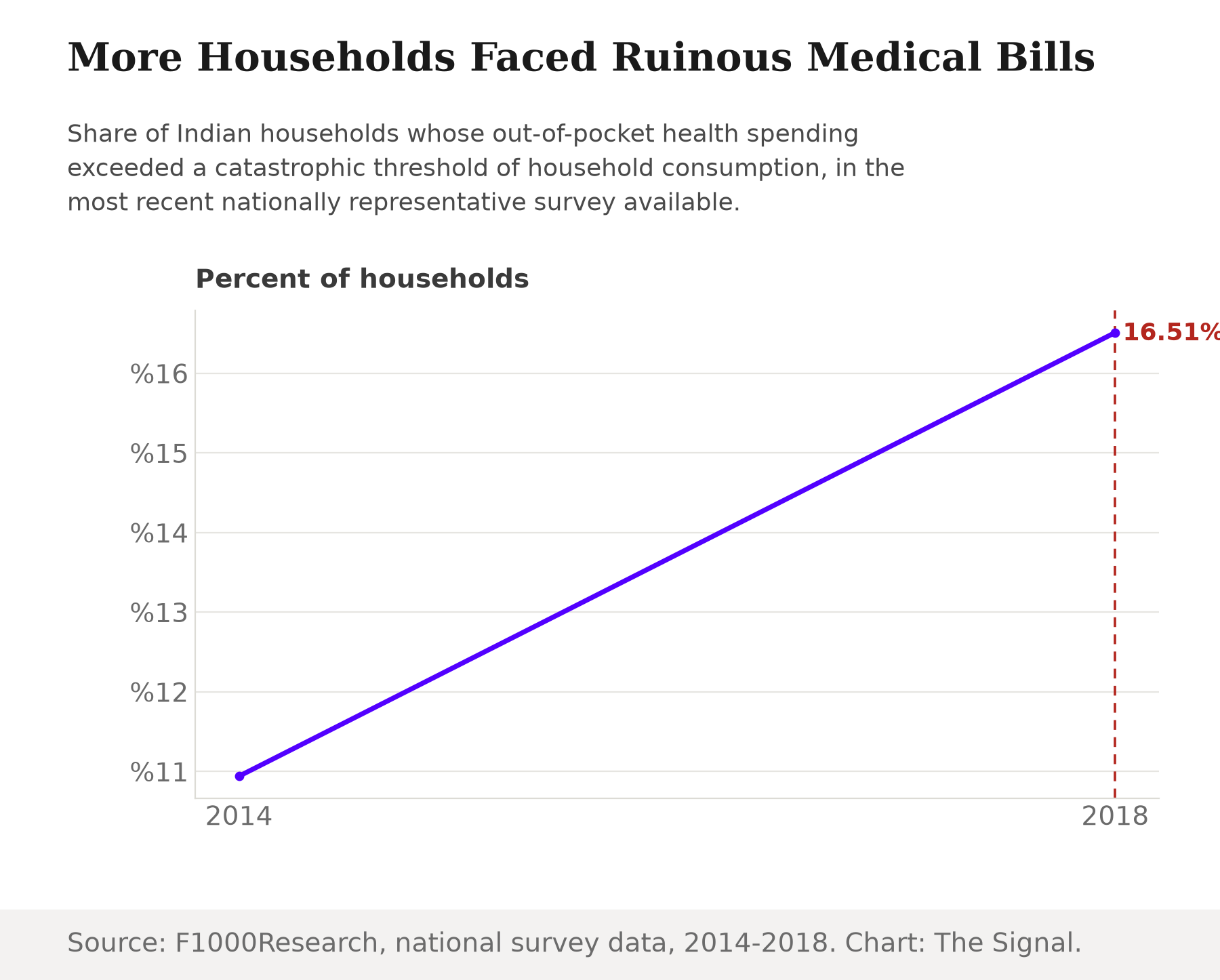
What a ruinous bill actually looks like
Antimicrobial resistance is where that gap between the aggregate and the household stops being an abstraction. A drug-resistant infection costs 45.7% more to treat in an Indian government hospital and keeps a patient admitted two extra days, per a BMJ Open cohort study run by the National AIDS Research Institute, Pune, across eight Indian tertiary-care government hospitals on patients treated through early 2019.
| Metric | Drug-resistant infection | Drug-susceptible infection |
|---|---|---|
| Median treatment cost | $199 | $109 |
| Median hospital stay | 14 days | 12 days |
Source: BMJ Open, National AIDS Research Institute cohort study across eight Indian tertiary-care government hospitals. Figures are the study's reported medians.
That cost gap is not an insurer's or a hospital's problem in India; it is the patient's. In the same cohort, 46.5% of patients had to borrow money to cover their hospitalisation, and 73.5% had no medical insurance of any kind. That is a patient drawn from roughly the midpoint of the national accounts' eight-year decline in out-of-pocket share, and for that patient, the aggregate improvement bought nothing at all: a longer stay, a bigger bill, and, more often than not, a loan to cover it.
The mechanism getting worse
The infections behind that bill are not a fixed, shrinking category. They are becoming more common, because the drugs meant to treat them are losing ground. Susceptibility of E. coli isolates to imipenem, a carbapenem antibiotic reserved for infections that do not respond to first-line drugs, fell from 81.4% in 2017 to 57.6% in 2024 in ICMR's national hospital surveillance network, the most recent year that network has reported.
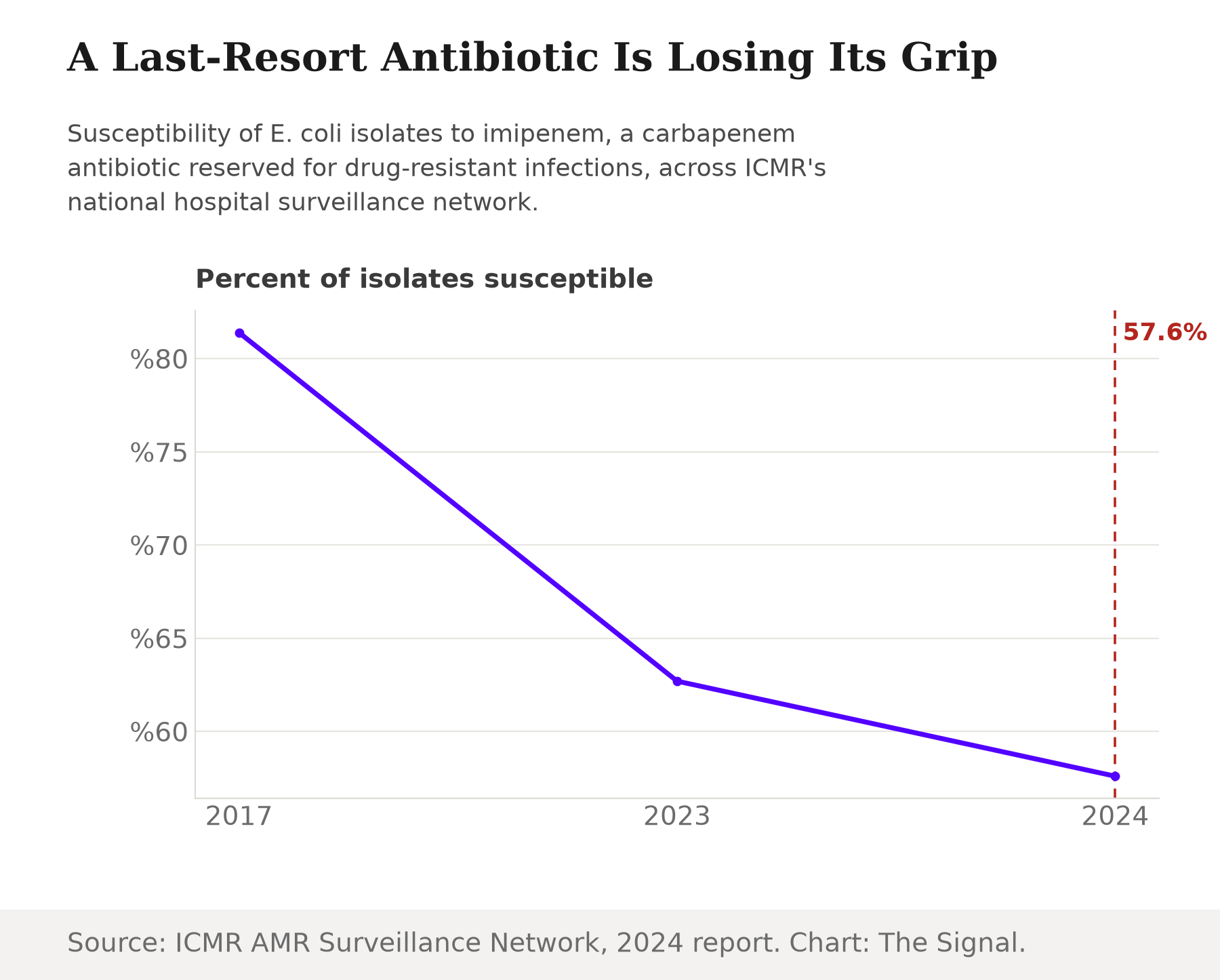
Each percentage point lost there is a percentage point of infections pushed out of the cheaper, shorter-stay bracket the BMJ Open cohort measured for drug-susceptible infections and into the costlier, longer one. The mechanism runs in one direction only: as resistance climbs, the $199-and-14-days case becomes the more common case, not the exception.
Coverage does not reach the patients who need it most
Insurance is the obvious backstop against a bill like that, and by one national measure it has been expanding. 41.2% of Indian households had at least one member covered by some form of health insurance, per an analysis of National Family Health Survey-5 data covering more than 608,000 households surveyed in 2019-21. That is already a minority of households. But it is a household-level figure, counting a family as covered if even one member has a policy; the BMJ Open cohort's 73.5% uninsured rate is a patient-level figure, drawn from patients treated through early 2019, inside that same 2019-21 window. The two are not directly comparable on a shared denominator, yet the direction is unmistakable: across that overlapping 2019-2021 stretch, the specific patients paying the resistant-infection premium were uninsured at a markedly higher rate than the 41.2% national household figure.
The stakes beyond the bill
The financial burden sits on top of a mortality toll. The GRAM project, published in The Lancet, estimated 389,000 deaths in South Asia in 2019 were directly attributable to bacterial antimicrobial resistance, and 1.39 million deaths were associated with it. A rising resistant-infection caseload is not only a bigger bill for the families who survive it. It is a larger share of a regional death toll already measured in hundreds of thousands.
The honest objection
The strongest case against reading this as a worsening crisis is that the national accounts data is simply newer and more comprehensive than the household-level data, and newer is not the same as wrong. The catastrophic-expenditure survey stops in 2018; the insurance figure is from 2019-21; the cost and borrowing figures from the resistant-infection cohort sit in the same window. The National Health Accounts estimates, by contrast, run through 2021-22, three years further on, and on their own terms they are a genuine, multi-year improvement funded by real increases in government health spending. It is entirely possible that catastrophic expenditure and insurance coverage have both improved since the last time either was measured, simply following the aggregate down.
That case would be more comforting if either number had actually been re-measured. Neither has. The honest position is not that the household-level burden is definitely still rising. It is that the only patients we have direct financial evidence for were treated in the very years the aggregate was said to be improving, and the national trend line does not explain that away. Among those patients, 46.5% borrowed money for hospitalisation and 73.5% carried no insurance.
The Signal
India's headline health-financing number is real, and so is the government's expanding share of it. But an aggregate share is an average, and averages hide the sharpest cases inside them. Antimicrobial resistance is precisely the mechanism that keeps widening that sharp end: a rarer, costlier, longer-staying case, falling on patients who are less insured than the national household figure and who, in the one dataset that followed them directly, borrowed money nearly half the time. Watch two things going forward: whether India runs a new nationally representative catastrophic-expenditure survey to replace the one that stops in 2018, and whether the imipenem susceptibility line in ICMR's own surveillance network finds a floor. Until both happen, the country's official financing story and the bill an actual resistant infection leaves behind are being measured on two different clocks.
Reporting basis: the resistant-versus-susceptible infection costs, hospital stays, and the borrowing and insurance rates among that patient cohort are from a BMJ Open study led by the National AIDS Research Institute, Pune, an ICMR institute, covering eight Indian tertiary-care government hospitals. The carbapenem susceptibility trend is from ICMR's Antimicrobial Resistance Surveillance Network's own 2024 annual report. The out-of-pocket and government expenditure shares are from the Union Health Ministry's National Health Accounts Estimates, released via the Press Information Bureau. The catastrophic health expenditure incidence is from a nationally representative survey study published in F1000Research. The household insurance coverage figure is from an analysis of National Family Health Survey-5 microdata published in Frontiers in Public Health. The South Asia mortality estimates are from the Lancet-published GRAM project, led by the University of Oxford and the Institute for Health Metrics and Evaluation. No figure in this piece is The Signal's own calculation; every number is as reported by its origin.