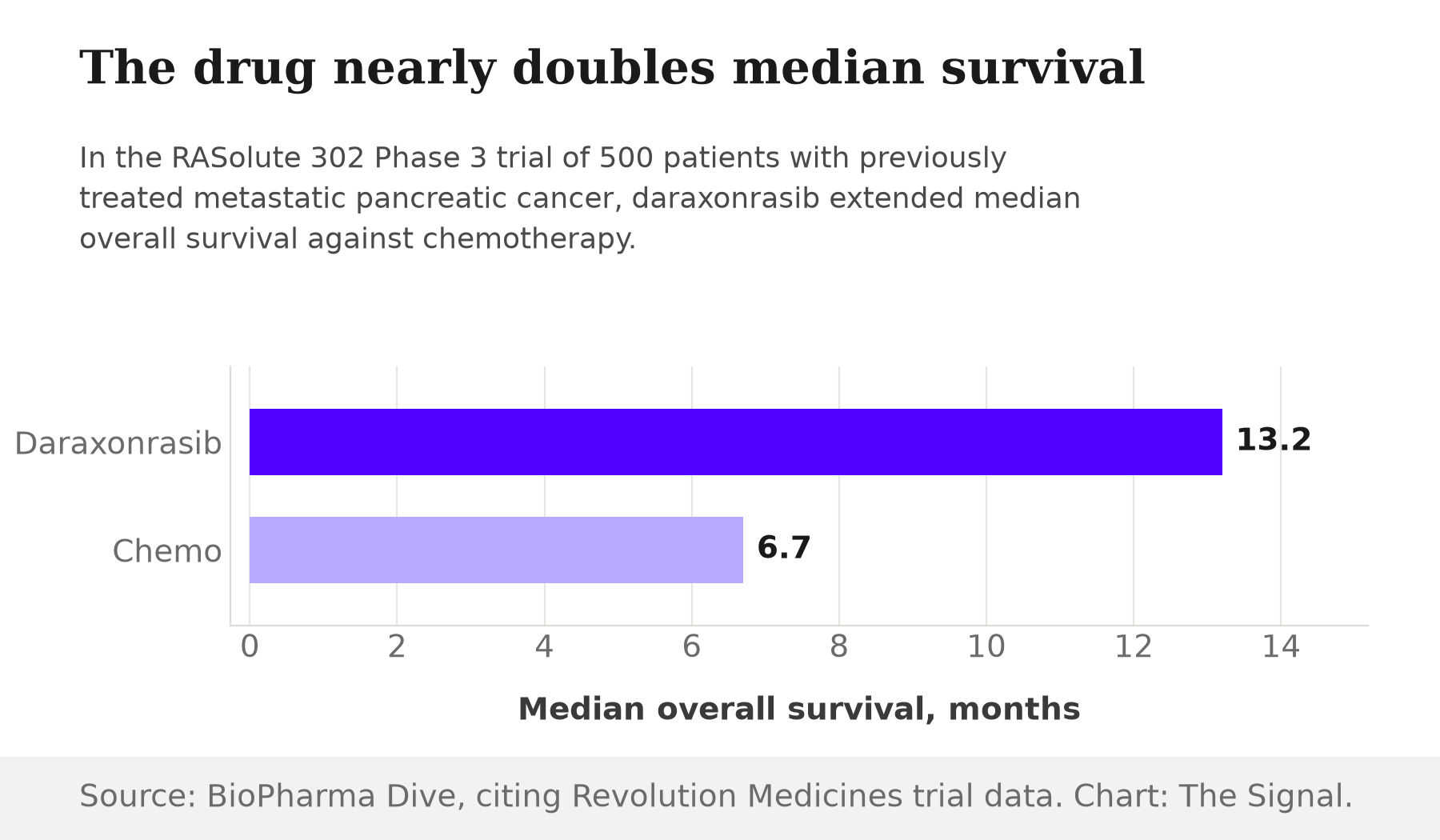
On August 26, the FDA approved daraxonrasib, sold as Rasonque, as a life-extending treatment for advanced pancreatic cancer, one of the deadliest common cancers there is. In the pivotal RASolute 302 trial, 500 patients with previously treated metastatic pancreatic cancer were randomized to daraxonrasib or standard chemotherapy, and patients on the drug lived a median of 13.2 months, against 6.7 months on chemotherapy, nearly double. For a cancer this lethal, that is a rare number.
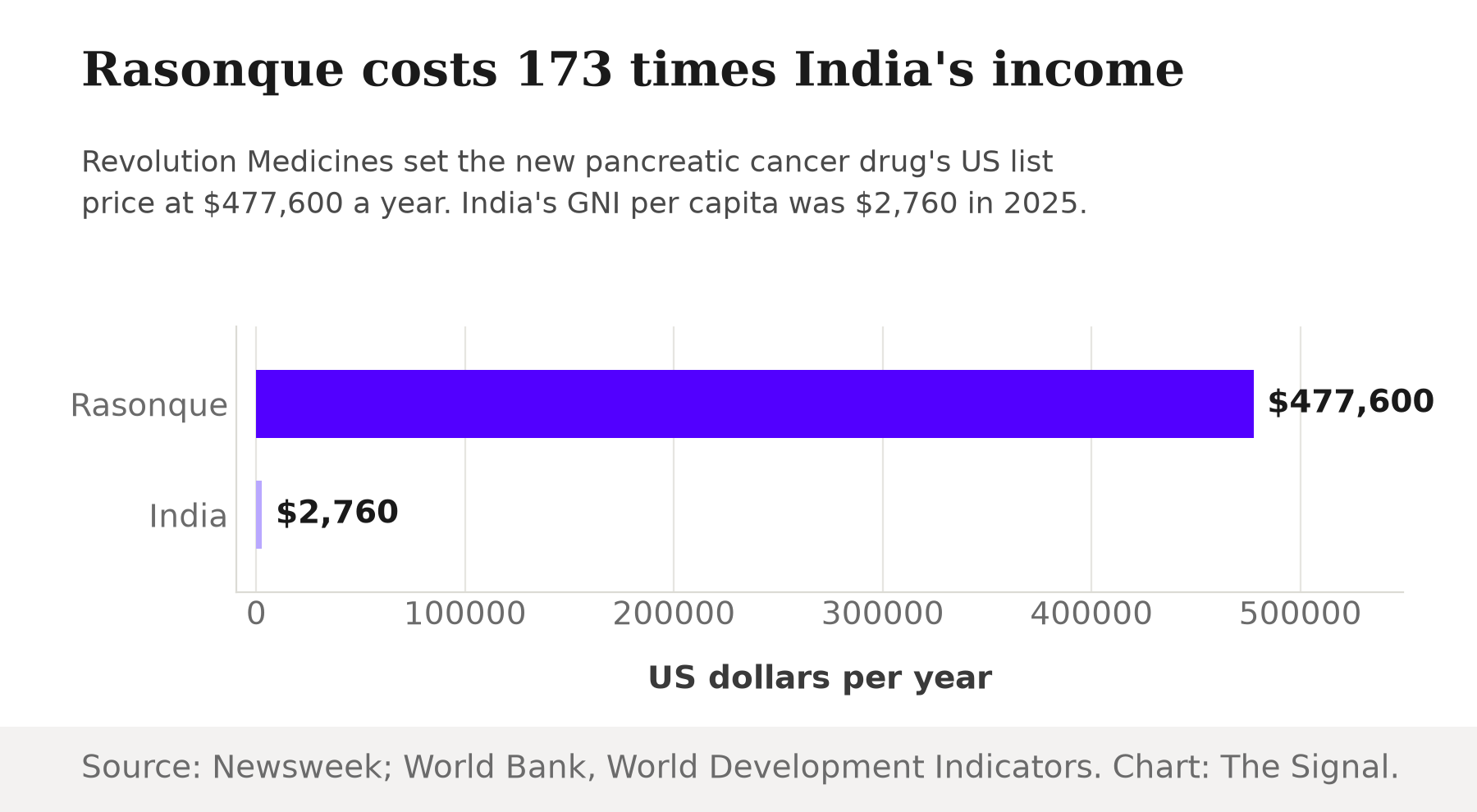
It is worth slowing down on what "approved" actually buys a patient. Revolution Medicines set Rasonque's wholesale acquisition cost at $39,800 for a 30-day supply, which annualizes to roughly $477,600. That is the US list price, before insurer or patient-assistance discounts, and it is the number that turns a medical breakthrough into a policy question the moment it crosses a border. India's GNI per capita was $2,760 in 2025, which puts Rasonque's US price at about 173 times what the average Indian earns in a year, our calculation from those two figures.
Why this drug exists at all
Rasonque targets RAS, a family of proteins that drive cell growth and that drugmakers spent three decades failing to drug directly. KRAS point mutations show up in more than 90 percent of pancreatic ductal adenocarcinoma cases, the dominant form of the disease, which is why a drug that finally works against mutant RAS has a shot at nearly every patient diagnosed with it. The trial that proved it out was not small by cancer-drug standards either: 500 randomized patients, tested head to head against the standard of care. The science is real. The question is who gets to use it.
The patients who will not reach the price tag anyway
Pancreatic cancer's defining problem, price aside, is that it is caught too late for most treatments to matter. In the United States, five-year relative survival is 13.7 percent, and 51 percent of cases are diagnosed only after the cancer has already spread to distant sites. In India the picture is worse. The country recorded an estimated 21,068 new pancreatic cancer cases in 2022, 12,511 in men and 8,557 in women, a small share of India's overall cancer burden but a near-uniformly fatal one. At Tata Memorial Hospital, 95 percent of pancreatic cancer cases diagnosed between 2007 and 2012 were already at a non-localized, advanced stage, against 15 to 20 percent presenting at an operable stage worldwide.
| Where the disease is caught | Share of cases | What the figure measures |
|---|---|---|
| Tata Memorial Hospital, India (2007-2012) | 95% | Diagnosed at non-localized (regional or distant) stage |
| Worldwide comparison, same review | 15-20% | Diagnosed early enough to present at an operable stage |
| United States, SEER (2016-2022) | 51% | Diagnosed after distant metastasis specifically |
Source: Indian Journal of Medical Sciences; SEER, National Cancer Institute. The three figures use different stage definitions, noted above, and are not directly interchangeable.
A drug that adds six and a half months of median survival matters enormously to a patient who is eligible for it. But eligibility in RASolute 302 required a specific, previously treated, metastatic diagnosis, caught early enough to be treated at all. Where most patients arrive after that window has closed, price is often not the first barrier. Diagnosis timing is.
India already has a lever for this
The reason Rasonque's US price is not automatically India's future price is that India has used its own tools against exactly this kind of drug before. On February 27, 2019, India's National Pharmaceutical Pricing Authority capped trade margins on 42 non-scheduled anti-cancer drugs at 30 percent of the retail price, a direct move against the markups that inflate cancer-drug bills. The sharper precedent is older and more aggressive. In 2012, India issued a compulsory license against Bayer's kidney and liver cancer drug Nexavar, cutting the price of a monthly 120-tablet dose from ₹280,428 to ₹8,880, a roughly 97 percent reduction, because the patented price put the drug out of reach for Indian patients.
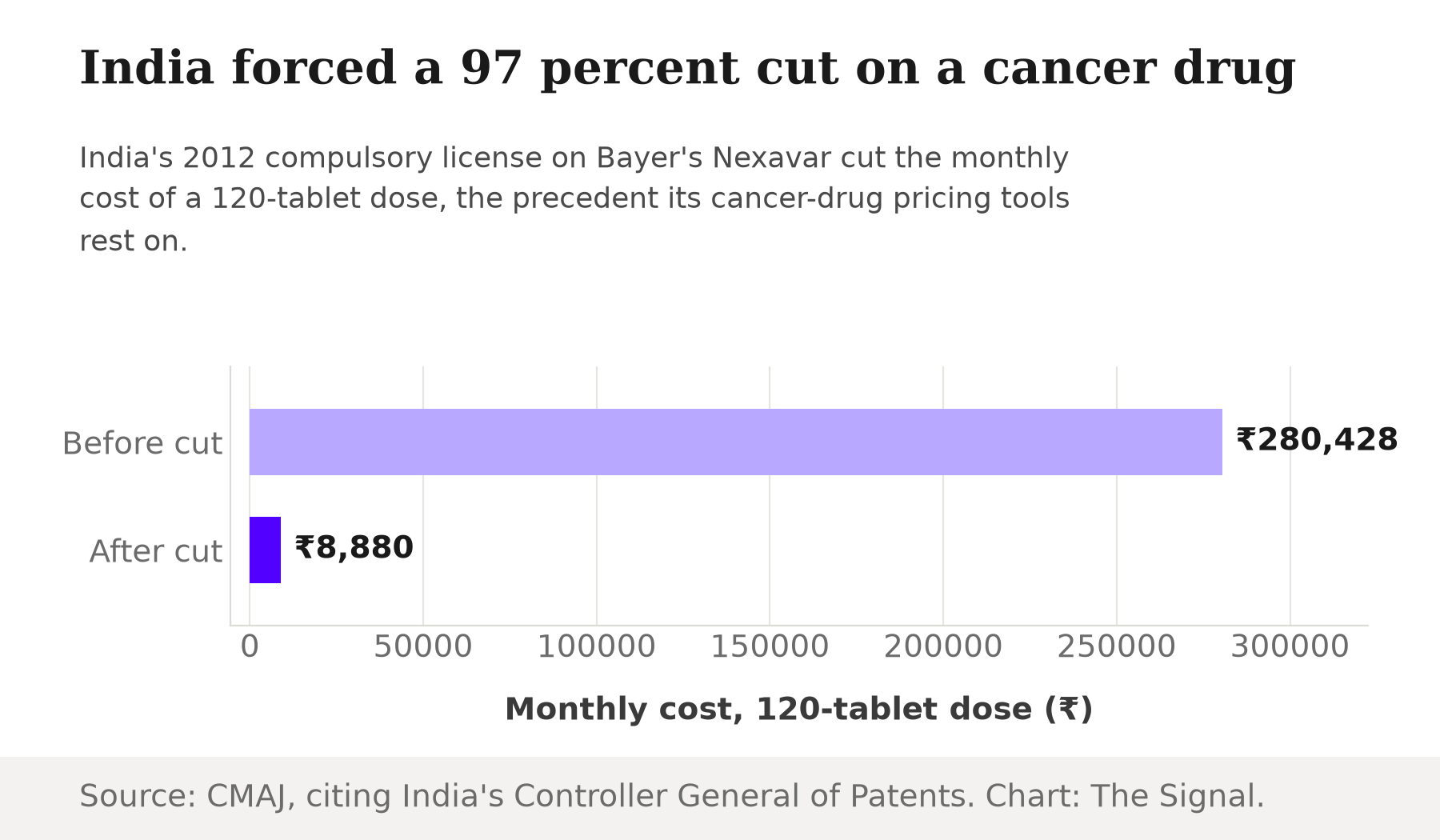
That is the machinery Rasonque's global rollout is filing against. It does not guarantee India forces the same outcome twice; the Nexavar license was one drug, one patent, one negotiation. But it shows that when a patented cancer drug's price collides with what Indian patients can pay, India has already acted on price rather than simply watch it. Compulsory licensing is also not the default lever, just the most aggressive one on record: India's flagship public health insurance scheme, Ayushman Bharat PM-JAY, covers high-cost oncology drugs only through static package rates, with no mechanism for outcomes-based agreements, differential pricing, or risk-sharing tied to a drug's demonstrated clinical value, so absent a specific license or negotiated deal, insurance alone will not close the gap on a drug priced like Rasonque.
The honest objection
The strongest case for Rasonque's price is that it reflects something real: a drug that works against a target the industry spent thirty years failing to hit, validated in a randomized trial of 500 patients, for a cancer that kills faster than almost any other. Cost-recovery pricing for a genuine breakthrough is not automatically predatory, and a narrow patient population, previously treated, metastatic, RAS-mutant, is a smaller base to spread development costs across than a drug for a common chronic disease.
That case holds up as an explanation for why the price is high. It does not hold up as a reason India's pricing tools should stay dormant. Nexavar was also a genuine scientific advance with real development costs behind it, and India cut its price 97 percent anyway once it decided patient access mattered more than the patent-holder's global price. The precedent rests not on the theory that expensive drugs are overpriced, but on the narrower claim that a price no patient can pay is not a functioning price, however sound the science behind it.
The Signal
Rasonque's approval sets a real number: this is what the industry now believes a genuine survival gain in advanced pancreatic cancer is worth, and every future RAS-targeted drug will be priced against it. But $477,600 will not decide what happens in India. ₹8,880 will, the figure India already used to answer the same question on a different cancer drug. So will 95 percent, the share of Indian patients whose diagnosis arrives too late for any drug on this list to help. A price ceiling only matters to patients who can reach the drug at all. Watch whether Revolution Medicines files for a price or an access deal in India, and whether India's own diagnosis timelines move before its pricing authority has to.
Reporting basis: the FDA approval and Rasonque's US list price are as reported by STAT News and Newsweek respectively, both citing Revolution Medicines. The RASolute 302 trial's design and enrollment come from its ClinicalTrials.gov registry record; the survival data from that trial are as reported by BioPharma Dive, citing Revolution Medicines. The KRAS mutation prevalence figure is from a peer-reviewed review in the Journal of Clinical Medicine. US pancreatic cancer survival and stage-at-diagnosis figures are from the National Cancer Institute's SEER program. India's incidence estimate is from the Indian Council of Medical Research's National Cancer Registry Programme, published in the Indian Journal of Medical Research. The India and worldwide stage-at-diagnosis figures are from a single peer-reviewed epidemiological review in the Indian Journal of Medical Sciences and are the only source for that comparison. The 2019 NPPA trade-margin cap is as reported by Mondaq's legal-analysis summary of the regulatory order. The 2012 Nexavar compulsory license and its price figures are from a peer-reviewed article in the Canadian Medical Association Journal. India's GNI per capita is from the World Bank's World Development Indicators. The 173-times price ratio is The Signal's calculation from the Newsweek and World Bank figures. The description of Ayushman Bharat PM-JAY's oncology-drug reimbursement structure is from a peer-reviewed analysis in The Lancet Regional Health - Southeast Asia.