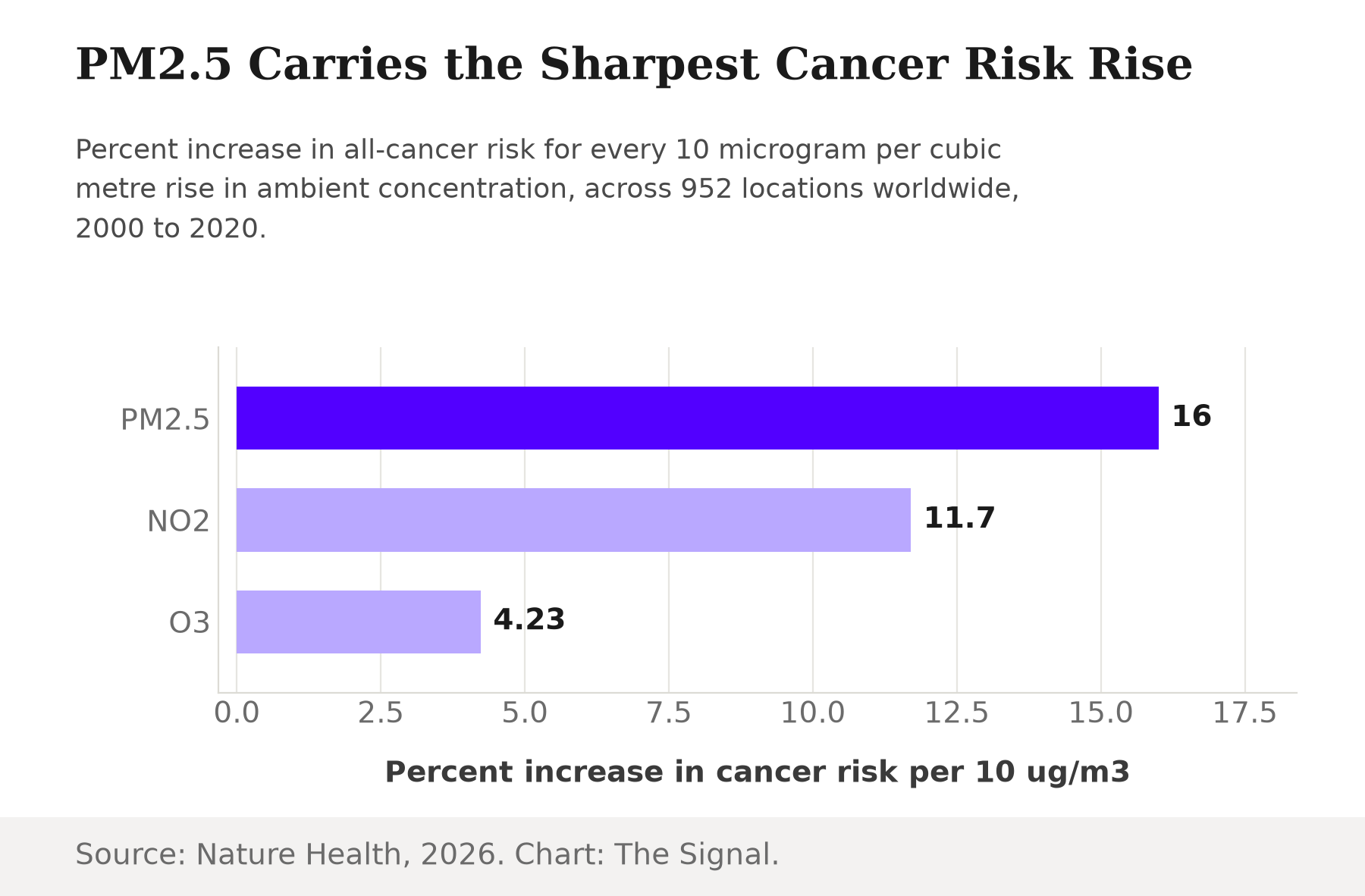
On August 24, 2026, a Nature Health study covering 109 million cancer cases across 952 locations worldwide between 2000 and 2020 ranked the three major ambient air pollutants by how much each one raises cancer risk. Each 10 microgram per cubic metre rise in PM2.5 concentration was linked to a 16.0 percent increase in all-cancer risk, against 11.7 percent for nitrogen dioxide and 4.23 percent for ozone. PM2.5 is fine particulate matter, small enough to lodge deep in the lungs and pass into the bloodstream; nitrogen dioxide comes mostly from vehicle exhaust; ozone is the gas behind summer smog alerts. Read quickly, the ranking looks like a technical footnote: three pollutants public health researchers already worried about, now ordered more precisely by one more paper.
That ordering sharpens ground the WHO had already staked out. The organization links an estimated 4.2 million deaths worldwide in 2019 to ambient air pollution, attributing them mainly to heart disease, stroke, chronic obstructive pulmonary disease, lung cancer, and acute respiratory infections. The new study does not revise that toll. It identifies which pollutant inside it deserves the most scrutiny.
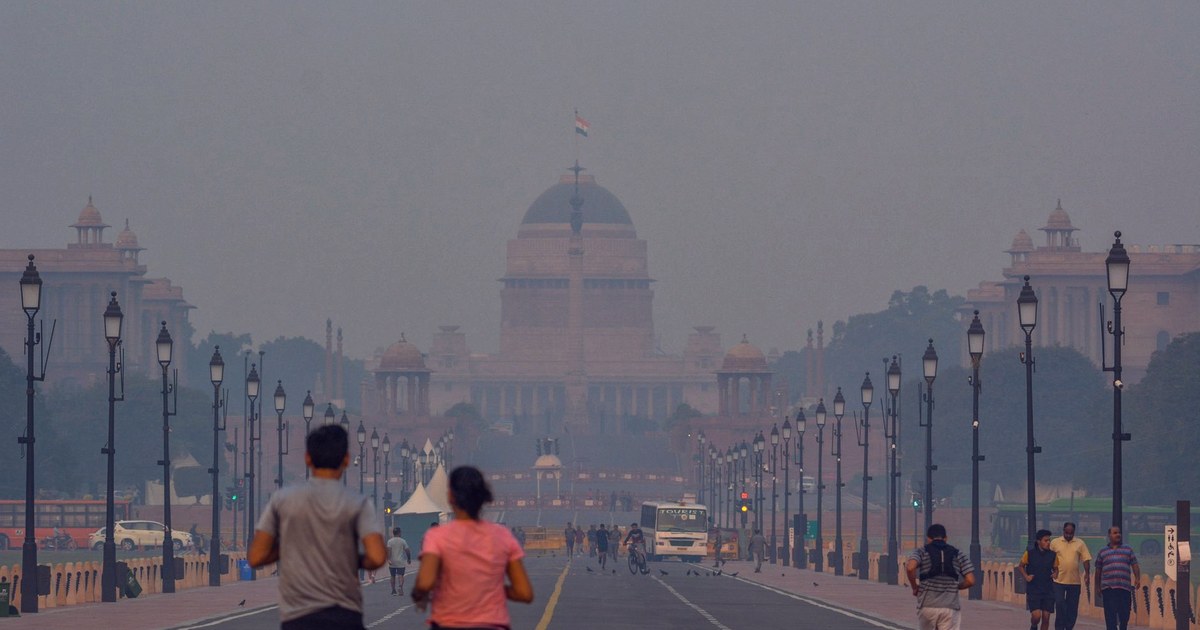
It is worth slowing down on that framing. A 10 microgram per cubic metre step is a small move, the kind of difference between two moderately polluted days rather than the jump from clean air to a health emergency. India's national average PM2.5 concentration was 50.6 micrograms per cubic metre in 2024, more than ten times the WHO's annual guideline, and the country was home to six of the world's nine most polluted cities. A country running that far outside the normal range is not a data point plotted somewhere in the middle of the new study's curve. It is close to defining one end of it.
Source: Nature Health. Chart: The Signal.
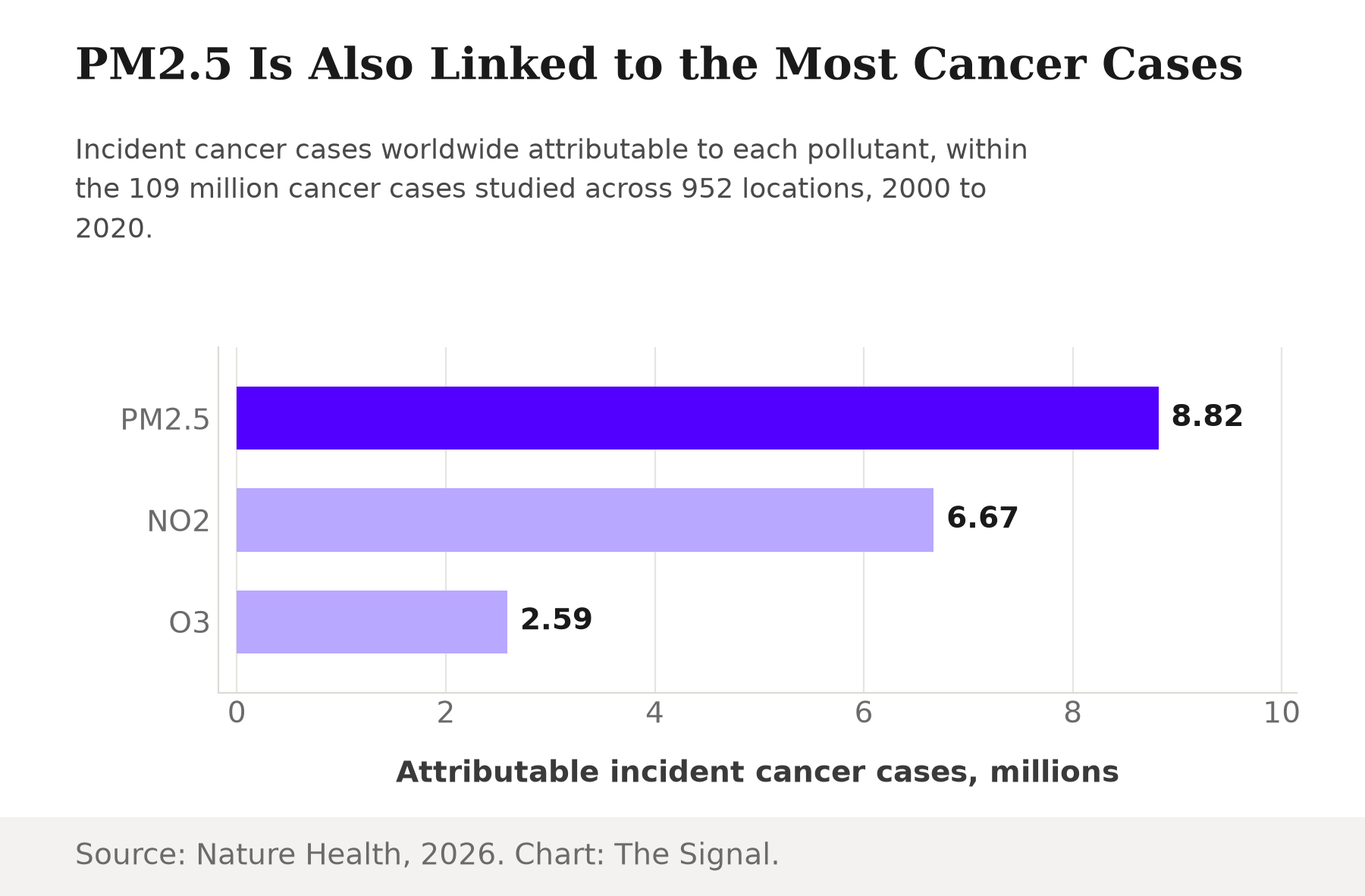
India's population was 1,450,935,791 in 2024, against a global population of 8,140,897,523 that same year: about 17.8 percent of the world's people. Apply that share evenly to the 8.82 million PM2.5-attributable cancer cases the Nature Health study counted worldwide across 2000 to 2020, and roughly 1.6 million of them would fall on India alone. That is our calculation, and it is a floor rather than an estimate: the arithmetic assumes India's exposure sits at the global average, and it does not. India's measured concentration runs more than ten times over the WHO's guideline, closer to the top of the range the study drew on than the middle of it. A population-only share is the least this finding could mean for India, not the most.
Source: Nature Health. Chart: The Signal.
What the standard you pick does to the count
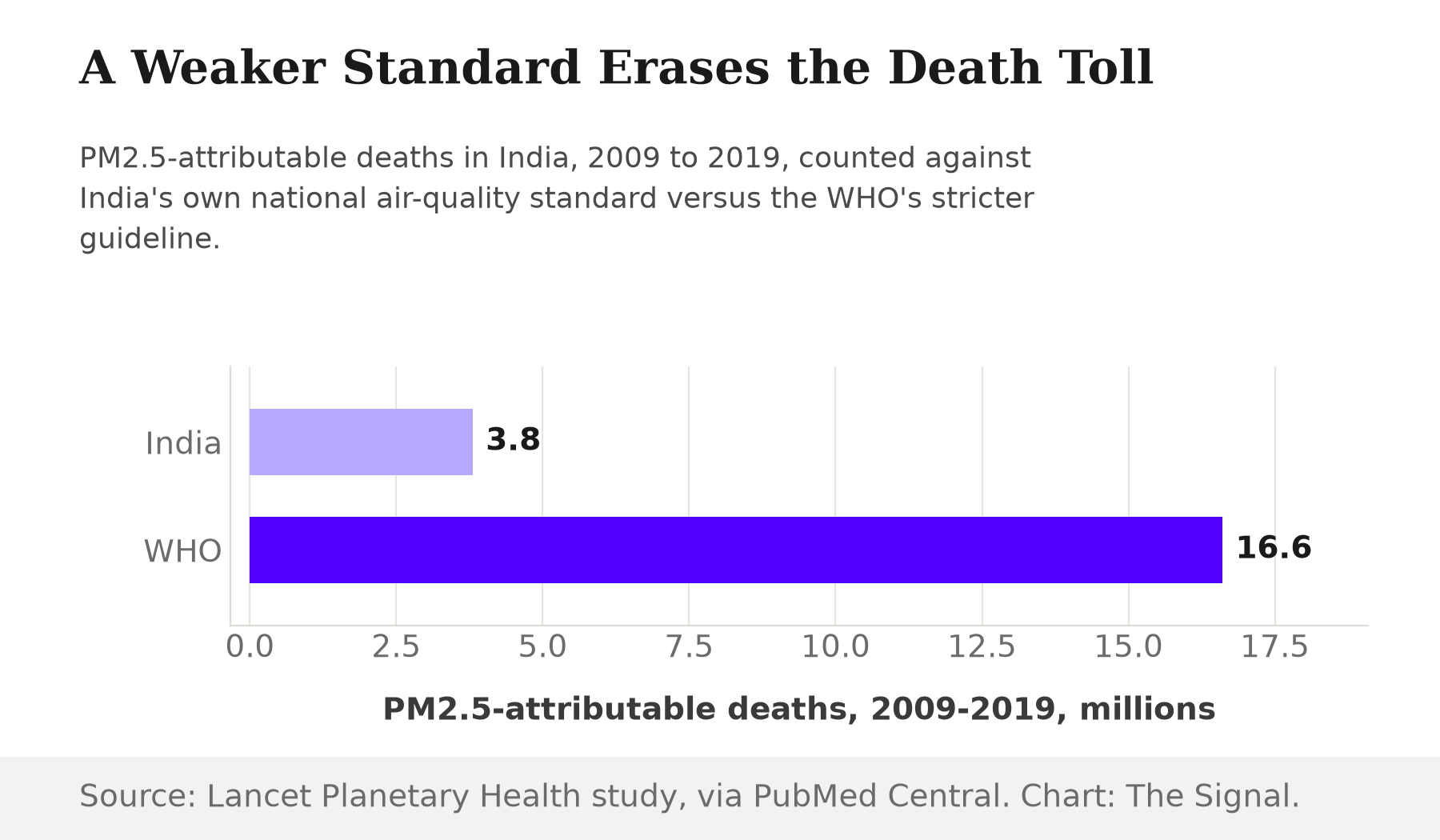
India has run this experiment once already, on overall mortality rather than cancer specifically, and the result is a warning about what happens when a country grades its own air on its own curve. Using the WHO's PM2.5 guideline as the benchmark, air pollution was linked to an estimated 16.6 million deaths in India between 2009 and 2019, 24.9 percent of all deaths in that decade. Measured instead against India's own weaker national standard, the same decade counts just 3.8 million deaths, 5.0 percent. The entire 1.4 billion-strong Indian population lived, across those years, in areas where PM2.5 concentrations exceeded the WHO's guideline. The 12.8 million-death gap between those two counts is not a disagreement about how polluted India's air actually was over that decade. It is the same air, read against two different lines on the same chart, and the line India uses domestically is the one that erases most of the toll.
Source: Lancet Planetary Health, via PubMed Central. Chart: The Signal.
The tobacco story still crowds out the pollution one
GLOBOCAN 2022 estimated 1,413,316 new cancer cases and 916,827 cancer deaths in India that year, a mortality-to-incidence ratio of roughly 65 percent: most people diagnosed did not survive. Cancers at sites associated with tobacco use account for over a quarter, 27.1 percent, of all cancers recorded by India's National Cancer Registry Programme, and that is the figure most public conversation about cancer risk in India reaches for first, in policy debates and in clinics alike. Ambient air pollution rarely gets equal billing. Not because the underlying evidence is thinner, but because it lacks a single identifiable behavior, like lighting a cigarette, that a public health campaign can put a face to and a warning label on. A pollutant that 1.4 billion people breathe by default does not lend itself to the same kind of personal-responsibility messaging, even when its per-unit cancer-risk signal, by this new study's own numbers, is the sharpest of the three measured.
The honest objection
The strongest case against leaning on any of this is that a population share is not a measurement. Nothing in the Nature Health study breaks its worldwide totals out by country, so the 1.6 million figure above is an allocation, not a reported number. A relative-risk study built from pooled data across 952 locations also cannot fully rule out confounding factors, diet, genetics, competing causes of death, that vary across geography as much as air quality does, and a study of this kind establishes an association at population scale, not a diagnosis in any one patient.
That case is real, but it cuts in only one direction, and not the reassuring one. If India's exposure differs from the global average implicit in the study's per-unit relationship, it differs by running worse, not milder. A national PM2.5 average more than ten times the WHO's guideline is not a rounding error against the dataset's mean; it sits near the extreme end of the range the relationship was fitted to. A population-share floor built on a global average understates a country sitting well above that average. It does not overstate one.
The Signal
PM2.5 outranking nitrogen dioxide and ozone on cancer risk per unit of exposure is the number this study leaves behind. What India does with it is the harder, separate question: whether a national air-quality standard that produces a death count four times smaller than the WHO's benchmark, for the same decade, gets revisited now that the pollutant it under-weights has just been named the sharpest cancer signal of the three studied. A standard is a policy choice dressed up as a measurement. This study is a reminder that the choice comes with a body count attached, and for now India has picked the version that hides most of it. Watch what the country's own regulators do with a finding that makes its own air-quality standard harder to defend than it was a week ago.
Reporting basis: the pollutant cancer-risk rankings and attributable case counts are from a Nature Health study covering 109 million cancer cases across 952 locations worldwide, 2000 to 2020, published August 24, 2026. The global mortality baseline against which that study is read is the World Health Organization's estimate of 4.2 million ambient-air-pollution deaths worldwide in 2019. India's PM2.5 concentration and its global city rankings are from IQAir's 2024 World Air Quality Report. The mortality comparison between India's national air-quality standard and the WHO's guideline, and the finding that India's entire population lived above that guideline between 2009 and 2019, are from a Lancet Planetary Health study, accessed via PubMed Central. India's cancer case and death counts for 2022 are GLOBOCAN estimates, via a peer-reviewed analysis on PubMed Central, and the tobacco-linked cancer share is from a review of India's National Cancer Registry Programme, also via PubMed Central. Population figures for India and the world in 2024 are World Bank data. India's population share of the global PM2.5-attributable cancer case count, the resulting floor estimate, and the mortality-to-incidence ratio, are The Signal's calculations from those figures.