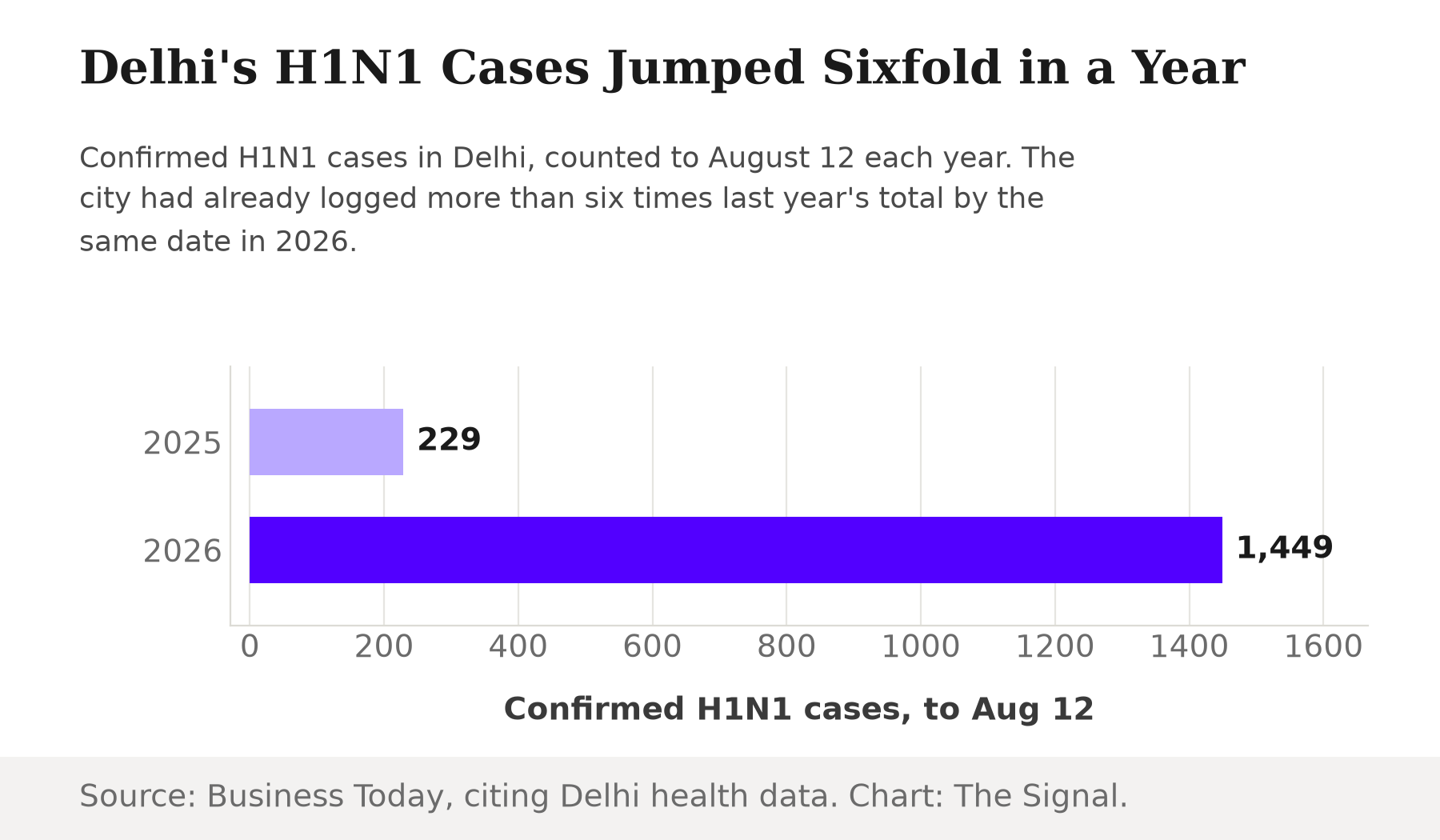
On August 12, 2026, Delhi's health department had counted 1,449 confirmed H1N1 cases this year, more than six times the 229 recorded in the same window in 2025, Business Today reports. A week later, a 62-year-old woman from Ujjain died of H1N1 on August 19, 2026, after treatment at a private Indore hospital that never reported her case to the health department. Asianet Newsable reports, quoting the Indore Chief Medical and Health Officer: "Since H1N1-positive patients are required to be reported under the notifiable disease provisions, the hospital management was required to inform us, which was not done." The Madhya Pradesh Health Department has opened a probe and issued the hospital a show-cause notice. The read most coverage is running: a seasonal outbreak, one hospital's compliance lapse, a state department doing its job.
It is worth slowing down on that read. Delhi's case count does not spike because one hospital in Indore failed to file a form. It spikes every year, on a wider base each time, because almost nobody who might catch the flu was offered a vaccine before the season began. India presently has neither a universal influenza immunization programme nor a vertical national programme on influenza, and flu vaccination is not incorporated into the routine child immunization programme, a 2023 Indian Journal of Medical Research paper concludes.
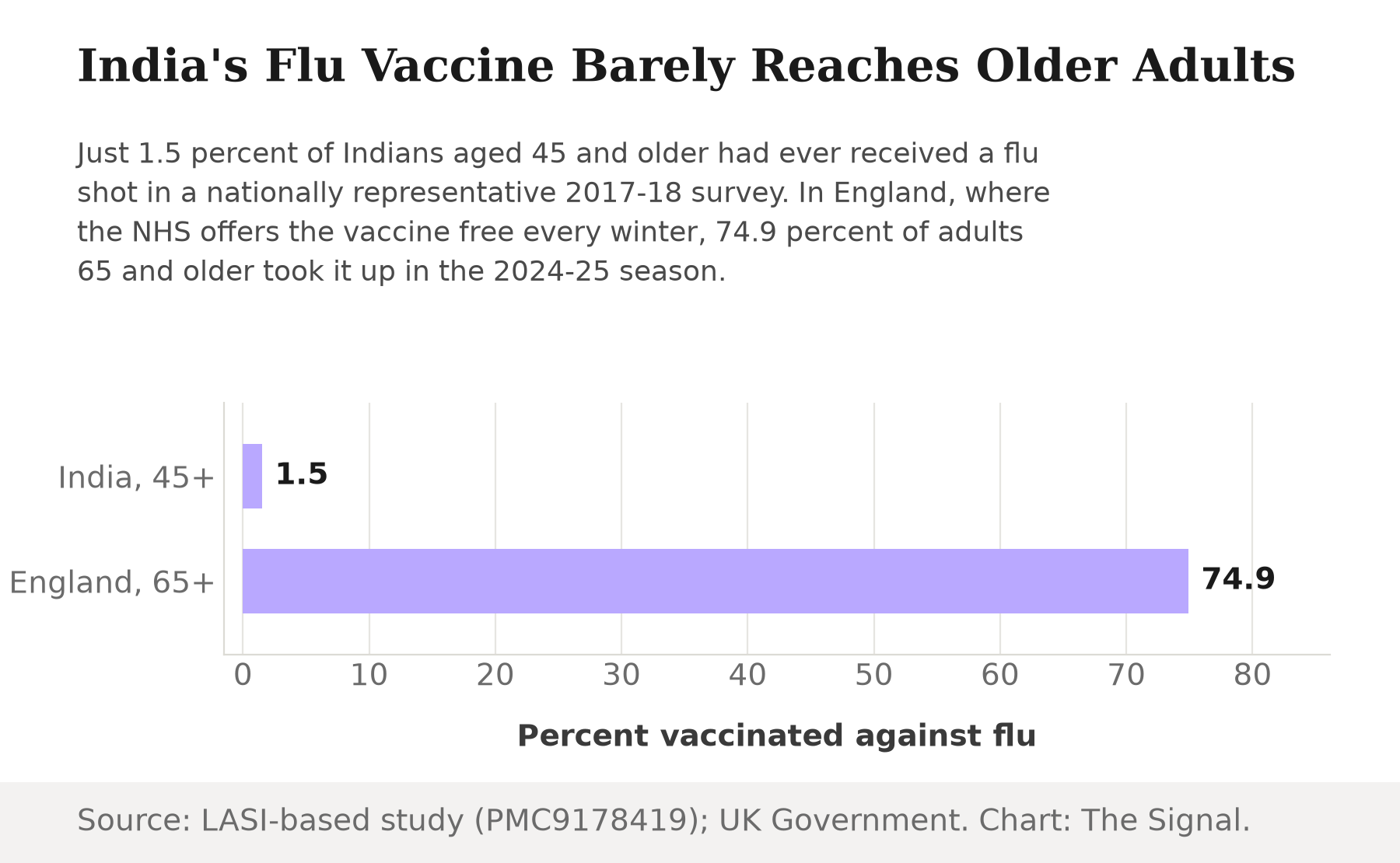
Just 1.5 percent of Indians 45 and older have ever had a flu shot.
That is how thin the gap actually is. A nationally representative study using Longitudinal Ageing Study in India data found an overall flu vaccine uptake of just 1.5 percent among adults 45 and older, in a survey fielded in 2017-18. That is not a niche omission. It is close to the total absence of a program that health systems elsewhere treat as standard for exactly this age group.
The list has twelve diseases, not flu
India's Universal Immunization Programme is not a small effort. It provides free vaccination against 12 diseases: nationally against diphtheria, pertussis, tetanus, polio, measles, rubella, severe childhood tuberculosis, hepatitis B, and the meningitis and pneumonia caused by Hemophilus Influenza type B, and sub-nationally against rotavirus diarrhoea, pneumococcal pneumonia, and Japanese encephalitis, according to India's National Health Mission. Seasonal influenza, despite sharing part of its name with one of those twelve, is not on either list.
That gap is not an oversight. It has persisted across governments while the argument for closing it only strengthened. Compare it with a system built the other way.
The other model
| India | England | |
|---|---|---|
| National flu vaccine policy | Not among the 12 diseases in the Universal Immunization Programme (National Health Mission) | NHS offers it free every year to everyone 65 and older, pregnant women, people with certain long-term conditions, carers, and frontline health and social care workers (NHS England) |
| Uptake in the relevant older-adult group | 1.5% of adults 45 and older, 2017-18 survey (LASI-based study) | 74.9% of adults 65 and older, 2024-25 season, just short of the WHO's 75% target (UK government statistics) |
England already runs the targeted program described above, funded and repeated every year. India has not built an equivalent list.
What the gap costs
The toll behind that near-zero uptake is not theoretical. An estimated mean of 127,092 influenza-associated respiratory and circulatory deaths occur in India each year, according to a study published in the Journal of Global Health in 2013. Globally, the World Health Organization estimates that 290,000 to 650,000 respiratory deaths linked to seasonal flu occur worldwide each year, an estimate published in 2017. India's own number sits close to the lower end of that entire global range, on its own, from a country that runs no program to bring it down.
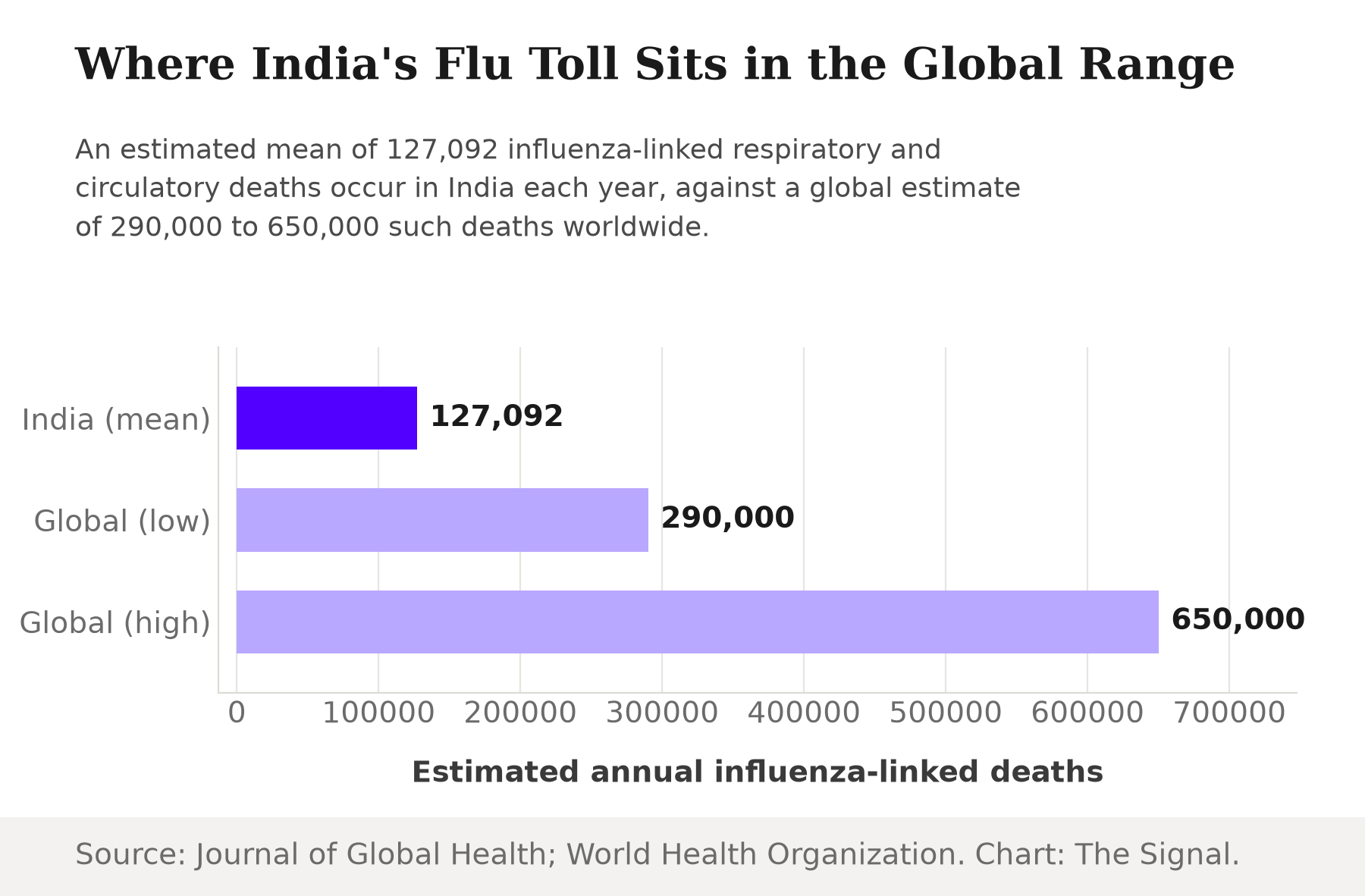
Delhi's climbing 2026 case count and Ujjain's unreported death are this year's entries in a toll the country has already measured and largely left unaddressed.
The honest objection
The strongest case against building an Indian flu program is not indifference. It is a considered research verdict. A 2023 paper in the Indian Journal of Medical Research concluded that neither a universal influenza immunization programme nor a vertical national programme on influenza is presently justified for India, weighing cost-effectiveness against a health budget already stretched across the Universal Immunization Programme's twelve diseases, tuberculosis, HIV, and a long list of other priorities. That argument is genuine and deserves to be taken at face value, not dismissed as a dodge.
But the paper's target is a universal program, one that vaccinates every child or every citizen the way the Universal Immunization Programme does. England's own scheme is not that either. The NHS reserves the free flu shot for defined risk groups: people 65 and older, pregnant women, those with certain long-term conditions, carers, and frontline health workers, not the whole population. A targeted scheme for the highest-risk groups is a cheaper, narrower proposal than the one the 2023 paper weighed and rejected, and it is one that assessment itself never evaluates. The 1.5 percent uptake figure among Indians 45 and older is not evidence that a targeted scheme was tried and failed. It is evidence that no such scheme exists for them to use, inside or outside the Universal Immunization Programme.
The scale of that gap is knowable even without a pilot. India's population aged 60 and above, the age band at the core of the NHS's at-risk list, was estimated at nearly 138 million people in 2021, according to the National Statistical Office's 'Elderly in India 2021' study, before pregnant women, the chronically ill, and frontline health workers are even added to the count. A targeted scheme has a defined population to cost against. It has simply never been priced out.
The Signal
Delhi's outbreak will likely recede this season, and the Madhya Pradesh Health Department's probe into Ujjain's unreported death will likely end in a notice to one hospital, not a policy shift. Neither fixes the actual mechanism. Cases return each season because almost nobody who might have benefited from a subsidized shot before it began was ever offered one, and the debate that could change that, a targeted at-risk-group program of the kind England already runs, has not even been formally weighed in India. Only the far larger universal version was, and it was reasonably rejected. What to watch is not the case count. It is whether any Indian state is first to cost out a flu vaccine scheme for the people who actually die of it: the old, the pregnant, and the already sick. Until one does, an outbreak that arrives on schedule will keep getting covered as news.
Reporting basis: Delhi's 2026 H1N1 case count is per Business Today's account of health department data through August 12, 2026. The Ujjain death and the Madhya Pradesh Health Department's probe are per Asianet Newsable, quoting the Indore Chief Medical and Health Officer. The Universal Immunization Programme's disease list is from India's National Health Mission, Ministry of Health and Family Welfare. The 2023 assessment of a universal or vertical influenza programme is from a peer-reviewed paper in the Indian Journal of Medical Research. India's annual influenza-death estimate is from a peer-reviewed Journal of Global Health study; the global estimate is from the World Health Organization. Flu vaccine uptake among Indians 45 and older is from a population-based study using Longitudinal Ageing Study in India data; uptake among adults 65 and older in England is from UK government statistics, and the NHS's eligible groups are from NHS England. India's 60-and-above population figure is from the National Statistical Office's 'Elderly in India 2021' study, as reported by Business Today. No figure in this piece is The Signal's own calculation.