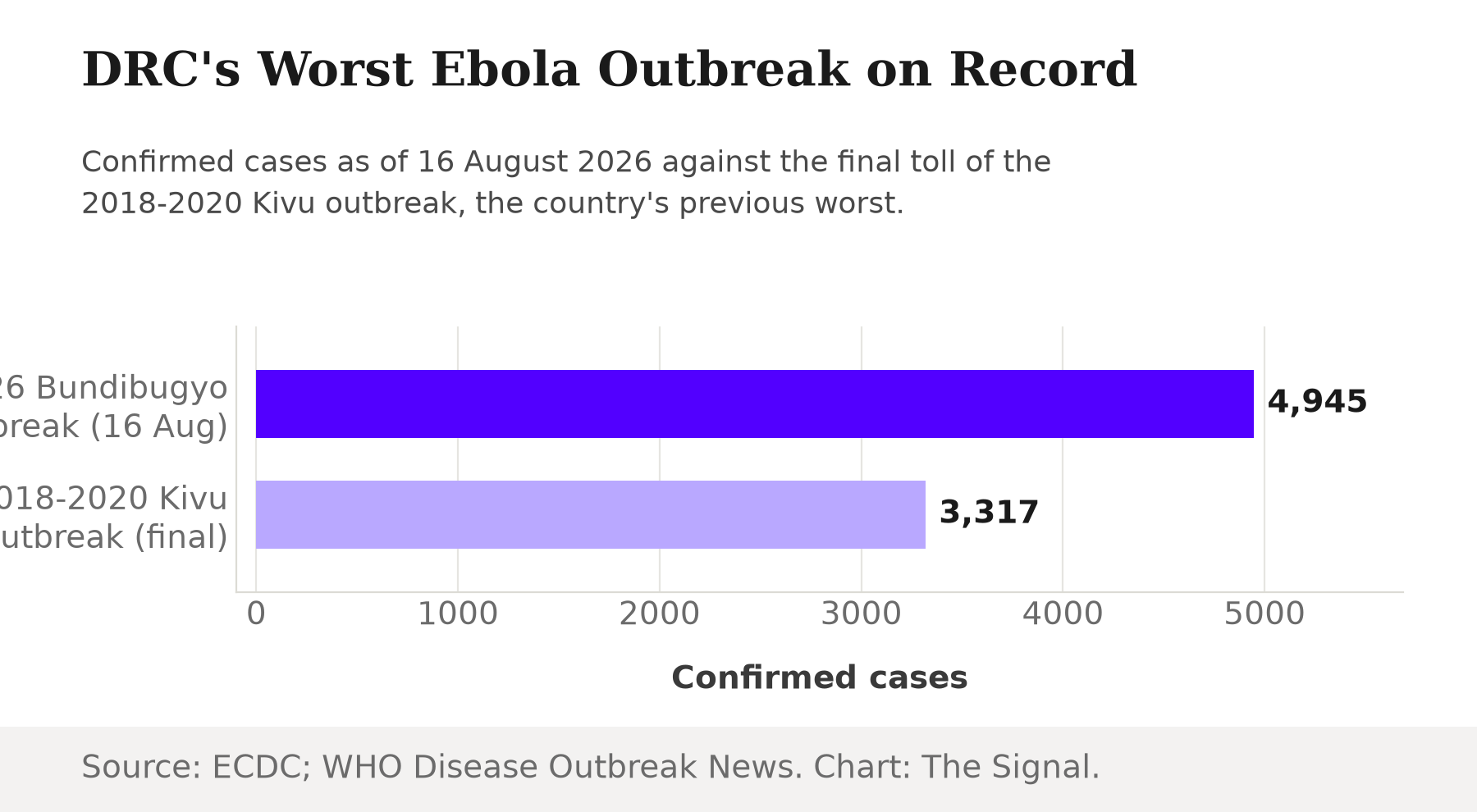
On 16 August 2026, the European Centre for Disease Prevention and Control counted 4,945 confirmed Ebola cases in the Democratic Republic of Congo and 2,325 deaths, most of them in Ituri province. Four days earlier, the World Health Organization had already confirmed that this outbreak is now the largest Ebola disease outbreak ever documented in the country, with more cases than the 2018-2020 Kivu outbreak's 3,317. The DRC has been through severe Ebola outbreaks before, and on paper the world's response machinery has never been more mature: a licensed vaccine, global stockpiles, an established WHO emergency framework.
It is worth slowing down on that framing. Every part of that muscle memory, the vaccine, the stockpile, the trial networks built after West Africa's 2014-16 epidemic, was built against a specific virus. The WHO states plainly that the Bundibugyo species of Ebola driving this outbreak is one for which there is no vaccine or specific treatment, with candidate testing only now under way. This is not the strain the world already solved.
That gap is concrete, not just rhetorical. Gavi's global Ebola vaccine stockpile, built entirely from Ervebo, the licensed vaccine for the Zaire strain, is maintained at 500,000 doses. For the Bundibugyo strain spreading through Ituri, that reserve is zero.
The outbreak has passed the country's previous worst by nearly half again, with no vaccine behind it.
The 4,945 cases confirmed as of 16 August exceed the 2018-2020 Kivu outbreak's final count of 3,317 by nearly 49 percent, though that earlier outbreak had a licensed vaccine deployed for most of its length. This one has none.
The response had to start from zero
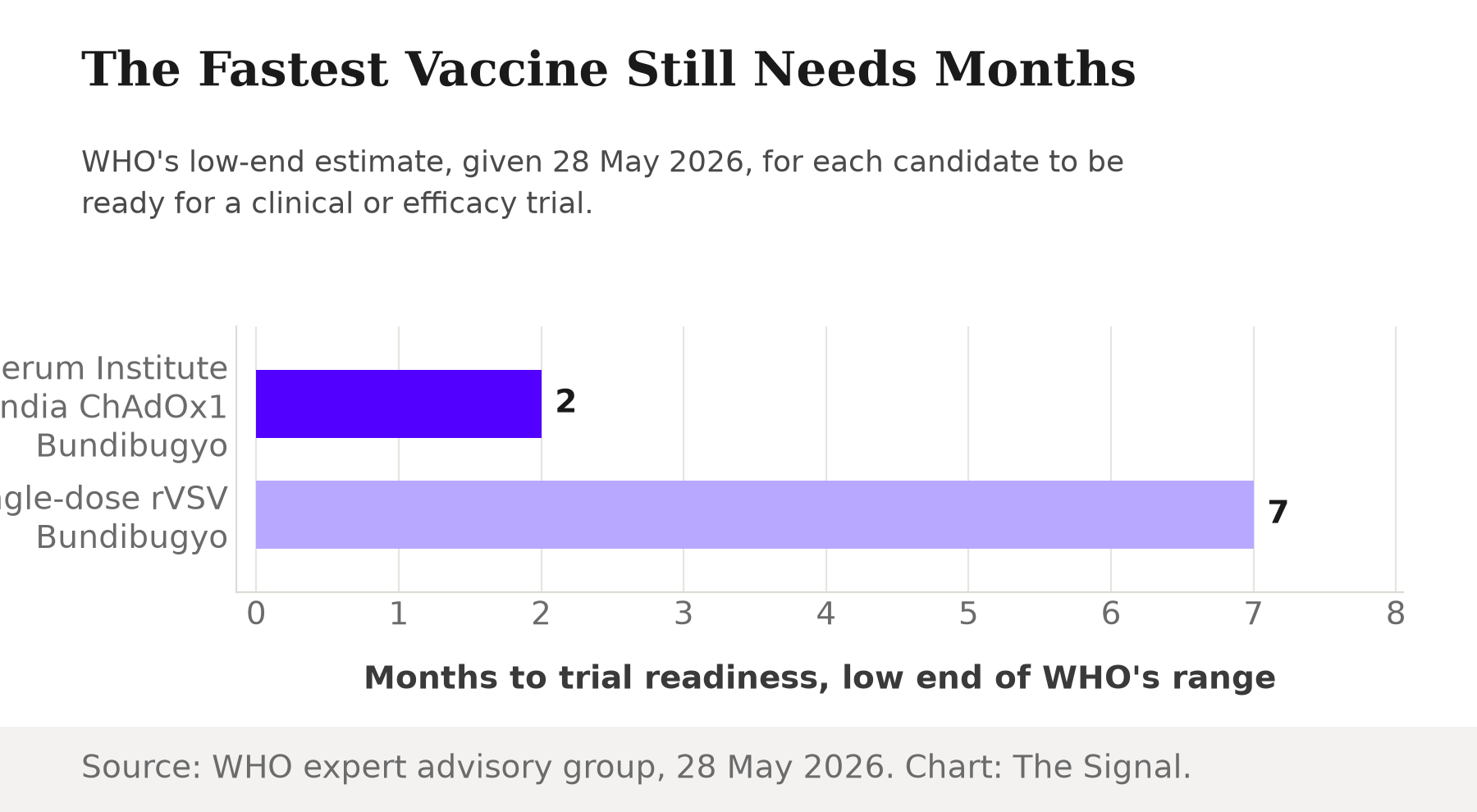
The WHO Director-General determined on 17 May 2026 that the outbreak in the DRC and Uganda constitutes a Public Health Emergency of International Concern, the organization's highest alarm level. Eleven days later, a WHO expert advisory group rated the single-dose rVSV Bundibugyo vaccine, developed by the International AIDS Vaccine Initiative, as the most promising, but said it would need seven to nine months before it could even be assessed through a clinical trial. A second candidate, ChAdOx1 Bundibugyo, developed by Oxford University and the Serum Institute of India, could be ready for efficacy assessment within two to three months. Neither timeline is fast next to a case count adding hundreds of people a week, though both beat starting a vaccine program from nothing.
Just two weeks after the PHEIC was declared, CEPI and its partners the University of Oxford and the Serum Institute of India launched a US$8.6 million partnership to advance the ChAdOx1 candidate. That speed is the tell: the program was assembled after the emergency was declared, not before.
India's Serum Institute is running the fastest lane
Of the two candidates WHO's experts named, the Oxford/Serum Institute of India shot is the one with doses already in hand. The Serum Institute of India has stockpiled around 620,000 doses of ChAdOx1 BDBV to support the vaccine's Phase 1 trial, the first human trial of a Bundibugyo-specific vaccine, reported as of 23 July 2026.
A Phase 1 trial tests whether a vaccine is safe in a small group of volunteers, the stage Gavi reports the stockpile was built to support. It does not test whether the vaccine prevents Ebola. Manufacturing 620,000 doses for that first, narrow stage is a bet the candidate clears the stages still ahead. It is the only such bet on the table for this strain.
WHO's own advisors just changed the calculus
The two Bundibugyo-specific candidates are not the only route WHO is now chasing. WHO's Technical Advisory Group on candidate vaccine prioritization issued an updated recommendation on 31 July 2026 that Ervebo be fast-tracked directly into a Phase 3 trial against this outbreak, skipping the Phase 2 stage entirely. That is a vaccine licensed for the Zaire strain, pushed toward a trial against Bundibugyo on existing safety data and emerging cross-protection evidence, rather than waiting on either purpose-built candidate.
It is a bet in the other direction from Serum Institute of India's: deploy the 500,000 already-stockpiled Ervebo doses and test whether a vaccine built for the wrong strain works well enough against this one anyway. Neither bet has reported a result yet.
The clock WHO set for itself is running out now
WHO's own experts gave the ChAdOx1 candidate a window of two to three months from their 28 May 2026 assessment to reach efficacy-trial readiness. Counted forward, that window runs from roughly the end of July to the end of August 2026, closing in these same weeks. The furthest-dated evidence available, from 23 July, still places the candidate in Phase 1 safety testing, with the stockpiled doses earmarked for that trial rather than a proven efficacy result.
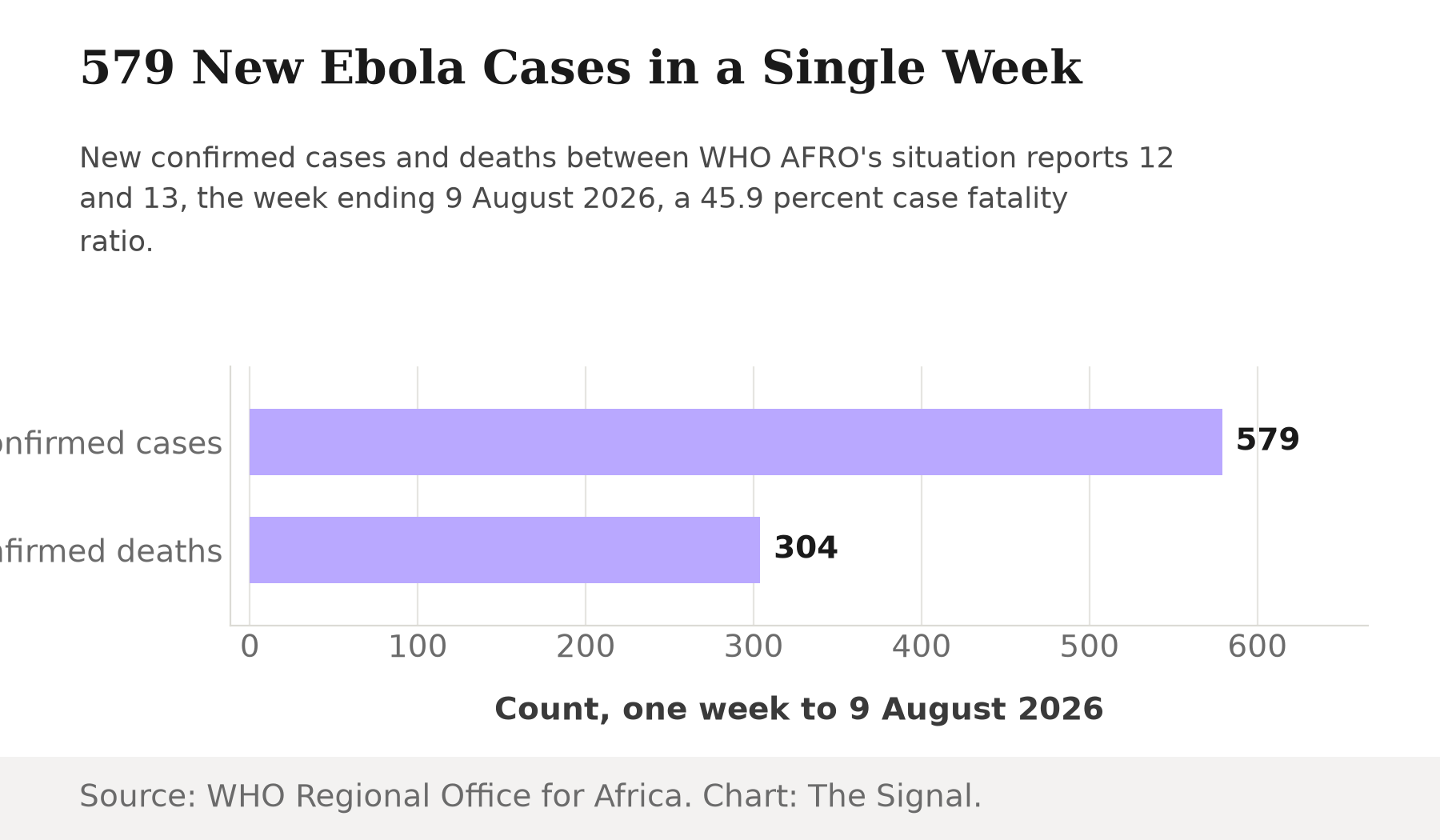
The outbreak has not paused to wait. Between WHO AFRO's external situation reports 12 and 13, the DRC added 579 confirmed cases and 304 confirmed deaths in a single week, taking the running total to 4,381 cases and 2,011 deaths as of 9 August 2026, a case fatality ratio of 45.9 percent. By our calculation, the following week was no calmer: ECDC's newest count of 4,945 cases on 16 August is another 564 cases higher than the 4,381 recorded a week earlier, almost matching the prior week's addition. The outbreak's pace has not slowed as the vaccine's readiness clock ticks down.
Ituri province carries most of the outbreak, but North Kivu is not contained either.
| Province | Confirmed cases | Deaths | Health zones affected |
|---|---|---|---|
| Ituri | 4,194 | 1,838 | 28 of 36 |
| North Kivu | 596 | 417 | 12 of 34 |
Source: ECDC, 16 August 2026.
The outbreak did cross the border. Uganda's Ministry of Health declared its own Bundibugyo outbreak over on 28 July 2026, after 42 days without a new locally transmitted case following the last patient's discharge on 16 June; the total there was 20 confirmed cases and 2 deaths. Uganda closed its outbreak with the same vaccine gap the DRC has, using surveillance and contact tracing rather than a shot. It is a smaller picture than Ituri's, but shows a vaccine gap alone does not doom a response.
The honest objection
The strongest case against reading this as an unusually severe outbreak is a counting effect: surveillance and case-finding have improved since the 2018-2020 outbreak, so more of today's true infections are being caught and confirmed than would have been then, inflating the case count relative to a fair comparison across years.
That argument softens the case-count record, but it leaves the fatality numbers untouched, because a case fatality ratio is a rate, not a raw count. Better case-finding would, if anything, pull that ratio down, not up. Instead, WHO AFRO's reported ratio of 45.9 percent as of 9 August and ECDC's implied ratio of roughly 47 percent a week later both sit near the historic high end for any Ebola outbreak. Improved surveillance is a real caveat on the "worst ever" case-count claim. It says nothing about how many who catch this virus are dying from it.
The Signal
This is not simply Congo's worst Ebola outbreak by count. It is the worst fought, so far, without the tool that ended the last two: no vaccine exists for the Bundibugyo species driving it. Two different bets are now racing to close that gap: India's Serum Institute manufactured its strain-specific candidate before its own safety trial reported out, and WHO's advisors separately fast-tracked the licensed Ervebo vaccine into a Phase 3 trial against a strain it was never built for. WHO's optimistic clock for that candidate is expiring in the same weeks the outbreak keeps adding cases at an undiminished pace. Watch what that trial reports next. A safety readout that lets it move toward an efficacy trial on WHO's May two-to-three-month schedule would give the world its first real answer to a strain it has ignored for over a decade. If it slips into the same seven-to-nine-month range as its slower rival, the only vaccine tested before this outbreak ends, one way or another, may be the Ervebo gamble, or none at all.
Reporting basis: case and death counts are from the European Centre for Disease Prevention and Control's 16 August 2026 update and the WHO Regional Office for Africa's external situation report of 9 August 2026, both of which compile figures from the DRC Ministry of Health. Uganda's case count and outbreak closure, the record-outbreak comparison, and the PHEIC determination are all from WHO's Disease Outbreak News (DON602, DON615). The vaccine candidate timelines are from a WHO expert advisory group's 28 May 2026 assessment. The Ervebo Phase 3 recommendation is from WHO's Technical Advisory Group on candidate vaccine prioritization. The Ervebo stockpile size is as reported by Gavi, the Vaccine Alliance, and the Serum Institute of India's dose stockpile is as separately reported by Gavi. The CEPI, Oxford and Serum Institute partnership and its funding figure are per CEPI's own announcement. The nearly-49-percent case comparison, the implied 16 August case fatality ratio, and the week-on-week case addition between the ECDC and WHO AFRO reports are The Signal's calculations from those figures.